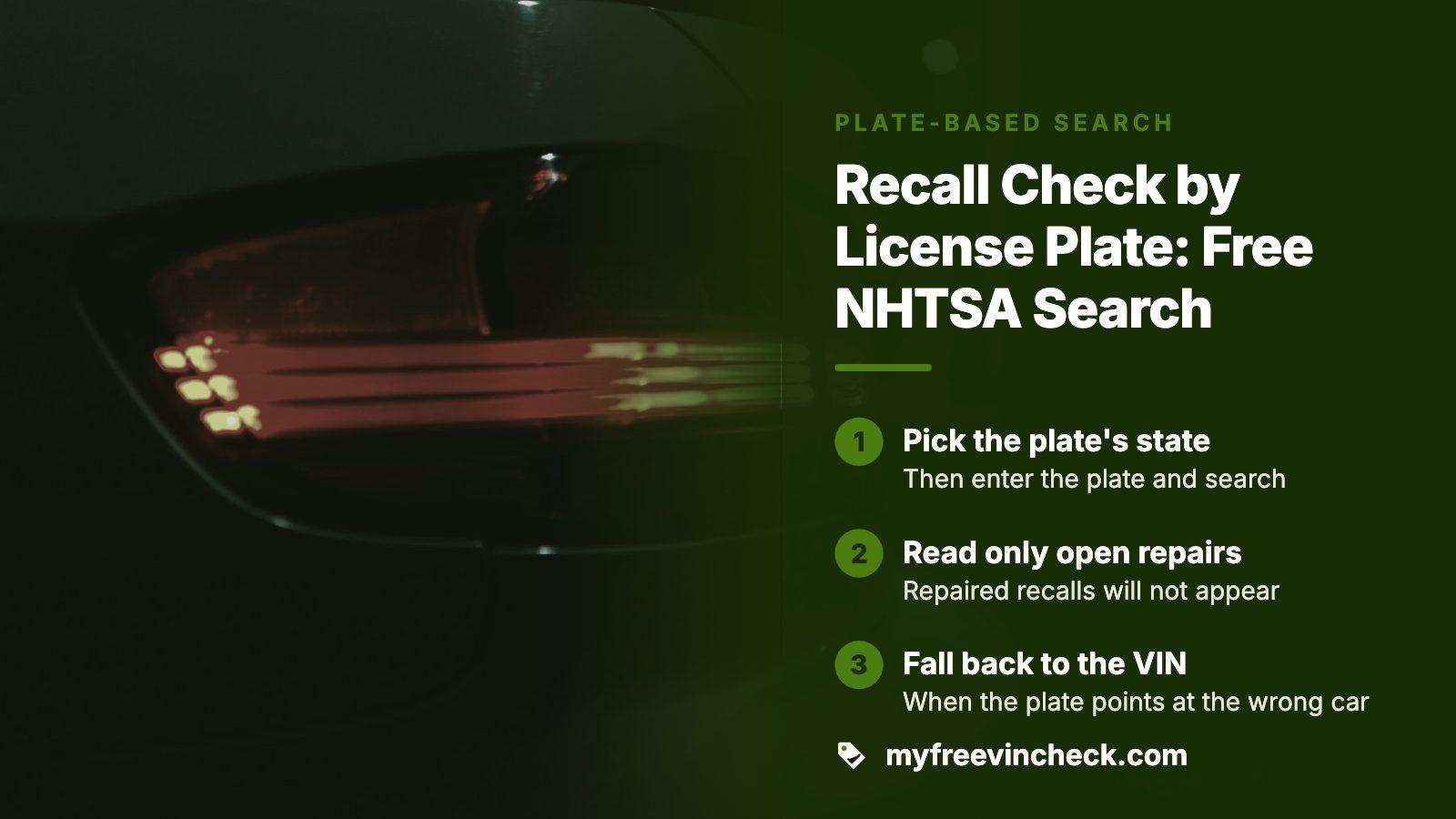
THE SHORT ANSWER
Go to NHTSA's Check for Recalls page, choose the plate's state, enter the plate and search. The page tells you whether that specific vehicle still has a recall repair waiting. It does not list fixed recalls, owners or past damage. If the plate returns the wrong car or nothing, read the VIN off the car and search that instead.
- Who runs the search
- NHTSA, with plate records from state motor vehicle departments
- What comes back
- Recall repairs still unfinished on that one vehicle
- Not covered
- Repaired recalls, recalls older than 15 years, small makers
- Backup
- The 17-character VIN
What the plate box on NHTSA's page actually does
Our angle at this site is simple: use the tools that already work, and say what each one cannot do. The plate search on NHTSA's Check for Recalls page is one of them. You pick a state, type the plate, and the page matches it to a vehicle through a motor vehicle department record, then reports whether a safety recall repair is still outstanding on that vehicle.
Handing over a plate or VIN is voluntary, and the result is about that single car rather than a general list for the model. That difference counts when a seller is waiting beside the car. A plate result is a statement about this car's repair status today, not a story about where it has been.
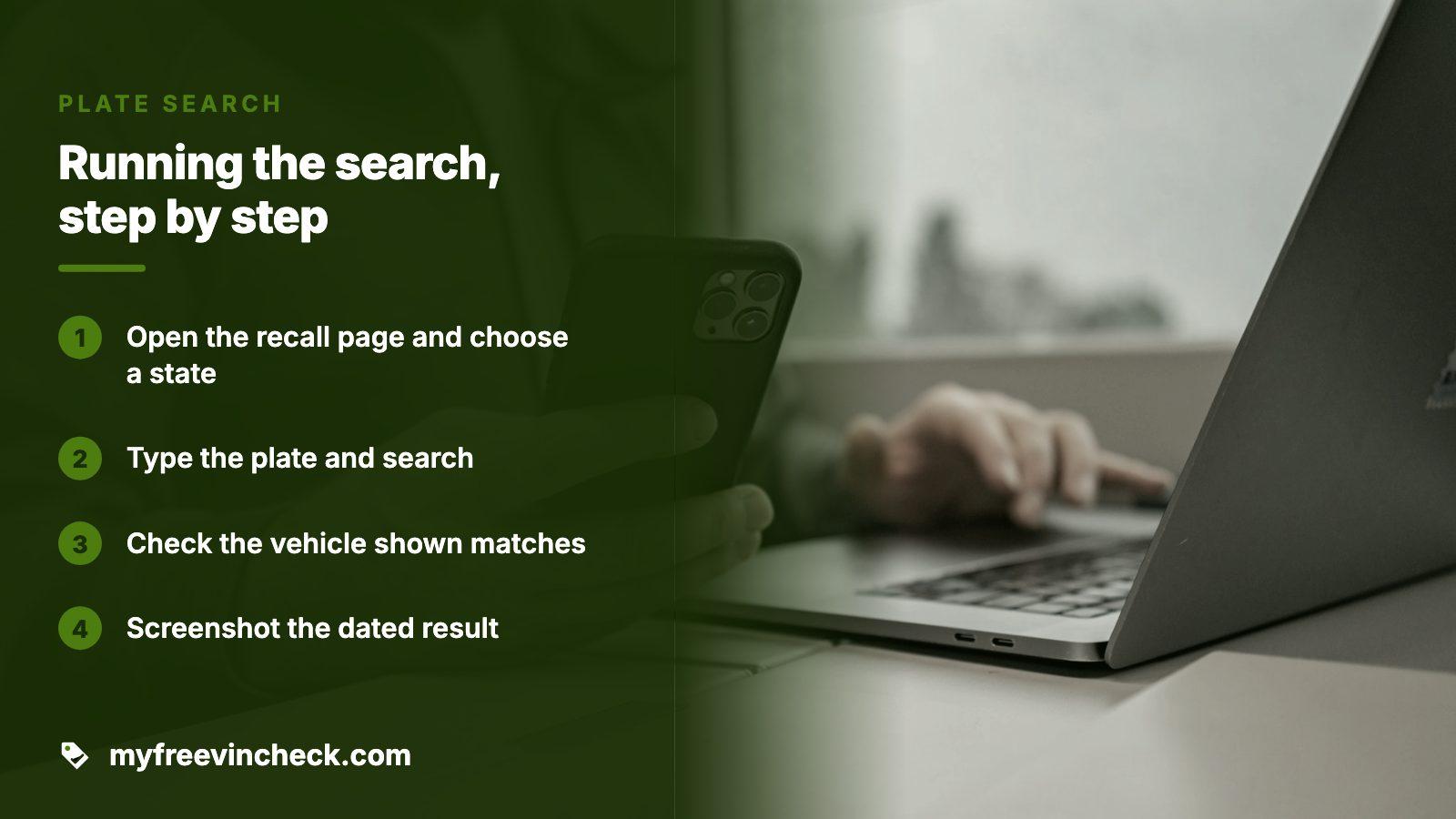
Running the search, step by step
- Open the Check for Recalls page on nhtsa.gov and choose the option that takes a plate rather than a VIN.
- Select the state that issued the plate, then type the plate characters exactly as stamped, without spaces you are unsure about.
- Read the result for the vehicle shown. Check that the model year and model shown agree with the car in front of you before believing the rest.
- If an open recall appears, write down the campaign details and ask the dealer for the repair date and whether parts are available.
- Screenshot the page with the date visible, so you have a record to show the seller.
The same page can also take a batch of up to 100 VINs, handy for a small lot or a household with several cars.
What a clear result does not tell you
A message saying nothing is unrepaired feels like good news, and for recalls it is partly that. NHTSA is open about the gaps, and a careful buyer should read them before relying on a clean screen.
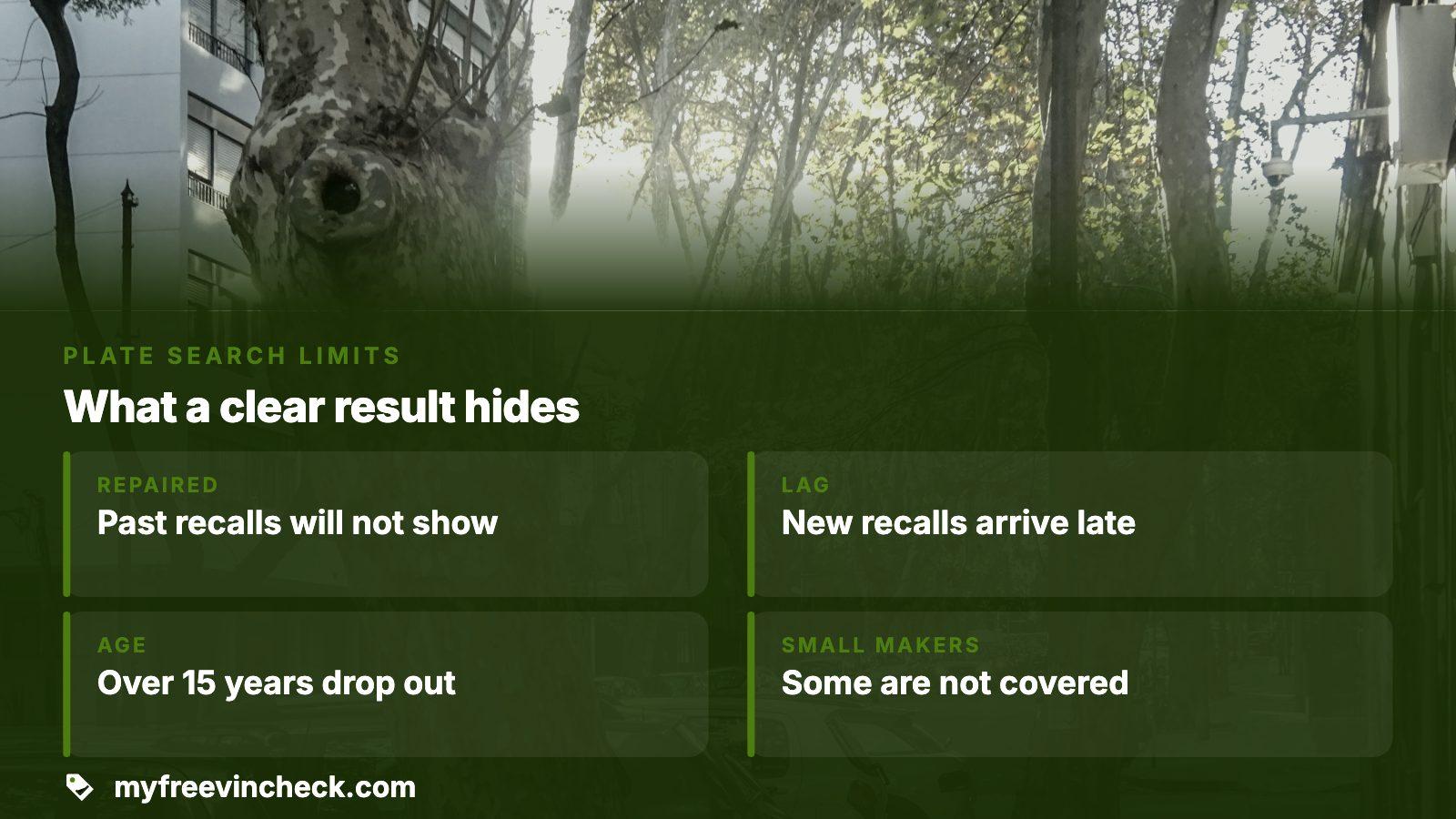
- A recall that was already repaired will not show, so you cannot see the repair history from this tool.
- New recalls can lag, because the affected VINs are added over time rather than all at once.
- Recalls older than 15 years drop out unless the maker extends coverage.
- Some small makers, including certain specialty and ultra-luxury brands, are absent.
- Customer-service campaigns from the maker are not safety recalls and will not appear.
- Cars built for other countries are not covered.
None of that is a flaw in the search. It is a recall tool, so it says nothing about title brands, flood damage, odometer rollbacks or theft.
When the plate points at the wrong car
The plate side of the search depends on what the state record currently says. NHTSA warns that a plate can bring up a vehicle the owner had before the current one. That happens when the registration was moved to a new car and the record was not refreshed.
The fix is to contact the state DMV and ask it to correct the record. Meanwhile, you do not need to wait: switch to the VIN. NHTSA lists the lower left of the windshield and the registration card as places to read it, and the insurance card can carry it too. A plate seen through a windshield cannot lie about the VIN stamped into the dash, so the number on the glass is the one to trust.
When the screen says clear and the car says otherwise
Tools can disagree with reality, and owners notice first. One example is public in NHTSA's own complaint records.
From an NHTSA owner complaint
The owner of a 2013 Chevrolet Malibu wrote that the dash showed a charging-system warning. Reading online, they learned other cars of the same year and model had been recalled for that problem, yet entering their VIN showed no recall on theirs. They asked for a free repair and said the cost was a hardship.
The lesson is to treat a clear search as a snapshot of recall status, not a clean bill of health. A warning light, a smell or a noise still deserves a dealer visit even when the lookup is empty.
Getting a VIN from a plate without a shady lookup
Some buyers go from a plate to a VIN hoping to open up a record on the owner. We do not offer that, and you should be wary of anyone who does. The federal Driver's Privacy Protection Act, which is chapter 123 of Title 18, bars a state DMV from handing out personal details held in a vehicle record unless the use is on a short list. Getting that data knowingly for a use outside the list is against the law, and an affected person may bring a lawsuit.
Permitted uses include motor vehicle safety, theft, recalls and advisories, plus insurers, courts and agencies, and cases where the person gave written consent. For a shopper the practical path is easier: ask the seller for the VIN, look at the registration or insurance card, or read it from the car.
Plate, VIN or model year: which search answers what
| Search by | What you learn | Best used when |
|---|---|---|
| Plate and state | Open recall repairs on the car tied to that record | You can see the car but not its VIN yet |
| VIN | Open recall repairs on that exact car, with no record lag | The plate is missing, wrong or from out of state |
| Year, make, model | Every campaign for that model year, open or not | You are researching a model before shopping |
The third row can look alarming. NHTSA's recalls API returns 18 campaigns for a 2017 Ford F-150, but that is the whole model year, not the open items on one truck. A single 2015 Toyota Camry campaign shows how much the count varies by model.
Using the free preview after the recall check
Once you have the VIN, our free preview decodes the car and checks it against NHTSA data, so you can confirm that the make, model and year match what the seller advertised. That alone catches a plate that was swapped between cars.
Want more than recall status? The full report is paid once per vehicle, no subscription, and adds what a recall tool cannot see: title brands, damage entries, mileage readings and theft flags. Only the preview is free. See the pricing page for the current options.
What to do with an open recall
An unfinished recall on a used car is a bargaining chip and a scheduling job more than a deal breaker. Request that the seller book the repair before money changes hands, or learn when parts will arrive. Keep the dealer's paperwork, then search again to watch the item disappear.
After the sale, NHTSA's SaferCar app can ping your phone when a new recall turns up on a car you added.
Where this information comes from
- NHTSA: Check for Recalls — plate and VIN search, its coverage limits, where to find the VIN
- govinfo: 18 U.S.C. chapter 123 — federal limits on releasing motor vehicle record data
- NHTSA recalls API: 2015 Toyota Camry — example of a year-make-model recall query
- NHTSA owner complaint 11735733 — owner experience, paraphrased
Sources and photos: Facts checked against the sources above in November 2026. Photos by Johnathan Kaufman, Anastasiia Nelen and Nikolai Kolosov on Unsplash; diagrams by MyFreeVINCheck.
Keep reading
- Check a VIN Number for Recalls: Free Lookup, Then the Full PictureThe VIN version of this search, which skips the plate record.
- Where Can I Get a Free VIN Check? Three Lookups and What They MissWhat the free preview decodes once you have the VIN.
- NHTSA Complaints Lookup: Search Owner Reports by Year, Make and ModelOwner complaints, the other public record beside recalls.
- Free Stolen VIN Check: A Step-by-Step Way to Run OneA theft check, which a recall search will not do.
Frequently asked questions
Is a recall check by license plate really free?
Yes. NHTSA runs the plate search on its own recalls page and does not charge for it. Entering a plate or VIN is voluntary. What costs money is a history report that goes beyond recalls, and that is a separate step you can skip.
Can I see the owner's name from the plate?
No. The recall tool shows recall status for a vehicle, nothing personal. A federal privacy law limits what a state DMV may release, and getting it for a use outside the allowed list is illegal. Our site does not offer owner lookups.
Why did the plate show a car I do not own?
Plate data comes from state records, and a plate can still be linked to an earlier vehicle after a registration change. Ask your state DMV to update it, and search by VIN in the meantime. The VIN is tied to the car itself.
If nothing shows up, is the car free of recall history?
Not at all. The search leaves out repaired recalls, very old recalls, some small makers and manufacturer service campaigns. It only tells you what is still unrepaired on that vehicle, so use other checks for repair, title and damage questions.
Which is better for a used car, plate or VIN?
The VIN, when you can get it. It identifies the exact car, and you can read it on the windshield corner or registration. Use the plate only as a quick first pass when the VIN is out of reach.
Now check the car itself
The guide explains what to look for. The report shows what this VIN has on record.