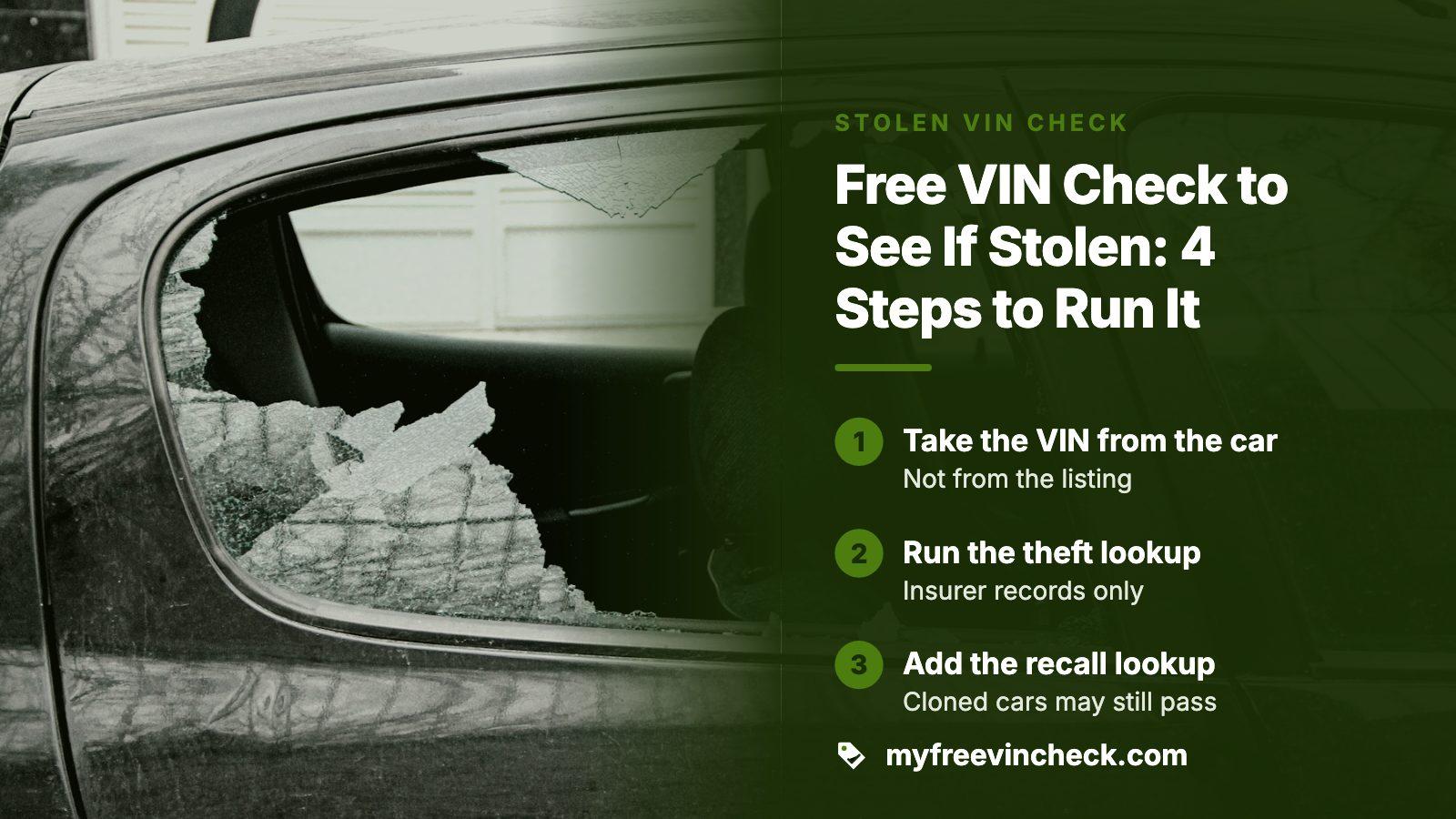
THE SHORT ANSWER
Take the VIN from the vehicle, type it into NICB's VINCheck and read the theft, salvage and flood answer. Each IP address gets five free searches a day. Then line the VIN on the car up with the paperwork. A clean answer can still miss police-only files and cloned cars, and a paid report fills part of that gap.
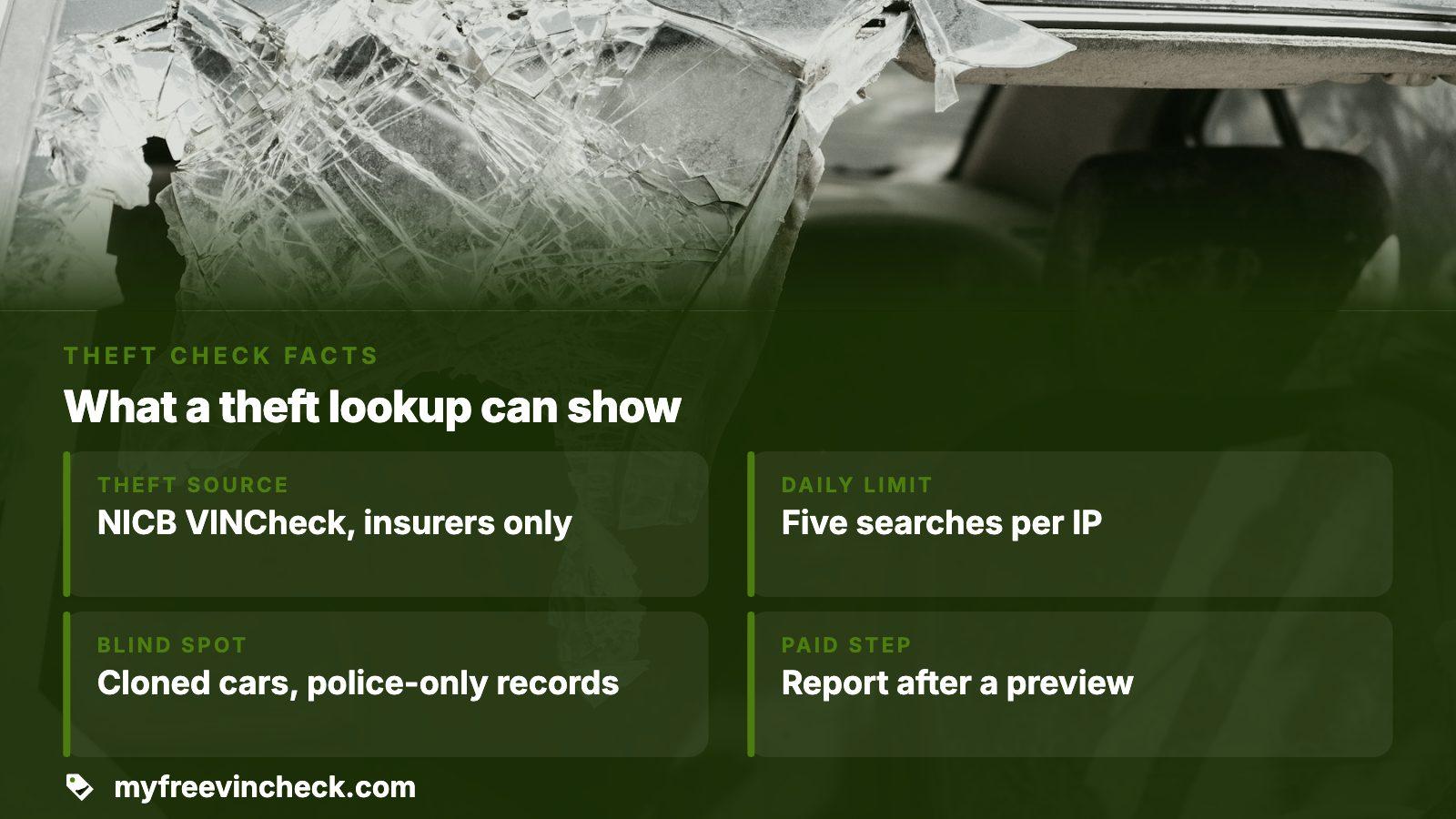
- Free theft source
- NICB VINCheck, insurer records only
- Daily limit
- Five searches per IP address
- Blind spot
- Cloned cars and police-only records
- Paid step
- Full report after a free preview
What a free theft check really looks up
No free tool here searches a national police list. NICB built VINCheck from claims that member insurers reported, and about 92.49 percent of US premium sits with those members. The question it answers is narrow: has any insurer in the program ever filed this VIN under theft with no recovery, a write-off, or a flood claim?
That narrowness is useful once you know it. At MyFreeVINCheck we build around the tools that work without a payment, and this is the first of them. The steps below take about ten minutes and cost nothing, and they show you exactly where the free route stops.
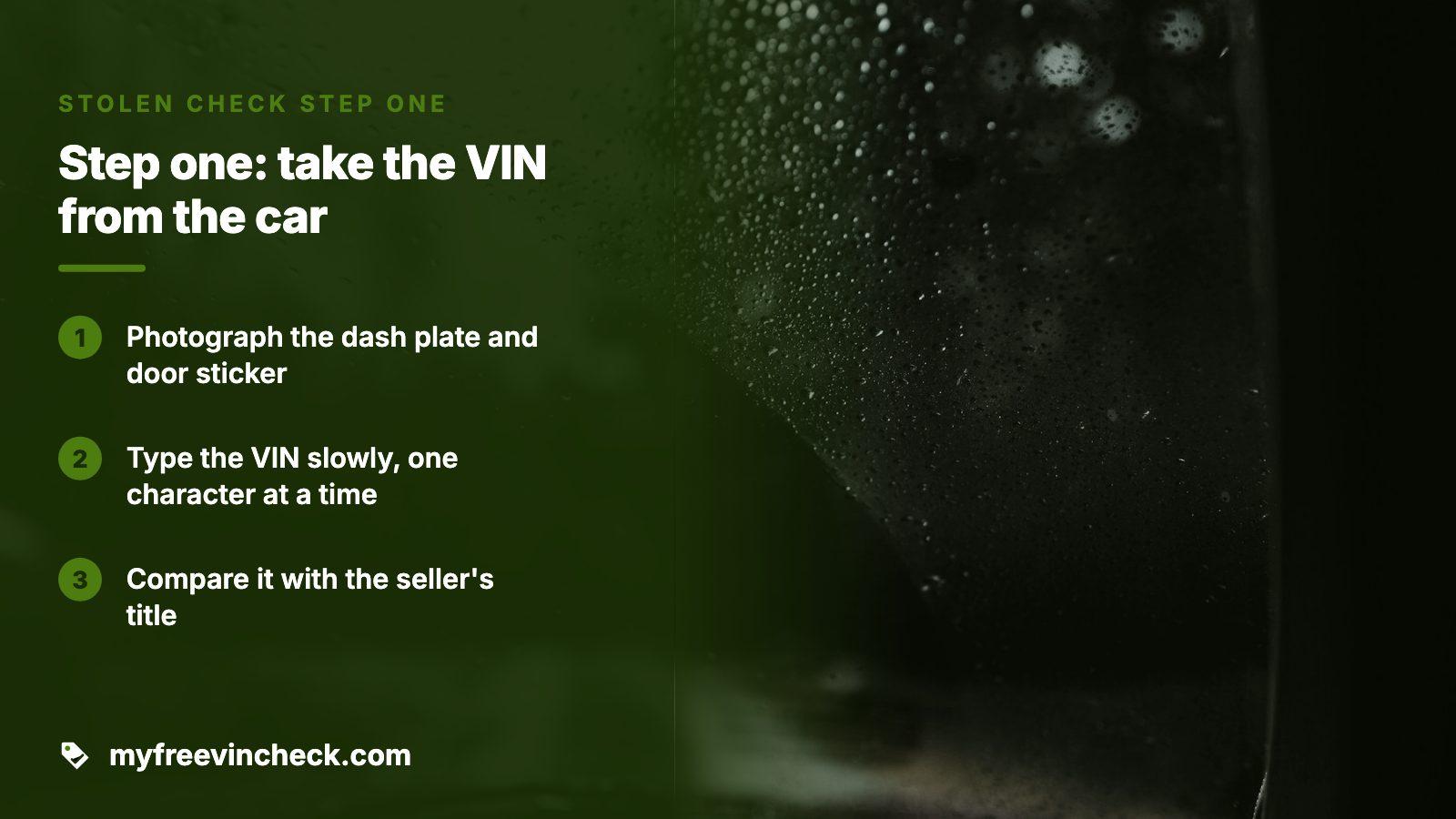
Step 1: take the VIN from the vehicle itself
Sellers sometimes type a VIN into a listing from memory or from an old document. Stand beside the vehicle and read it yourself. On NHTSA's recall page the plate is described as sitting at the bottom driver-side edge of the glass, and the registration card repeats the same 17 characters.
- Take a photo of the dashboard plate, then of any sticker on the door pillar.
- Type the VIN slowly. One wrong character can return no match, and NICB warns that a bad VIN may hide a real record.
- Compare it with the title or registration the seller shows you. Any mismatch between the car and the paper ends the deal until it is explained.
Step 2: run the NICB lookup
Go to NICB's VINCheck, enter the number, agree to its terms and read what comes back. A hit for stolen and not recovered means stop and do not hand over money. A salvage or flood hit is a different problem, but it still changes what the car is worth and whether it is safe.
Search limit
The meter runs at five lookups a day per connection, and it resets, so a second day is fair game. Shopping several cars? List the VINs and spend your five on the likeliest ones first.
A clean answer is good news, nothing more. NICB itself calls the tool no substitute for a full history report, and warns that a stolen or badly damaged car may leave no matching record.
Step 3: add the federal recall lookup
NHTSA's recall page has nothing on theft, so this step does not clear a car of anything. It earns its place as the second free pass over the same VIN: it lists recalls that are still unrepaired, or tells you there are none for that number. It leaves out repaired recalls and very new ones whose VINs are not yet loaded.
Run it because a seller who has ignored an open safety recall may have ignored other things too, and because the answer costs you a minute.
The free tools side by side
| Lookup | Theft answer | What it leaves out |
|---|---|---|
| NICB VINCheck | Insurer-logged theft, not recovered | Police-only records, insurers outside the program |
| NHTSA recall search | None | Anything about ownership, theft or title |
| NMVTIS-approved report (paid) | Theft data in some cases, plus title and brand history | Not every state reports, so a gap is possible |
| A full paid report | Theft records alongside title, liens and impounds | Still no substitute for an inspection |
The gap a free check cannot close: cloned cars
This is the scenario that beats a simple lookup. Picture a thief who photographs the VIN on an honest owner's car, prints a fake tag and papers, steals a look-alike and bolts the tag on. The VIN you enter belongs to an honest owner somewhere else, so it returns nothing.
How big this gets
In a multistate case the Justice Department's NMVTIS site describes, investigators recovered roughly 250 cloned, stolen vehicles. Nobody at the title office, and none of the buyers, could see the theft from the VIN alone.
NICB adds that the buyer of a clone never legally owns it. Once the swap is exposed, the car is seized and returned to the original owner or the paying insurer. Warning signs are a late-model car with no lien holder, an ownership pattern that does not hang together, and a VIN that disagrees between locations on the car.
When the paid report becomes the next step
The free route stays free; the report is the upgrade for a car you are serious about. Begin with this site's preview for the VIN, which sketches what the report contains without charging you. If the car still looks worth pursuing, one purchase gets you the whole report, nothing recurs, and the pricing page lists the options.
For theft questions the report matters because it puts theft records beside title brands, liens, impounds, odometer readings and salvage history in one place. The FTC recommends a history report before any used purchase, and notes that approved NMVTIS providers charge for theirs.
If a lookup flags the car, or the VIN looks wrong
- A stolen hit: walk away and do not confront the seller. Passing the VIN to local police is safer than handling it yourself.
- VIN numbers that disagree on the car: treat it as a possible clone and ask the state motor vehicle office to confirm the VIN.
- A suspected fraud in the sale: NICB accepts reports online or by phone at 800-835-6422.
- A clean result but a seller who is rushing you: run a paid report and get an independent inspection before you pay.
One more wrinkle from the NMVTIS site: when a stolen car stays missing past a month, its insurer can book it as a total loss, and that entry survives a later recovery in perfect shape. So a total-loss entry on a record is not proof of a wreck.
Where this information comes from
- NICB: VINCheck lookup — Shows the scope of the free lookup, its daily cap and what NICB itself says about leaning on it.
- NICB: Buying a used vehicle — Backs the description of cloning and the advice to verify the VIN and search the title.
- NMVTIS (Department of Justice): For consumers — Source for the cloned-vehicle case, theft data in title reports and the 30-day total loss note.
- NHTSA: Check for recalls — Shows where the VIN sits on the car and what the recall lookup leaves out.
- FTC: Used cars — Backs the call for a history report and a hands-on inspection.
Sources and photos: Facts checked against the sources above in November 2026. Photos by Ali Aliakbari, Justin Cron and Macro.jr on Unsplash; diagrams by MyFreeVINCheck.
Keep reading
- Where Can I Get a Free VIN Check? Three Lookups and What They MissThe wider picture of what free VIN tools cover beyond theft.
- Free Salvage Title Check by VIN: What It Shows and MissesThe same lookup also returns insurer salvage records, and this page explains them.
- Is a Free VIN Check Legit? What the Real Ones Cover and MissUseful if you doubt what a no-cost lookup can really promise.
- Sample reportOpen a finished example first and judge the layout before you spend anything.
Frequently asked questions
Can I check a VIN to see if a car is stolen for free?
Yes, through NICB's VINCheck, which flags insurer-logged thefts that were never recovered and also salvage and flood records. It covers participating insurers only and skips law enforcement files, so a clear result trims the risk but leaves some.
How many free stolen VIN searches do I get?
NICB meters lookups at five a day for each connection. Over a longer stretch there is no ceiling, so you can run the rest the next day. Prioritize the cars you would actually buy.
Does a clean VINCheck mean the car is not stolen?
No. NICB cautions that no result is a guarantee. A stolen car with a cloned VIN, or one that only police know about, can come back clean. Pair the lookup with a VIN comparison on the car and a title review.
Is the full report on this site free?
No. Only the preview costs nothing; the report itself is bought once and has no subscription. See the pricing page for amounts. Use the preview to judge whether the report suits the car before paying.
What should I do if the VIN comes back stolen?
Stop the purchase and avoid confronting the seller. Report it to local police, and if you suspect a fraudulent sale you can also tell NICB online or by calling 800-835-6422. Keep the VIN, the listing and any messages.
Now check the car itself
The guide explains what to look for. The report shows what this VIN has on record.