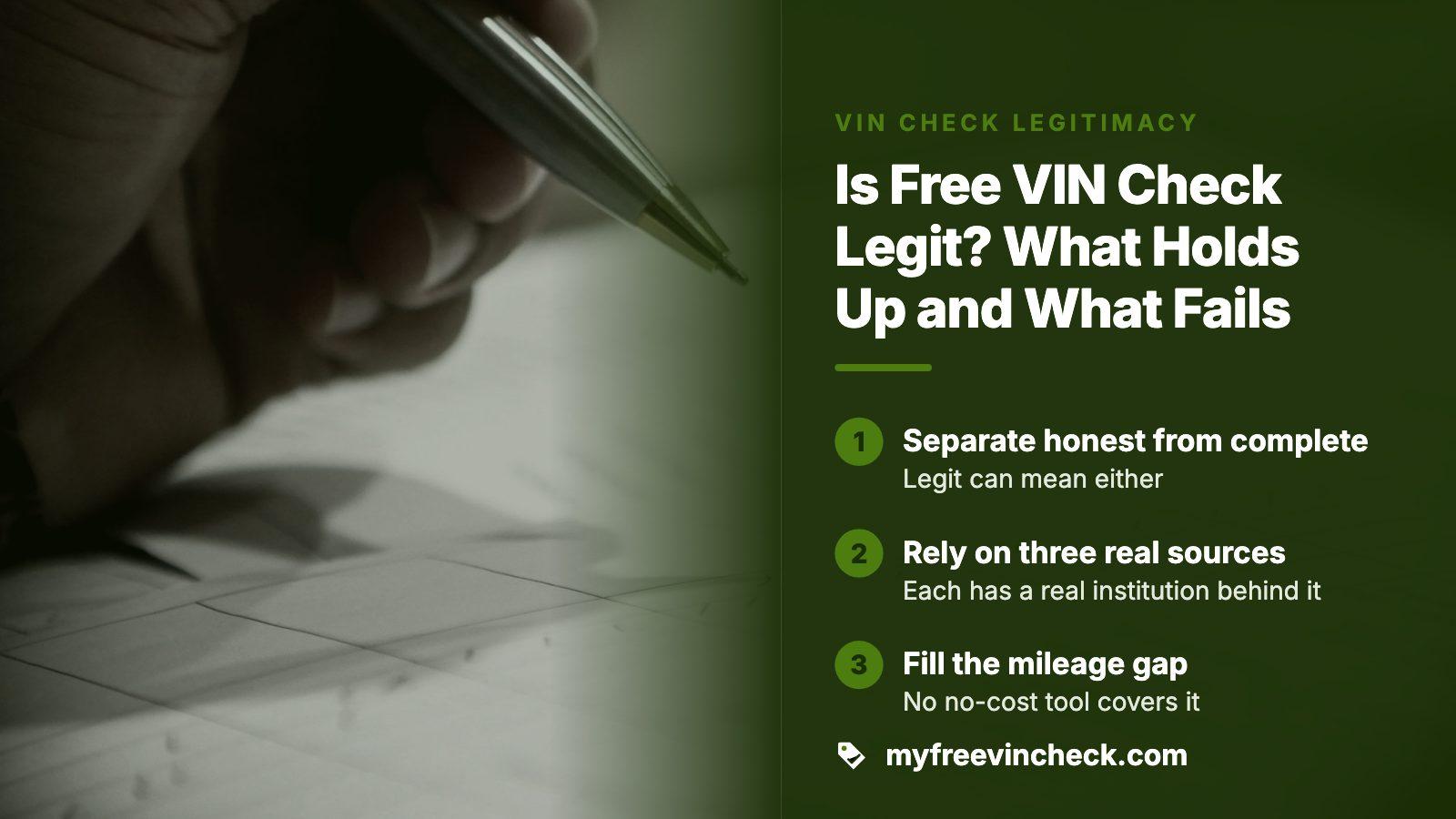
THE SHORT ANSWER
Yes, a few are. NHTSA's VIN decoder, NHTSA's recall search and NICB's VINCheck are free, run by institutions rather than ad funnels, and open about their limits. Distrust any site that wants an email address or card before it shows a result. For the records those three cannot reach, a free preview on this site counts what is on file before you decide on a paid report.
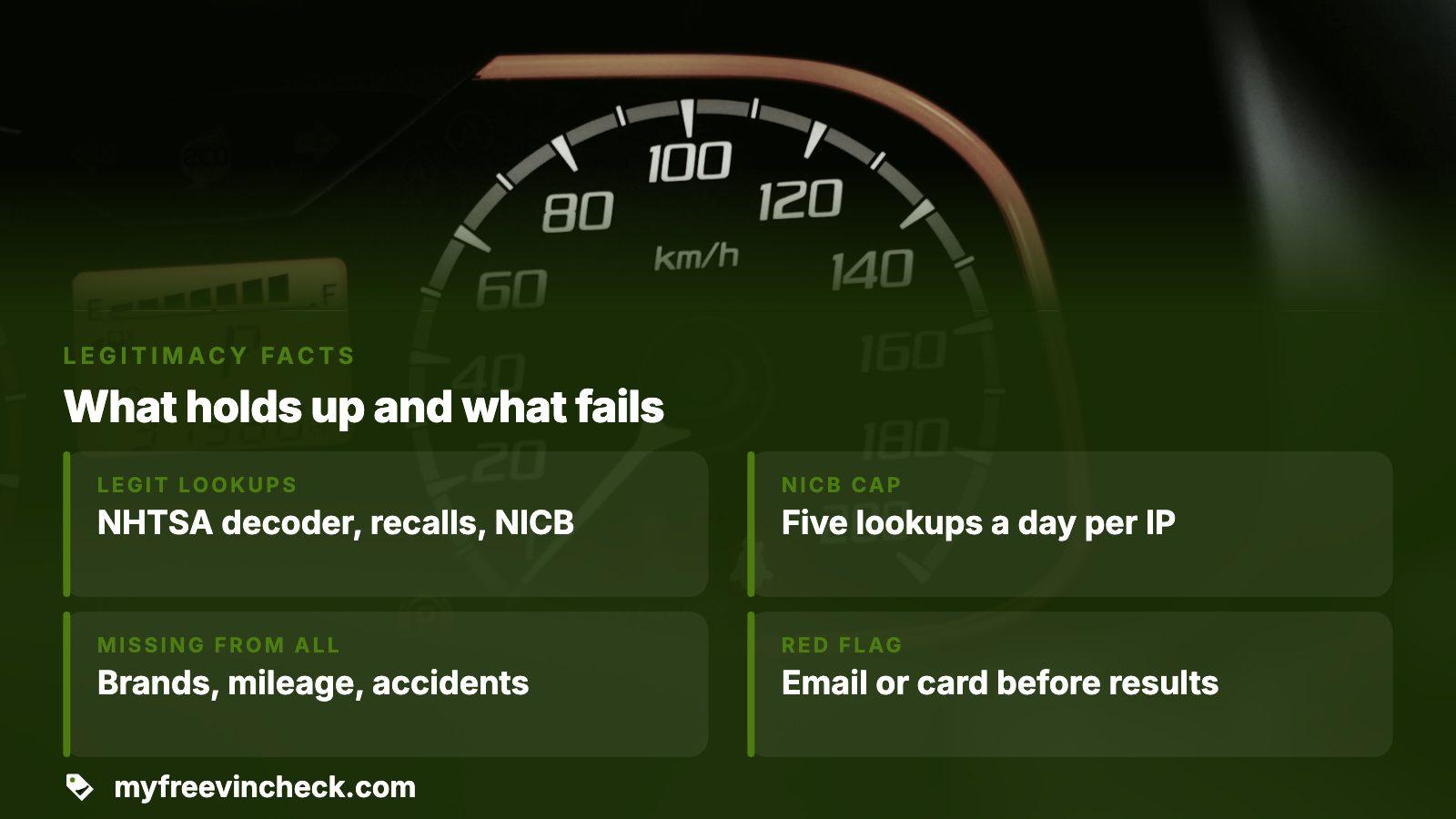
- Legit free tools
- NHTSA decoder, NHTSA recall search, NICB VINCheck
- NICB cap
- Five lookups a day per IP address
- Missing from all three
- Title brands, mileage history, accident records
- Red flag
- Email or card wanted before any result
Legit can mean honest, and it can mean complete
Buyers who ask this usually mean two things: whether the site will take advantage of them, and whether the answer is enough to buy a car on. A free check can pass the first test and still fail the second.
The lookups in the next section pass the first test easily. They fall short on the second only because each answers one narrow question. Know where each one stops and a clean result becomes a useful filter instead of a green light.
The three free lookups with a real institution behind them
All three take the same 17-character number, and each answers a single question about it.
| Lookup | Who runs it | What goes in | What comes back |
|---|---|---|---|
| VIN decoder | NHTSA, a federal safety agency | The full VIN | Build facts the maker reported, such as the plant and country |
| Recall search | NHTSA | The VIN, which NHTSA calls voluntary to provide | Whether that car carries a recall nobody has repaired |
| VINCheck | NICB, a nonprofit fighting insurance fraud | The VIN plus a tick in the terms box | Whether member insurers reported the car stolen, salvaged or flooded |
NICB's form and NHTSA's recall form ask for nothing beyond a vehicle identifier. Neither has a field for an email address or a card, which is the first thing to hold up against any other site that calls itself a free check.
What a real free check still cannot see
Honest tools can still be thin, and their operators say so. NICB describes VINCheck as a screen that reads insurance records alone, and only those filed by insurers that take part. Its terms of use add that the data is unverified, many stolen and salvage vehicles are absent, and a recovered car can stay listed. Each IP address gets five searches per 24-hour period.
- Title brands recorded by the state, because none of the three reads state title files.
- Odometer history. A decode, a recall search and a theft screen carry no mileage.
- Damage no insurer wrote off. A crash repaired without a total-loss declaration has no place in a salvage file.
- Recalls outside NHTSA's net: repaired ones, brand-new ones still being loaded, anything past 15 years unless the maker extends coverage, and non-safety campaigns.
What one buyer found out after paying
From an NHTSA owner complaint
An owner who had just bought a 2015 Hyundai Sonata told NHTSA in 2018 that it had been through three recalls and sat at the dealer for a month. The owner then ran the VIN through an online lookup, which listed a Texas salvage brand dated January 2017 and a junk brand that April. Hyundai's corporate office, the owner says, confirmed both were on its records. The car no longer felt safe for a daughter to drive.
State title brands are what the free three leave out, and this buyer learned of them after paying. That answer belongs before money changes hands, not after.
Mileage is the gap no free tool fills
Odometer readings live in the records NICB says full reports draw on: DMV title files, auction data and service history, most of them sold for a fee. The decoder, the recall search and VINCheck hold none of that, so nothing in the free set can say whether the dash number is believable.
From an NHTSA owner complaint
A buyer of a 2010 Hyundai Santa Fe told NHTSA in January 2026 that the car showed 142,000 miles when it came from a private seller. A VIN check afterward turned up 223,000, last recorded in June 2025. Local police took no report because too little was known about the seller.
A private seller who cannot be traced afterward leaves one protection: the odometer record has to be seen before the sale.
Where a free offer turns into something else
A genuinely free lookup has no use for your card. If a site advertising a free check demands one first, you are dealing with a billing arrangement, and its terms decide what you owe.
The FTC's October 2018 consumer alert shows the downside for sellers. A supposed buyer insists that the seller pull a history report from one particular website. The seller hands over about $20 on a card, forwards the report, and the buyer vanishes. The FTC says such a site can be a ruse to collect personal and card details, or a feed for lead generators who resell what they gather for advertising and marketing.
Its advice: when someone pushes a specific report site, ask why, since the operator may be a complete unknown.
Five checks to run on any site that says free
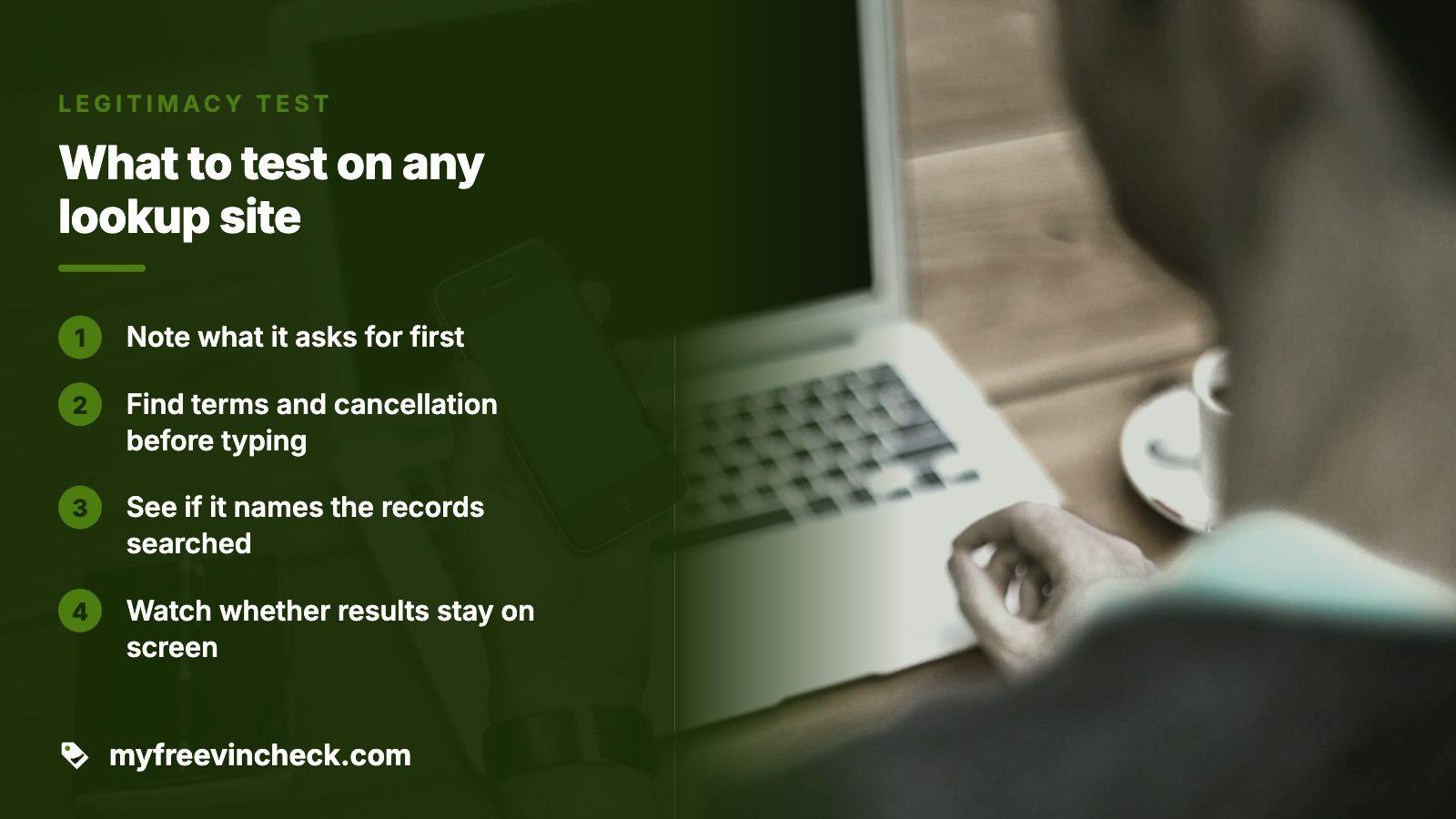
- Look at what it asks for first. A VIN is enough for a lookup; an email address or card number before any result needs a reason you accept.
- Find the terms and cancellation steps before typing anything. If they are missing or unreadable, leave, and untick any pre-checked box that permits later charges or data sharing.
- See whether the page names the records it searched. NICB names insurers and NHTSA names recalls; a promise of full history with no named source tells you nothing.
- Watch whether the result stays on screen. A teaser that becomes a payment wall is a paid report, which is fine when it says so plainly.
- Search the company name beside words like complaint, rating or scam, and confirm you can tell who runs the site.
Putting the free results to work on one car
Decode first and set the answer beside the ad: body, engine, plant. If it does not match, stop there. Next comes the recall search. A dealer fixes a recalled part for free, so an open recall is a scheduling point rather than a veto. NHTSA's page takes up to 100 VINs at once, handy for a shortlist.
Keep VINCheck for finalists, given the daily cap. If it shows a car as stolen and unrecovered, NICB's terms tell a buyer to ask NICB or local police whether the theft report is still open before doing anything, since a recovered car can stay listed. A salvage flag is no ban either: NICB notes such a car can be legally rebuilt and re-titled, so ask what was repaired.
Where this site's preview and report fit in
This site starts with the same free tools, a decode and a recall check on NHTSA data, and they deserve a run on every car you consider. The paid report is the step up for the single car that survives them.
The preview is free and shows whether the VIN has records on file. A report is then a single payment for one car, or 3, 5 or 10 together for shoppers choosing between several. Nothing renews; the amounts are on the pricing page.
Beyond the free set, it brings state brands with dates, odometer readings in order, damage and accident entries, and salvage-auction photos where they exist. Buy it for the car you are ready to leave a deposit on, and still pay a mechanic to look underneath.
Where this information comes from
- NICB: VINCheck lookup — What VINCheck searches, its daily cap, the insurer share behind it and NICB's own cautions.
- NICB: Terms of use for VINCheck — NICB's statement that the data is unverified and incomplete, and what to do if a car shows as stolen.
- NHTSA: Check for recalls — What the VIN recall search shows and leaves out, and how a recall repair works.
- NHTSA: VIN decoder — What the decoder returns and that the build data comes from the manufacturer.
- FTC consumer alert: vehicle history report scams — How a pushed report site can be used to take card details or feed lead generators.
- NHTSA owner complaint 11131152 — owner experience, paraphrased
- NHTSA owner complaint 11712911 — owner experience, paraphrased
Sources and photos: Facts checked against the sources above in November 2026. Photos by Masjid MABA, Alejandro Escamilla and muhammad dennisa on Unsplash; diagrams by MyFreeVINCheck.
Keep reading
- Where Can I Get a Free VIN Check? Three Lookups and What They MissThe three free lookups in order, with the limits of each.
- Check a VIN Number for Recalls: Free Lookup, Then the Full PictureHow the recall search works and what an open recall means for a purchase.
- Free Salvage Title Check by VIN: What It Shows and MissesWhat a free salvage or title screen can confirm before you pay.
- PricingWhere the amounts sit: one report or a pack, paid once, no subscription.
Frequently asked questions
Is NICB's VINCheck safe and accurate?
It is run by a nonprofit that fights insurance fraud, and its form asks for a VIN and a tick in the terms box, nothing more. Accuracy is separate: NICB's terms say it has not verified the data and cannot vouch for it. Treat a flag as a lead to confirm and a clean result as one data point.
Should I give my email or card to a free VIN check site?
Not before you know what happens next. The NHTSA and NICB forms asked for neither when reviewed for this page. A site that does ask should show its terms, any charge and the cancellation steps up front. If those are missing, close the tab.
Can a free VIN check show accident history?
Not from the three real free tools. VINCheck covers theft, salvage and flood reports, NHTSA's search covers open recalls, and the decoder covers how the car was built. A collision repaired with no total-loss claim appears in none of them. Accident entries come from wider records, where a paid report starts.
Is a car safe to buy if the lookup comes back clean?
No. NICB says a clean VINCheck result does not guarantee a clean history, and no record check tests brakes, suspension or a slow oil leak. Keep the car on your list, then pay a mechanic for an inspection and ask for the repair estimate in writing.
A buyer for my car wants me to pull a report from a site they chose. Should I?
Pause. That matches the pattern the FTC described in 2018, where the seller paid, sent the report and never heard back. Ask why they cannot run a lookup themselves, and offer the plain VIN so they can run their own.
Now check the car itself
The guide explains what to look for. The report shows what this VIN has on record.