THE SHORT ANSWER
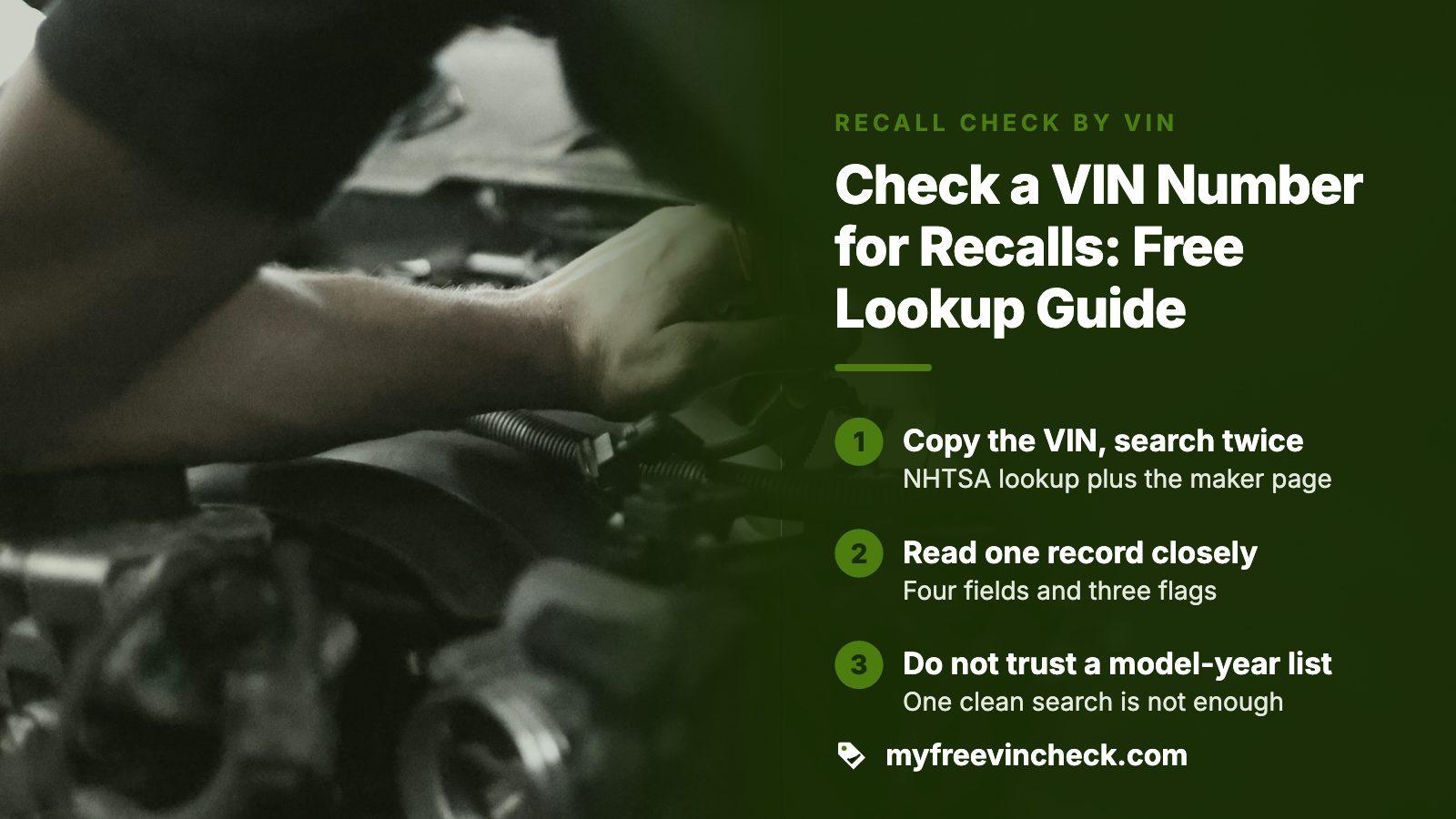
Enter the VIN in the free preview here to see the car identified and its open NHTSA recalls counted, then search the same VIN in NHTSA's own lookup. Zero open means nothing is unrepaired today, not that the car is sound, and a campaign can appear after you buy. Search again before paying and on delivery day. The paid report covers what recall data never touches.
- Preview shows
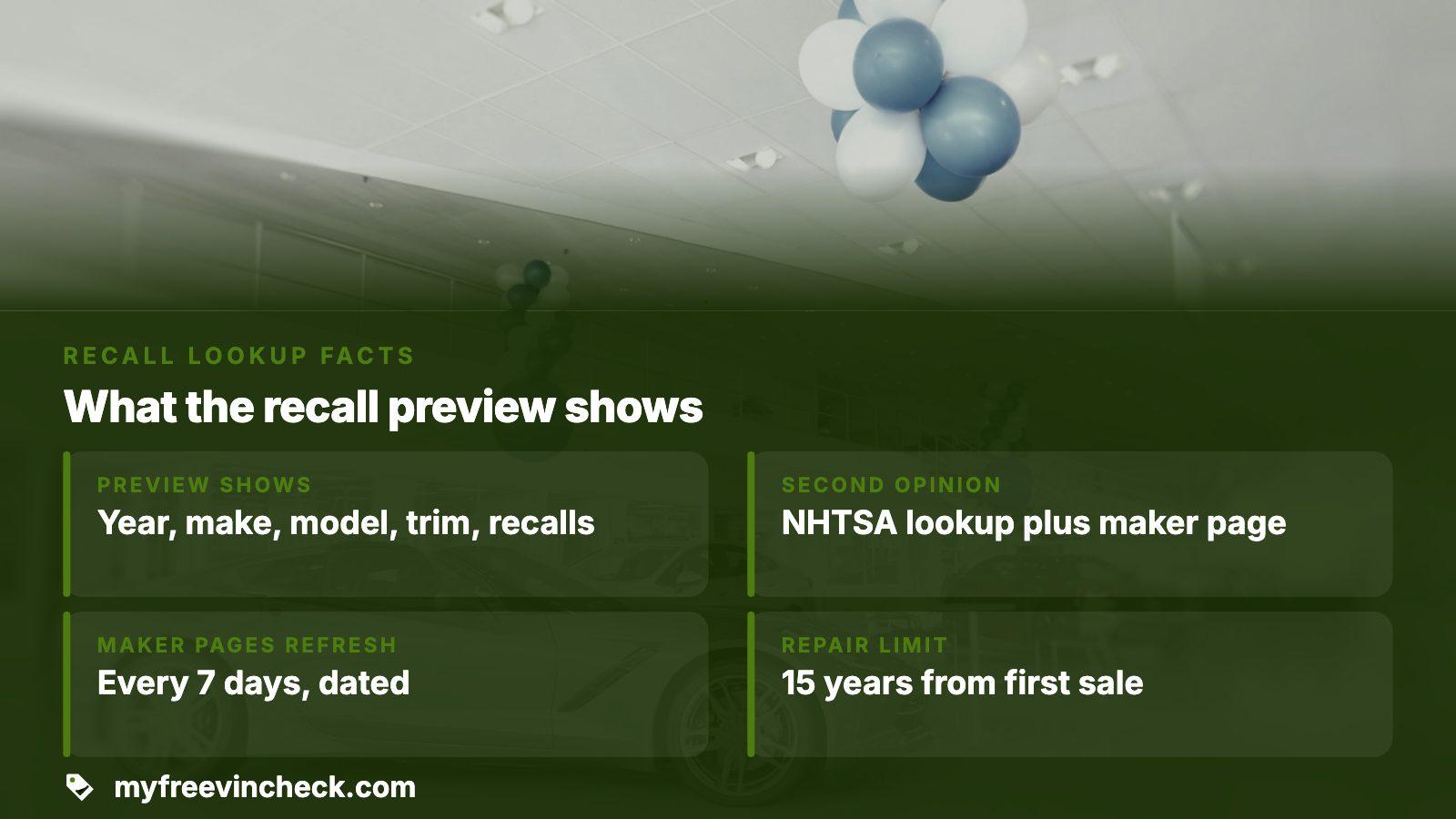
- Year, make, model, trim and an open recall count
- Second opinion
- NHTSA's own VIN lookup, plus the maker's page
- Maker pages refresh
- At least every 7 days, with the date shown
- No-charge repair limit
- 15 calendar years from first sale to the maker's notice
Copy the VIN off the car, then search twice
Copy the code off the vehicle, not the advert, and photograph it twice: once from the plate behind the glass at the driver's side of the dash, once from the sticker on the doorframe. One wrong character in a listing returns a tidy answer for some other car.
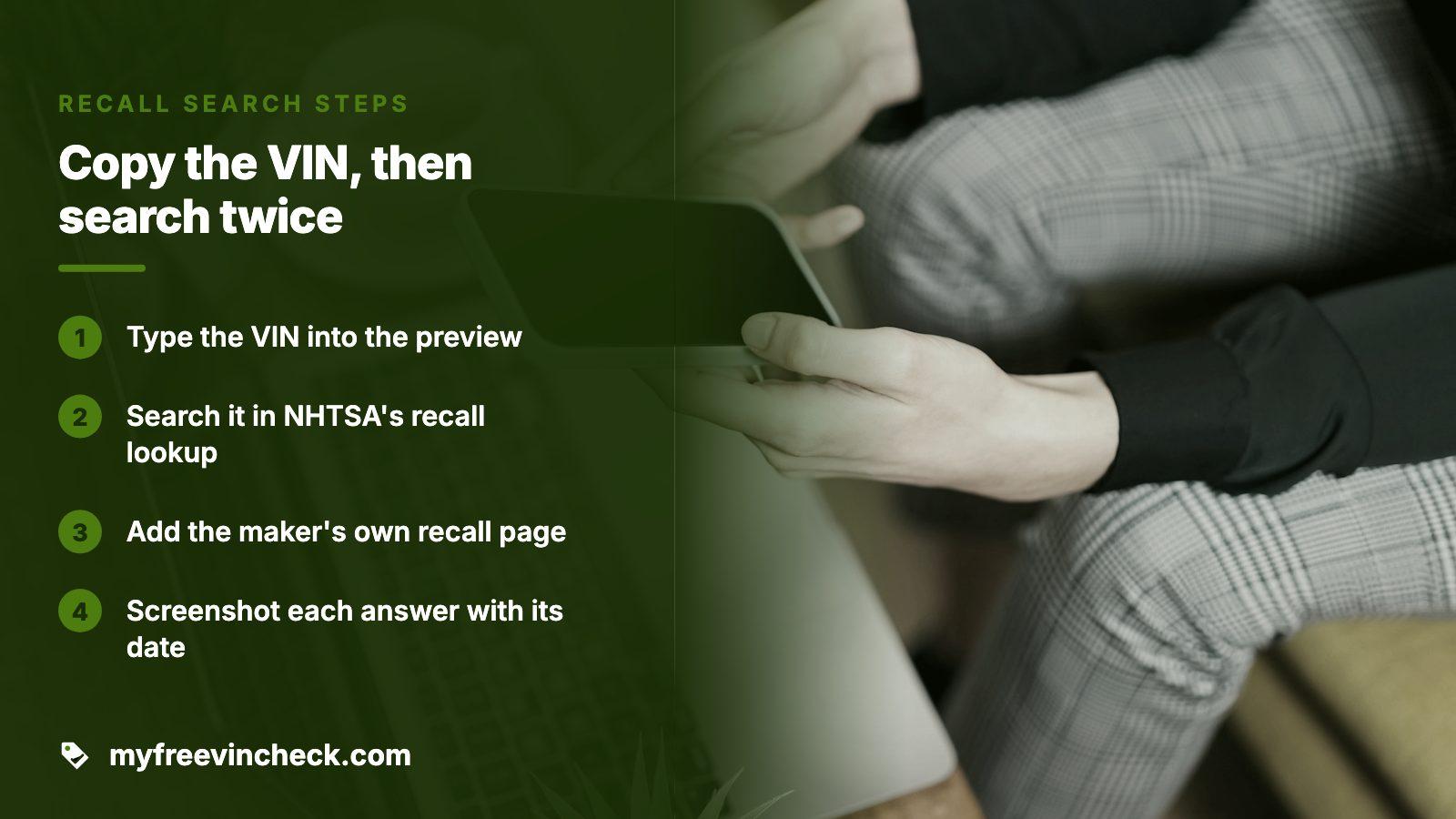
- Type the VIN into the preview. It lists the car's model, trim level and year, then counts open recalls. If the model differs from the one in front of you, the VIN is wrong.
- Search the same 17 characters in NHTSA's recall lookup, which the FTC lists as a free way to see open recalls by VIN.
- For a car from a big maker, add the maker's own page. Federal rules require those to cost nothing, need only make, model and VIN, and carry no sales pitch.
- Screenshot each answer with its date visible.
What costs nothing here and what the report adds
| Tool | What it answers | Cost |
|---|---|---|
| Preview on this site | Year, make, model and trim, with counts of open recalls, title records and auction records | Free, no card |
| NHTSA recall lookup | Safety repairs still undone on that VIN | Free |
| Maker's recall page | The maker's own list of open campaigns | Free |
| Full report | Open recalls in full, with brands on the title, accidents, odometer readings, ownership and use type | One payment |
Only the last row is paid: one purchase that renews nothing, sold singly or in three-, five- or ten-report bundles, with amounts on the pricing page. Work through the first three rows before deciding whether the fourth suits this car.
A model-year list is not your car: the 2012 BMW 535i
NHTSA's developer feed takes make, model and model year, and refuses a VIN: on 3 November 2026 it answered a VIN request with a 400 error. For a 2012 BMW 535i it lists one campaign, 16V746000, filed October 2016, about an in-tank fuel pump with possibly weak wire crimps.
The record says the maker is recalling certain vehicles, naming the 2011 and 2012 535i among many models. A car on that list can sit outside the affected group or have been repaired years ago. The sample report here covers a 2012 BMW 535i and counts zero open recalls for its VIN. Both answers hold; they respond to different questions.
From an NHTSA owner complaint
A 2013 Volkswagen Jetta owner told NHTSA in April 2022 that the steering-wheel clock spring had failed and cut the driver's air bag link. Many Jettas of that year were recalled for the part, yet a search by this VIN found nothing, and the owner was told they were about 1600th in line for a back-ordered replacement.
A model-year recall that skips your VIN speaks to the campaign, not the part. If the symptom matches, report it to NHTSA anyway.
Reading one record: four fields and three flags
| Field | What the BMW record said |
|---|---|
| Campaign number | 16V746000; the first digits match the 2016 filing year |
| Component | Fuel system, gasoline, delivery, fuel pump |
| Consequence | A melted connector and fuel leak, or a pump that quits and stalls the engine |
| Remedy | Dealer swaps the pump module at no charge; the program began in February 2017 |
| Yes-or-no flags | Park it, park outside and over-the-air update: all marked no |
Read the consequence first, since records are not ranked and severity lives there. Fire, a fuel leak or lost braking justifies asking for the repair before you sign. A park-it flag marked yes means the car should not be driven, and park-outside means it should sit away from buildings.
If a fix is not ready yet, the maker's page has to flag the car as included and the part as unavailable. Get that in writing from the dealer.
One clean search is not enough
That BMW campaign was filed in October 2016 against a car built for the 2012 model year, with repairs starting in February 2017. A search in 2015 could not have shown it, and was correct that day. Maker pages must refresh at least every 7 days and show the date on both pages, so a date long past a week is worth a call.
Search when the listing catches your eye, the day before you sign, and on delivery day if a week has gone by.
From an NHTSA owner complaint
A 2015 Nissan Altima owner told NHTSA in January 2024 that they had bought the car only days before. The salesperson had said it had zero recalls, but running the VIN showed 10, none repaired, one for the low-beam headlights. The owner assumed it was too late for fixes.
A spoken "no recalls" is not a search result. Run it yourself before you sign.
What a clean result leaves out
Federal law stops a dealer selling a new car still on its lot when a recall notice arrives, and stops rental companies renting or selling a recalled car before repair. That limit does not reach used cars, so your own search is the check that counts.
- Crashes and total-loss rebuilds, which sit in title, insurance and salvage records.
- Odometer readings and whether they climb in order.
- Faults the maker has not yet acknowledged. A recall follows discovery, so a defect can exist before it has a number.
From an NHTSA owner complaint
A 2013 Ford Edge buyer told NHTSA in July 2023 that VIN searches on several sites showed no recalls and the dealer said it had inspected the car, sold as is. The back-up camera then began prompting a call to the dealership, and the touchscreen changed songs and settings untouched. The owner doubted the inspection.
The FTC advises a history report plus an independent mechanic's inspection; neither replaces the other.
If something is open: what you can ask for
- Call a dealer for that brand with the VIN and campaign number. The maker owes the repair at no charge once the car is presented.
- If parts are short, ask for the expected date in writing.
- The maker picks repair, an equivalent replacement, or a refund net of depreciation. A repair still inadequate 60 days after presentation is prima facie evidence of unreasonable delay, which obliges the maker to replace or refund.
- The free-repair duty lapses when the first buyer's purchase predates the maker's notice by over 15 calendar years.
- If you paid for the same fix before the recall was announced, ask the maker about reimbursement; every maker must keep a plan for it.
Where the paid report fits after the free steps
Run the preview and both lookups first. If the car is clean, or its recalls are fixable, and you still want it, the report is the next check. It covers what recall data cannot: any salvage or flood brand on the title, damage and crash records, mileage readings, and who used the car and how, rental and fleet work included.
One payment renews nothing, and three-, five- and ten-report bundles suit anyone comparing cars; amounts are on the pricing page. An open fire-risk recall with no remedy date deserves scrutiny first.
Where this information comes from
- eCFR 49 CFR 573.15: public recall information — What a maker's VIN lookup must offer: no charge, no sales messages, a 7-day refresh and a visible date.
- 49 U.S.C. 30120: remedies for defects — No-charge remedy, replacement or refund, the 60-day rule, the 15-year limit and the new-vehicle sale limit.
- FTC Consumer Advice: Used Cars — NHTSA's free VIN listing of open recalls, and why a history report does not replace an inspection.
- NHTSA recalls API: 2012 BMW 535i — The record behind the worked example, read directly from NHTSA's data feed.
- NHTSA owner complaint 11564313 — owner experience, paraphrased
- NHTSA owner complaint 11460189 — owner experience, paraphrased
- NHTSA owner complaint 11529928 — owner experience, paraphrased
Sources and photos: Facts checked against the sources above in November 2026. Photos by Mustafa Sheikhmouss, Jakub Żerdzicki and Richard R on Unsplash; diagrams by MyFreeVINCheck.
Keep reading
- Tire Recall Check: What a VIN Search Misses and the Sidewall Code FindsTires carry their own recall codes, which a VIN search never reads.
- Free Salvage Title Check by VIN: What It Shows and MissesThe title-side check that a recall search leaves out.
- Sample reportSee how the 2012 BMW 535i report lists open recalls beside its other records.
- PricingHow the report is billed, singly or in bundles, with nothing to cancel.
Frequently asked questions
How can I check a VIN for recalls at no cost?
Enter it in the preview on this site, then in NHTSA's lookup, and for a newer car in the maker's own page. Compare all three. If they disagree, ask the maker, whose page has to say how to question what it shows.
Is a free recall check by VIN accurate?
It is as current as its last refresh. Maker pages must update at least every 7 days and display the date, so read it. No search shows a campaign filed this morning, and none describes the car's condition. Treat it as a records check, then add an inspection.
Why does my VIN show no recall when my model year was recalled?
Campaigns often name only certain vehicles within a model year, and the VIN decides whether yours is included. Ask a dealer to confirm in writing. If your car shows the same symptom, file your own complaint with NHTSA so the report is on record.
Can I check recalls on a car before I buy it?
Yes. You need only the VIN, which a seller can photograph on the car itself. Federal law speaks of the vehicle being presented for repair, so a fix owed on the car is not tied to who bought it. Searching before the test drive costs nothing.
Does a recall check show accidents or a salvage title?
No. It reads safety campaigns only. The FTC points to the NICB's VIN check for flood, theft and salvage declarations. On this site the preview counts title and auction records at no charge, and the paid report spells out title brands, accident records and odometer readings.
Now check the car itself
The guide explains what to look for. The report shows what this VIN has on record.