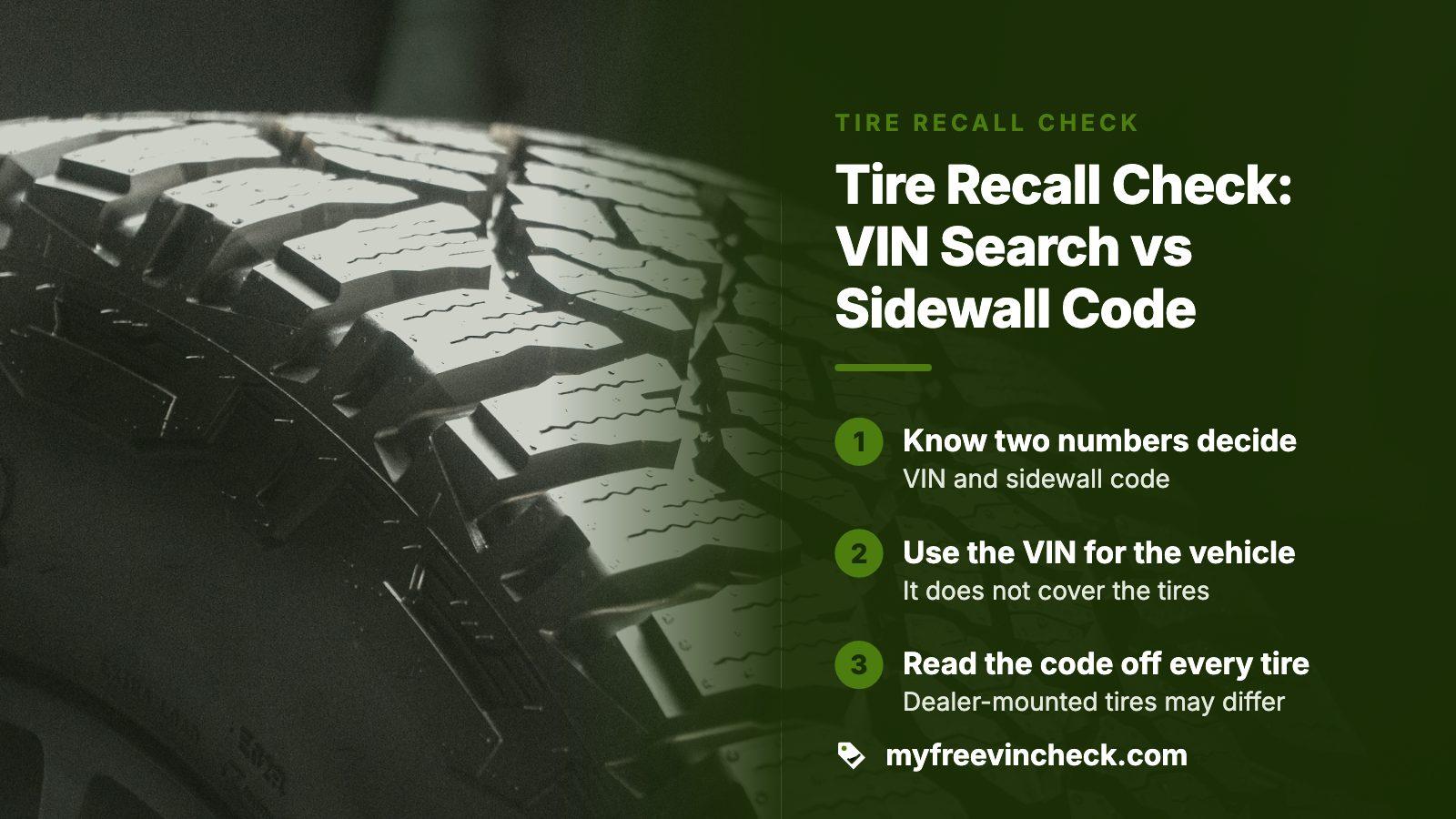
THE SHORT ANSWER
A tire recall check has two halves. The vehicle half is a VIN recall search on NHTSA data, which this site runs at no charge. The tire half means copying the full identification code from each sidewall, checking it against NHTSA's recall search, and registering the tires with their maker. Do both before you buy, because a tire recall is tied to the code and the original buyer's name, not to the car.
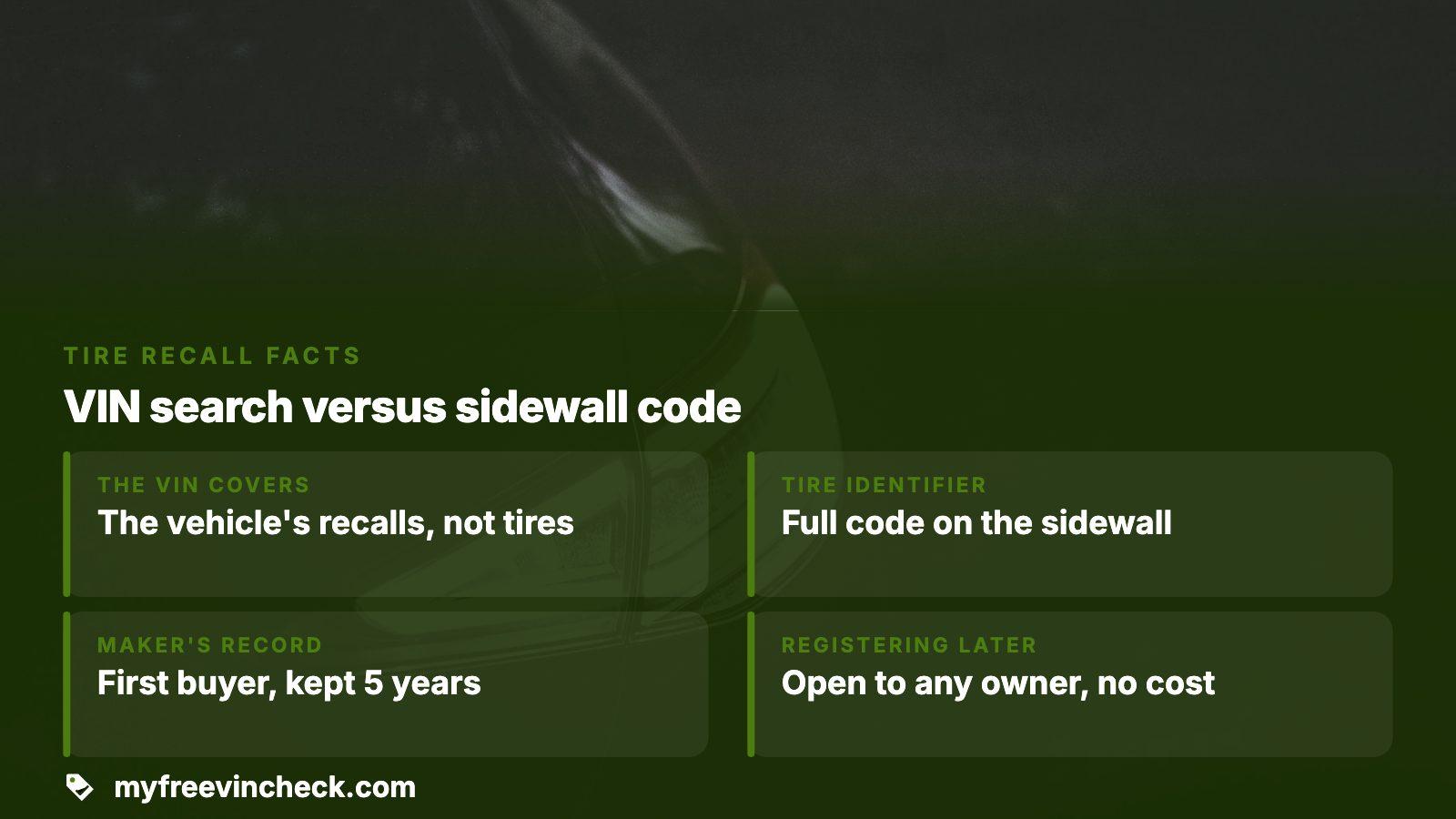
- The VIN covers
- The vehicle's recalls, not the tires'
- Tire identifier
- A full code molded into each sidewall
- Maker's record
- First buyer's name, kept 5 years from that sale
- Registering later
- Open to any owner and costs nothing
Two numbers decide what you can check
A car has one 17-character VIN and, separately, a code on each tire. The two are not linked. The VIN opens the vehicle's recall record; the tire code, stamped by the maker into the rubber, opens the tire's.
| Question | Number | Where it lives | Where to run it |
|---|---|---|---|
| Does the car have an open recall? | The VIN | Dash plate and door-pillar label | VIN recall check here, or NHTSA's lookup |
| Do my tires have a recall? | The tire code | Sidewall of each tire, sometimes the inner face only | NHTSA's recall search, which lists tires as equipment |
| What happened to the car before me? | The VIN | Same plate | The paid report |
The vehicle half: what the VIN tools on this site show
The decode reads the build off the 17 characters. The recall check then pulls NHTSA's records for that number and lists each campaign still open, so you learn whether the car itself has an unrepaired fuel line, air bag or brake part. Both cost nothing.
Neither settles the tire question. NHTSA keeps tires as separate equipment with their own campaigns, so a tire maker's recall will not surface under a VIN. A carmaker can also recall factory tires or the spare under a vehicle campaign, which is one reason the VIN search still goes first.
Why the notice skips the second owner
Federal tire rules are built around the purchaser. For each vehicle it ships, the carmaker or its designee logs the new tires fitted and who bought the vehicle first, by name and address, and holds that for at least five years after the sale. A tire maker's own list works alike: it holds people who registered, or whose seller registered for them.
Buy second-hand and you are on neither list. A recall can be announced, go to the first buyer's old address and never reach you, and the carmaker's record may have aged out already. A car first sold in 2019 can be past the minimum retention period.
When a dealer mounted new tires before selling the car
Lots often mount fresh tires before listing a used car. The rule treats a dealer that sells a used vehicle on new tires, or leases it for longer than 60 days, as a tire dealer. One with no tie to a tire maker has three ways to comply:
- Hand you a paper form listing the complete code of each tire and the dealer's contact details.
- Fill in your name and address and send the form to the maker for you, at no charge, within 30 days.
- Send the same details electronically, again within 30 days at no charge.
A dealer owned or controlled by a tire maker reports at least every 30 days, though a small seller may wait until 40 tires have sold, with six months as the cap.
From an NHTSA owner complaint
Two Cooper Discoverer SRX sidewalls failed within a month on a 2016 Honda CR-V, its owner told NHTSA in August 2019. The SUV was a certified pre-owned purchase from a Maine dealer. The owner noted that a recall covered this tire line in a different size. The report is silent on who fitted the set.
Certified or not, ask for the tire codes in writing at delivery, and whether anyone filed a registration.
Reading the code off every tire
A flashlight is all you need. On many tires the full string sits on the inner face, so crouch or look from underneath.
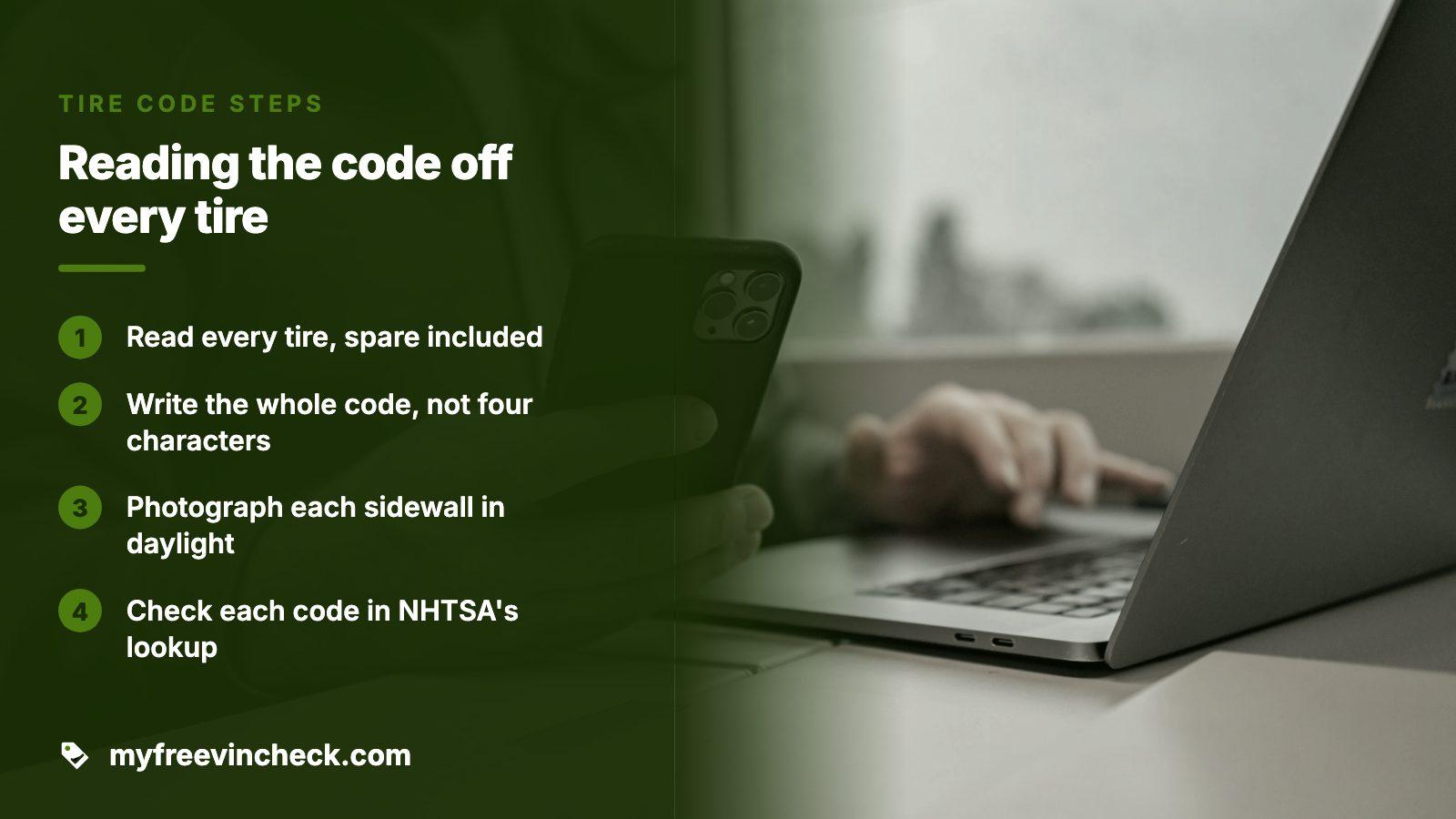
- Read every tire, the full-size spare included. Tires get replaced at different times, so one car can carry several codes and dates.
- Write the whole code, not the last four characters.
- Photograph each sidewall in daylight and work from the pictures.
- Check each maker, tire line and code in NHTSA's recall lookup, then run the VIN recall check for the car.
From an NHTSA owner complaint
One Ford Edge owner (model year 2014) told NHTSA in November 2019 that a Cooper Discoverer SRX sidewall let go at roughly 35,000 miles, as the SUV came down from 70 mph to 30 mph near town. The tires were replaced at once, and only afterward did the owner learn some Cooper tires had been recalled. The DOT number had not been copied; a photo of the failure was all that remained.
Copy the code before a tire leaves the car; afterward a recall notice has nothing to match against.
What the answer means, and the warning signs
A clean answer clears only the code you entered. A recall is written for a tire line, a size and a span of production weeks, and a set just outside the span can still fail identically.
From an NHTSA owner complaint
Sidewall bulges on all four tires sent a 2014 Silverado 1500 owner searching in April 2022. The search found recall 21T002000, so the owner sent every DOT code to the maker. The reply was that this set was a retailer's own version, outside the recall, and the store insisted "no recall exists". By the owner's account, size, production week and bulges all matched the notice.
A maker's no speaks for its own lots only. If the symptoms match, keep the photos and codes and file your own report with NHTSA.
- A bulge, split or crack in a sidewall, whatever the lookup says.
- Codes or dates that differ across the four tires, with no receipt to explain it.
- A code too worn or hidden to read.
- A seller who cannot say who fitted the tires or whether anyone registered them.
Putting your own name on the list
Any owner can register, it costs nothing, and you need only the maker's or brand's name and the full code from each tire. A late registration covers notices issued from then on, which is why the lookup comes first. No public register shows whether a previous owner or a dealer ever filed, so assume nobody did.
Fleet and lease cars deserve a second look. Some commercial operators pay for tire use by distance run rather than buying outright, and tires supplied that way may never have been registered in a private name.
What it costs and where the paid report fits
Nothing is charged for the decode, the recall check or the preview, which shows how many records are on file for the VIN. A report is bought once, with no subscription behind it, and larger packs exist for buyers weighing several cars. Each amount is on the pricing page.
The report earns its place after the sidewall check passes. It brings in title brands, accident and odometer records, open recalls and the ownership and use type, which shows whether the car worked in a fleet. It still cannot read a tire, because the code exists only on the sidewall.
If a tire matches an open recall, contact the maker or a dealer named in the notice about the remedy.
Where this information comes from
- eCFR 49 CFR 574.10: manufacturer tire records — Records of tires and of the first purchaser, kept at least five years from the first sale.
- eCFR 49 CFR 574.9: motor vehicle dealers — Why a dealer selling a used car on new tires is treated as a tire dealer.
- eCFR 49 CFR 574.8: tire distributors and dealers — The registration routes, the no-charge rule and the 30-day, 40-tire and six-month timings.
- NHTSA recalls search — Federal recall lookup covering vehicles and tires as equipment.
- NHTSA owner complaint 11279989 — owner experience, paraphrased
- NHTSA owner complaint 11459523 — owner experience, paraphrased
- NHTSA owner complaint 11246090 — owner experience, paraphrased
Sources and photos: Facts checked against the sources above in November 2026. Photos by Rob Wingate, Anastasiia Nelen and Maurice Sahl on Unsplash; diagrams by MyFreeVINCheck.
Keep reading
- 2014 Chevrolet Silverado 1500 Recalls: What to Check by VINThe vehicle-side campaigns for the truck behind one complaint above, sorted by what they cover.
- 2013 Ford Edge Recalls: 2 Campaigns, a Fuel Line and a HalfshaftThe vehicle recalls for the Edge, a year earlier than the SUV in the sidewall complaint.
- Sample reportSee which vehicle records a finished report lists after the preview.
- PricingHow one report or a pack is billed, with no subscription.
Frequently asked questions
Does a VIN check show tire recalls?
Generally no. A VIN lookup returns recalls filed against the vehicle, while tire recalls attach to the tire's own code. A carmaker can recall factory tires under a vehicle campaign, so run the VIN search first, but a clean result says nothing about the set on the car today.
Where do I find the number to check my tires?
Molded into the sidewall of each tire beside the maker's other markings. The full string matters, and on some tires it appears only on the inner face. Photograph every tire, the spare included, in good light.
Can I register tires that came with a used car?
Yes. Any owner can register, it costs nothing, and it puts you on the maker's list for notices issued afterward. You need the full code from each tire and the maker's name. A recall announced earlier may not reach you, so run the lookup too.
Why was no tire recall notice ever sent to me?
Notices go to the first purchaser of the tires, and a seller that registered a set may have filed months after the sale. A second owner sits in neither record. The sidewall check and your own registration close that gap.
What does a tire recall check cost on this site?
The VIN decode, the recall check and the preview cost nothing, and NHTSA's own lookup is also free to use. The paid report is one purchase covering the vehicle's title, accident and odometer records, and it is optional.
Now check the car itself
The guide explains what to look for. The report shows what this VIN has on record.