THE SHORT ANSWER
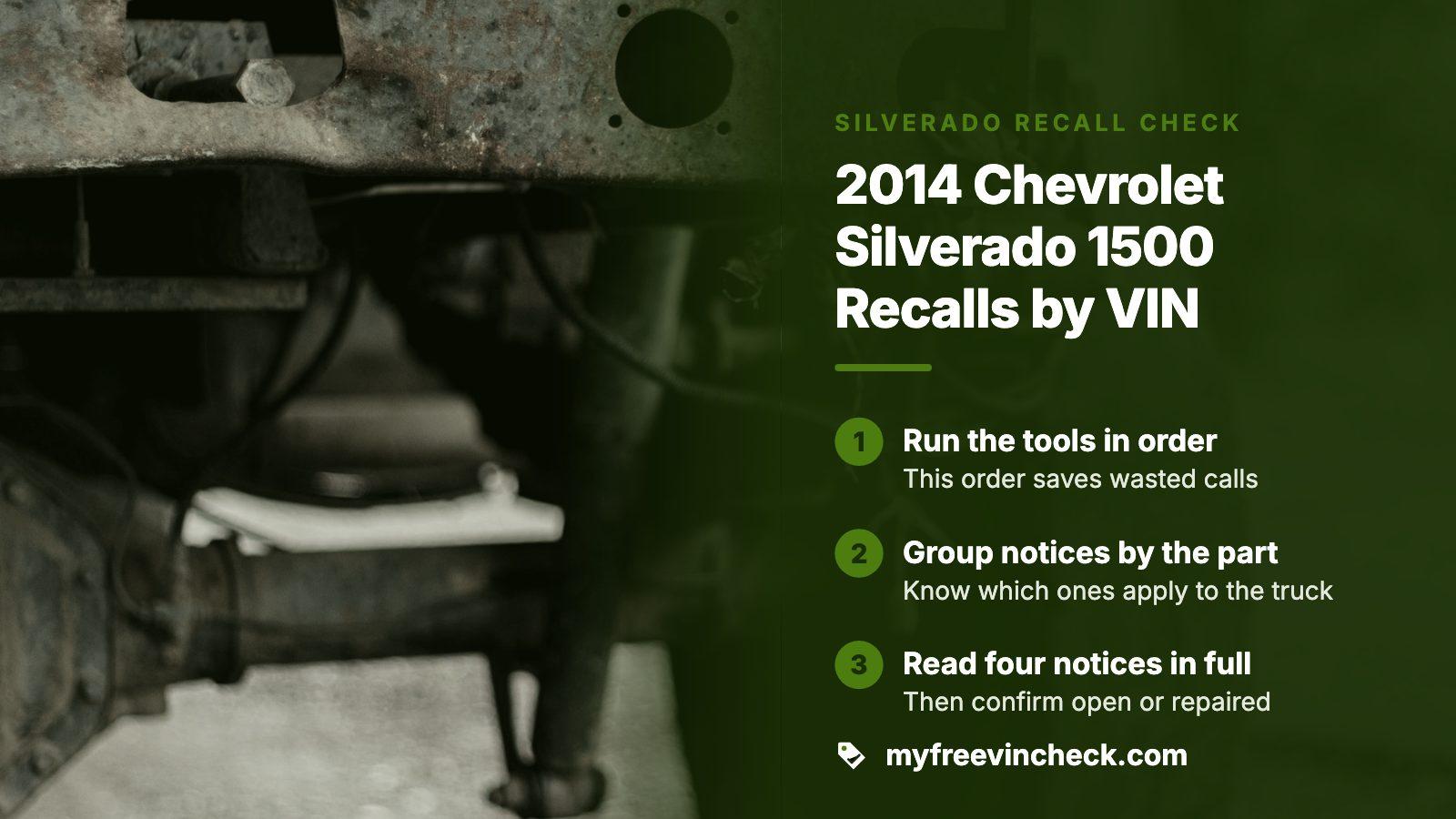
The 2014 Chevrolet Silverado 1500 carries 20 NHTSA campaigns, touching air bags, seat belts, steering, brakes, transmission cooler lines, a transfer case and electrical parts. Each reaches only a build range, so the answer for one truck comes from its VIN. NHTSA's lookup is free and so is the preview here. The paid report adds open recalls to the title and accident records.
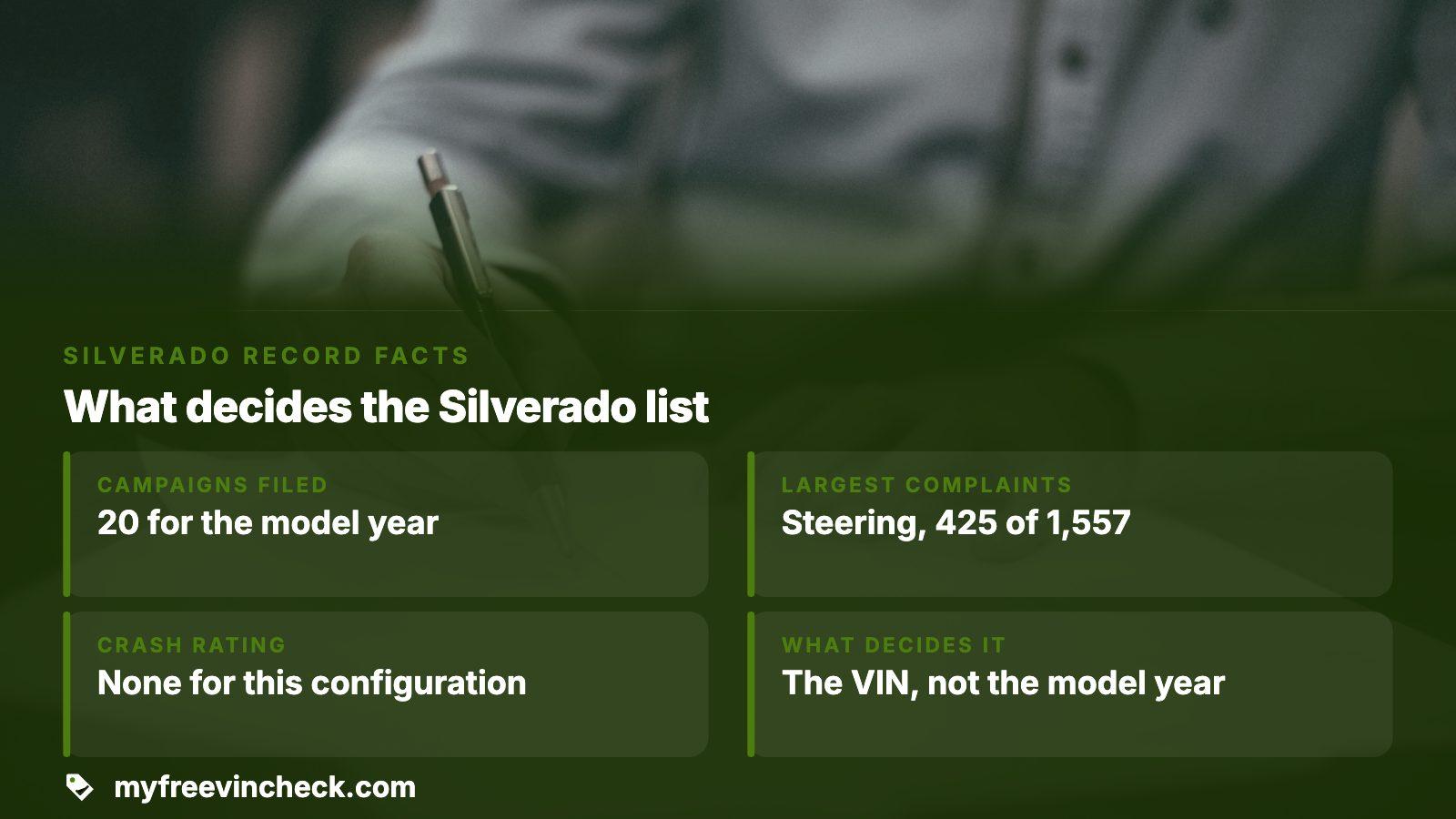
- Campaigns
- 20 filed for the model year
- Owner complaints
- 1,557, steering the largest group at 425
- Crash rating
- None published for this configuration
- What decides it
- The VIN, not the model year
Twenty campaigns on the model year, fewer on one truck
That count describes the model year as a whole. A recall is written for a production range, usually bounded by build dates, so a truck assembled a few weeks outside the range is untouched, while one inside it may have waited years for its repair.
Several notices also name heavy-duty trucks, vans and SUVs, so the count overstates what a single half-ton pickup carries. The VIN identifies the build, and the build decides which campaigns reach the truck. Treat the 20 below as a checklist.
From an NHTSA owner complaint
One owner told NHTSA that the driver's front seat belt tensioner cable on a 2014 Silverado 1500 had fractured. An independent mechanic found the lap pretensioner needed replacing. The owner linked it to seat belt campaign 21V245000, yet that truck's VIN was not in the recall.
A matching symptom is not coverage. Only the VIN shows which side of a campaign's range a truck falls on.
The free tools first, in the order that saves time
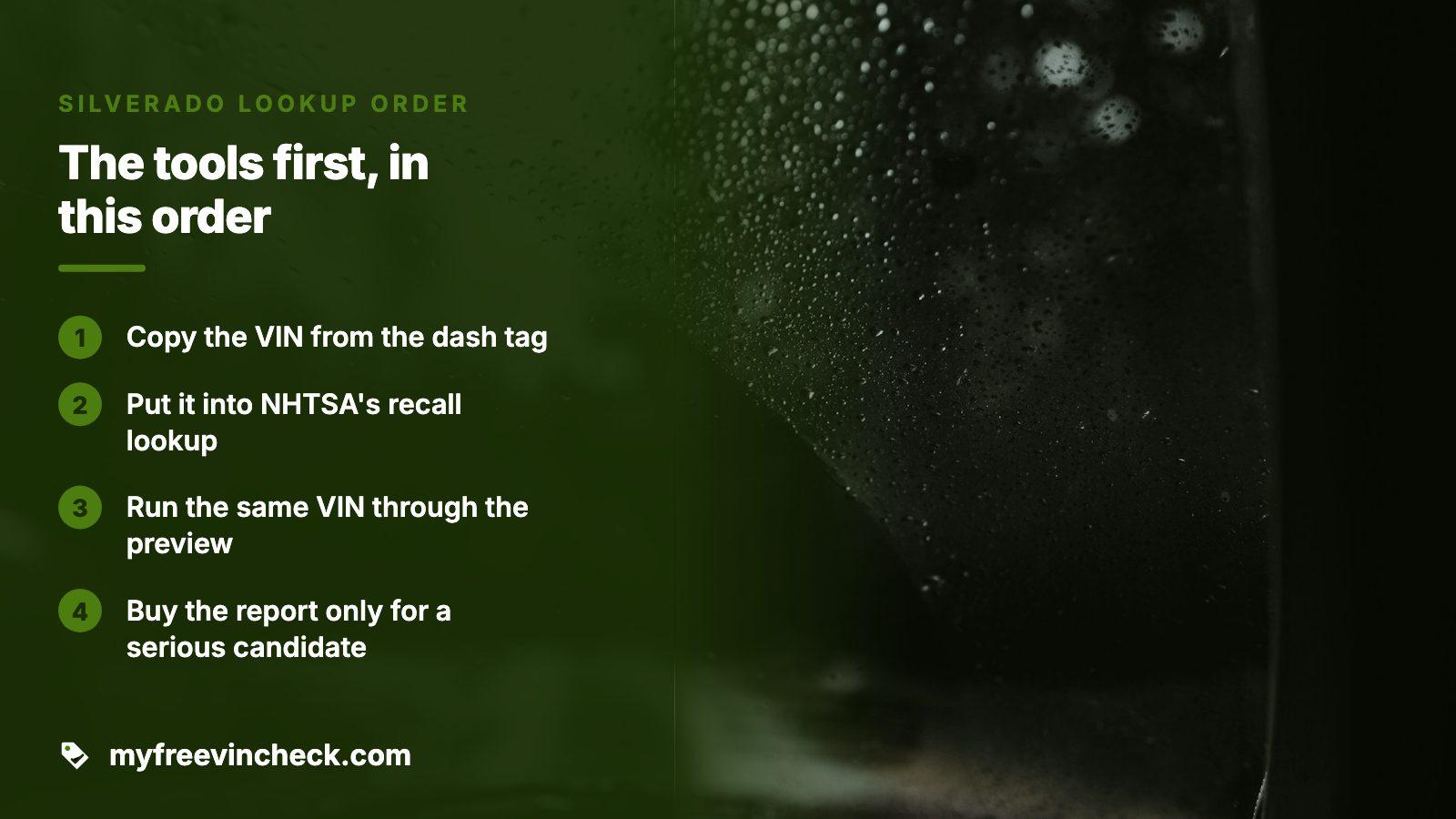
- Copy the VIN from the small tag on the dash nearest the driver; it can be read from outside the truck. The door post sticker repeats it, so check the two against each other and against the title.
- Put it into NHTSA's recall lookup. The agency runs that tool, it costs nothing, and it reports the campaigns on the VIN that remain open.
- Run the same VIN through the preview on this site. It costs nothing and counts the records on file for that truck.
- If the truck is a serious candidate, buy the report, which sets the open recalls beside the title, accident and odometer records.
The 20 campaigns grouped by what they cover
Give the dealer the campaign number, since it pins down exactly which recall you mean.
| System | Campaigns | What the notices concern |
|---|---|---|
| Air bags | 13V315000, 16V651000, 17V437000 | A passenger inflator weld on early builds, plus two frontal air bag campaigns |
| Seat belts | 16V209000, 21V245000 | Seat belt hardware, the later one on the front belts |
| Seats | 13V488000, 14V446000 | Seatback play on manual recliners, plus a second seat campaign |
| Steering | 14V246000, 17V414000 | The tie rod assembly and the electric power assist |
| Brakes | 19V645000, 19V761000 | Vacuum power assist, and the ABS wheel speed sensor or tone ring |
| Drivetrain and engine | 14V152000, 14V374000, 14V007000 | Transmission cooler lines, the four-wheel-drive transfer case, the exhaust |
| Electrical | 14V301000, 13E073000, 15V640000, 14V614000 | Two software campaigns, an ignition one, a chassis module that can short |
| Equipment | 13V544000, 14V345000 | A CNG fuel label size, and driver's floor mat retention |
Four notices worth reading in full
Each has a build range to hold against the truck, and in every case the remedy costs the owner nothing.
- Passenger air bag inflator, 13V315000: a weld can fracture on deployment, so gas vents behind the dash and the bag may not fully inflate. The range is trucks built in June 2013. Dealers replace the module.
- Driver's floor mat, 14V345000: trucks assembled from May 15, 2013 through January 29, 2014, with the all-weather mat option and vinyl flooring, cannot hold the driver's mat down, and it can foul the accelerator. GM reimburses the mat.
- Front seatbacks, 13V488000: manual recliners built August 1 through September 10, 2013 may have play, which fails the head restraint standard in a rear impact. Dealers inspect and adjust the recliner.
- Chassis electronic module, 14V614000: contamination can short the module, and the vehicle could stall. Dealers replace it. The notice lists many GM models, so confirm it reaches your truck.
Reading the result: open, repaired, or not this build
For each campaign a VIN result lands in one of three places: not this build, applies and repaired, or applies and still open. The last one needs action.
- An open air bag, seat belt or brake campaign. Seven on this list touch those systems, and they are the ones to settle before money changes hands.
- A seller who says the dealer handled it but has no paperwork. A recall letter mailed to a previous owner is not a recall repaired.
- A status that contradicts the seller's story. Ask for the dealer invoice.
Recalls are not complaints
NHTSA also holds 1,557 owner complaints for this model year, steering first at 425 and electrical next at 361. They are unverified accounts, not confirmed defects; only a recall carries a repair the manufacturer owes.
Where the free layer ends and the paid report starts
This site is built around the free steps: the preview costs nothing, and NHTSA's lookup is free. Neither shows the paid records.
| Step | Cost | What it tells you about the truck |
|---|---|---|
| NHTSA recall lookup | Free, run by the agency | Recalls on the VIN still open |
| Preview on this site | Free | How many records exist for the VIN |
| Full report | One payment, no subscription | Open recalls next to title brands, accident entries, odometer readings and lien records |
Anyone weighing several trucks can buy 3, 5 or 10 reports at once, and the pricing page lists the rates. A recall lookup will not show a lien or a rebuilt title, and a title search will not show a recall.
What a recall check misses on a used pickup
A closed recall means the known defect was logged as handled, not that the fix held or how the truck was used.
From an NHTSA owner complaint
A buyer told NHTSA that the brake vacuum recall on their 2014 Silverado was done in 2019, before the sale, as a computer adjustment. A month in, the pedal still went hard and the truck crept forward under braking. The dealer called the recall complete and left the repair cost with the owner.
Treat a completed status as paperwork, not a test result: try the brakes at parking-lot speed, forward and in reverse. With no crash score published for this configuration, condition counts most.
- Frame rails and crossmembers, the first structure to rust and costly to repair properly.
- Towing leaves marks the odometer misses: a hitch worn smooth, a cooler fitted to the transmission, wiring spliced in for a trailer.
- Rear leaf springs and the differential, where sagging or weeping prices the truck more than paint.
- Steering, electrical and engine bay wiring, since 18 of the complaints describe a fire.
If the truck turns up with an open recall
An open campaign alone rarely kills a deal. The repair is the manufacturer's cost, and a Chevrolet dealer can book it from the VIN and campaign number.
From an NHTSA owner complaint
A buyer who got a 2014 Silverado from a private owner phoned GM and heard that five recalls applied and four were done. The one left open was the seat belt wire repair. The owner needs the truck for daily work.
A seller's word is not a recall record, so run the VIN before you pay. If an item turns up open, follow these steps.
- Record the campaign number and status from the lookup, with the date you ran it.
- Have the dealer complete the repair before the sale, or agree in writing who will arrange it.
- For an air bag or seat belt campaign, do not close the sale until the work is done.
- Rerun the VIN afterward. The campaign should no longer show as open.
Where this information comes from
- NHTSA: Recalls — Where a VIN is run for open recalls, and where the campaign numbers cited on this page can be searched.
- NHTSA: Vehicle safety — The agency's public complaint records, the source of the owner report counts mentioned here.
- 49 U.S.C. 30120: Remedies for defects and noncompliance — The statute behind the no-charge repair, including its 15-year limit.
- NMVTIS: Vehicle history — The national title record, which covers brands and history that a recall list leaves out.
- NHTSA owner complaint 11773234 — owner experience, paraphrased
- NHTSA owner complaint 11688240 — owner experience, paraphrased
- NHTSA owner complaint 11636216 — owner experience, paraphrased
Sources and photos: Facts checked against the sources above in November 2026. Photos by Zoshua Colah, Justin Cron and Scott Graham on Unsplash; diagrams by MyFreeVINCheck.
Keep reading
- 2019 Ram 1500 Recalls: Run the VIN Before You PayThe same recall check on the Silverado's main full-size rival.
- 2016 Toyota Tacoma Recalls: 4 Campaigns, Checked by VINA midsize pickup with a much shorter recall file, for comparison.
- Sample reportSee what the paid report contains before you buy one.
- PricingHow the single report and the packs work.
Frequently asked questions
How many recalls are on file for a 2014 Silverado 1500?
NHTSA lists 20 campaigns for the model year, covering air bags, seat belts, steering, brakes, the drivetrain and electrical parts. Every campaign is limited to a build range, so a single truck can carry far fewer. The VIN is what separates the campaigns that apply to this truck from the rest, and shows whether each repair was done.
Do I have to pay to get a Silverado recall fixed?
No. Recall repairs cost the owner nothing, whoever holds the title. The statute behind the free repair has a 15-year limit, so ask the dealer to confirm in writing that the campaign is still covered.
Can a recall check show whether a Silverado was in an accident?
No. A recall lookup lists manufacturer campaigns only. Accident, salvage and title records come from other sources, so a clean recall status can sit on top of a rebuilt title.
Where is the VIN on a 2014 Silverado 1500?
Seventeen characters long, it sits on a plate at the dash corner nearest the driver and on a label in the driver's door frame. Paperwork such as the title and registration carries the same number. Be wary if the dash and the documents disagree.
Are the recalls a reason to avoid the 2014 Silverado 1500?
Not by themselves. A recall means the manufacturer owes a repair, and most here are routine. What counts is whether this truck's repairs were completed, above all the air bags and seat belts, plus a clean title and a sound inspection.
Now check the car itself
The guide explains what to look for. The report shows what this VIN has on record.