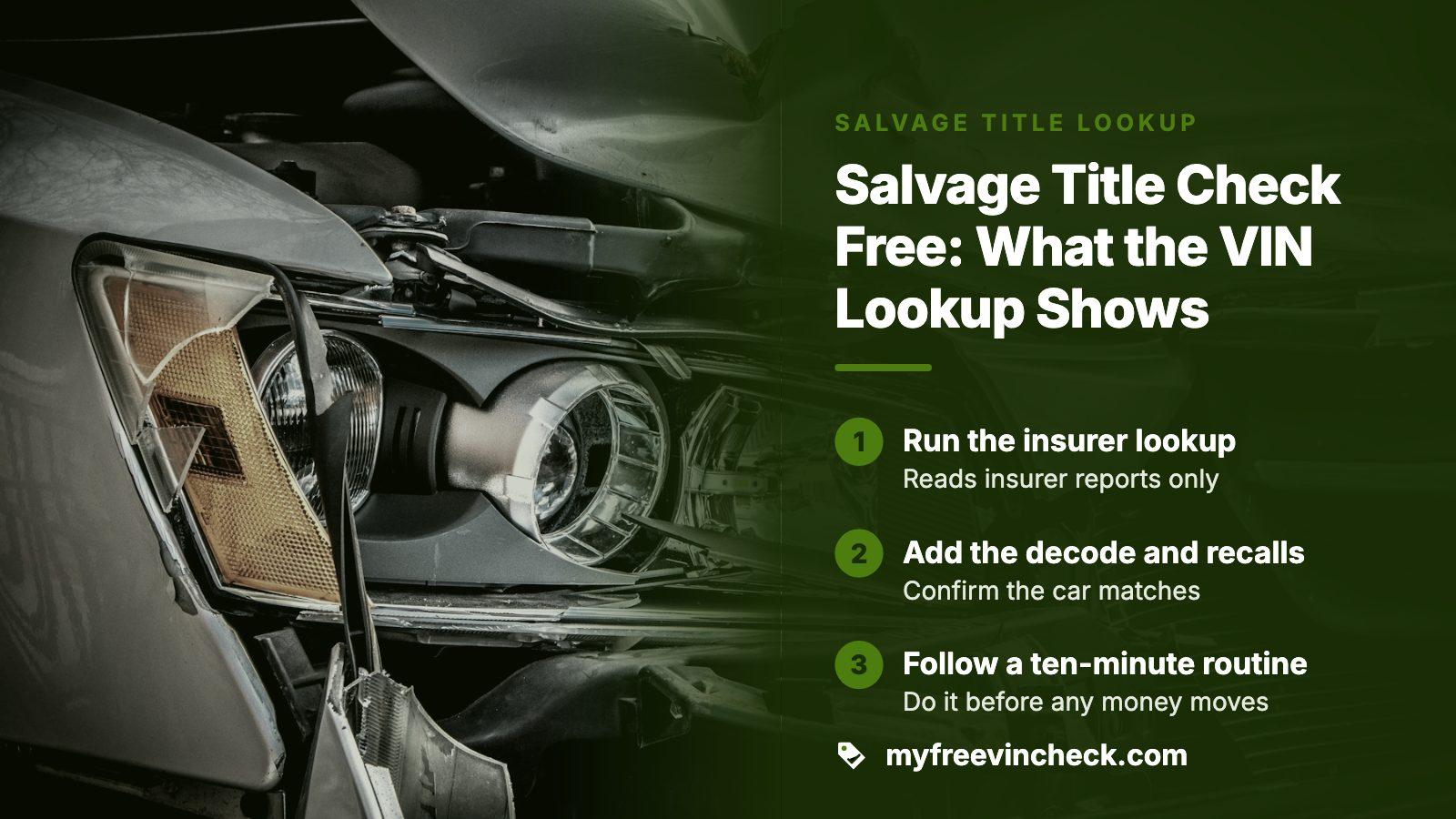
THE SHORT ANSWER
Partly. NICB's VINCheck is free and reports whether a participating insurer logged the VIN as stolen without recovery, salvage or flood damage, with five searches in any 24-hour window per IP address. NHTSA's decoder and recall lookup, also free, confirm the build and any open recall but say nothing about title brands. State brands, auction records with photos and odometer history sit in the paid report, after a free preview.
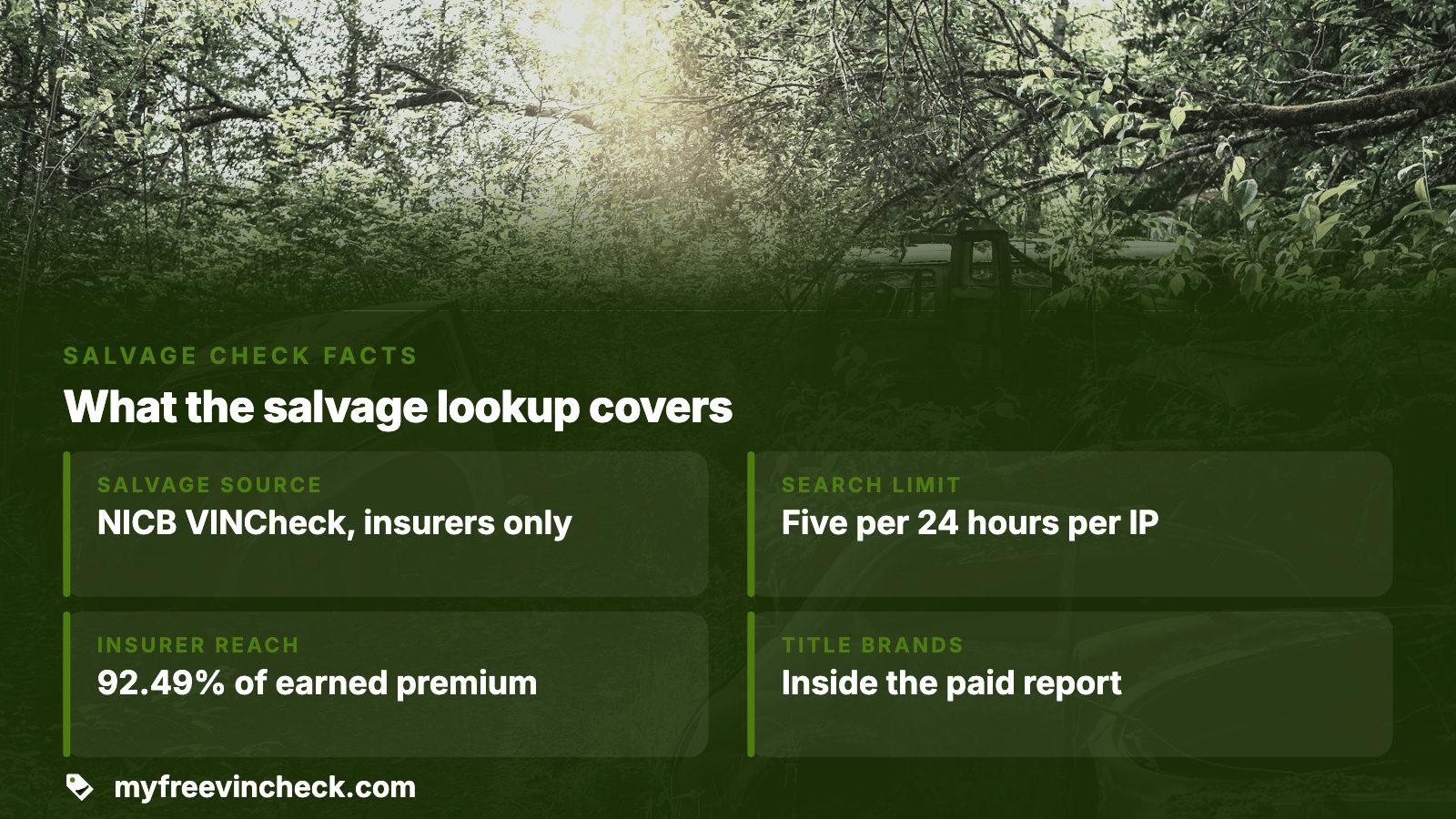
- Free salvage source
- NICB VINCheck, insurer reports only
- NICB search limit
- Five per 24 hours for each IP address
- Insurer reach
- 92.49 percent of US earned premium
- Title brands
- Inside the paid report, after a free preview
Four no-cost lookups and what each says about salvage
Salvage is a record, not a trait of the car, so a lookup helps only when it reads the right record. These four cost nothing, and only the first speaks to salvage directly.
| Lookup | What it reads | Salvage signal | Blind spot |
|---|---|---|---|
| NICB VINCheck | Insurer-filed theft, salvage and flood entries, from insurers that take part | Direct, when an insurer reported the car | Cars nobody claimed on, and insurers that opt out |
| NHTSA decoder | Build details the maker filed | Indirect: shows what the car should be | Nothing on title, owners or damage |
| NHTSA recall lookup | Open safety recalls for that VIN | Indirect: a rebuilt car can still have recalls open | Repaired recalls and small makers |
| Preview on this site | How many title and auction entries are on file | A count only: zero or not zero | The records stay inside the paid report |
NICB VINCheck: the one free tool that reads salvage reports
The National Insurance Crime Bureau fills VINCheck from its member insurers, whose book of business equals 92.49 percent of US earned premium as of August 2026. Enter all 17 characters exactly, since one wrong digit can miss a record that exists. NICB allows five searches in any 24-hour window for each IP address.
A salvage hit means an insurer wrote the car off: repair costs crossed a set share of its value, so the claim was paid instead of the car being fixed. The owner may still repair and re-title it legally, so the flag calls for a closer look, not an automatic no. NICB itself says VINCheck is no full history and should not be the only check before buying.
What the NHTSA decode and recall lookup add
The decoder turns the VIN into the build the maker filed. A sample decode of 1HGCM82633A004352 came back as a 2003 Honda Accord EX-V6 coupe made in Marysville. The record had 154 fields and only 45 held values, none about title, owners or mileage. Use it as a sanity check: if the ad claims a different year, trim or engine, ask why.
The recall lookup asks something else: does this VIN still need a safety repair? It leaves out repaired recalls, recalls from small makers and recalls older than 15 years, and a dealer handles open ones at no charge. A salvage-branded or rebuilt car can have recalls open like any other, so the lookup earns its place despite ignoring the title.
A ten-minute routine before any money moves
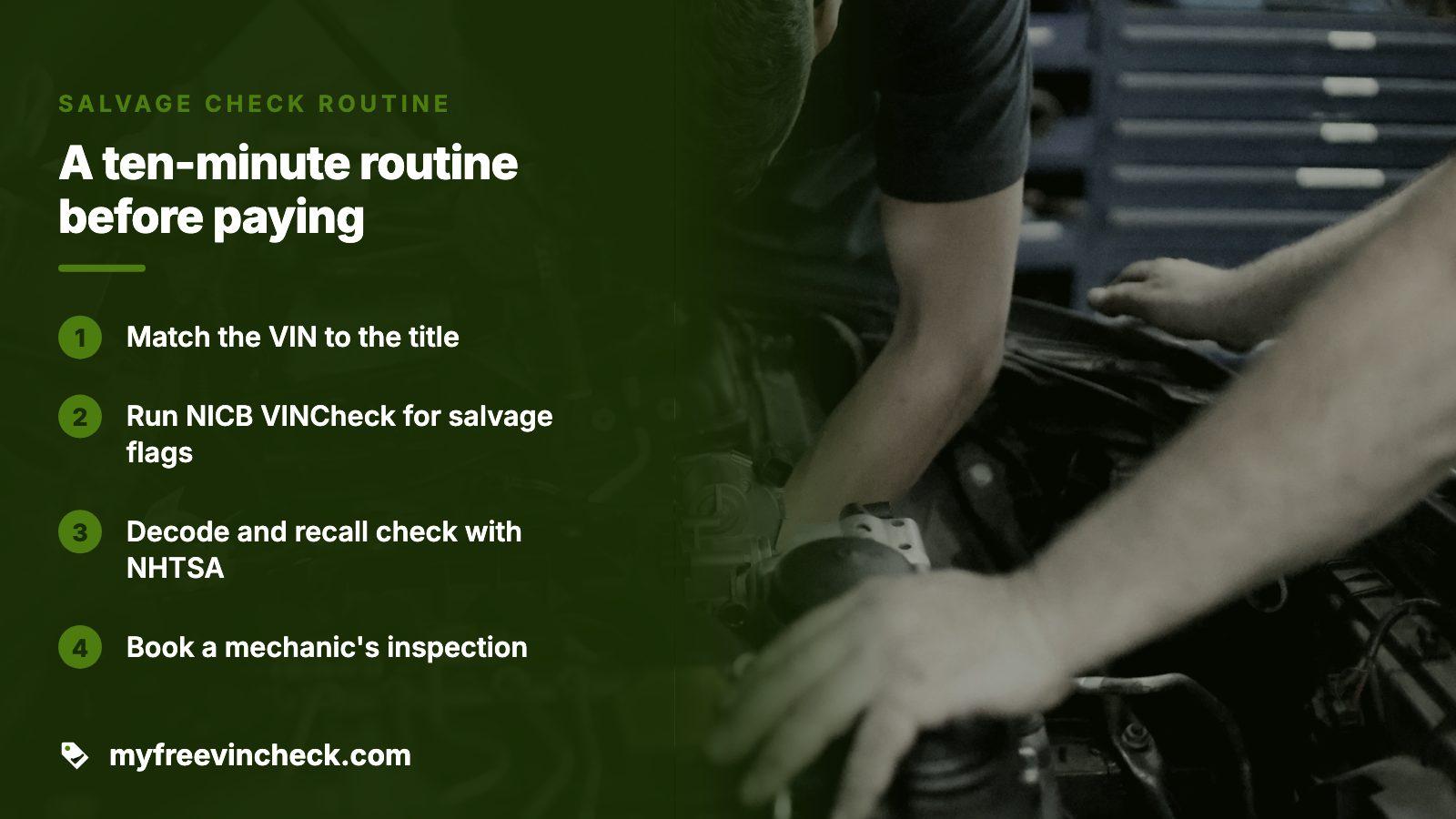
- Copy the VIN off the car at the driver-side corner of the windshield, then match it against the seller's registration or title. A mismatch ends the conversation.
- Run it through NICB VINCheck and note any theft, salvage or flood flag.
- Decode it with NHTSA and hold the year, trim, engine and body style against the listing.
- Check NHTSA recalls and write down anything open.
- Enter the VIN here for the preview and read the title and auction record counts. Anything above zero is the cue for the full report.
- Book a mechanic's inspection, because no database sees a damp carpet or a bent frame.
From an NHTSA owner complaint
A 2012 Honda Civic owner told NHTSA in March 2026 that a private seller, met through an online marketplace app, promised a clean title and 112,000 miles. Tire pressure and air bag warnings were already lit when the car arrived home, and the owner later learned it carried a salvage brand and had closer to 180,000 miles or more.
A brand and a mileage gap are exactly what a VIN lookup tests, and a lit air bag light is reason enough to run one first.
Why a clean free result is not clearance
Each free tool reads someone else's records, so an unreported car can still be damaged. NICB points out that an owner with no coverage files no claim, which lets a flooded car keep its original clean title through cleanup and resale. A second route is moving the car to another state to collect a fresh title.
- Insurer-only data: VINCheck covers participating insurers, not police files and not the state's title record.
- Uneven brands: one state may brand a car salvage at a damage level where another brands nothing, and only some states use a flood brand.
- Washed titles: a state that retitles without checking earlier states can issue paper that hides a brand, though the federal system keeps every brand a state has reported.
- Reporting gaps: a search can say no salvage history when a source never reported, and private databases share that weakness.
When the paper title and the VIN disagree
From an NHTSA owner complaint
A 2013 Nissan Altima owner told NHTSA in July 2020 that the car, bought in 2018, carries a clean title. When a transmission recall letter arrived, Nissan declined the repair because the VIN showed salvage records in two other states, and asked for a clear title from them. People in both states said no second title could be issued while the current one stood.
The paper and the VIN told different stories, and the maker went by the VIN. A buyer who reads only the seller's title sees half of it.
The Justice Department encourages reading the state's own title record too, and each approved provider's report points to the full title record at the state agency holding the current title. If the seller's paperwork and a lookup disagree, settle it before paying.
Reading a salvage flag and its neighbors
The labels sound alike but differ, so read the exact word and the date.
| Label | What it means | Sensible next step |
|---|---|---|
| Salvage | An insurer or state decided repair cost outweighed the car's value | Ask for repair records and photos, then price for the history |
| Rebuilt | A salvage car that was repaired and re-titled | Have a mechanic inspect it and ask an insurer about cover first |
| Flood | A brand some states use, or an insurer flag | Check carpets, seatbelt retractors and the spare tire well |
| Total loss, no wreck | A stolen car still missing after 30 days can be labeled one, and the label stays | Read the date and reason, then inspect as usual |
None of these settles the question alone. Significant damage often earns a salvage or junk brand, so a flagged car deserves a lower price and a harder inspection.
Where the paid report picks up
The free tools stop where records get specific. The full report on this site is a single payment with no subscription: one report or a bigger bundle sized 3, 5 or 10, with amounts on the pricing page. That is where the title brand appears with its state and date, salvage and auction entries carry photos, and odometer and damage entries sit side by side.
The preview comes first and needs no card. Expect the vehicle's identity, photos when on file, an open recall tally and the number of title and auction records tied to that VIN.
Suggested order
Free screens first, the preview second, the full report last, and only for a car that survived both and still suits the price.
Where this information comes from
- NICB: VINCheck lookup — Source for the insurer-record scope, the search limit, the meaning of a salvage result and NICB's own warning about relying on it.
- NICB: Buying a used vehicle — Supports the points on flood cars with clean titles, moving a car across state lines and the flood warning signs.
- U.S. Department of Justice: NMVTIS for consumers — Explains what a brand is, why states brand differently and why a title search can come back empty.
- NHTSA: Check for recalls — Describes what the VIN recall lookup shows and the recalls it leaves out.
- NHTSA: VIN decoder — Confirms the decoder reads maker-reported build data from the 17-character VIN.
- NHTSA owner complaint 11726572 — owner experience, paraphrased
- NHTSA owner complaint 11342126 — owner experience, paraphrased
Sources and photos: Facts checked against the sources above in November 2026. Photos by Clark Van Der Beken, Mustafa Sheikhmouss and Patrick von der Wehd on Unsplash; diagrams by MyFreeVINCheck.
Keep reading
- Car Auction History by VIN Free: What Free Tools Show, What Needs a ReportWritten-off cars are sold at salvage auctions, and this page shows what those records add.
- Can I Check if My Car Has Been in an Accident for Free? What the Free Tools ShowThe damage side of the story: what a free accident lookup can and cannot show.
- Check a VIN Number for Recalls: Free Lookup, Then the Full PictureThe NHTSA recall lookup in full, including what it leaves out.
- Sample reportSee a finished report before deciding whether to buy one.
Frequently asked questions
Is there a salvage title check that is completely free?
Partly. NICB's VINCheck costs nothing and reports insurer-logged salvage, flood and theft, and NHTSA's tools cost nothing too, but none of them shows a state title brand. NICB notes that most full history reports are sold, so budget for one when a car looks promising.
Does the free preview show whether a car is salvage?
No. What the preview gives is a tally of title and auction entries for the VIN, which is a nudge to look closer. The brand with its state and date, and any auction photos, are inside the paid report, bought once with no subscription.
Can a flooded car carry a clean title?
Yes. NICB says an uninsured owner never files a claim, so the original clean title can survive cleanup and resale, and a trip to another state can earn a fresh one. Check under carpets, inside the seatbelt retractors and around the spare tire, then get a mechanic's opinion.
How many NICB searches can I run?
Five in any 24-hour window from one IP address, with no cap over time. A no-hit result is one data point, not a verdict, since NICB itself says a clean answer guarantees nothing. Comparing several cars, spend the searches on the strongest candidates first.
Is a salvage car always unsafe to buy?
Not automatically. A total-loss label can follow a theft recovery with no damage at all, and a repaired salvage car can be legally re-titled. Still, significant damage is often behind the brand, so inspect hard, price low and confirm an insurer will cover it.
Now check the car itself
The guide explains what to look for. The report shows what this VIN has on record.