THE SHORT ANSWER
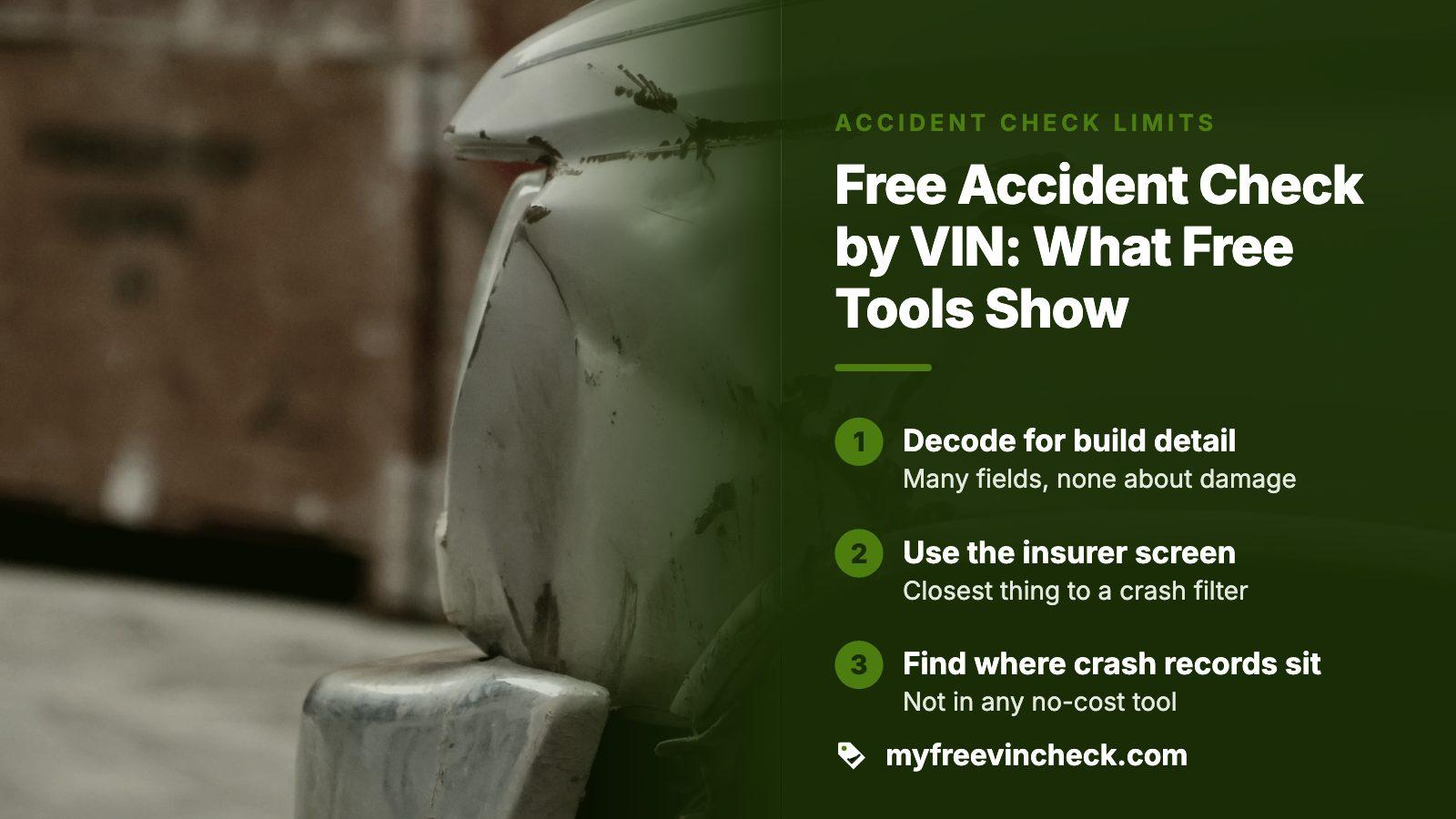
Two free sources touch the subject. NICB's VINCheck returns records of theft, salvage and flood damage reported by insurers, which stand in for a serious crash. NHTSA's decoder and recall search describe the build and unrepaired safety recalls, and hold no crash data at all. Anything milder than a write-off has to come from the seller's paperwork, a mechanic's inspection or a paid history report.
- Closest free screen
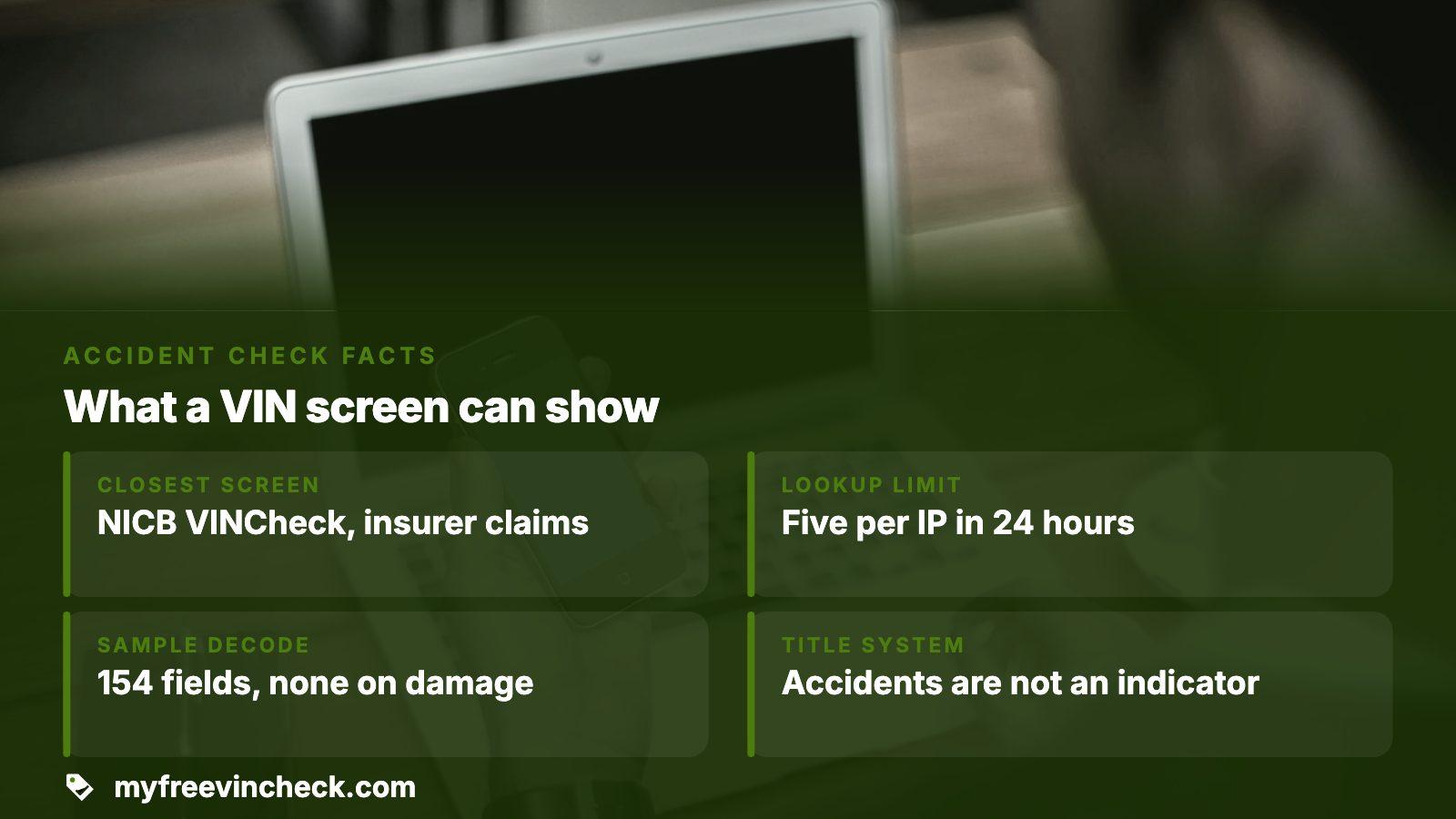
- NICB VINCheck, built on insurer claim data
- VINCheck limit
- Five lookups per IP address in 24 hours
- Sample decode
- 154 fields returned, 114 blank, none about damage
- Federal title system
- Brands, odometer, total loss; accidents are not an indicator
What each free lookup can and cannot say about a crash
Three no-cost lookups apply, and each answers a different question for a different organization. None is a crash register, so the task is matching each tool to the doubt it can settle.
| Free lookup | What it settles | What it cannot say about an accident |
|---|---|---|
| NICB VINCheck | Whether a participating insurer reported this VIN as stolen, salvage or flood damaged | Crashes that stopped short of a write-off, or never reached an insurer |
| NHTSA VIN decoder | Whether this is the car the VIN describes, as the maker built it | Anything after the factory: damage, repairs, owners, mileage |
| NHTSA recall search | Whether a safety recall is still open on this exact car | Whether it was ever hit; zero open recalls is not a clean past |
All three take about five minutes. A flag on the first can end your search. Clean answers merely shortlist the car.
A real decode: lots of build detail, no damage detail
Run the sample VIN used throughout this site through NHTSA's decoder and it identifies a 2012 BMW 535i: a four-door sedan with a 3.0 L six-cylinder gasoline engine, built in Dingolfing, Germany, with a valid check digit in the ninth position. Of 154 fields returned, 114 came back empty.
None of the filled fields concerns a collision, a title or a mileage reading. The restraint rows are there (air bag positions, head and knee inflatable restraints, belt pretensioners), but they list factory equipment, not deployment. NHTSA's own note is that a blank means no data on file, not an absent feature.
Use the decode as a cross-check against the ad and the car in front of you. A mismatched body style, engine or restraint list calls for questions about repairs, though it proves no crash by itself.
VINCheck is the closest free thing to a crash screen
NICB builds VINCheck on theft and salvage records from member insurers, which account for 92.49% of earned premium in the US. A hit means a participating company flagged the VIN as stolen and still missing, salvage, or flooded. Salvage deserves most of your attention. The insurer concluded that repair would cost too much relative to the car's worth and settled the claim in cash. Such a car can be rebuilt and titled again afterward.
Two constraints apply. An IP address is limited to five lookups in any 24 hours, so shortlist first and save the searches for finalists. The VIN must also be typed exactly, because one wrong character can hide a record that exists.
Things a clean VINCheck result can still sit on top of:
- A collision the owner paid for personally, so no claim was ever opened.
- Damage an insurer fixed without declaring a total loss.
- Companies that opt out, and police files, neither of which VINCheck searches.
Where crash records actually sit
The Justice Department's title database, NMVTIS, comes next, and it costs money: consumers buy a report from an approved provider. The report is built on five indicators (title state and date, brands, odometer, total loss, salvage), and a crash is not one of them. A clean NMVTIS report therefore says little about a collision that was repaired and never written off.
Coverage is partial as well. The department puts about 87 percent of US vehicles in the system, but reporting is still incomplete, so a search can return a false all-clear. The total-loss label can also mislead in reverse: a stolen car missing for 30 days may be written off and keep the label after it turns up undamaged.
Entries describing the collision itself come from private history reports, which the FTC says can reveal accidents and flood damage.
A buyer who met the history at trade-in
From an NHTSA owner complaint
An owner of a 2016 Ford Explorer told NHTSA that the family bought it, lost control on a bumpy road and visited two Ford dealerships, paying for suspension repairs at the second. A history report, seen only at trade-in time, showed two accidents and a total-loss entry. They were never told it was salvage, the owner wrote, and would not have bought it. It was traded in at a significant loss after about two months, most of them spent in repair shops.
The record already existed at the sale. A look at insurer data before paying could have raised the question far sooner.
Free legwork that finds what databases miss
A small crash fixed at a body shop is found by asking more often than by searching.
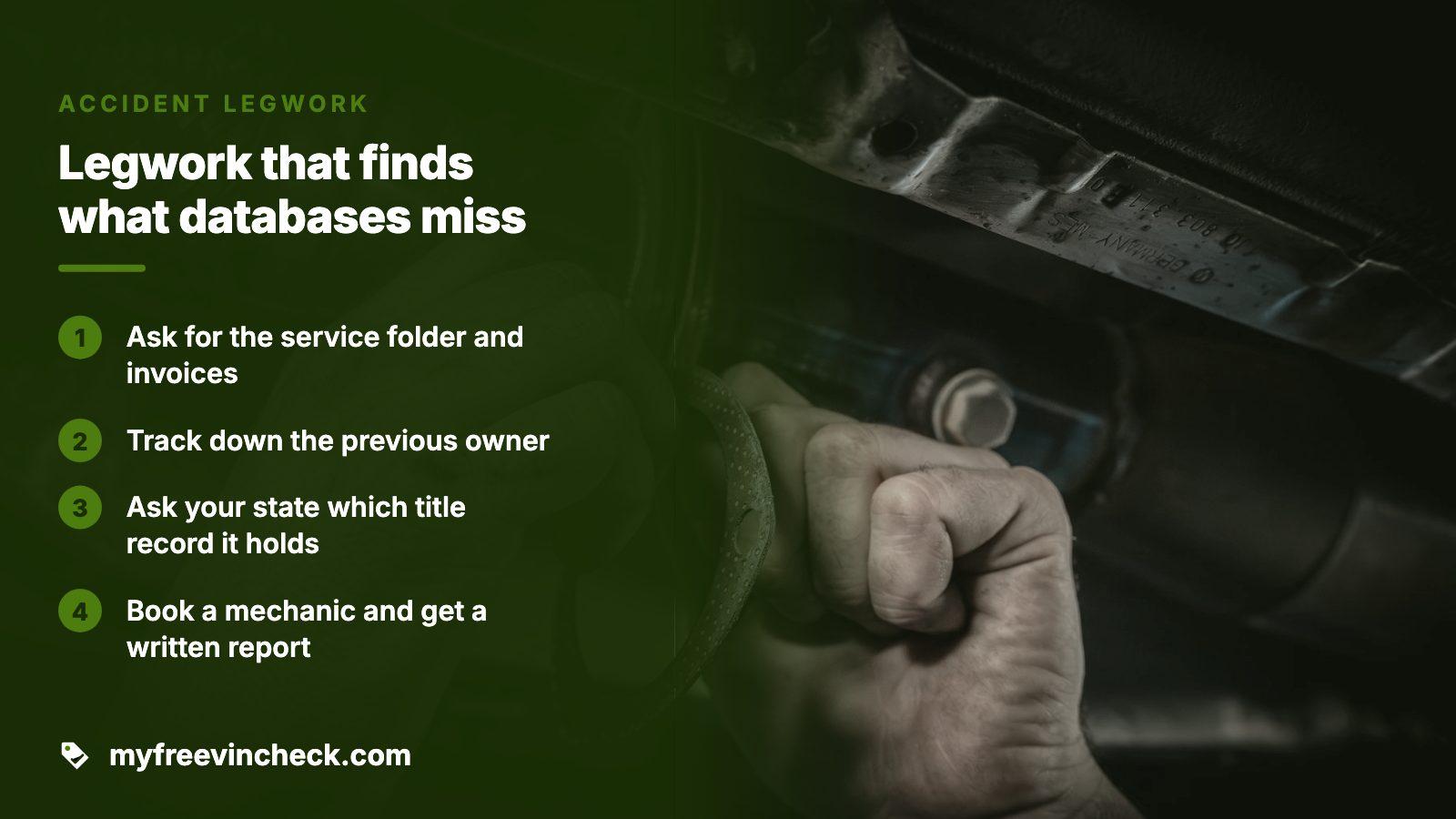
- Ask the seller for the service folder, body-shop invoices included. The shop that did most of the work may keep copies and share them.
- Track down the previous owner if the present one cannot explain the car's past.
- Ask your state motor vehicle agency which title record it holds under the VIN. Federal title reports point to that state record too.
- Drive over hills, on a highway and through stop-and-go traffic, noting any pull, vibration or rattle.
- Book an independent mechanic and request a written report that names the VIN and itemizes repairs. The FTC says the fee is yours, and the estimate can support a lower offer.
A dealer that refuses any outside inspection is one the FTC says to reconsider.
From an NHTSA owner complaint
A 2018 Ford Focus owner told NHTSA the car came from a dealer with a branded title and the assurance that only the driver's door had been hit and fixed. Once the engine failed, the extended-warranty company ran a history lookup and told the owner the damage went far beyond what they had been told.
Treat a seller's summary as a claim until paperwork backs it up.
If the car is already yours
Many searches start after the purchase, when the car's story begins to look thin. Repeat the free steps with the VIN from your registration card, then ask any shop that has serviced the car about earlier body work and whether it kept the paperwork.
If VINCheck or a title record reveals a brand, learn that before you sell. A state brand, once applied, stays in the federal record, so the next buyer will find it.
When the preview and a paid report make sense
Enter the VIN in the preview and it reports how many records exist for that exact car, no card required. Zero means you saved a purchase. A positive count means the report can show the entries: collisions and damage, title brands, dated odometer readings, and salvage or auction listings with photos where they exist.
The report is a single charge for one car. Buyers comparing several cars can buy in sets of three, five or ten. There is no renewal. Amounts live on the pricing page. It earns its cost on the car that survived the free steps and is about to get a deposit, since a crash entry then can move the price.
Even so, it is one input among several. The FTC cautions that a report cannot replace a mechanic's independent exam, because it seldom describes mechanical condition.
Where this information comes from
- NICB: VINCheck lookup — What the lookup returns, who supplies the records, the daily cap and the limits NICB states.
- NHTSA: Check for recalls — What a VIN recall search shows and what it leaves out.
- NHTSA: VIN decoder — The decoder's build data is reported by the manufacturer.
- Justice Department NMVTIS: For consumers — What the federal title system holds, its coverage and its false-negative caveat.
- FTC: Buying a used car from a dealer — History reports versus an independent inspection, and what to do if a dealer refuses one.
- NHTSA owner complaint 11556734 — owner experience, paraphrased
- NHTSA owner complaint 11572491 — owner experience, paraphrased
Sources and photos: Facts checked against the sources above in November 2026. Photos by Everett Pachmann, Martin Fennema and Alejandro Escamilla on Unsplash; diagrams by MyFreeVINCheck.
Keep reading
- Free Salvage Title Check by VIN: What It Shows and MissesThe brand that most often follows a serious crash, and how to look for it without paying.
- Where Can I Get a Free VIN Check? Three Lookups and What They MissThe same three free lookups laid out as one routine, with what each leaves out.
- Check a VIN Number for Recalls: Free Lookup, Then the Full PictureHow the recall search works and what an open recall means for a car you are buying.
- Sample reportA finished report, so you can see how accident and damage entries read.
Frequently asked questions
Does any free tool show a car's accidents by VIN?
Not as a crash list. VINCheck draws on theft, salvage and flood claims that insurers report, the recall lookup shows unrepaired recalls, and the decoder confirms what the car is. A dent fixed without an insurance write-off appears only in repair invoices, the seller's records or a paid history entry.
What is the step-by-step way to check a VIN for accidents at no cost?
Read the 17 characters at the lower left of the windshield, then match them against the registration, the insurance card and the ad. Search VINCheck, then NHTSA's decoder and recall lookup. Compare the decode with the car itself, and request repair invoices before paying for anything.
If VINCheck comes back clean, was the car never in a crash?
No. It only sees theft, salvage and flood records from insurers that take part. A collision repaired after a small claim, or paid for by the owner, gives it nothing to match. NICB itself describes a clean result as short of an absolute guarantee.
Can NHTSA's recall search reveal earlier collisions?
No. It reports whether a safety recall is unrepaired, and its all-clear message refers to recalls alone. It also leaves out repaired recalls, very recent ones still being loaded, and anything older than 15 years unless the maker extends coverage. A recall count is silent about collisions.
Is the free preview the same thing as an accident report?
No. The preview tallies what is on file under the VIN, with no card needed, so you learn whether any records exist. The report is a one-time purchase that opens each entry, and nothing recurs. Amounts for a single report or a pack are on the pricing page.
Now check the car itself
The guide explains what to look for. The report shows what this VIN has on record.