THE SHORT ANSWER
Run the VIN through NHTSA's decoder (what the car was built as), NHTSA's recall search (unrepaired safety recalls) and NICB's VINCheck (stolen, flood and salvage reports from participating insurers). A full free car history report does not exist, because the federal title records behind brands and odometer history are sold through approved providers. A no-card preview on this site counts the records on file for your VIN before you decide on a report.
- Free lookups
- NHTSA decode, NHTSA recall search, NICB VINCheck
- NICB limit
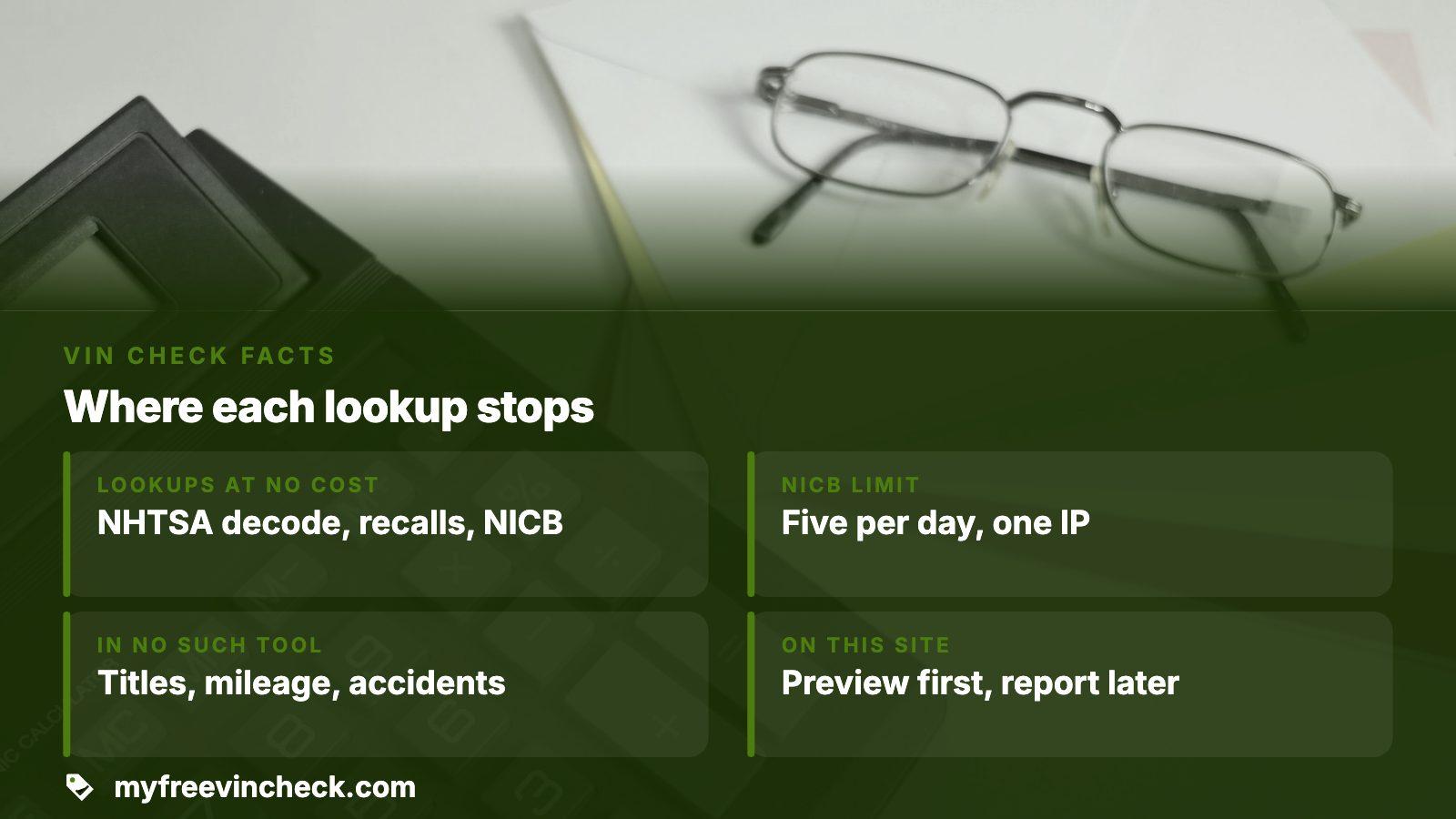
- Five lookups per day from one IP address
- In no free tool
- Title brands, odometer history, accident records
- On this site
- Preview first, report as a single payment later
The three free lookups, and the question each one answers
A free VIN check is really three small tools used one after another. Each takes the same 17-character number and answers a single question, then stops short.
| Free tool | Question it answers | Where it stops |
|---|---|---|
| NHTSA VIN decoder | Is this VIN valid, and does the build match the listing? | Owners, title, mileage and crashes are not in it |
| NHTSA recall search | Does this exact car carry a safety recall nobody has repaired? | Repaired recalls, service campaigns, very new and very old recalls |
| NICB VINCheck | Did a participating insurer report it stolen, flooded or salvage? | Police records, insurers that opt out, damage no insurer declared |
Run all three before you spend anything. Any one of them can take a car off your list.
Decode first, then compare the result with the ad
NHTSA's decoder reads the build record that manufacturers file for each VIN. It is meant for model years from 1981 on and for vehicles made to be sold or imported into the US; anything else returns a thin result.
Here is what a real decode looks like. This site's sample VIN comes back as a 2012 BMW 535i: a four-door sedan with a 3.0 L six-cylinder gasoline engine rated at 300 hp, assembled in Germany at the Dingolfing plant. The output also flags the VIN's built-in check digit as valid, a handy test for a number you copied by hand.
Treat the record as a match test. If a seller advertises a four-cylinder and the decode says six, stop and ask why. Expect gaps as well: in that example, 114 of the 154 fields came back blank.
The recall search is the free result that matters most
Type the VIN into NHTSA's recall search and it reports whether that specific car has an unrepaired recall. A clean car gets a zero-count message. An open recall is not an automatic deal-breaker, since the dealer repairs the recalled part at no charge to the owner.
- Recalls that were already repaired do not appear.
- Brand-new recalls may be missing while NHTSA is still loading the affected VINs.
- Recalls older than 15 years drop out, unless the maker extends its coverage.
- Small manufacturers, some ultra-luxury brands and specialty builds are not covered.
- Non-safety service campaigns and cars built for other countries are left out.
From an NHTSA owner complaint
Owners of a 2012 Ford Explorer told NHTSA in July 2023 that they had just bought it. Only after getting it home and reading up on the vehicle did they learn of a recall still open for the rear toe link, a defect that can reduce steering control. The local Ford dealer, they added, showed little urgency about seeing the car.
The lesson is timing. The answer is worth the most before payment, while the seller can still fix the problem, adjust the price or lose the sale.
NICB VINCheck screens for theft, flood and salvage
VINCheck compares a VIN with theft, flood and salvage records filed by participating member insurers, which per NICB's August 2026 figure write 92.49% of US earned premium. A salvage flag means the insurer wrote the car off and paid the claim rather than repairing it. Such a car can legally be rebuilt and re-titled, so a hit is a reason to dig further, not an automatic no.
Two limits apply. One IP address can run five lookups in a 24-hour stretch, so spend them on finalists. And only insurance records appear: no police records, and nothing from insurers that opt out. NICB's own caveat is that a car can be stolen, heavily damaged or tangled in title problems and the lookup may still show nothing.
That matters most for flood cars. NICB notes that a flooded vehicle can keep a clean title when the owner never filed a claim, and that title washing means retitling a flood or salvage car in another state.
What no free check shows, and why a free full report does not exist
A real history is built on title records, and the main federal source for them is fee-for-service by law. The Justice Department says the Anti-Car Theft Act requires that user fees, not federal funds, cover the title system, so a consumer reaches it through an approved provider whose price varies. The FTC's version is short: pick a provider, enter the VIN, pay its fee.
That title data is exactly what the free tools lack: brand history, the latest odometer reading, and salvage and total-loss records. Repair history is not part of it.
- Odometer history: a decode carries no mileage, so the dash number has nothing to be checked against.
- Title brands: free lookups never touch state title records, where junk, salvage and flood labels are applied.
- Crash and total-loss detail beyond what one insurer happened to report.
From an NHTSA owner complaint
A buyer of a 2010 Ford Explorer, purchased from a private seller, told NHTSA in February 2026 that the dash read 135,902 miles at the sale. During a later service visit it emerged that the title mileage was 224,283, a figure that came from a history report.
Neither the decoder nor the recall search holds mileage, so neither could have flagged a gap like that. Earlier readings sit in the paid layer.
Running all three on one car, in order
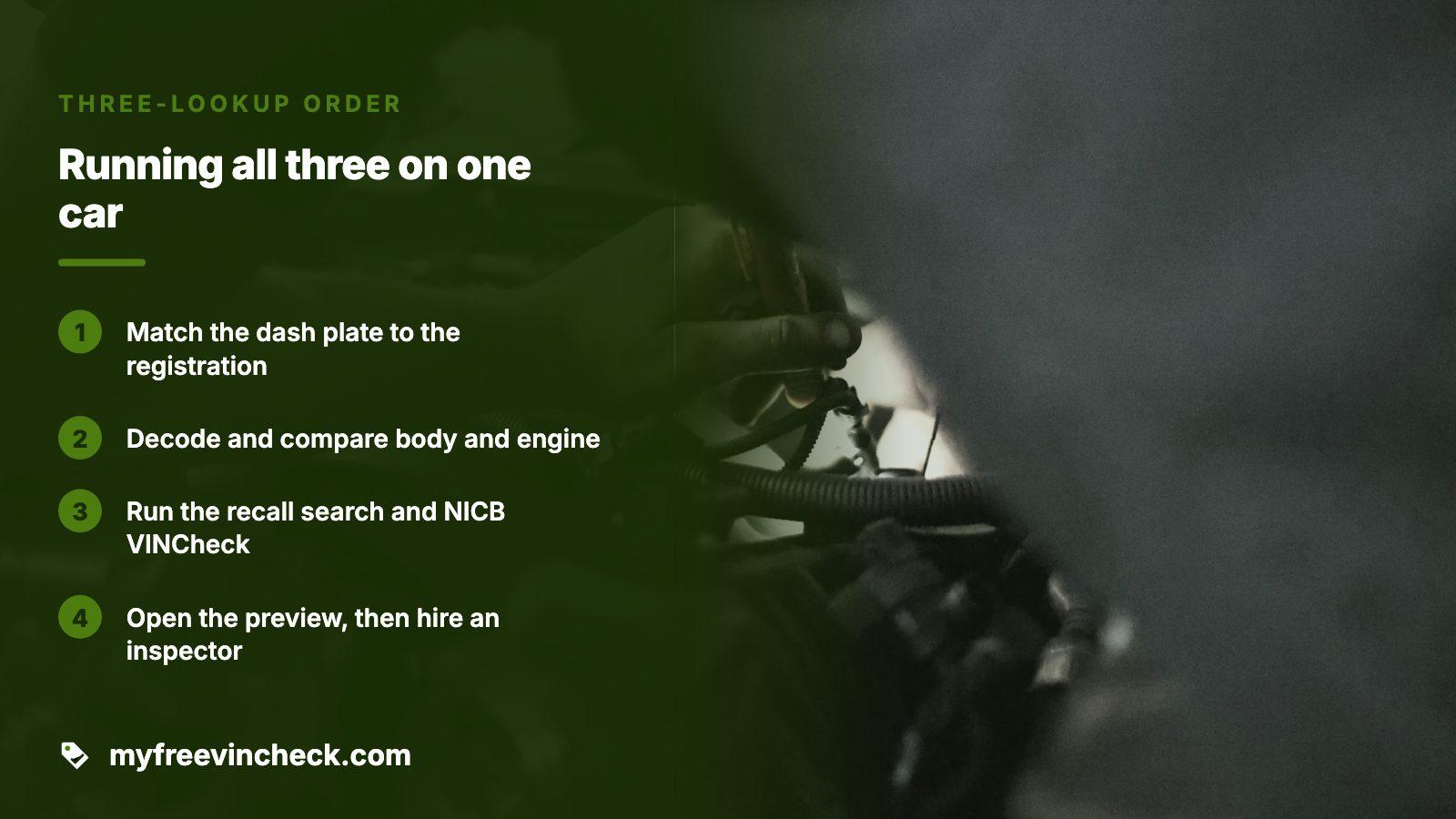
- Photograph the dash VIN plate in the lower driver's-side corner of the glass and match it against the registration and the advert. NICB describes a cloned car as a stolen one wearing a copied VIN, so a mismatch is the first red flag.
- Decode it and compare body style, engine and assembly plant with the ad.
- Run the recall search and note any open campaign. NHTSA's recall page takes a batch of as many as 100 VINs if you are weighing a long list.
- Run NICB's VINCheck, within the daily limit.
- Ask the seller for any paperwork tied to that same VIN, then open the no-card preview to see if title, mileage and damage records exist for it.
- Pay an independent mechanic to look the car over. FTC guidance is that a report never substitutes for that.
Where the paid report picks up, and what it costs
The preview needs no card and counts the records on file for the VIN, so you learn whether the paid layer has anything to show before spending a cent.
Buying the report is a one-off charge: one vehicle, or a larger pack in sizes of three, five and ten for people comparing several cars. Nothing recurs, and each amount lives on the pricing page.
The report adds the part the free tools skip: odometer readings in date order, title brands with the state and date, and crash and damage entries, along with salvage and auction listings and photos where they exist. Buy it for the car that survived the free steps and is about to get a deposit, not for one already ruled out by a recall or a decode mismatch.
Where this information comes from
- NICB: VINCheck lookup — What VINCheck searches, its daily cap, the insurer share behind it and the limits NICB states.
- NHTSA: Check for recalls — What the VIN recall search shows, what it leaves out and how recall repairs work for owners.
- NHTSA vPIC VIN decoder — Model-year range and vehicle scope of the decoder, and the build data it returns.
- Justice Department NMVTIS: FAQs — Why title data is fee-for-service and which records it holds and omits.
- FTC: Used cars — How the FTC points buyers to history reports, recall lookups and an independent inspection.
- NHTSA owner complaint 11533697 — owner experience, paraphrased
- NHTSA owner complaint 11719863 — owner experience, paraphrased
Sources and photos: Facts checked against the sources above in November 2026. Photos by Michal Biernat, Mustafa Sheikhmouss and Cht Gsml on Unsplash; diagrams by MyFreeVINCheck.
Keep reading
- Check a VIN Number for Recalls: Free Lookup, Then the Full PictureWhat an open recall means for a car you are buying, and how the repair works.
- Is a Free VIN Check Legit? What the Real Ones Cover and MissWhat separates a trustworthy free lookup from a sign-up funnel.
- Can I Check if My Car Has Been in an Accident for Free? What the Free Tools ShowWhat a no-cost search can and cannot say about crash history.
- PricingWhere every amount sits: one report or a pack, paid once, no subscription.
Frequently asked questions
Is there a completely free car history report?
Not a full one. The free tools return pieces: build data from NHTSA's decoder, open recalls from NHTSA, and theft, flood and salvage flags from NICB. Title brands, odometer readings and accident records sit behind fees because the federal title system is fee-for-service by law. A free preview can tell you whether such records exist before you pay.
How many free VINCheck searches do I get?
NICB limits each IP address to five searches in any 24-hour period, though searches are unlimited over time. The tool needs the correct 17-digit VIN, and a typo can miss a match. Comparing several cars? Rank them with the decoder and recall search first, then save VINCheck for the finalists.
Does the NHTSA recall check show accidents?
No. It lists unrepaired safety recalls for the VIN and nothing about crashes, owners or mileage. It also omits repaired recalls, service campaigns, very new recalls still being loaded, and recalls past 15 years unless the maker covers longer. Read a clean result as no open recall found, not as a clean history.
Can I check a VIN for free before buying from a private seller?
Yes. Decode it, run the recall search and run NICB's screen. NICB also suggests checking the VIN with your state motor vehicle bureau, running a title search, and having a certified mechanic inspect the car first when possible. Ask the seller for paperwork on that VIN as well.
If the free checks come back clean, can I buy the car?
Not on that alone. NICB says a clean VINCheck result does not guarantee a clean history, and the FTC adds that no report replaces an independent inspection. It cannot see odometer history or title brands, so treat a clean free result as a filter, not an approval.
Now check the car itself
The guide explains what to look for. The report shows what this VIN has on record.