THE SHORT ANSWER
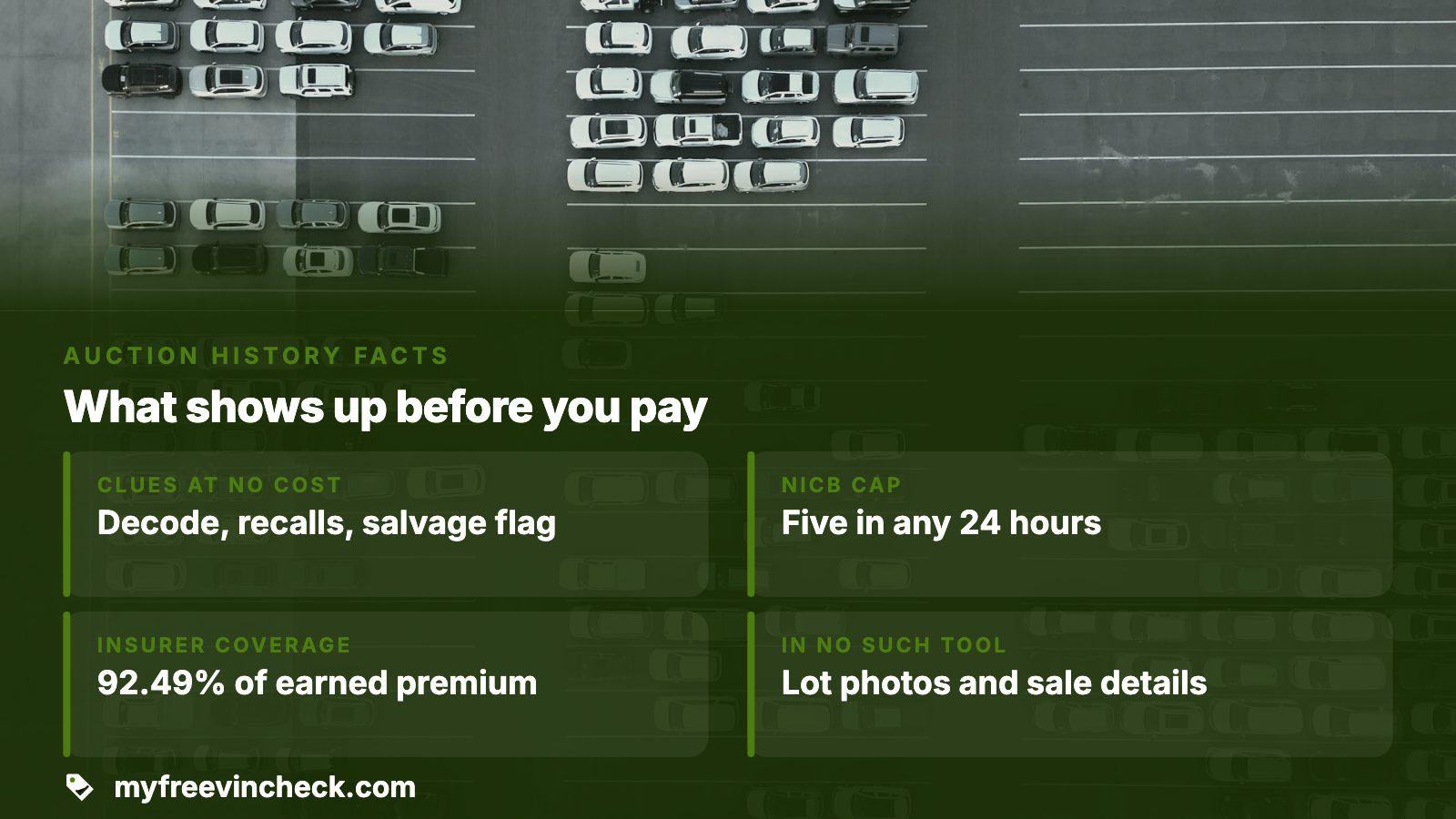
A true auction record is not available free. Three free lookups give you clues instead: NHTSA's decoder confirms which car you are researching, NHTSA's recall search lists open safety repairs, and NICB's VINCheck flags insurer-reported salvage and flood losses, the step that often comes before a salvage sale. Lot photos, damage notes and sale details come from a paid report, and the preview shows whether records exist.
- Free clues
- NHTSA decode, NHTSA recall search, NICB salvage flag
- NICB cap
- Five in any 24-hour window, per IP address
- Insurer coverage
- 92.49% of US earned premium
- In no free tool
- Lot photos, damage notes, sale details
What a free search can say about a car's auction past
An auction record, as a buyer wants it, belongs to one lot: intake photos, a damage note, the mileage that day and the sale. No agency publishes that for the public. NICB's own FAQ files auction data under the full reports its partners sell, and says most of those cost money. A free search therefore works through clues.
| Free lookup | Auction clue it gives | What stays hidden |
|---|---|---|
| NHTSA VIN decode | Confirms the build, so you know which car to research | Mileage, owners, title status, any sale |
| NHTSA recall search | Safety repairs still open on that exact car | Repaired recalls and damage of any kind |
| NICB VINCheck | A salvage or flood flag, pointing to a total-loss claim | Police records, insurers that opt out, photos |
Step one: decode the VIN so you pull the right car's records
NHTSA's decoder reads the build data manufacturers file, for model years from 1981 onward and vehicles sold or imported into the US. The sample number 1HGCM82633A004352 returns a 2003 Honda Accord EX-V6 coupe with a six-cylinder gasoline engine rated at 240 hp, assembled in Marysville, Ohio. It also confirms the ninth-position check digit, the quickest test for a number copied by hand.
Every later lookup runs on the same 17 characters, and NICB warns that a mistyped VIN may miss a record that exists. If the decode disagrees with the car or the advert, stop there. Expect blanks: 109 of the Accord's 154 fields came back empty.
Step two: a salvage flag is the closest free stand-in for an auction record
NICB describes the route for a flooded car: the insurer settles the claim as a total loss, then sells the wreck as salvage at an auto auction. Some of those cars reappear on dealer lots or in online ads. A VINCheck salvage answer means the insurer paid out rather than repair the car, the same step that precedes the sale in NICB's example.
The tool is free. NICB caps it at five searches in any 24-hour window per IP address. Its data comes from participating member insurers, which NICB says represent 92.49% of US earned premium.
Read a clean answer carefully
A salvage flag proves an insurer wrote the car off. A clean answer proves much less: a flooded car whose owner never filed a claim can keep a clean title, and moving a wreck to another state for a fresh one is what NICB calls title washing.
Under 28 CFR 25.55, insurers file a monthly list of cars they took over as junk or salvage. VIN and dates are required, the cause of the loss is not.
Step three: the recall search, free and specific to the VIN
NHTSA's search tells you whether that exact car has a safety recall nobody has repaired. An open one is fixed by the dealer at no charge, and says nothing about damage.
- Missing from the result: recalls already repaired.
- Missing: brand-new recalls still being matched to VINs.
- Missing: recalls older than 15 years, unless the maker offers longer coverage.
Auction buyers are told to do this themselves: IAA's published rules put the job of finding safety recalls on the buyer.
Auction listings are not the last word either
Even a genuine lot record has limits, and IAA says so in its published rules. It disclaims any duty to verify the VIN, mileage, title, airbag or damage entries and tells bidders not to rely on them. Photos are not meant to show condition exhaustively, a note like front end damage is general, and hidden damage may sit underneath.
An intact airbag means only that it did not look deployed on arrival, and some cars carry deployed bags nobody replaced. Treat an entry as one dated witness and check it against title records and the car.
Where the paid report takes over
The preview comes first. Enter the VIN and the page counts the records on file, so you learn whether any title, damage or auction material exists before paying anything.
After that the report is bought once. A single vehicle is one payment, and packs of three, five or ten exist for comparing several cars. Amounts sit on the pricing page, and nothing bills again.
From an NHTSA owner complaint
A 2016 Nissan Sentra owner told NHTSA in June 2018 that the dealer described the car as a rental used only by its own customers. A history report pulled at another dealership showed it had come from a California auction, with a title brand for frame or structural damage and a possible odometer rollback. The owner said the report left the car impossible to trade in.
Read the salvage and auction entries, the odometer readings and the title brands against the seller's account before any deposit.
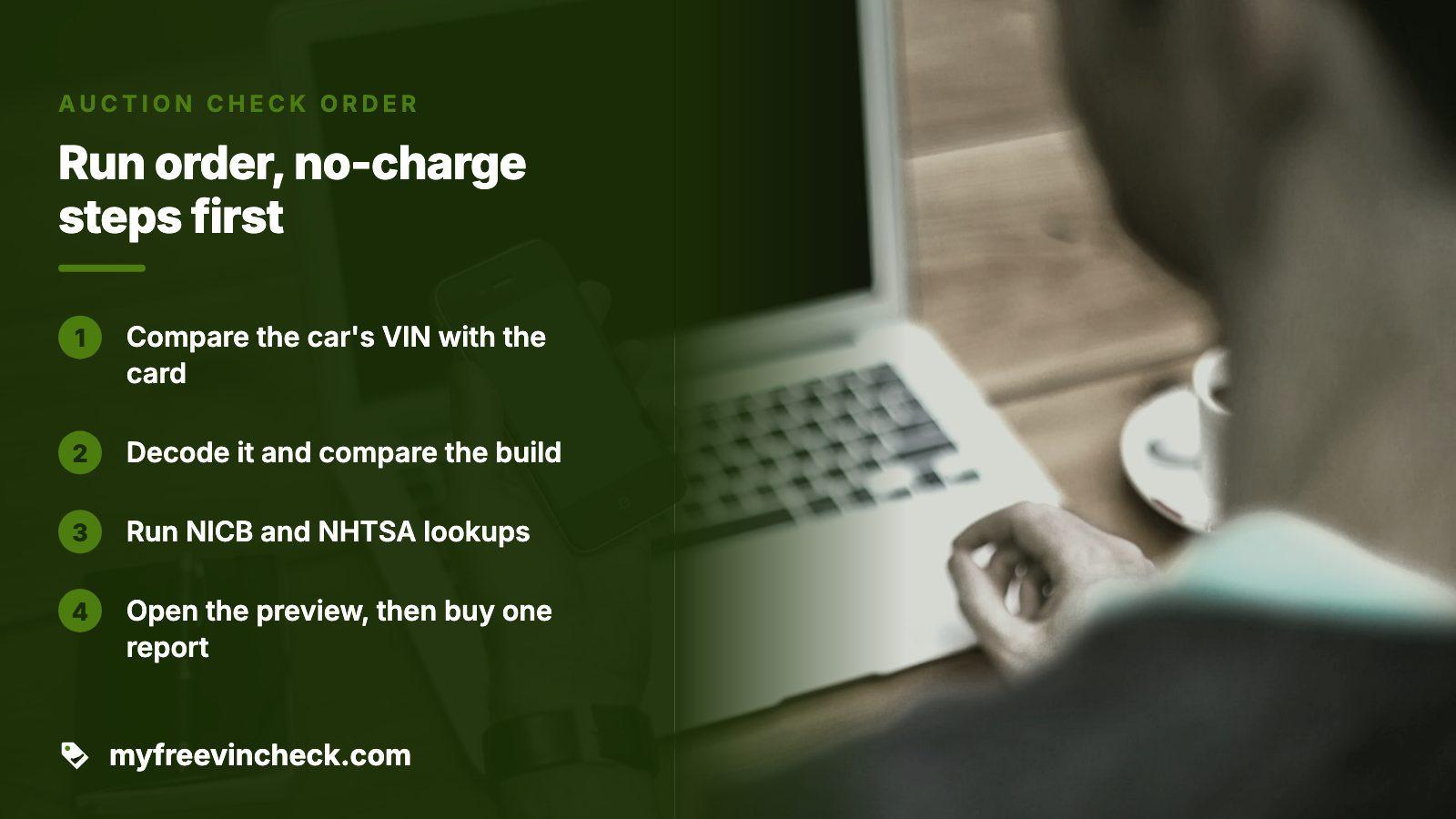
Run order for one car, free steps first
- Compare the VIN on the car itself with the registration card, and ignore the one in the advert.
- Decode it and compare the build with the advert.
- Run NICB's VINCheck and note any salvage or flood flag.
- Run NHTSA's recall search and write down anything open.
- Open the preview to see whether title, damage or auction records exist.
- Buy the report for the car still on your list, then pay a mechanic to inspect it.
Sites that promise auction history and charge at the end
Searches like this one attract pages that advertise a lot record and ask for a card at the last step. The FTC has flagged a related pattern: a stranger offers to buy your car but first insists you purchase a report from one named website, which takes a card payment while the buyer never answers.
Pick a provider from the Justice Department's approved list, and look a company up beside the words complaint or scam first.
Where this information comes from
- NICB: VINCheck lookup — Search cap, insurer coverage, what a salvage result means and where NICB places auction data.
- NMVTIS: For consumers — What the federal title record holds and its stated coverage gaps.
- NHTSA: Check for recalls — What the VIN recall search shows, what it omits and the multi-VIN option.
- IAA: Auction rules — How an auction company describes the limits of its own listings.
- 49 CFR part 580 — The records auction companies must keep on each sale.
- NHTSA owner complaint 11040275 — owner experience, paraphrased
- NHTSA owner complaint 11101261 — owner experience, paraphrased
Sources and photos: Facts checked against the sources above in November 2026. Photos by Leo_Visions, Alejandro Escamilla and Iain on Unsplash; diagrams by MyFreeVINCheck.
Keep reading
- Free Salvage Title Check by VIN: What It Shows and MissesWhat a salvage brand means and how to look for one before you buy.
- Can I Check if My Car Has Been in an Accident for Free? What the Free Tools ShowWhat a no-cost search can and cannot say about crash history.
- Check a VIN Number for Recalls: Free Lookup, Then the Full PictureHow to read an open recall and what the repair involves.
- Sample reportSee what the paid sections look like before you decide.
Frequently asked questions
Is there a government site that lists auction history by VIN?
Not that its own pages describe. NMVTIS, the Justice Department's title system, holds title brands, odometer data, total losses and salvage records, and its consumer pages mention no auction sale records. Access costs money because the law behind it requires user fees.
Does a clean NICB result mean the car never sold at auction?
No. VINCheck searches only what participating insurers have reported, so police records and insurers that opt out sit outside it. IAA also sells clear-title cars that no insurer ever wrote off, and VINCheck would say nothing about those. NICB itself says a clean result is not an absolute guarantee.
Can a car bought at a salvage auction be driven legally?
Only after a repair and a state-issued rebuilt or restored title, according to IAA, and the rules vary by state. Stolen or abandoned cars can carry a salvage title too, depending on state rules, so the brand does not always mean a crash. Check the state's own process before you pay.
Can I check recalls for several cars at once?
Yes. NHTSA's search accepts up to 100 VINs in one go, which suits a shortlist built from auction listings. Each result covers only unrepaired recalls, so repaired ones, very new ones and those older than 15 years will not appear.
Do I pay before I know if the report has anything?
No. Only the preview is free, and it counts the records on file for the VIN. You pay once for the report, nothing recurs, and each amount is listed on the pricing page. If the count comes back at zero, you have learned that without spending anything.
Now check the car itself
The guide explains what to look for. The report shows what this VIN has on record.