THE SHORT ANSWER
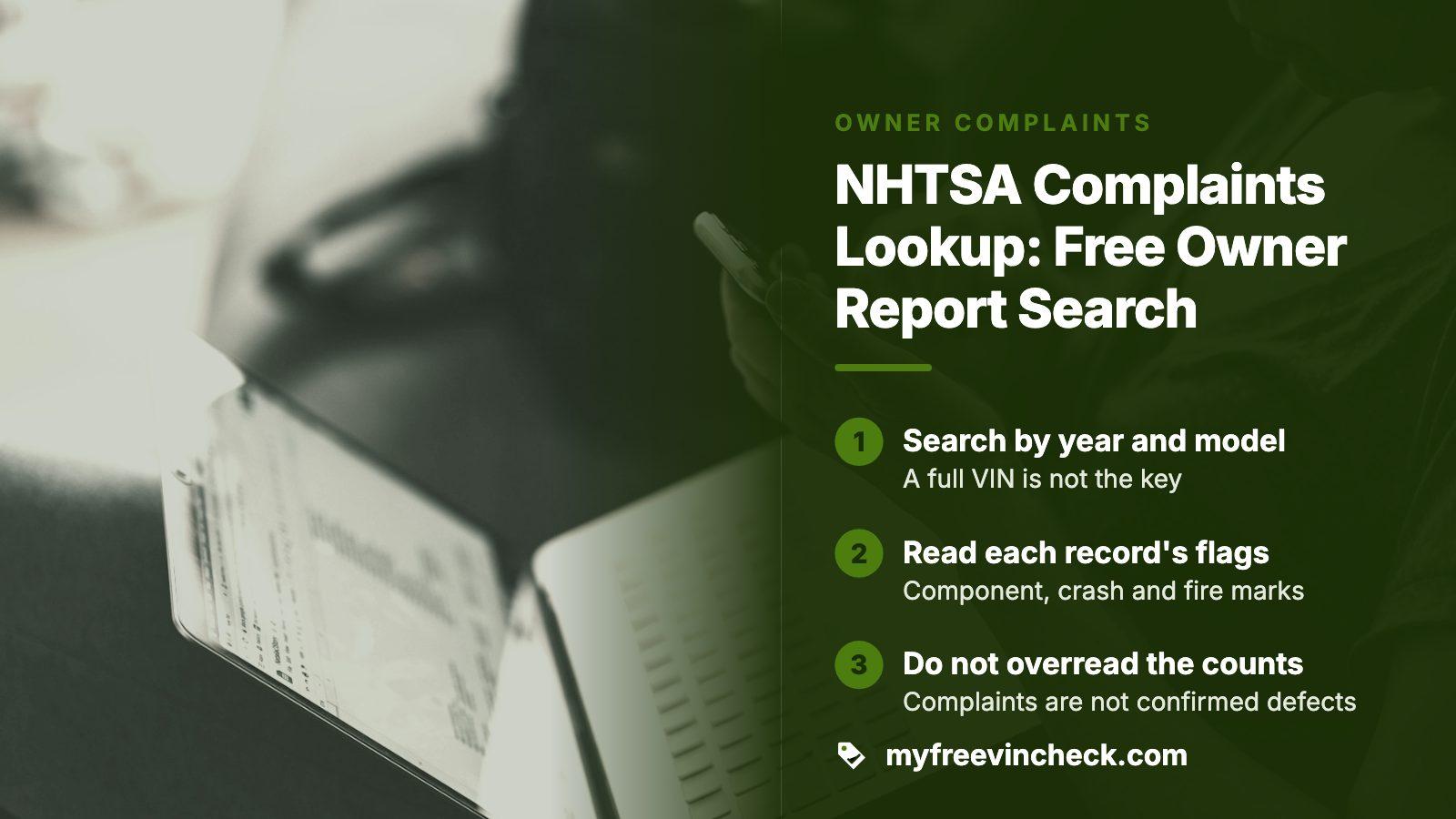
Search NHTSA's complaints by vehicle year, make and model, or pull the same records from NHTSA's public complaints API. Each record names the component, says whether a crash or fire was reported, and carries the owner's own words. The record holds only a partial VIN, so it describes the model's pattern. For the history of a specific car, run its VIN through a report.
- Searched by
- Year, make and model (not a full VIN)
- Cost of the lookup
- Free, from NHTSA
- Each record shows
- Component, crash and fire flags, owner summary
- What it cannot show
- Title brands, odometer readings, one car's history
What an owner complaint record holds
When a driver files a complaint with NHTSA, the agency removes anything that identifies the person and publishes the rest. Investigators read these filings next to other data, looking for safety issues that deserve a closer look and for signs of a defect trend. They also use them to test whether a recall reaches enough vehicles.
Through the complaints API, each record comes back with an ODI number, the date of the incident and the date it was filed, flags for crash and fire, counts of injuries and deaths, the affected component, and a free-text summary written by the owner. The VIN field is truncated, so you see the first characters only.
Steps for pulling a model's complaints
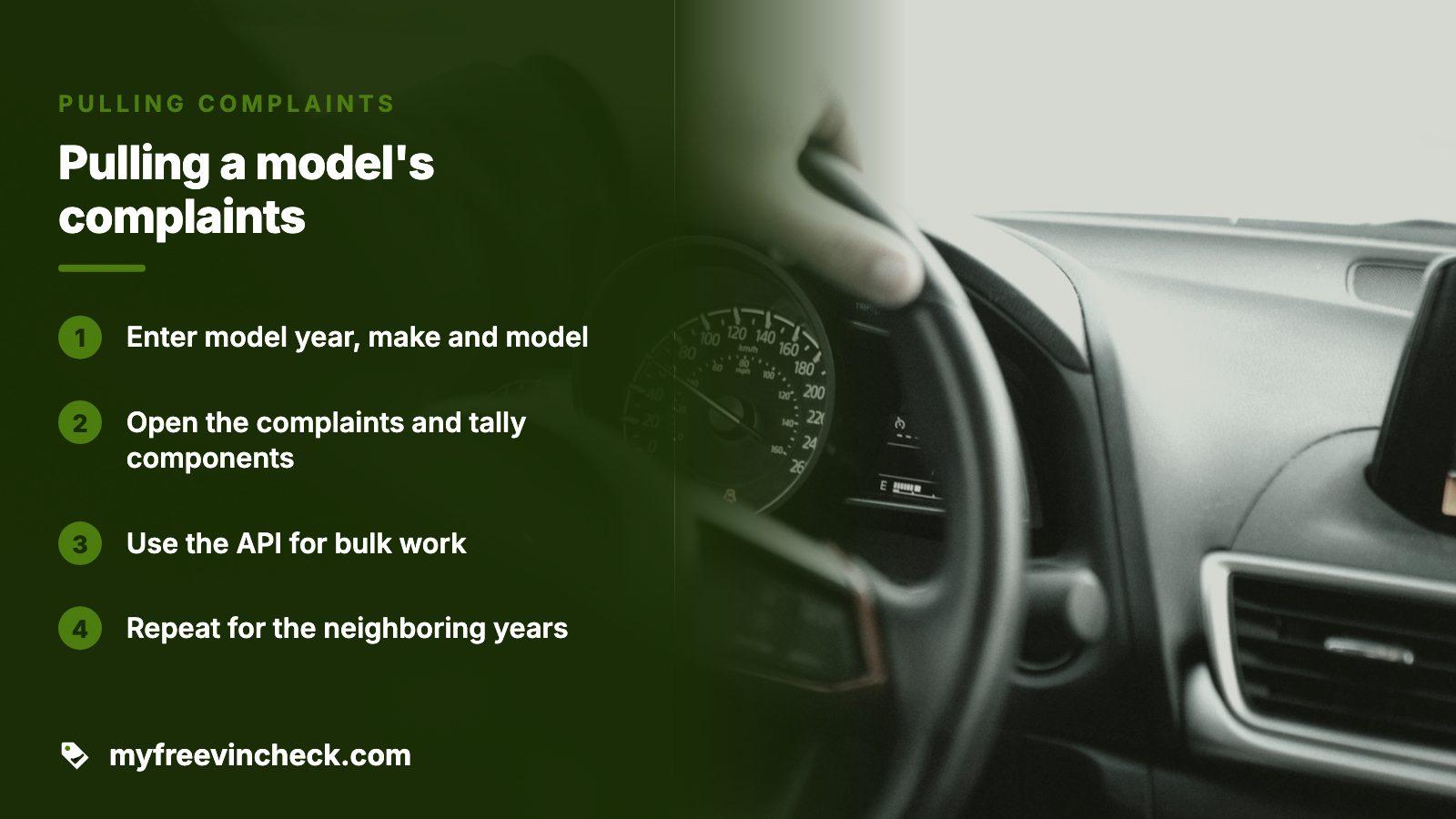
- Go to NHTSA's recalls page and type a model year, make and model into the vehicle search instead of a VIN. That route gives broad results that cover investigations and manufacturer communications as well as complaints.
- Open the complaints list for that model year and tally the components before reading single stories.
- For bulk work, call the complaints API with make, model and modelYear in the query string. It returns JSON you can sort or count yourself.
- Repeat for the model years on either side of the one you are shopping. A fix often lands partway through a generation.
If you also want to know whether this exact car has an open recall, that is a separate VIN search on the same NHTSA site. NHTSA lets you search up to 100 VINs in one pass, which suits a buyer comparing several listings.
Reading the counts without overreading them
When I pulled complaint data from the API for three popular used models, the totals ranged widely. A big total mostly reflects sales volume and years in service, so it proves little by itself. The useful signal is which parts the filings pile up on.
| Vehicle | Complaints | Crash flagged | Fire flagged | Top component | Recall campaigns |
|---|---|---|---|---|---|
| 2018 Toyota Camry | 755 | 46 | 4 | Power train (200) | 8 |
| 2016 Honda Civic | 1082 | 36 | 4 | Steering (446) | 5 |
| 2014 Chevrolet Silverado 1500 | 1562 | 75 | 18 | Steering (427) | 6 |
The recall column comes from the separate recalls API and counts campaigns, not repaired cars. Each complaint total only reflects owners who decided to file, which makes it a starting point for questions, not a ruling on the model.
What an owner's filing sounds like
From an NHTSA owner complaint
Filed just before November: the owner of a 2018 Camry reported a new noise that turned out to be the transmission. The person doubted the form was filled in right, had seen web chatter about other owners with the same fault, and asked whether it is more frequent than normal.
Notice what the record does and does not give a buyer. It tells you which part to ask about during a test drive and a pre-purchase inspection. Whether the car you are looking at was the one in that filing stays unknown.
Where complaint lookups stop
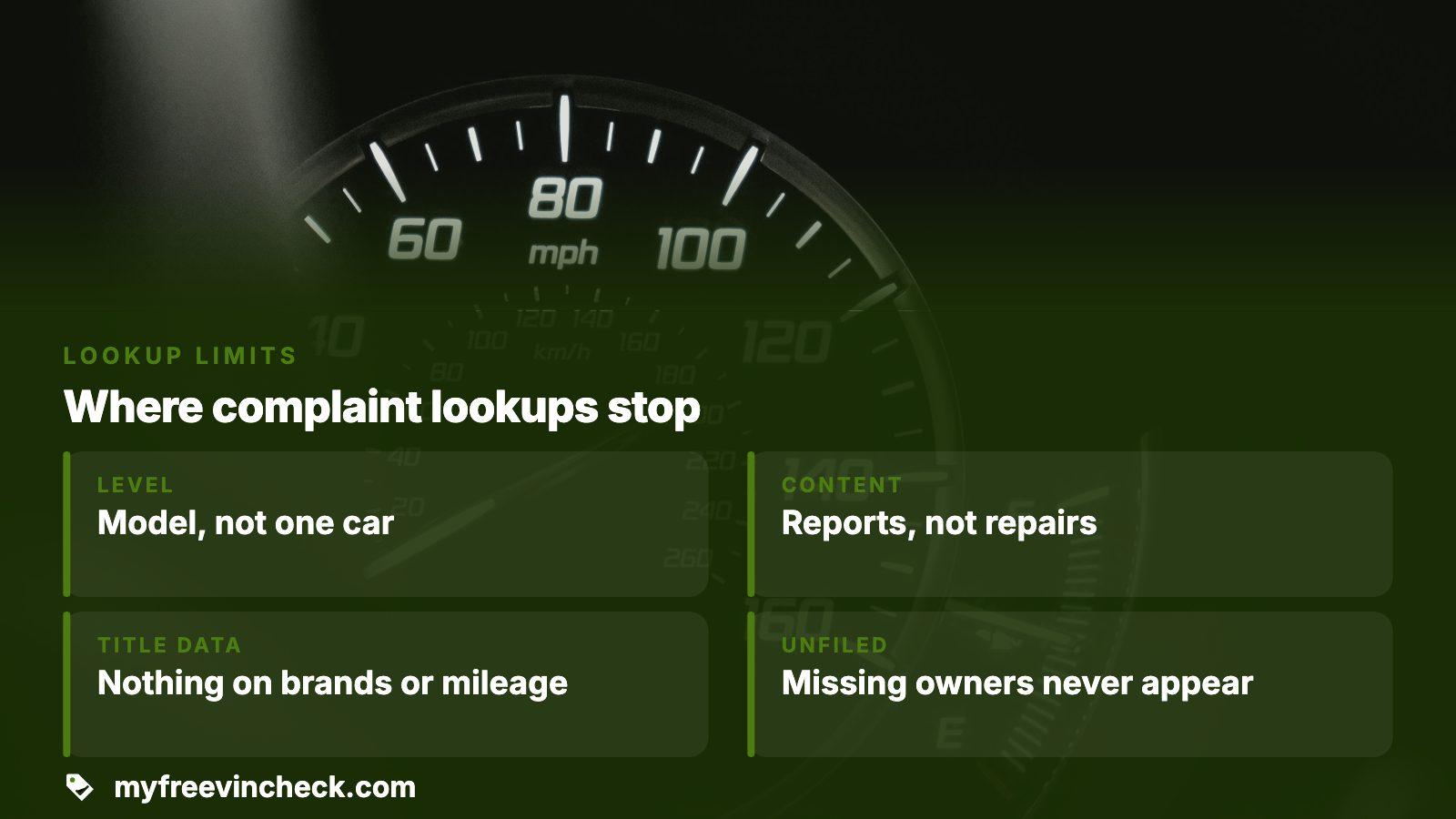
- They are model-level. The partial VIN in each record cannot be matched to your car.
- They show reports, not repairs, so a problem fixed under a recall can still sit in the complaint pile.
- Nothing in them speaks to branded titles, mileage records, crashes, liens or past owners.
- Complaints from owners who never filed are not there at all.
NHTSA's own VIN recall search has holes as well. Fixed recalls drop out, as do campaigns from some small builders, and anything older than 15 years is missing unless the maker extended coverage.
Where to get the VIN for the next step
NHTSA's advice is to look at the 17-character number visible at the lower left of the windshield glass. Your registration card prints it too, and the insurance card may. Check two of these against the ad, and if they disagree, keep your wallet shut.
From the model's record to this car's record
Think of the complaint lookup as the reading you do before the visit, and the VIN check as the reading you do about the specific car. A model with many steering complaints is a reason to press on the steering during the drive. Salvage branding, odometer rollback and theft entries live only in that one car's own records.
On this site you can run a VIN decode and an open-recall check at no cost, then start a preview for the same number. A preview carries no fee and shows what is on file under that VIN before you commit. Paying for the full report is the sole charge in the flow, and it never renews.
What this costs and your next move
The complaint search, the API and NHTSA's recall search cost nothing. The pricing page lists report options. Only the preview is unpaid. A single report is tied to one VIN, and bigger packs suit anyone comparing several cars.
- Search complaints for the exact model year and the two beside it.
- Note the two or three components that dominate, and ask the seller about them.
- Put the car's own number through the decoder and the recall search.
- Start the preview before you pay a deposit.
Where this information comes from
- NHTSA: Check for Recalls — what the VIN and year-make-model searches return and omit
- NHTSA: Datasets and APIs — how the agency uses complaints and offers them as an API
- NHTSA complaints API — record fields and the counts in the table
- NHTSA: Report a Safety Problem — where owners file a complaint
- NHTSA owner complaint 11773735 — owner experience, paraphrased
Sources and photos: Facts checked against the sources above in November 2026. Photos by Michal Biernat, Miles Loewen and NATHAN MULLET on Unsplash; diagrams by MyFreeVINCheck.
Keep reading
- Free TSB Lookup by VIN: What Works, and the Two Steps to Run ItManufacturer service bulletins sit next to complaints and often explain them.
- Check a VIN Number for Recalls: Free Lookup, Then the Full PictureThe VIN-level recall search for one specific car.
- Where Can I Get a Free VIN Check? Three Lookups and What They MissThe other free lookups a buyer can run on a VIN.
- Free Salvage Title Check by VIN: What It Shows and MissesA title brand is something complaint data can never show.
Frequently asked questions
Can I search NHTSA complaints by VIN?
Not in a way that isolates one car. The complaint database is searched by year, make and model, and each record keeps only a partial VIN. The VIN search on NHTSA's recall page answers a different question, whether that vehicle has an unrepaired recall.
Is the NHTSA complaints lookup free?
Yes. Searching complaints on NHTSA's site and calling its public complaints API both cost nothing. The only paid piece is this site's full report, bought once.
Does a high complaint count mean a car is bad?
Not on its own. Counts follow sales volume and age, and owners file when they choose to. Read the top components, the crash and fire flags, and whether recalls already cover the problem before drawing any conclusion.
What happens after an owner files a complaint?
NHTSA adds it to a public database after removing personal details. If similar reports pile up about the same product, that can lead the agency to open an investigation, which may end in a recall recommendation or in no defect found.
What should I run besides a complaints lookup?
Run the VIN through a recall check and a decode, then a vehicle history preview. Those cover open recalls, how the car was built, and the records tied to that specific number, which complaint data cannot supply.
Now check the car itself
The guide explains what to look for. The report shows what this VIN has on record.