THE SHORT ANSWER
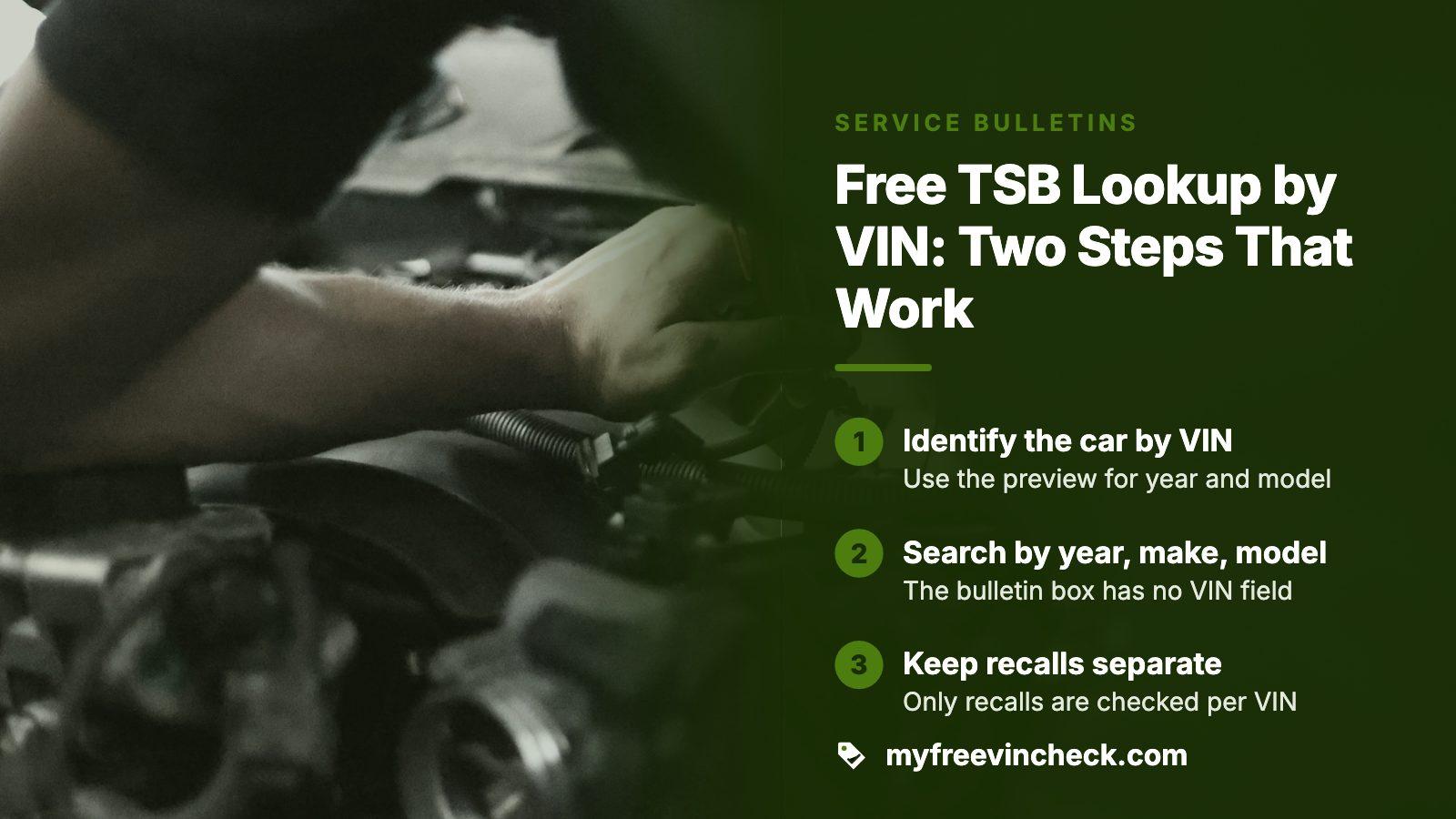
Put the VIN through the free preview to learn what car it is. Then look that car up on NHTSA's vehicle page by year, make and model and load the Manufacturer Communications list, which is where bulletins sit. Recalls are the part that can be matched to your exact VIN, so run that check separately on the same 17 characters.
- TSB search key
- Year, make and model, not VIN
- Sample model page
- 301 manufacturer communications for a 2016 Camry
- Per-VIN check
- Open recalls
- Cost of both steps
- Nothing, using the preview and NHTSA
Why the TSB box never asks for a VIN
People type a VIN into a bulletin search and expect the answer a recall lookup gives. The two records are built differently. A recall report names a population: for passenger cars, a line, a model year and the build months covered. A VIN either falls inside that window or it does not, so a lookup can answer for one car.
A service bulletin reaches NHTSA as a document the maker sent to its dealers or owners. Nothing in that filing draws a boundary around specific vehicles. So the government's bulletin listing is organized around the model year, and the VIN is only useful as the tool that tells you which model year to open.
What a bulletin is, and what it is not
Under 49 CFR 579.5, a manufacturer hands NHTSA its own bulletins and notices whenever they go out beyond a single recipient and describe a defect. Warranty extension letters and product improvement bulletins are named in the text, and the safety label does not matter: the rule reaches ordinary faults too.
That last clause is why a rough-running transmission or a rattling roof can be on the list even though no recall will ever cover it. A bulletin is a repair instruction for dealers. It is not a recall, and nothing in the rule says the repair is free to you.
Timing gap
Makers get a grace period after each month closes: 5 working days to file what they issued. A bulletin from the past few weeks may not show on NHTSA yet.
Step by step: from VIN to bulletin list
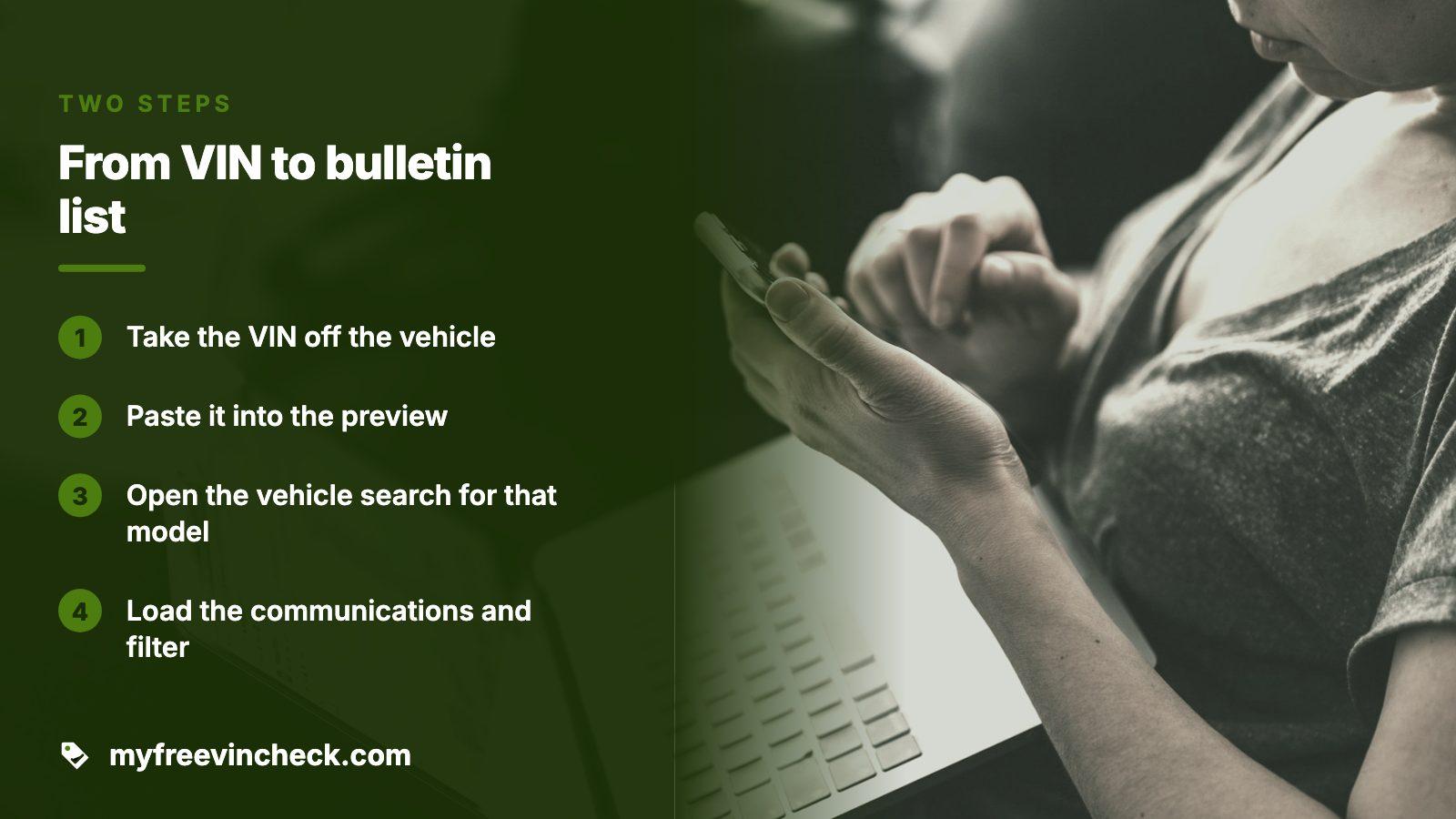
- Take the VIN off the vehicle in front of you rather than the listing. One wrong character and you are reading about a stranger's car.
- Paste it into the preview on this site. NHTSA's decoder supplies the car's identity, so you know which page to open.
- Open NHTSA's vehicle search for that model. The page shows tabs for complaints, recalls, investigations and manufacturer communications, each with a Load button.
- Load the manufacturer communications and filter by the component that worries you, such as engine or electrical system.
- Run the recall check on the full VIN, since that is the one result tied to your exact car.
A short or mistyped VIN is caught at step two: NHTSA's decoder returns an incomplete VIN error rather than guessing.
Reading what comes back
The 2016 Toyota Camry page on NHTSA showed 189 complaints and 301 manufacturer communications. The communications loaded four to a page across 76 pages, every line carrying a filing date, an ID and a tag for the part involved. A long list is not a verdict on its own. A maker with a good feedback loop may simply document more.
| What you see | How to read it |
|---|---|
| Many entries tagged engine | Open a few and check whether your mileage and build fit |
| One component repeated | Ask the seller whether that repair was already done |
| Nothing for your component | Not proof of no problem; check complaints too |
| Very recent date | May be incomplete given the filing delay |
What owners run into without the bulletin number
From an NHTSA owner complaint
An owner who bought a used 2016 Camry Hybrid described a knocking and ticking from the moon roof area on uneven roads. Toyota told them the car was out of warranty, so it was not the company's problem. The same owner noticed a repair procedure published in a bulletin for exactly that noise and wanted it done at no charge.
The takeaway: a bulletin proves the maker knows about a fault, but it does not decide who pays once warranty has ended. Before buying, ask what the known repairs cost and whether the car already had them.
The part you can check against one VIN
Recalls are filed within 5 working days of a defect being found to affect safety, and their remedies are written as free of charge. For the 2016 Camry, NHTSA's recall data returned 2 campaigns, one covering air bags. Whether either applies to your car depends on its build dates, which is exactly what a VIN check settles.
Run that check on the full VIN before you pay for anything, and again just before you hand over money, because new campaigns can be added at any time.
What these free steps do not show
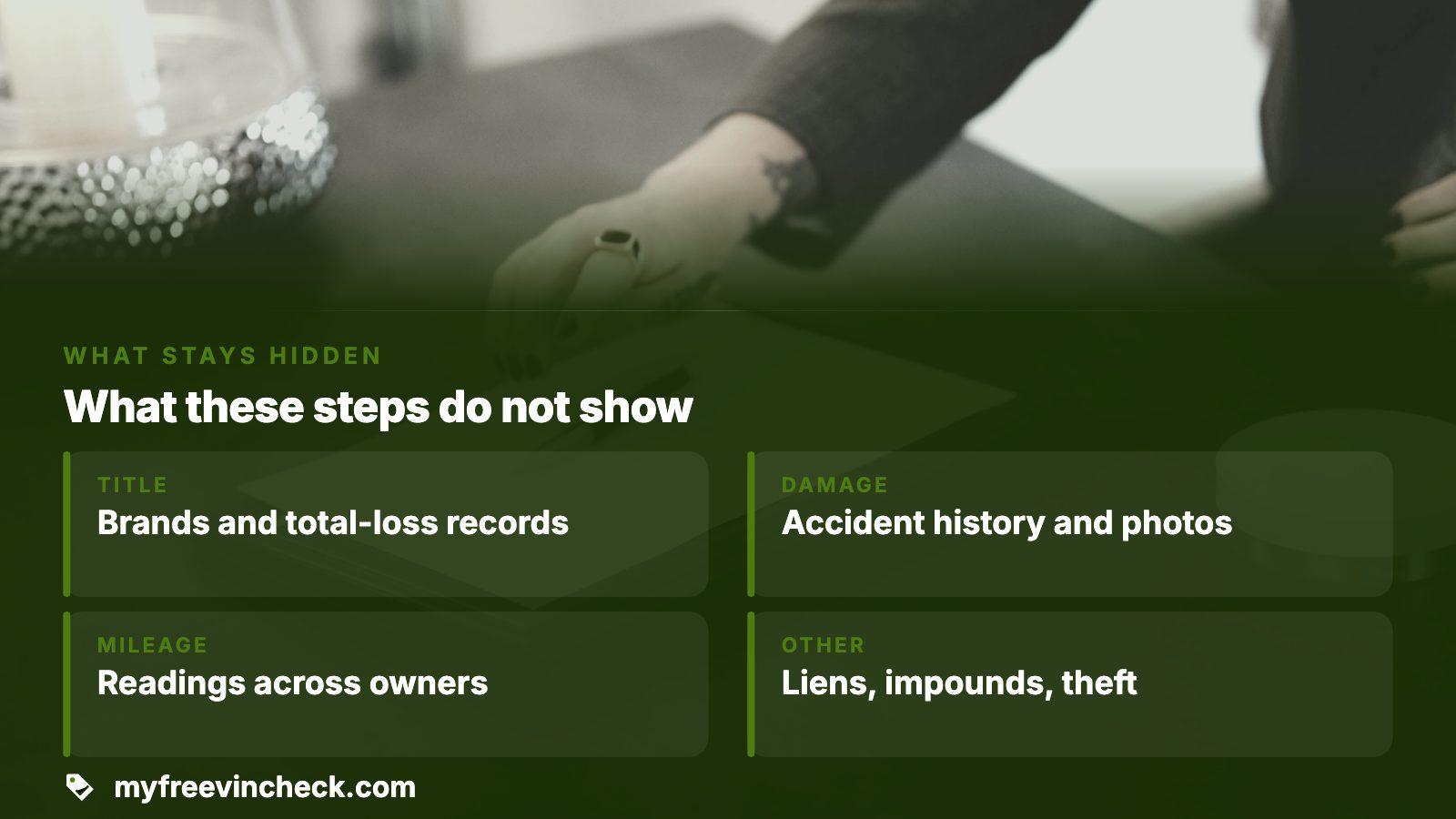
Bulletins and recalls describe how a model behaves. Neither says how this particular car was treated. A salvage brand, a rolled-back odometer or a lien will not appear in any bulletin list, and a clean recall result says nothing about them.
- Title brands and past total-loss records
- Accident and damage history, including auction photos
- Odometer readings across owners
- Liens, impounds and theft records
When the full report is worth buying
Use the free preview and NHTSA first. If the car passes your bulletin and recall reading and you still plan to buy it, the paid report is the next step: one payment, no subscription, with prices on the pricing page. Only the preview is free.
A bulletin list tells you what to inspect on the model. The report tells you whether this car's past gives you a reason to walk away before you spend money on an inspection.
Where this information comes from
- eCFR: 49 CFR 579.5 communications to NHTSA — what makers must send NHTSA and when
- eCFR: 49 CFR 573.6 defect reports — how recall populations are defined
- NHTSA: 2016 Toyota Camry vehicle page — where complaints, recalls and communications are loaded
- NHTSA: vPIC VIN decoder — VIN decode and incomplete VIN error
- NHTSA owner complaint 11315938 — owner experience, paraphrased
Sources and photos: Facts checked against the sources above in November 2026. Photos by Mustafa Sheikhmouss, Michal Biernat and Annika Wischnewsky on Unsplash; diagrams by MyFreeVINCheck.
Keep reading
- Check a VIN Number for Recalls: Free Lookup, Then the Full Picturethe one lookup that does match your exact VIN
- NHTSA Complaints Lookup: Search Owner Reports by Year, Make and Modelowner reports that sit beside bulletins on the same page
- Where Can I Get a Free VIN Check? Three Lookups and What They Misswhat the free preview shows and where it stops
- Pricinghow the one-time report payment works
Frequently asked questions
Can I look up a TSB by VIN for free?
Not in one step. NHTSA organizes bulletins by vehicle model. Decode your VIN for free to learn which one you have, then open that model's page and load its manufacturer communications. The whole route costs nothing, but you do the matching yourself.
Is a technical service bulletin the same as a recall?
No. A recall covers a safety defect and the remedy is written as free of charge. A bulletin is a maker's repair instruction to dealers, covers problems whether or not they affect safety, and does not by itself promise a free repair.
Why can't I see the newest bulletin?
Filing is due 5 working days after the month ends, so anything issued in recent weeks can be missing from NHTSA. If your symptom looks new, ask a dealer whether a fresh bulletin exists.
Does a long bulletin list mean the car is bad?
Not by itself. A big list can reflect a maker that documents repairs carefully. Look at which component repeats and whether your car's mileage and build fit, then compare against complaints for the same year.
What should I do after reading the bulletins?
Run the VIN for open recalls, ask the seller which listed repairs were already done, and have a mechanic check those components. If you still want the car, the paid report covers title, damage and odometer history.
Now check the car itself
The guide explains what to look for. The report shows what this VIN has on record.