THE SHORT ANSWER
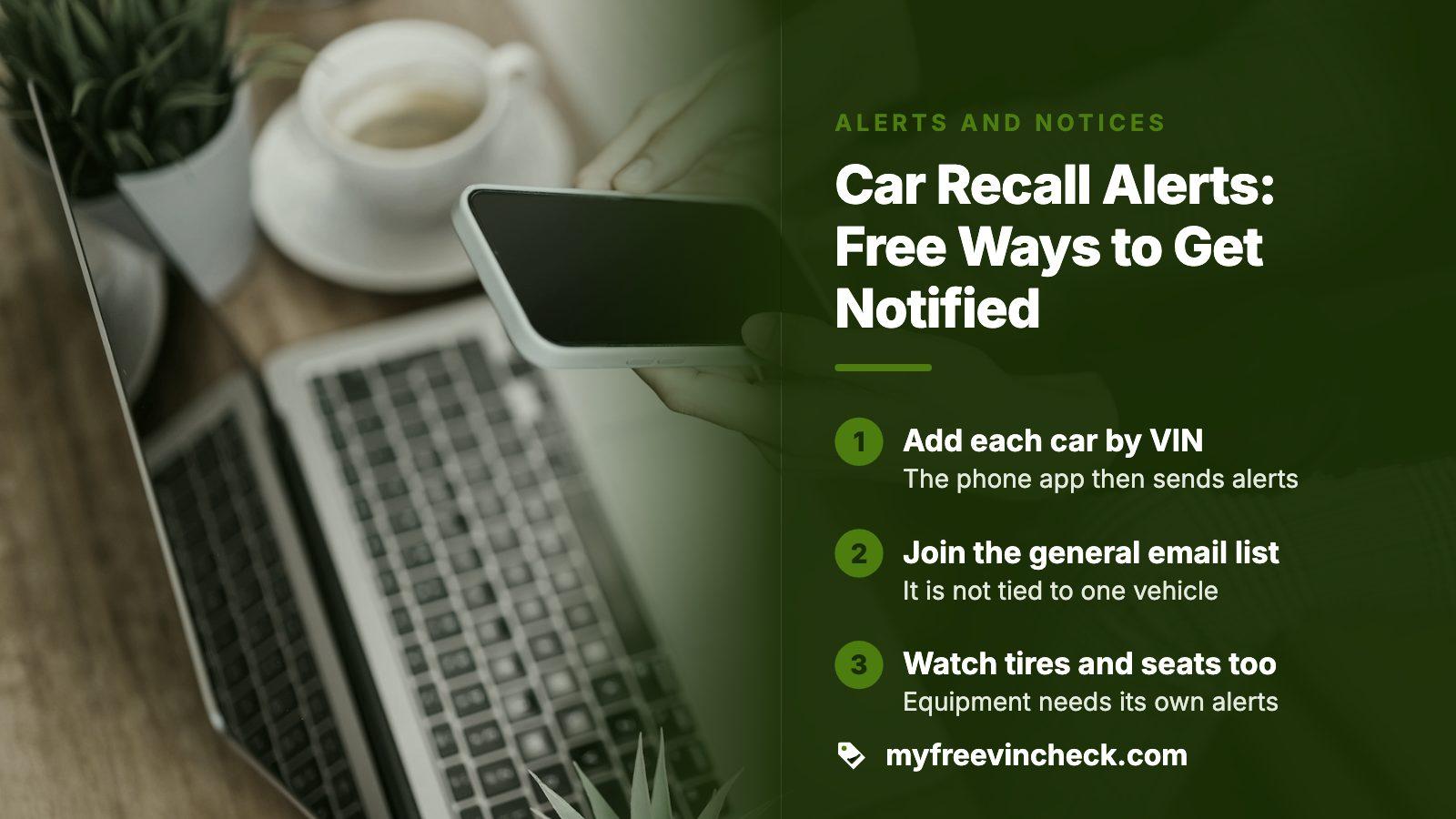
Install NHTSA's free SaferCar app, add each vehicle by VIN, and it sends a phone alert when a recall turns up for that car. You can also join NHTSA's general recall email list. Alerts only cover vehicles you have entered, so a car you are about to buy needs a one-time VIN search first.
- Best free alert
- SaferCar app, tied to the VINs you add
- Email option
- General NHTSA recall emails, not tied to one car
- Maker mail deadline
- First class mail within 60 days of the recall decision
- Gap
- No alert exists for a car you have not added yet
The two free alert channels NHTSA runs
NHTSA's recall page lists two ways to hear about new recalls without paying anyone. One is the SaferCar app for iOS and Android. The other is a recall notification email system, which NHTSA describes as email notices for vehicle and equipment recalls.
They behave differently. The app watches specific vehicles, car seats, tires and equipment that you type in, and pushes a message to your phone when it finds a recall for one of them. The email list is a general feed, so you read every notice and decide for yourself whether your car is in it.
| Channel | Tied to your VIN | Where it reaches you |
|---|---|---|
| SaferCar app | Yes, for each vehicle you add | Phone alert |
| NHTSA recall emails | No, general notices | Inbox |
| Maker's letter | Yes, registered owner | Postal mail |
Setting up SaferCar in about five minutes
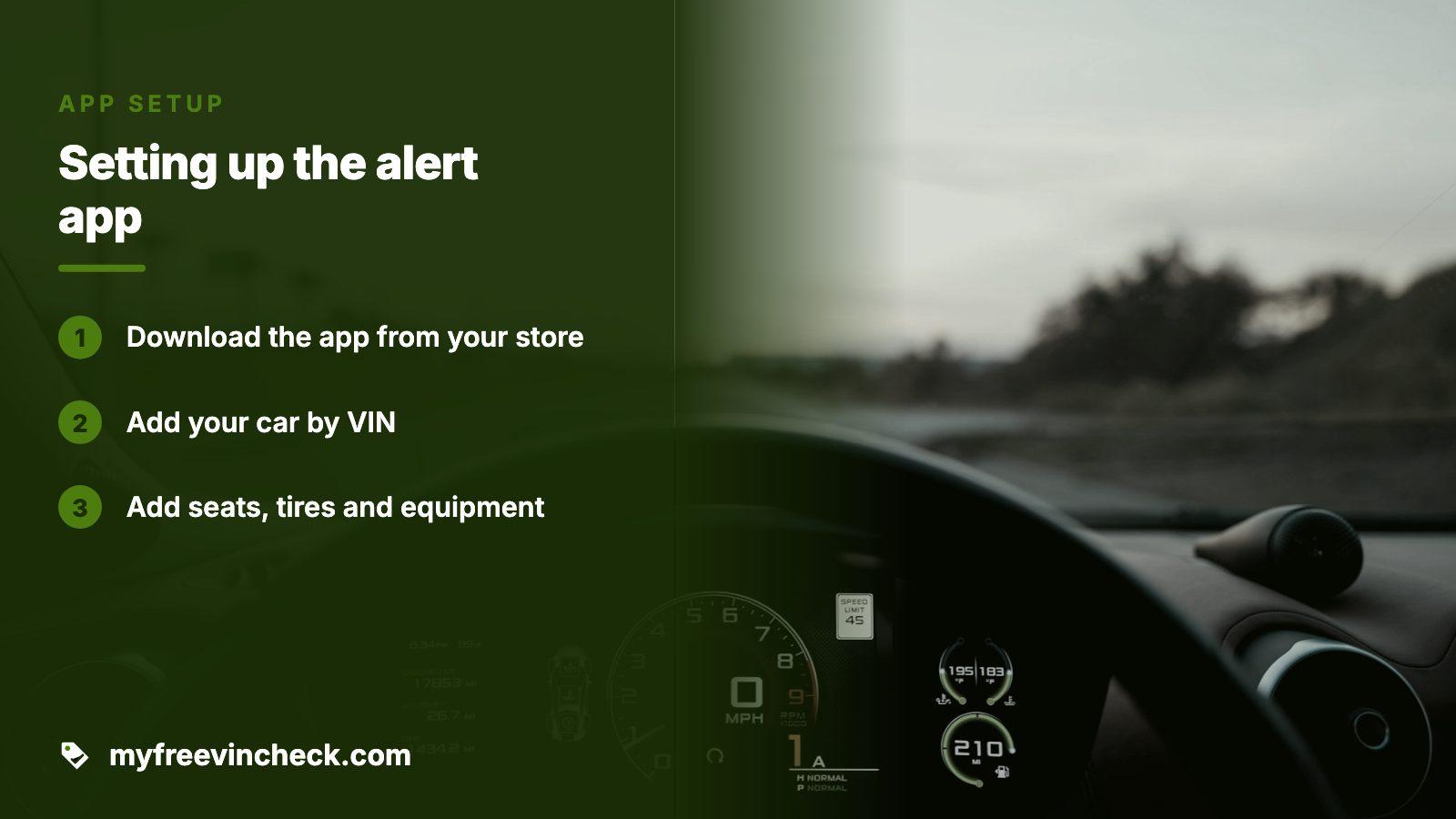
NHTSA describes setup as three steps. Everything below follows that page.
- Download the SaferCar app from the Apple or Google store.
- Add your vehicle by typing the 17-character VIN or scanning it.
- Add any car seats, tires, trailers and equipment you want watched.
You can keep as many vehicles in the app's virtual garage as you like, which suits a household with several cars. The app also points you to nearby dealers that handle the repair, and the repair itself is free. NHTSA says the agency keeps no copy of what you enter; your details stay on the phone itself, which settles the usual worry about handing over a VIN.
Why an alert beats waiting for the letter
By NHTSA's account, a manufacturer has 60 days after telling the agency about a recall decision to mail first class notices to registered owners. That mail goes to whoever the maker's records list, which is often a previous owner at an old address. NHTSA itself says millions of recalls go unrepaired or unaddressed each year.
From an NHTSA owner complaint
A 2013 Nissan Altima owner in Ohio told NHTSA that the hood flew up and struck the windshield on a side road in late December 2020, at roughly 20 mph. The owner wrote that no mail or email about open recalls had ever arrived. The takeaway: a recall can sit open on a car for years while its driver hears nothing.
A second owner of a 2013 Honda Accord described repeated no-start trouble and a battery replaced several times. Only later did that owner learn the VIN was in an electrical-system campaign, 17V418000, and say the maker had sent no notice. Both stories point the same way: do not rely on the postal system alone.
What alerts and the VIN search will not tell you
NHTSA is candid about the limits of its VIN search, and the alerts draw on the same recall data. Knowing the gaps keeps you from reading silence as a clean bill of health.
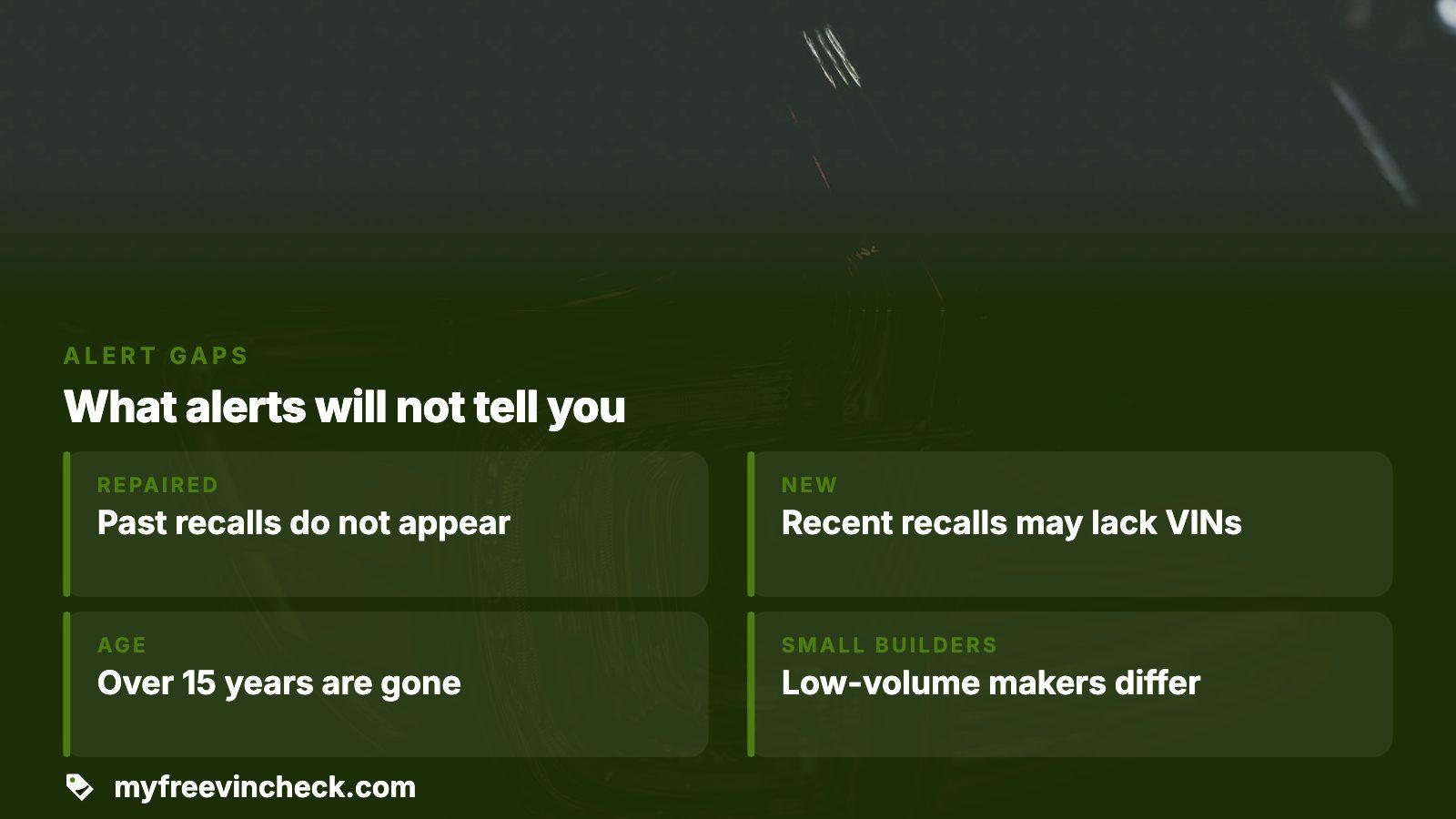
- Recalls that were already repaired do not appear.
- A recall announced last week may still be missing many of its affected VINs, which get filled in over time.
- Recalls older than 15 years are gone unless the maker chose to extend them.
- Low-volume builders, among them certain exotic and specialty brands, are left out.
- Goodwill and service campaigns from a maker are a different thing and never show up.
- Cars built for other countries fall outside it.
The search also covers certain manufacturers only. If it says 0 unrepaired recalls, that is a real answer for a covered brand, but it is a narrow one.
Tires, car seats and equipment need their own watch
A VIN identifies a vehicle, not the tires bolted to it or the seat in the back. NHTSA runs separate searches for tires, car seats and equipment, and its tire pages remind owners that tires get recalled too. SaferCar lets you add those items so they trigger alerts as well.
This matters most when you buy used. Tires on a used car may not be the ones it left the factory with, and a car seat bought second-hand carries its own history. Add each item once, and the app does the watching.
A car you have not bought yet has no alert
Alerts follow the VINs you enter. A car on a dealer's lot or in a stranger's driveway is not in your garage, so nothing is watching it. The sensible order is a one-time look at the car's recall status before you pay, then an alert once it is yours.
NHTSA's own tip is to register your vehicles, tires, car seats and equipment and to check recalls twice a year. For a purchase, add the VIN to the app on the day you sign, and keep a note of any recall that was open at the time of sale so you can ask the seller or dealer how it will be handled.
Finding the VIN to feed the alert
NHTSA points owners to the lower left of the windshield, viewed from outside. Registration paperwork repeats the number, and some insurance cards print it too. When you are looking at a car, photograph that plate and read it against the seller's papers. If the two disagree, walk away.
Check the characters
A VIN has 17 characters. A single wrong character in the app means it watches the wrong car, or no car, and stays silent. Read it back twice before saving.
Where a paid report fits after the alert
On this site the free tools do what alerts do for a single car: decode a VIN and check recalls against NHTSA data, with no account. Use them first, the same way you would use the government search.
A recall record answers one question. When you are weighing an actual purchase, the preview can be followed by a paid report that adds title brands, accident and damage history, odometer readings and theft records, so a clean recall search is not the only evidence you hold. You see the preview at no charge. The report itself is one payment, no subscription, and the options sit on the pricing page.
What to do when an alert arrives
- Read the recall summary and the interim safety guidance the maker gives, if any.
- Call a local dealer of that brand and book the repair; the fix is free of charge.
- If you do not get a clear answer, NHTSA's recall hotline is 888-327-4236.
- After the repair, expect the recall to drop out of the open list.
- Keep the repair paperwork for the day you sell.
If parts are not yet available, ask the dealer to note your name and to tell you when they arrive, and follow any instruction to limit use of the car in the meantime.
Where this information comes from
- NHTSA: Check for Recalls — Alert options, the list of what the VIN search omits, the 60-day mailing rule and the twice-a-year tip.
- NHTSA: SaferCar app — Three setup steps, the virtual garage, free dealer repair and the privacy statement.
- NHTSA: Recall notification email system — The agency's email notices for vehicle and equipment recalls.
- NHTSA: TireWise — Tires are recalled too and searched separately.
- NHTSA owner complaint 11385398 — owner experience, paraphrased
- NHTSA owner complaint 11645532 — owner experience, paraphrased
Sources and photos: Facts checked against the sources above in November 2026. Photos by Jakub Żerdzicki, Dennis Eusebio and A n v e s h on Unsplash; diagrams by MyFreeVINCheck.
Keep reading
- Check a VIN Number for Recalls: Free Lookup, Then the Full PictureThe one-time lookup to run on a car before it is yours.
- Tire Recall Check: What a VIN Search Misses and the Sidewall Code FindsTires carry their own codes that a VIN search never reads.
- Where Can I Get a Free VIN Check? Three Lookups and What They MissWhat the free tools show and where they stop.
- Recall Check by License Plate: What the Free Search ShowsHow to get from a plate to a VIN the lawful way.
Frequently asked questions
Are car recall alerts really free?
NHTSA's SaferCar app is free to download and use, and its general recall email list costs nothing either. The repair for a recall is also free at a dealer. Be wary of any service that charges for alerts that NHTSA already provides.
Will I get an alert for a car I do not own yet?
No. SaferCar only watches the vehicles, tires, seats and equipment you enter. For a car you are considering, run a VIN search first, then add the VIN to the app once you have bought it.
Do the emails tell me if my car is affected?
The email list is general, so each message covers a recall for some group of vehicles. You compare it with your own car. The app is the better fit if you want a message only when your entered VIN is hit.
Why did my VIN search show no recalls when one exists?
A brand-new recall may not have every VIN listed yet, and the search skips repaired recalls, very old ones, small makers and some international vehicles. Check again later and ask a dealer if something feels off.
Does a recall alert replace a history report?
No. An alert covers safety recalls only. It says nothing about title brands, accidents, odometer readings or theft. Those need a history report, which starts with a free preview here.
Now check the car itself
The guide explains what to look for. The report shows what this VIN has on record.