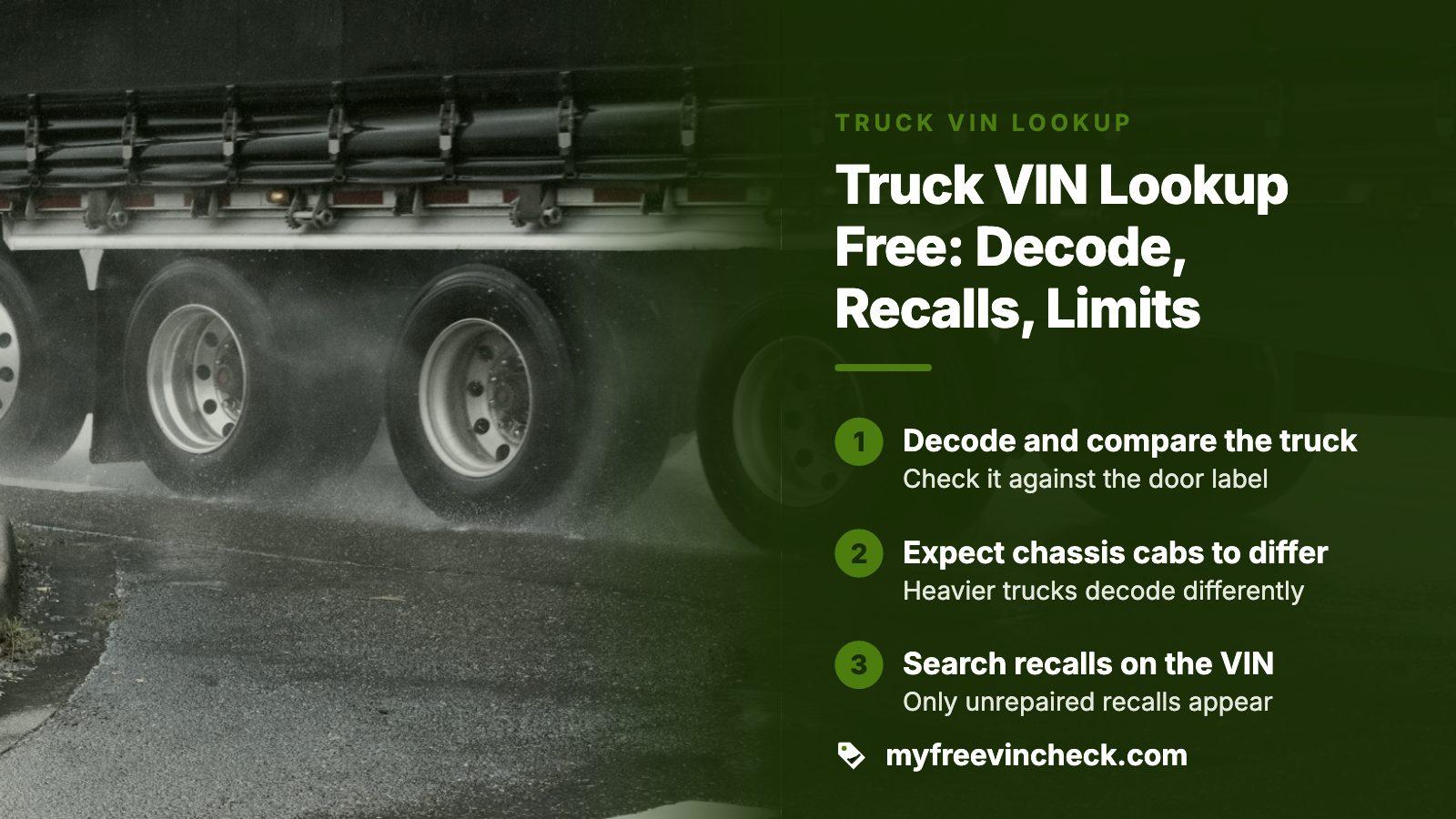
THE SHORT ANSWER
Type the truck's 17-character VIN into NHTSA's decoder to confirm make, model, cab, drive and weight class, then into NHTSA's recall search to see open safety repairs. Both cost nothing. They cannot tell you whether the truck was salvaged, flooded or rolled back on the odometer. For those, start the preview here and buy one report only for a truck you are serious about.
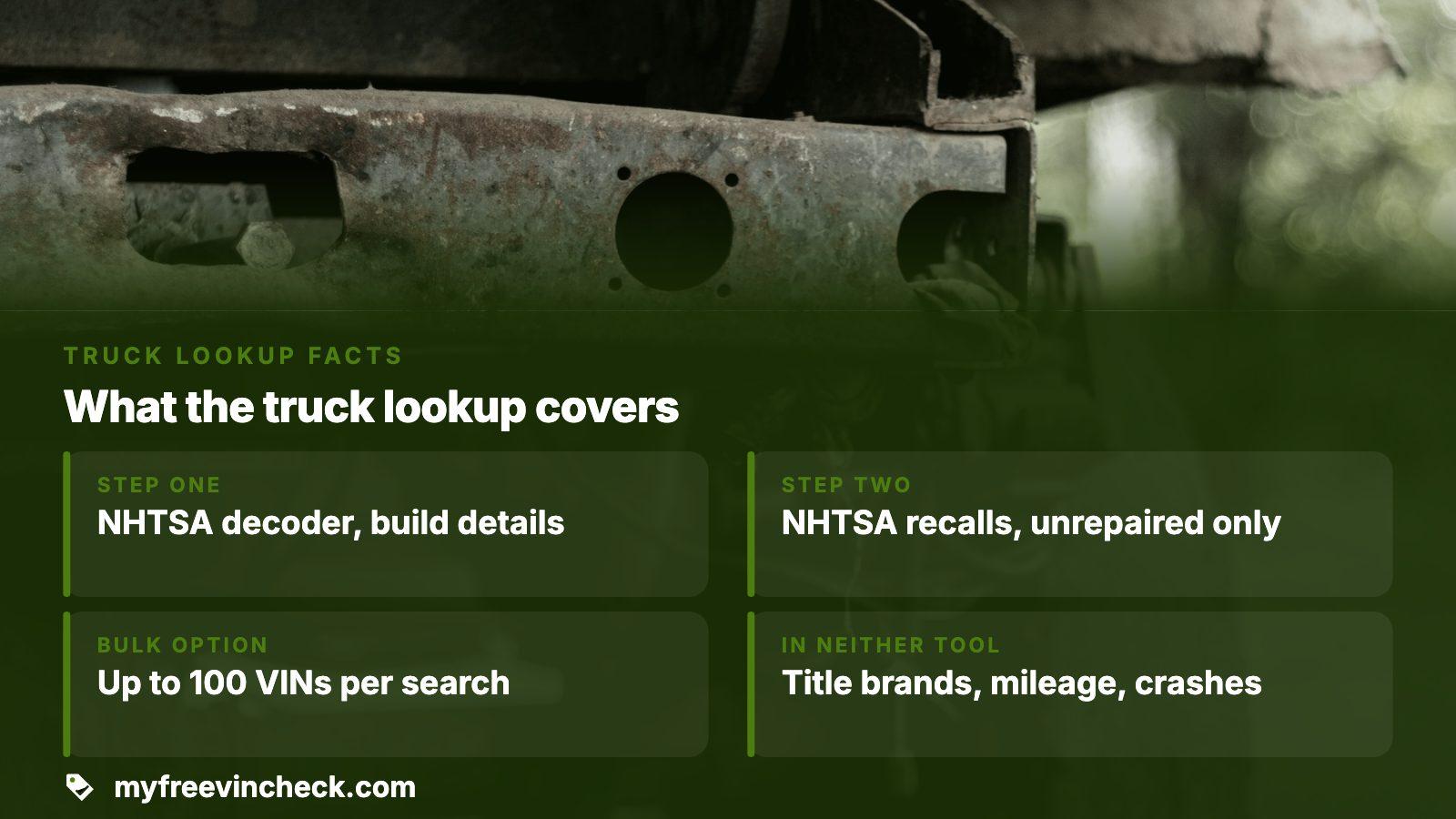
- Free step one
- NHTSA decoder: build details from the VIN
- Free step two
- NHTSA recall search: unrepaired recalls only
- Bulk option
- Up to 100 VINs per recall search
- Not in either tool
- Title brands, mileage history, crashes
What a free lookup covers on a truck
Two public tools do the useful work, and both come from NHTSA. The decoder answers a build question: is this truck what the seller says it is? The recall search answers a safety question: is any repair still waiting on this exact vehicle?
Everything past those two sits behind a different door. Title brands, the last reported odometer reading and insurance total-loss findings live in the federal title system, and a federal summary of that system is open to read on vehiclehistory.gov. Access to the data itself goes through approved providers, who charge for it. That is the gap this site fills, one report at a time with no subscription, and it is described further down.
Step one: decode the VIN and compare it to the listing
Paste the VIN into the decoder and read the result against the ad. A hand-typed test of a pickup VIN returned Ford, F-150, body class Pickup, a crew cab, four-wheel drive, eight cylinders on gasoline and a vehicle type of TRUCK. That is the kind of summary to hold up beside the seller's claims.
- Model and cab: a regular cab listed as a crew cab is a red flag worth asking about.
- Drive and engine: a 4x4 ad on a 4x2 VIN is a plain mismatch.
- Weight class: the decoder prints a GVWR class, such as Class 2F at 7,001 to 8,000 lb for that F-150.
- Plant and year: the model year can be guessed wrong, so enter the year yourself if you know it.
Warnings are part of the answer
The same test VIN came back with a check-digit error, because the ninth character did not calculate properly. On a real truck, that message usually means a typo, but it can also mean a VIN that does not belong to a real vehicle. Retype it before you decide which.
Chassis cabs and heavier trucks decode differently
A work truck is often sold as a bare chassis and finished by a body company, and the decoder reflects that. A partial VIN for a Ford F-550 returned a body class of incomplete chassis cab, a vehicle type of INCOMPLETE VEHICLE, 10 cylinders and Class 5 weight rating at 16,001 to 19,500 lb. The result also cautioned that the truck could have been modified since, so the data might not describe it today.
Take that caution at face value. The decoder knows what left the chassis plant, not what the upfitter bolted on afterward. A dump body, a flatbed or a utility box will not show up,. NHTSA's own message adds that an empty field is no evidence a feature is absent.
Step two: search recalls and know what a clean result means
NHTSA's recall search takes a VIN, or a plate and state, and reports only repairs that are still open. A truck with nothing outstanding gets the message that it has no unrepaired recalls associated with that VIN. Comparing a lot of trucks at once? NHTSA lets you submit up to 100 VINs together.
| The search shows | The search leaves out |
|---|---|
| Open safety recalls on this VIN | Recalls already repaired |
| Result tied to the exact vehicle | Fresh recalls where VINs are still being added |
| Message when nothing is open | Campaigns past the 15-year mark, with exceptions where a maker extends coverage |
| Major makers' campaigns | Small makers, some specialty builds and non-safety campaigns |
That last row matters for trucks, because upfit companies and low-volume builders are exactly the kind of maker that can fall outside the search. A clean result on a stock pickup is reassuring. On a specialty body, it proves less.
What an open recall looks like to the owner
NHTSA's recall list for one model year of a pickup can run long. The 2017 Ford F-150 has 18 campaigns on file, spanning seat belts, door latches, an air bag inflator, the transmission and the brakes. Which of them apply to a single truck is what the VIN search settles.
From an NHTSA owner complaint
An owner of a 2017 F-150 reported in October 2026 that a notice arrived for brake recall 25V236000, but after repeated calls the dealer kept saying the repair part was backordered. Fearing the risk, the owner took the truck to an outside mechanic and covered the brake repair personally. The maker then declined to reimburse, saying parts were available.
The lesson for a buyer: an open recall is a bill or a wait you inherit with the truck. Ask the seller to show the search result on the day you hand over money, and ask the dealer, in writing, whether parts are in stock.
What neither free tool can see
Federal title data exists to expose the problems a clean-looking truck can hide. The federal page defines a brand as a state label for current or past condition, with salvage, junk and flood as examples. Brands travel badly between states: one state may brand a damaged truck while another has no flood label at all, and a branded vehicle retitled elsewhere can come out with paperwork showing no brand.
- Title brands and the states that issued them
- The latest reported odometer reading
- Insurance total-loss or salvage findings
- Transfers to a junk or salvage yard
- Cloned VINs, where a stolen truck wears the identity of a real one
Even the federal report has limits. It is built around five indicators, and a clean one is a good sign, but states and yards do not all report, so a search can miss a problem that exists. Treat any history as a screen, then inspect the truck itself.
A sequence that costs nothing until the last step
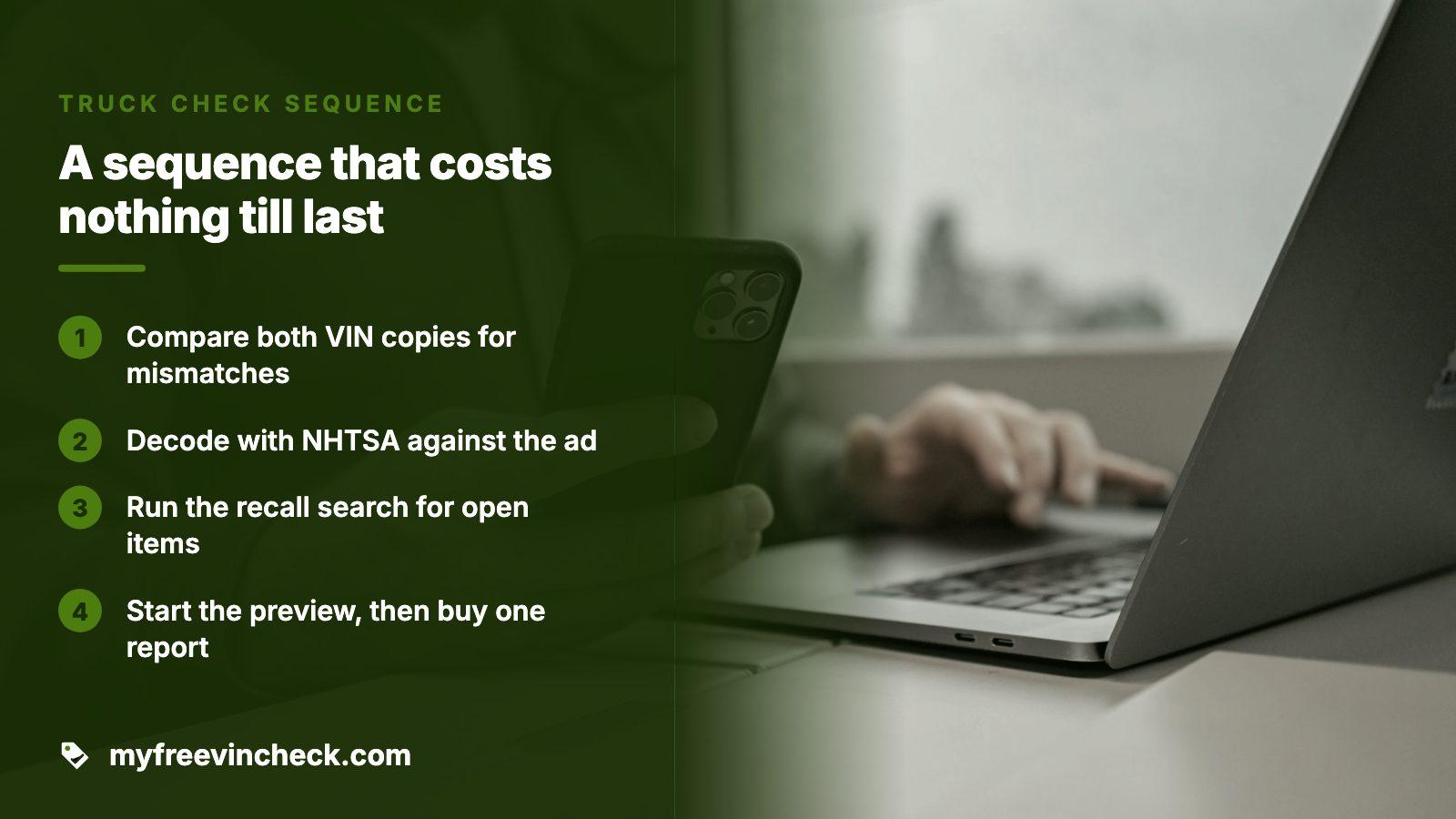
- Copy the VIN from the dash or the paperwork and compare both copies for mismatches.
- Decode it with NHTSA and check make, cab, drive and weight class against the ad.
- Run the recall search and write down anything open.
- Start the free preview on this site to see what records exist for the VIN.
- Buy one report only for the truck you are close to buying.
NHTSA points buyers to the corner of the windshield nearest the driver's door, and to the registration card, which may also carry it on the insurance card. If the dash number and the paper number differ, stop there and ask why.
When the report earns its cost
Begin with the preview. It is free, and it counts the records tied to your VIN. After that, one payment gets you the full report, or a pack if several trucks are in the running, and nothing renews. Look at the pricing page for current options; no figures appear here.
Pay for it when the truck passes the free steps and you are about to commit. One document brings together brand history, damage, mileage readings, auction photos, liens, theft entries and open recalls. Only a mechanic's inspection can show rust, worn suspension or a bent frame, so the report does not replace one.
Where this information comes from
- NHTSA: Check for recalls — what the VIN recall search shows and leaves out, VIN location, batch searches
- NHTSA vPIC VIN decoder — the decoder behind the build details and warnings described above
- NMVTIS consumer information (DOJ) — brands, odometer data, state differences and false negatives
- VehicleHistory.gov — federal overview of the title database for buyers
- NHTSA owner complaint 11773145 — owner experience, paraphrased
Sources and photos: Facts checked against the sources above in November 2026. Photos by fr0ggy5, Anastasiia Nelen and Zoshua Colah on Unsplash; diagrams by MyFreeVINCheck.
Keep reading
- Check a VIN Number for Recalls: Free Lookup, Then the Full PictureMore on reading a recall result and what to do when a repair is open.
- Where Can I Get a Free VIN Check? Three Lookups and What They MissThe same free tools for any vehicle, not just trucks.
- Free Salvage Title Check by VIN: What It Shows and MissesWhere salvage and junk flags come from and how far free tools reach.
- How to Check a VIN Number on a Trailer for Free, and What It MissesBuying a trailer with the truck? Trailer VINs behave a little differently.
Frequently asked questions
Can I really look up a truck by VIN for free?
Yes, for two things. NHTSA's decoder reads the build details and its recall search lists unrepaired safety recalls, both without payment. Neither shows who owned the truck, whether it was branded salvage or flood, or how the mileage changed over time. Those records sit in title databases that providers charge to open.
Does the decoder work on semi trucks and box trucks?
It decodes what the maker encoded, so a chassis cab returns an incomplete-vehicle result and a weight class rather than a finished truck description. Bodies added later by an upfitter will not appear. Treat the output as the starting chassis and confirm the rest by inspecting the truck.
Why does my truck VIN show an error?
The most common cause is a mistyped character, which makes the ninth-position check calculation fail. Partial VINs also return an incomplete-VIN message. Retype the number from the dash and the registration, and compare both. If the two disagree with each other, treat that as a serious warning sign.
A recall search says zero open recalls. Is the truck fine?
It means NHTSA currently holds no open repair against that VIN. It does not cover repaired recalls, very new campaigns still being loaded, small makers or non-safety service campaigns. It also says nothing about accidents or title history, so pair it with a history check and an inspection.
What does the free preview here show before I pay?
The preview counts the records attached to your VIN, which lets you decide if a report is worth the money. The report is a distinct step with its own single payment and no renewal. Only the preview is free; the pricing page has the current choices.
Now check the car itself
The guide explains what to look for. The report shows what this VIN has on record.