THE SHORT ANSWER
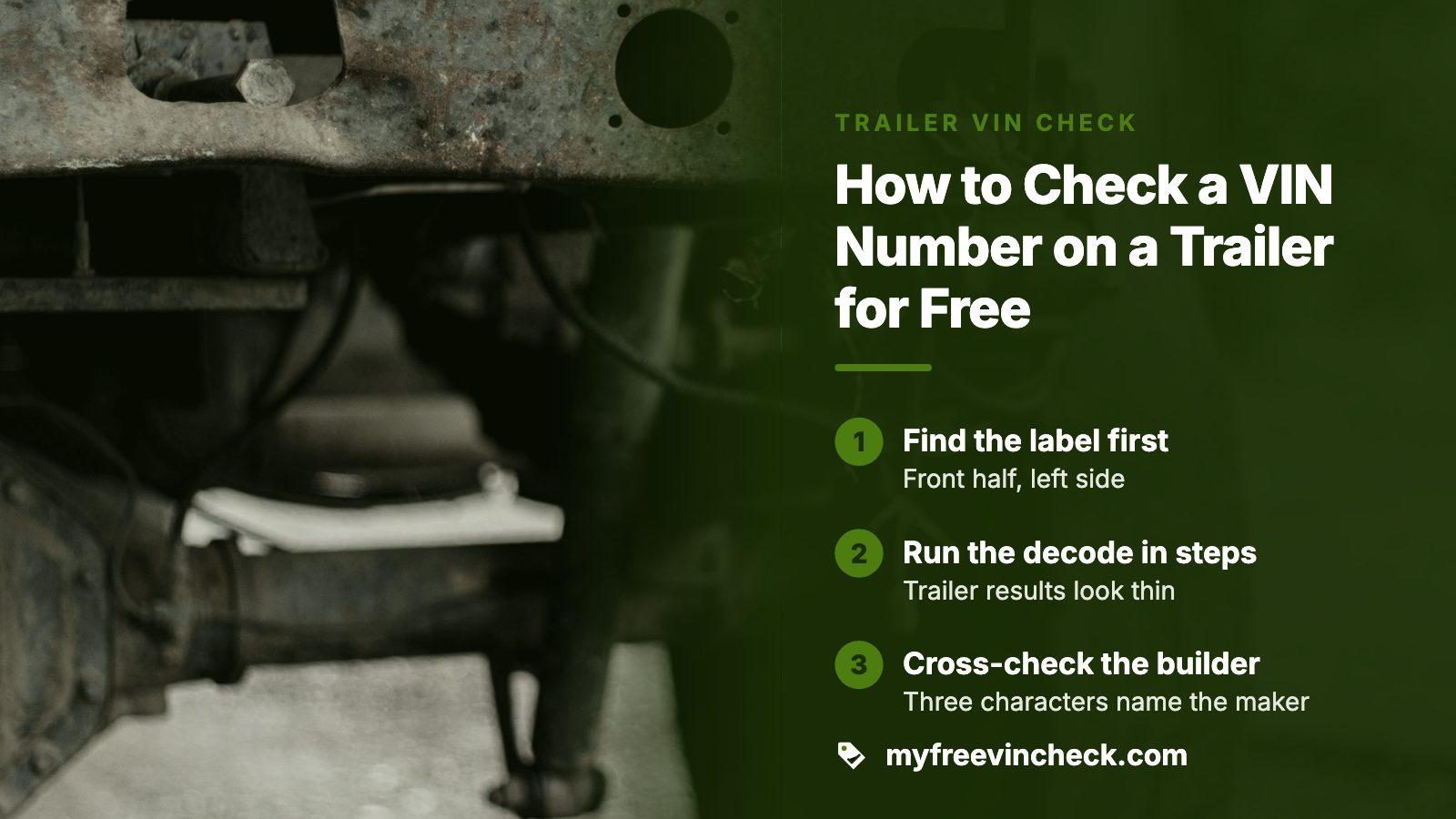
Find the certification label on the front half of the trailer's left side, copy the VIN exactly, and enter it in NHTSA's vPIC decoder to confirm the builder, the model year and a vehicle type of trailer. Then run NHTSA's recall lookup with the same number. Both cost nothing. They say nothing about theft, liens or title history, so for a trailer you plan to pay for, add a title check and the free preview.
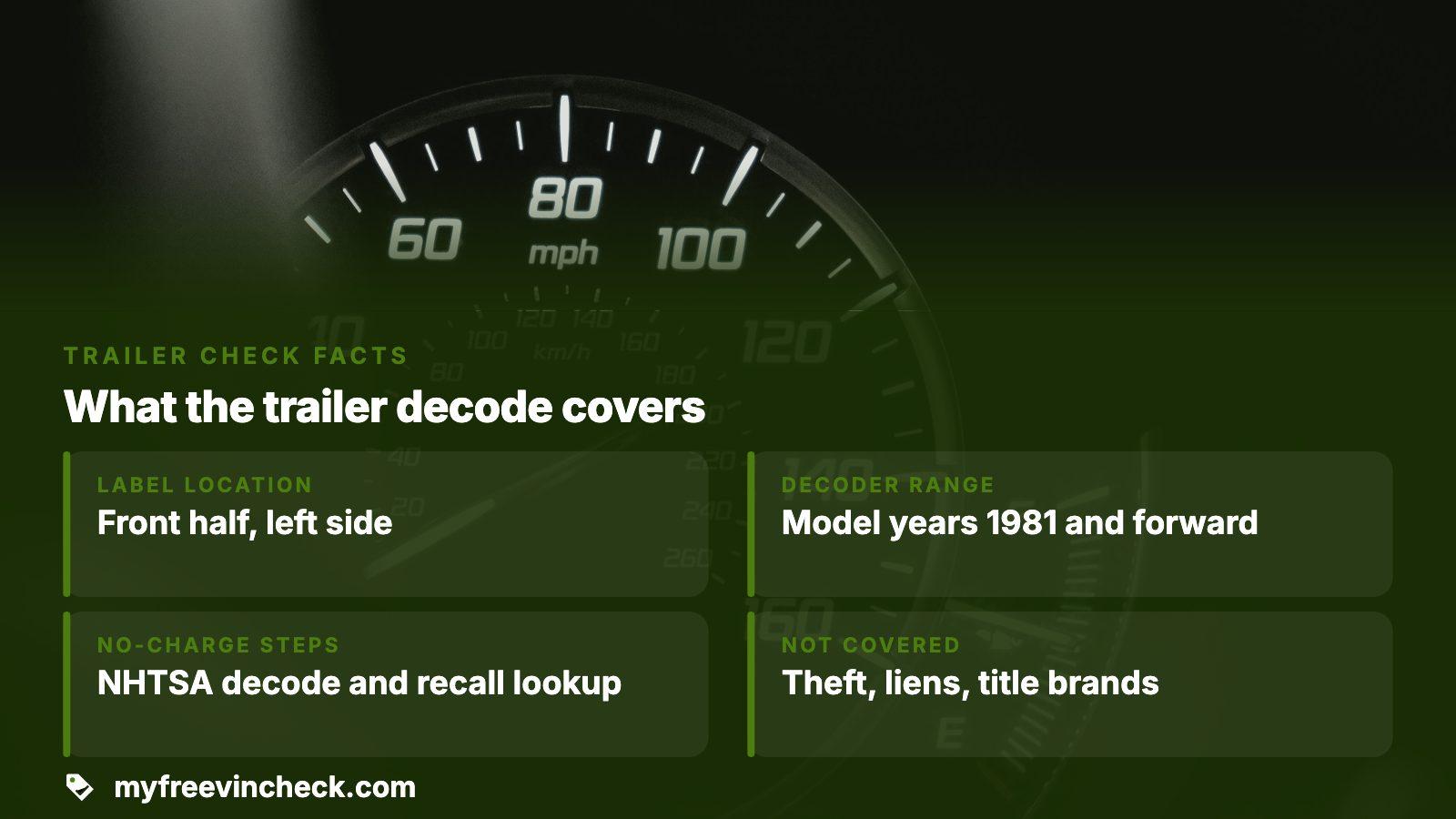
- Label location
- Front half of the trailer's left side
- Decoder range
- Model years 1981 and forward
- Free steps
- NHTSA decode and NHTSA recall lookup
- Not covered
- Theft, liens and title brands
Start with the label, not the listing
Federal rules put a trailer's certification label on the front half of its left side, readable from outside without moving anything. It has to be riveted or otherwise fixed so that prying it off wrecks it, so a label that lifts away intact deserves a question. Texas DMV adds a tip: check the tongue first, where the maker's name usually sits. A name there points to a factory-built trailer. Photograph all of the following before you leave.
- The VIN, copied one character at a time
- Month and year of manufacture
- GVWR, the most the loaded trailer may weigh
- GAWR for each axle, front to rear
- The builder's name, shown as Resp Mfr when a seller who builds trailers took on legal responsibility
Why a trailer decode looks thin
NHTSA's vPIC decoder takes trailer VINs, and it is built for model years 1981 onward, drawing on reports that makers file. That is why a trailer record reads differently from a car's: the five characters after the builder code only have to describe trailer kind, body, length and axle layout.
| Vehicle | What the middle characters must let the maker's filing decode |
|---|---|
| Passenger car | Make, line and series, body style, engine and restraint equipment |
| Trailer | The make, plus trailer type, body style, length and the number and layout of axles |
Expect a result that names the builder and model year and little more. A vehicle never meant for the US market returns only a limited result.
Running the decode in five steps
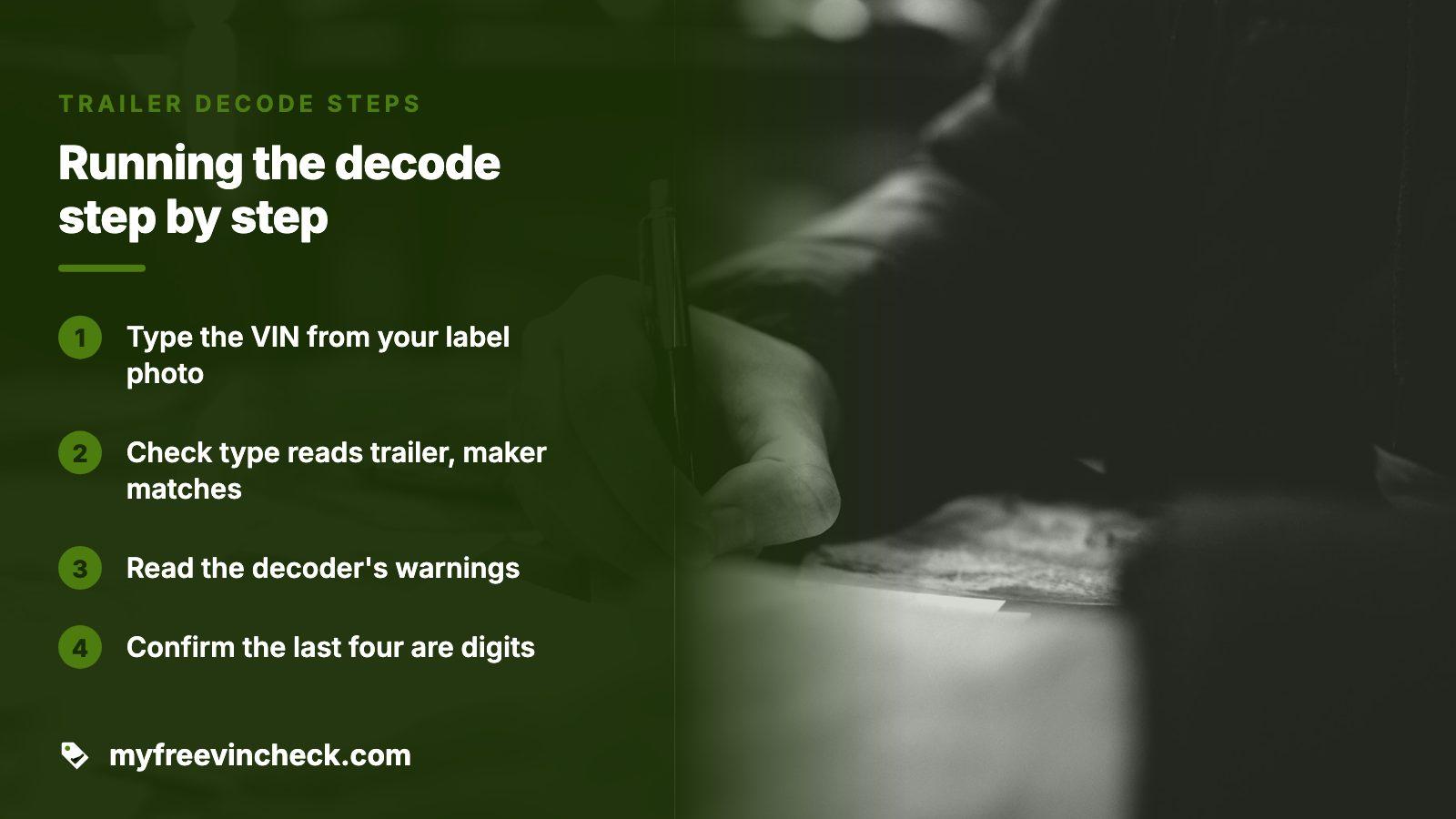
- Type the VIN from your photo of the label, not from the advert.
- Enter it in the vPIC decoder, adding the model year if the label's build date gives you one.
- Read the vehicle type. It should say trailer, and the maker should match the label.
- Read the warnings. The decoder flags a model year that disagrees with the tenth character.
- Check the last four characters. A trailer's must all be digits, so a letter there means a copying slip or a number to question.
The ninth character is calculated from the others to catch copying mistakes.
Cross-checking the builder from three characters
NHTSA's register of builder codes can be searched on its own. Enter the first three characters and it returns a builder name and a vehicle type.
| First three characters | What the register returned |
|---|---|
| 5KT | Karavan Trailers Inc., vehicle type Trailer |
| 1UY | Utility Trailer Manufacturing Company, Trailer |
| 4YM | Carry-On Trailer, Inc., Trailer |
| 4P5 | PJ Trailers Manufacturing, Inc., Trailer |
A 9 in third position signals a six-character builder code, used by low-volume makers. A code the register does not know, such as 5HG when tested, returns nothing. That proves little alone, but the label and the title must then carry the proof.
The recall lookup, and a trailer VIN it would not accept
Trailers do carry recalls. NHTSA's data for a 2014 Keystone Montana lists four campaigns, covering fire extinguishers, a microwave, entry-step rivets and an awning motor. Each remedy was free to the owner.
From an NHTSA owner complaint
In a December 2017 filing, the owner of a 2017 KZ-RV Gold, a maker NHTSA files under trailers, said they were trying to rule out recalls but the lookup "keeps saying the VIN is wrong" despite a photo of the VIN tag. The record does not say how it ended.
If a lookup rejects a number, compare it with your photo one character at a time, then search by make, model and year instead.
When a maker says the VIN is not covered
Recalls are written around build dates and parts, while the lookup answers by VIN, so some replies sound final and are not.
From an NHTSA owner complaint
A March 2015 complaint from the owner of a 2013 Keystone Montana High Country fifth wheel said an entry-step rivet snapped underfoot and one side collapsed, so a bolt went in as a patch. Keystone replied that the VIN sat outside the recall scope, though the owner noted a parts supplier made the step assembly. NHTSA's recall data shows a step-rivet campaign for certain Montana trailers, 15V102000, logged about a month earlier.
Read a "not covered" reply as a ruling on scope, not a clean bill for the part. If your trailer's part matches a recall description, ask the maker to explain in writing and report the failure to NHTSA.
When the label is missing or looks wrong
A trailer with no VIN is not automatically stolen, since some are homemade. Texas requires a VIN on a newly assembled trailer, issued after a law enforcement officer who handles auto theft inspects it, using Forms VTR-68A and VTR-68-N. Texas also refuses to register a factory trailer with lost paperwork as an assembled one.
- Does the label's VIN match the title and bill of sale exactly?
- Is the label riveted down, or does it lift off?
- Is the trailer factory-built or assembled? The tongue's maker name usually settles it.
- If there is no title, does your state require one at this weight?
Title rules differ by state. Texas titles manufactured trailers above 4,000 pounds gross weight, while for lighter used ones proof of ownership can be a bill of sale paired with the registration receipt.
What the free tools leave out
The decoder describes how the trailer was built, and the recall lookup lists open campaigns. Neither reports theft, liens, title brands or sale history, so those need other sources.
| Question | Tool | Gap |
|---|---|---|
| What was it built as? | NHTSA vPIC decoder | Thin for small builders |
| Any open recall? | NHTSA recall lookup | Answers by VIN and build scope only |
| Reported stolen or a total loss? | NICB VINCheck, a free lookup | Check its own page for trailer coverage |
| Junk or salvage record on the title? | A state title check through NMVTIS, paid | The Texas page does not say trailers are included |
Texas Title Check runs the VIN through NMVTIS and shows whether a junk or salvage yard held the vehicle or an insurer called it a total loss. Providers charge for it, and neither that page nor the federal NMVTIS site says whether trailers are included, so ask before paying.
Where the free preview fits
After the free tools, put the VIN into the free preview: a count of the records on file for that number, no card needed. Trailers are titled under state rules that vary, and some are never titled, so a trailer may show fewer records than a car.
If the preview counts records, the paid report spells them out, such as title brands, liens and theft or salvage entries. It is bought once, with no subscription, and current amounts sit on the pricing page. If the count is zero, do not pay hoping the report finds something; rely on the label, the title, the decode, the recall answer and your state's check.
Where this information comes from
- NHTSA vPIC VIN decoder — decoder range, trailer VINs, builder register and limited results
- eCFR 49 CFR 565.15, VIN content — what trailer VIN characters must describe, and the digit rule
- eCFR 49 CFR 567.4, certification label — label position and what it lists on a trailer
- Texas DMV: trailers — titling by weight, assembled trailers and missing VINs
- Texas DMV: Title Check — what a paid NMVTIS title check shows
- NHTSA owner complaint 11052590 — owner experience, paraphrased
- NHTSA owner complaint 10701437 — owner experience, paraphrased
Sources and photos: Facts checked against the sources above in November 2026. Photos by Zoshua Colah, Owen Michael Grech and NATHAN MULLET on Unsplash; diagrams by MyFreeVINCheck.
Keep reading
- Check a VIN Number for Recalls: Free Lookup, Then the Full PictureThe recall lookup in more detail, including what to do when a campaign is open.
- Where Can I Get a Free VIN Check? Three Lookups and What They MissWhat a free decode and recall check show for any vehicle, not only trailers.
- Free Salvage Title Check by VIN: What It Shows and MissesHow to look for salvage and total-loss signals before paying.
- Is a Free VIN Check Legit? What the Real Ones Cover and MissHow to judge what a free VIN check can honestly promise.
Frequently asked questions
How can I check a trailer's VIN for free?
Copy the VIN from the certification label on the trailer's front left side, decode it in NHTSA's vPIC tool, then run NHTSA's recall lookup. For theft and total-loss reports, add NICB's free VINCheck. None of these shows title brands or liens, so keep the title and the seller's paperwork beside you.
Do all trailers have a standard-length VIN?
NHTSA's decoder covers model years from 1981 on, and the federal format runs seventeen positions. Older trailers, homemade ones and state-assigned numbers may not follow it, so a different-looking number is a question for the seller, not a verdict on the trailer.
The decode shows almost nothing about my trailer. Is that a bad sign?
Usually not. A trailer's VIN only has to describe a few traits: the type, the body, the length and the axles. A vehicle never meant for the US market also returns only a limited result. Treat a thin decode as normal, and treat a record that contradicts the label as the real problem.
Can I find out for free whether a trailer was stolen?
NICB offers a free VINCheck lookup for theft and some total-loss reports. Read its page for what it covers, trailers included, because a clean answer only reflects what insurers reported. Match the VIN to the title and the seller's name too.
Is the preview free for a trailer VIN?
Yes. The preview costs nothing and asks for no card; enter the VIN and it shows how many records exist for it, so a count of zero tells you where to stop. The full report is a separate purchase, with amounts on the pricing page, and it is not free.
Now check the car itself
The guide explains what to look for. The report shows what this VIN has on record.