THE SHORT ANSWER
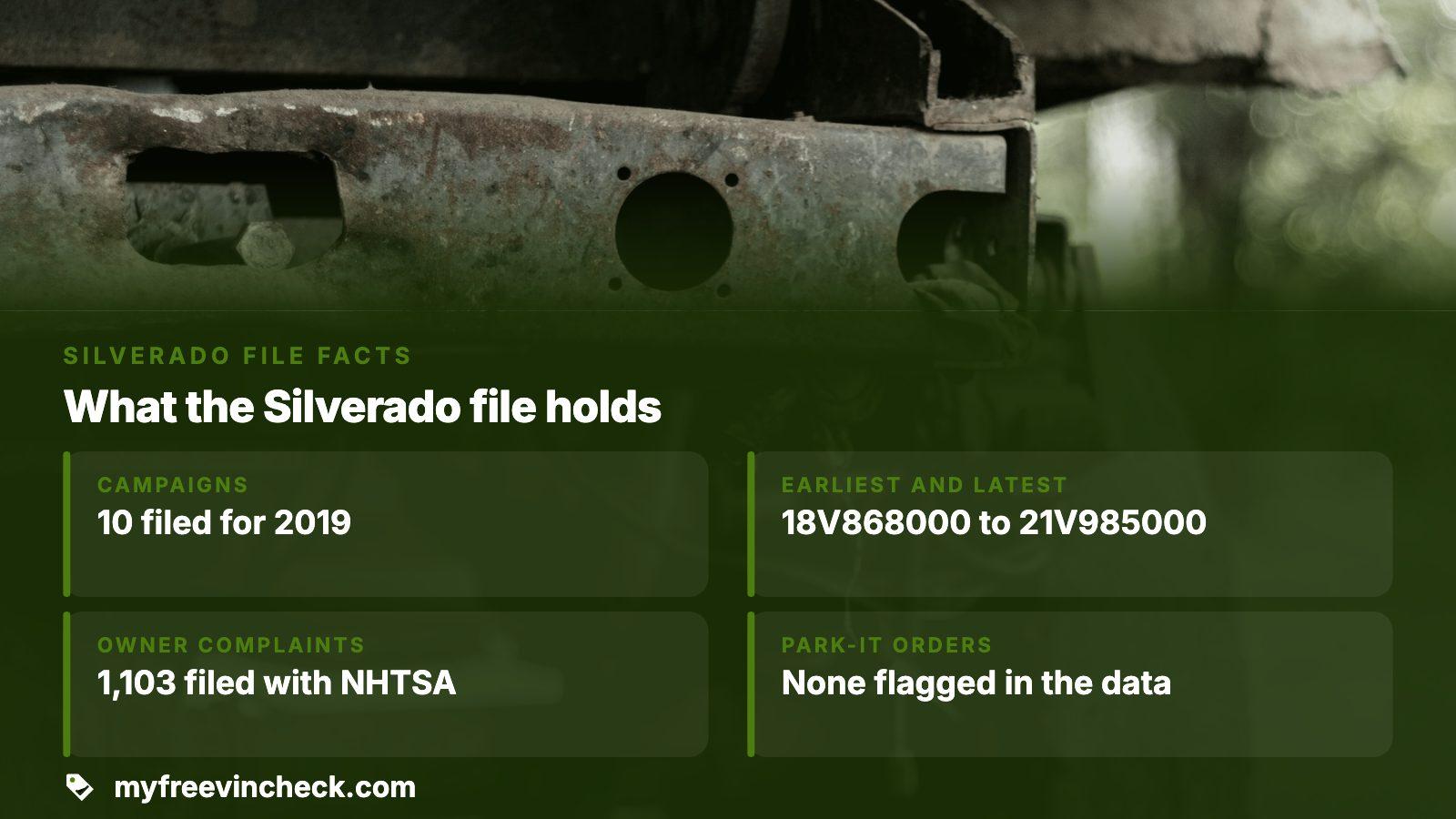
The 2019 Chevrolet Silverado 1500 has 10 NHTSA recall campaigns, announced between December 2018 and December 2021. Two involve brake control software, three involve tires, two involve seat belts, and the rest cover an air bag module, a battery cable and a driveshaft. GM repairs each one at a dealer without charge, but only for trucks in the affected range. The VIN shows which apply.
- Campaigns
- 10 filed under the 2019 model year
- Earliest and latest
- 18V868000 (December 2018) to 21V985000 (December 2021)
- Owner complaints
- 1,103 filed with NHTSA
- Park-it orders
- None flagged in the NHTSA data
The ten campaigns on file for the 2019 truck
The list below comes straight from NHTSA's recalls data for this make, model and year. Several campaigns also name the 2020 model or the matching GMC Sierra, because both trucks share parts, so a notice on this list can reach a neighbor model too.
| Campaign | Part | Risk named | Dealer fix |
|---|---|---|---|
| 18V868000 | Passenger air bag module (Crew Cab) | Bag may not inflate properly | Replace the module |
| 19V814000 | Front belt pretensioner bracket | Hot gas could ignite the carpet | Close off the bracket opening |
| 19V888000 | Battery positive cable at the alternator | Stall, or arcing and fire | Inspect, clean, replace damaged parts |
| 19V889000 | Brake control module software | Stability control and ABS may switch off | Reprogram the module |
| 20V055000 | Brake control module software | Electronic brake assist may switch off | Reprogram the module |
| 20V650000 | Driveshaft joint weld | Driveshaft may separate while moving | Replace the driveshaft |
| 20V792000 | Center front seat belt bracket | Belt may not restrain the occupant | Inspect and reassemble |
| 21V115000 | Continental tires, over-cured | Sidewall break or belt separation | Inspect, replace as needed |
| 21V423000 | Tires, over-cured | Sidewall break or belt separation | Inspect, replace as needed |
| 21V985000 | 17-inch spare with accessory wheels | ABS may not work properly | New compatible spare and label |
Two brake software notices, a few weeks apart
The brake control module is the computer behind stability control, antilock braking and electronic brake assist. Campaign 19V889000 says a software error can disable stability control and ABS, and that the warning lights might stay dark when it happens. The module on some trucks received a software update, and campaign 20V055000 says that update carried its own error that can cut brake assist. GM's fix for both is a reprogramming visit; the first began in February 2020 and the second later that month.
A truck that had one reflash may still be open on the other. A seller who says the brake recall was handled should be able to name which campaign number the paperwork shows.
From an NHTSA owner complaint
An owner of a 2019 Silverado 1500 told NHTSA in February 2020 that the truck went in for the brake recall, then the pedal later dropped to the floor. After a second dealer visit, the brakes failed again within days and the truck hit another vehicle, with one injury reported. The filing is one owner's account, not a finding by the agency.
Treat that as a reason to test-drive any truck of this year with an eye on the pedal feel, and to ask for the service record, not just the recall status.
Three tire notices, and why they matter for resale
Two campaigns, 21V115000 and 21V423000, describe tires that were cured too long at the factory. The result can be a sidewall break with sudden air loss, or a belt edge separation that lets tread peel away. The first reaches a wide spread of GM vehicles plus aftermarket Continental tires; the second is narrower and names the 2019 Silverado 1500 and Sierra 1500. The third, 21V985000, is about a spare: the 17-inch one supplied with certain trucks does not suit the accessory wheels, and ABS may then misbehave.
From an NHTSA owner complaint
An owner reported to NHTSA in April 2022 that a front tire on a 2019 Silverado 1500 had separated down to the cord. A tread-separation recall followed a week later, but the dealer called the damage road-related and outside the bumper-to-bumper warranty, so the owner paid to replace it.
The lesson for a buyer is plain: read the tire sidewalls, not only the recall screen. A recall that says open means the inspection is still owed; a recall that says done does not guarantee the tires now on the truck are the replacements.
The fire, stall and driveline notices
Three campaigns concern parts that can fail while the truck is moving. Campaign 19V888000 says glue on the battery cable rings may give an intermittent link to the alternator, which could stall the truck or cause arcing. Campaign 19V814000 says gas from a seat belt pretensioner could vent into carpet. Campaign 20V650000 says a driveshaft joint may be poorly welded, so the shaft can come apart in motion and power to the wheels is lost.
Ask the seller whether the driveshaft was replaced, and have an inspector look at it from underneath.
Running the recall check on one Silverado
Because the notices cover certain trucks, the decode comes first: it confirms the model year and cab style, which matters because the air bag campaign names Crew Cabs. Then the recall check shows what is still open.
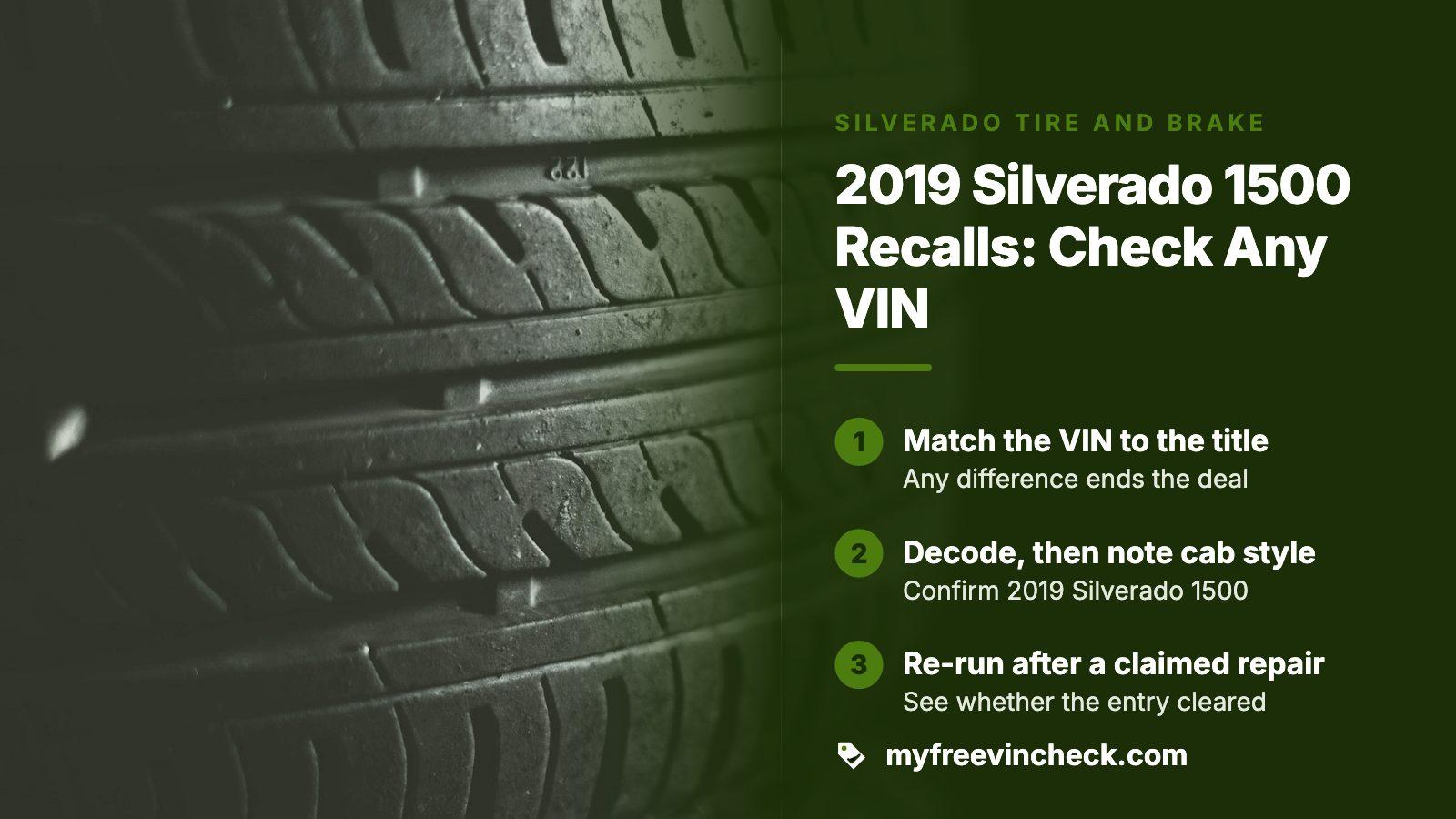
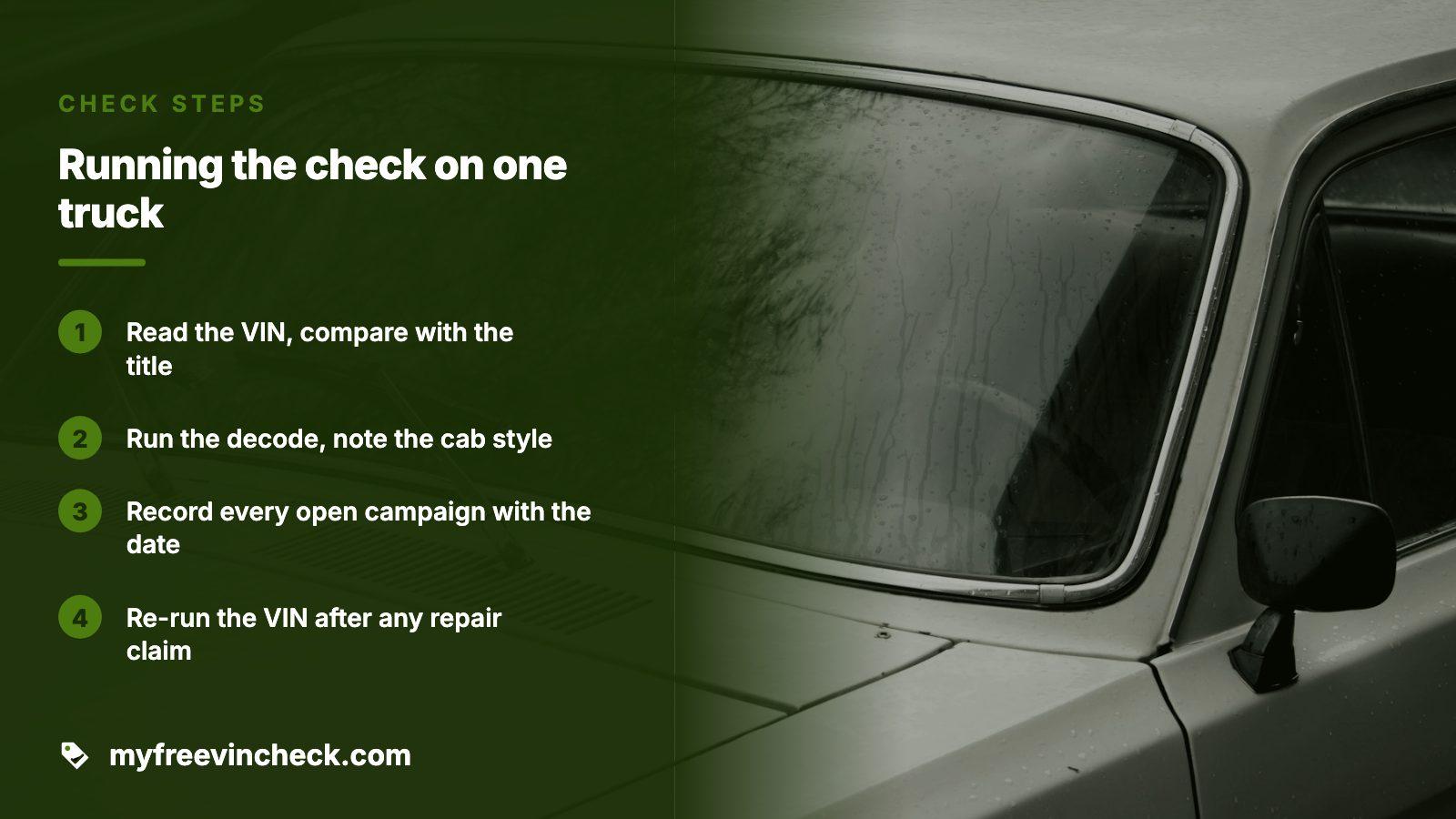
- Stand at the truck and read its VIN, then hold it against the title or registration. Any difference between the two ends the deal.
- Run the free decode and confirm a 2019 Chevrolet Silverado 1500, and note the cab style.
- Run the recall check and record every open campaign number with today's date.
- For any campaign the seller calls finished, ask for the dealer repair order, then run the VIN again to see whether the entry cleared.
The agency's own lookup follows the same logic, and one search can hold 100 VINs, handy when a lot has several Silverados.
How much a clean recall screen proves
NHTSA says its VIN search reports unrepaired recalls only. When nothing is open, the screen prints a zero count for that VIN. Several things stay invisible even then, and each matters before a deposit.
- Repairs already finished do not appear, so you cannot tell which campaigns were ever open.
- Very recent notices may be missing, because VINs are added to the database as they are identified.
- Dealer service campaigns that never became safety recalls are not in the lookup.
- Nothing in recall data reveals a salvage brand, an odometer rollback, a lien or a collision.
Reading the complaint file beside the recalls
Reading through the 1,103 filings, NHTSA's data shows 28 with a crash, 8 with a fire and 15 injuries. The components named most often are the engine with 383 mentions and the power train with 331, followed by the electrical system and the service brakes at 192 each. A filing can name more than one component, so these tallies overlap.
None of the 10 campaigns addresses the engine or the power train, which is why a recall-only check leaves a gap. Shifting behavior and engine noise belong on the test-drive list in their own right.
Where the free lookup stops and the paid report starts
The decode and the recall check cost nothing here, and the preview of a report is free too. They answer what the truck is and which safety campaigns are open. They cannot say who owned it, whether it was in a crash, or whether the odometer is honest.
When one truck is the serious candidate, the paid report brings in the records a recall screen cannot: brands on the title, collision damage, mileage history, liens and theft. You pay once per report, see the pricing page for the packs, and nothing renews. Run the free tools on every truck on your list, and spend on a report for the one you plan to buy.
Where this information comes from
- NHTSA: Check for recalls — The agency's VIN and plate lookup, and what it leaves out.
- NHTSA recalls API: 2019 Chevrolet Silverado 1500 — Source of every campaign number, date and remedy in the table.
- NHTSA complaints API: 2019 Chevrolet Silverado 1500 — Complaint totals and component tallies for the model year.
- NHTSA owner complaint 11307762 — owner experience, paraphrased
- NHTSA owner complaint 11462646 — owner experience, paraphrased
Sources and photos: Facts checked against the sources above in November 2026. Photos by Benjamin Brunner, Tigran Shishmanyan and Zoshua Colah on Unsplash; diagrams by MyFreeVINCheck.
Keep reading
- Check a VIN Number for Recalls: Free Lookup, Then the Full PictureThe step-by-step version of the recall lookup used here.
- 2014 Chevrolet Silverado 1500 Recalls: What to Check by VINAn older Silverado year with a longer campaign list.
- Truck VIN Lookup Free: What You Get, What You Don't, and the Next StepWhat the free tools cover when you shop for a pickup.
- Tire Recall Check: What a VIN Search Misses and the Sidewall Code FindsHow to look up a tire notice separately from the VIN.
Frequently asked questions
How many recalls does the 2019 Chevrolet Silverado 1500 have?
The agency has 10 campaigns filed against this model year. They cover an air bag module, a battery cable, a driveshaft, two brake software errors, two seat belt parts and three tire matters. None applies to every truck, so the VIN lookup is what shows whether a given Silverado is affected and still open.
Are 2019 Silverado 1500 recalls repaired for free?
Each campaign's remedy text says GM dealers do the work free of charge. Call a Chevrolet dealer with the VIN before booking to confirm the truck is covered.
Can I check Silverado recalls on this site without paying?
Yes. The VIN decode and the recall check run on NHTSA data with no charge, and the preview costs nothing either. A full report is bought separately, worth it when you are close to buying one specific truck and want title, accident and odometer records.
Does a brake recall that was done mean the truck is fixed?
It means the dealer reprogrammed the module for that campaign. Two separate brake software notices exist for this year, so confirm both numbers appear on the repair order. Feel the pedal on a test drive, and treat a soft or sinking pedal as a reason to walk.
Do the recall results cover engine and transmission problems?
No. Owners filed more complaints about the engine and power train than any other area, yet none of the 10 campaigns addresses either. Recall data only shows formal safety campaigns, so budget for a pre-purchase inspection to look at shifting, noises and fluid condition.
Now check the car itself
The guide explains what to look for. The report shows what this VIN has on record.