THE SHORT ANSWER
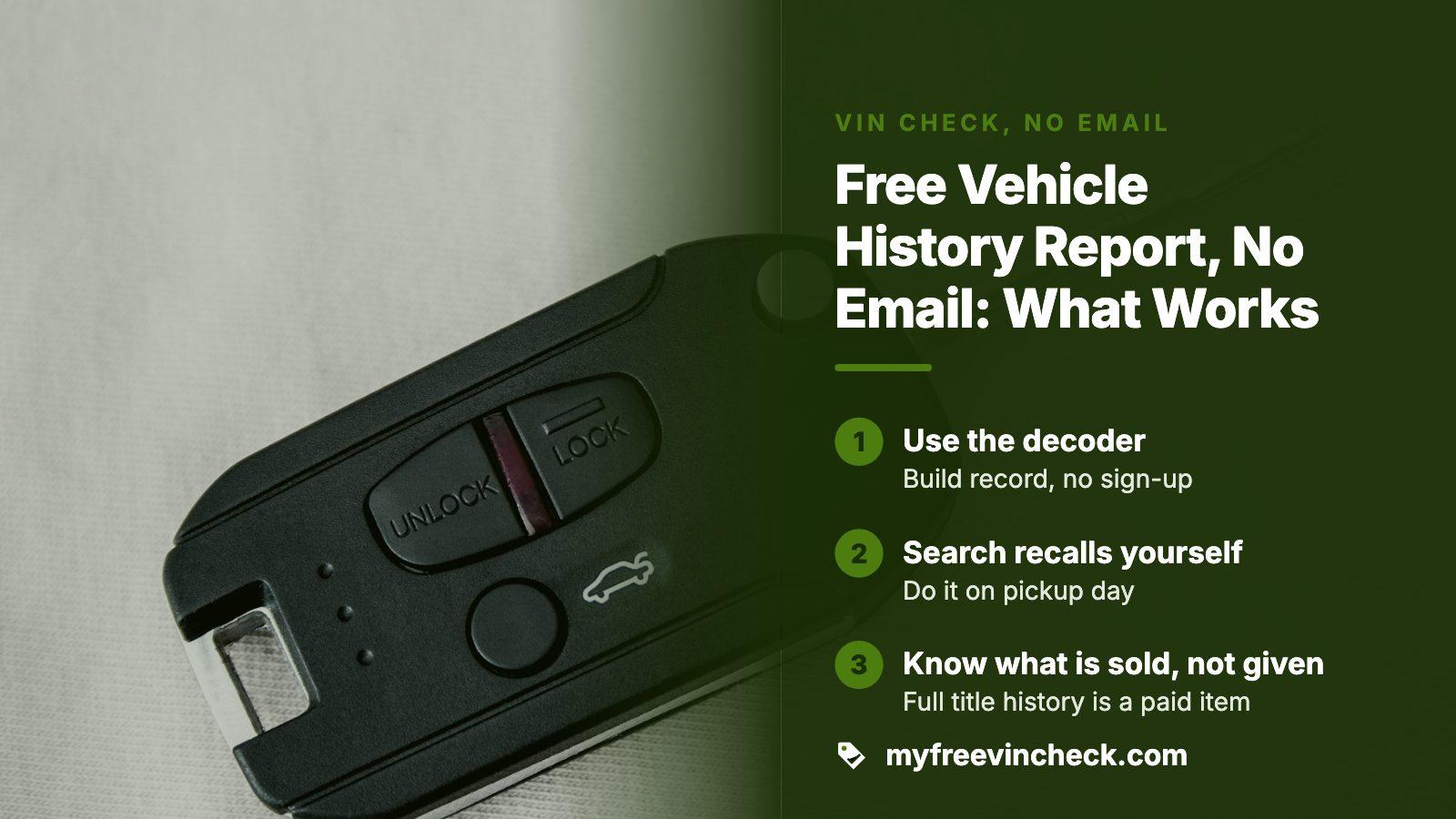
Skip any site that trades a report for your email. Use NHTSA's VIN decoder, NHTSA's recall search and NICB's VINCheck: their forms want a VIN and no contact details. They show build data, unrepaired recalls and insurer theft, salvage and flood reports. Title brands, odometer history and crash records need a paid report. On this site the preview takes a VIN alone, and an email is asked for only at checkout.
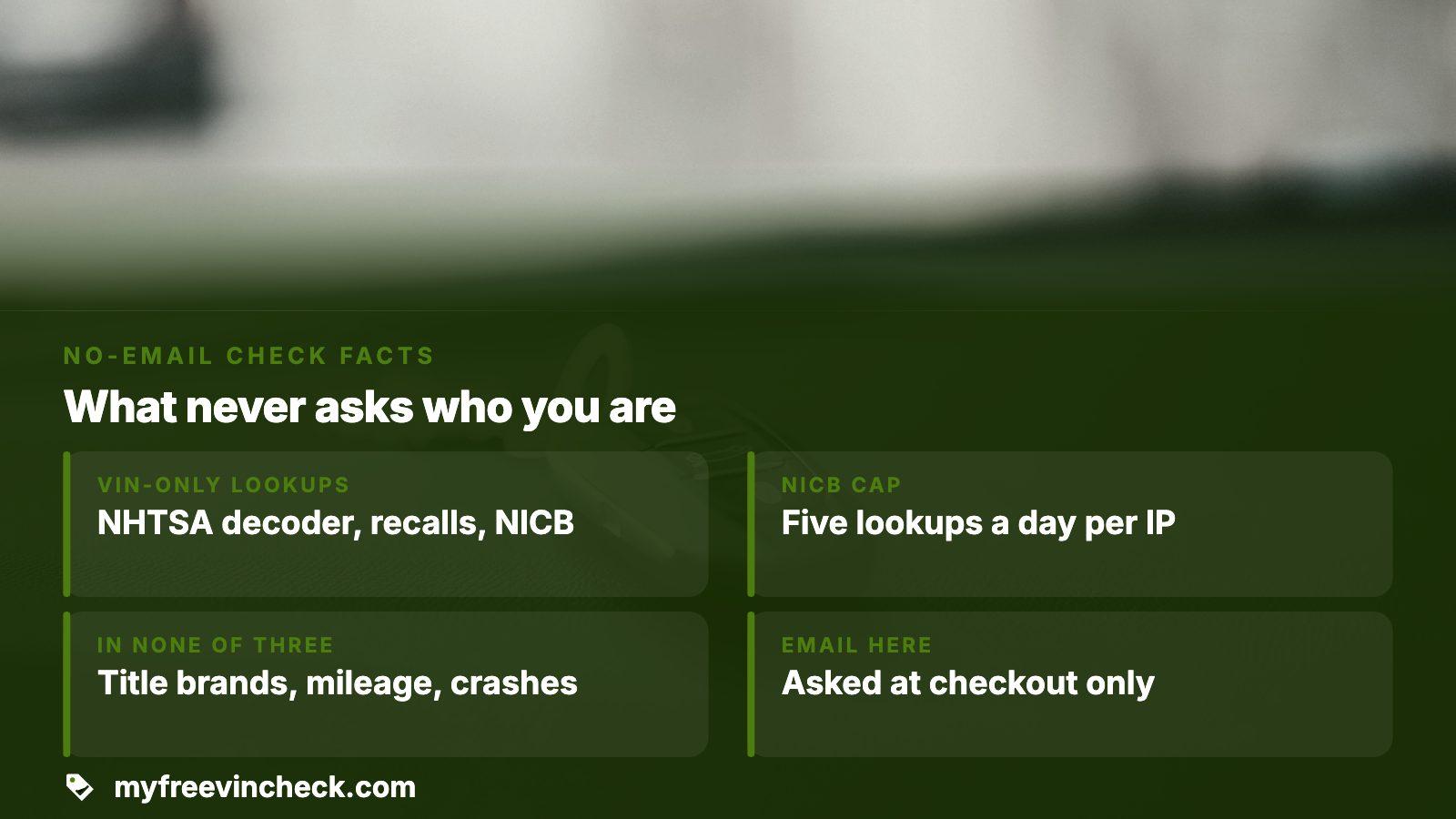
- VIN-only lookups
- NHTSA decoder, NHTSA recall search, NICB VINCheck
- NICB cap
- Five lookups a day per IP address
- In none of the three
- Title brands, odometer history, crash records
- Email on this site
- Asked at checkout; the preview takes a VIN
Three lookups that never ask who you are
A full report with no email attached does not exist, because the title records behind one are sold. With only the 17-character number you can still run three public lookups, and none has an email field.
| Lookup | What it asks for | What it answers | What it cannot see |
|---|---|---|---|
| NHTSA VIN decoder | The VIN; model year is optional | Year, make, model, engine and build plant as the manufacturer reported them | Owners, title, mileage, crashes, recalls |
| NHTSA recall search | The VIN, or year, make and model | Whether that car still waits on a recall repair | Repaired recalls, recalls past 15 years, maker service campaigns |
| NICB VINCheck | The VIN and a tick for the terms | Theft, salvage or flood reports filed by participating insurers | Police records, uninsured damage, title brands, mileage |
Each one answers a single question and stops. Run all three and you hold a filter, not a history.
Decode first: the build record is the cheapest lie detector
NHTSA's decoder page offers a VIN box, an optional model-year box and a willingness to take a partial VIN. Nothing on it asks for a name. The output is the manufacturer's own build record, aimed at model years from 1981 on and at cars made for sale in the US.
The partial VIN 5UXWX7C5*BA went through NHTSA's public API with no key and no login. The reply flagged the VIN as incomplete, yet still named a 2011 BMW X3 xDrive35i with all-wheel drive and a 3.0 L six-cylinder engine rated at 300 hp, built in Munich. Of 154 fields in the record, 116 were blank, which NHTSA says means no data on file rather than a missing feature.
Run the recall search yourself, on pickup day
Type a VIN into NHTSA's recall search and it says whether that car is still waiting on a recall repair; a clean car gets a zero message. Entering a VIN is voluntary, and the only email option on the page is for optional alerts.
- Recalls that were already repaired do not appear.
- Brand-new recalls may be missing while NHTSA adds the affected VINs.
- Recalls older than 15 years drop out unless the maker covers more.
From an NHTSA owner complaint
In a 2021 complaint, the owner of a 2014 Jeep Cherokee wrote that the car refused to move at a green light, in drive or reverse. The buyer had seen a recall flagged on a history report before purchase and raised it with the dealer, who replied "we took care of that". No paper backed that up.
A minute on the federal search beats a spoken assurance. If a recall ever turned up, ask for the repair paperwork.
NICB VINCheck screens insurer records, and only those
NICB's lookup checks the VIN against records from participating member insurers: cars reported stolen and never recovered, declared salvage, or damaged by flood. NICB puts those insurers at 92.49% of US earned premium. A salvage entry tells you an insurer paid out on the car instead of repairing it; such a car may be rebuilt and retitled legally.
Three limits apply. One IP address gets five searches in any 24 hours, so spend them on finalists. A mistyped VIN can miss a match. No police records or opted-out insurers feed it, and NICB says plainly it is no full history to lean on when buying.
Flood is the soft spot. If the owner never carried insurance or filed a claim, a drowned car can be cleaned up and sold on its original clean title. Title washing is the other route: retitle a flood or salvage car in another state.
Why the full title history is sold, not given away
The Justice Department's FAQ explains that the Anti-Car Theft Act requires the national title system to run on user fees, not federal money, so a consumer buys through an approved provider at a price that varies. The data covers title state and date, latest odometer reading, theft history, brands with dates, and salvage or total-loss entries. An empty result may only mean participating states reported nothing, so it is no proof of a clean past.
From an NHTSA owner complaint
A 2017 Chevrolet Malibu owner told NHTSA that the car stalled at about 30 mph on the day it was bought from a used-car dealer. Only afterward, checking a history report, did the owner learn the car had been totaled before. The dealer offered no help.
That record existed before the sale and was read after it. The order is what to reverse.
Why a "free report" site wants your email first
A page that promises a report for nothing and then asks for contact details may be selling something other than the report. The FTC warns that some history-report sites belong to lead generators, which gather details and resell them to advertisers and marketers. In one scam it describes, a fake buyer sends a seller to a named site, the seller pays about $20 by card, and the buyer disappears.
- Ask why anyone insists on one particular site.
- Look the company up with words such as complaint, rating or scam added to its name.
- Be wary of car business done on a .vin address, a domain ending first meant for wine sites.
- Treat a card number demanded for a free result as a reason to close the tab.
Where an email address enters the picture
The preview is free and takes a VIN, with no card. It lists the vehicle's build details down to trim, shows photos when they exist, and counts open recalls plus title and auction records. You learn what sits behind the report before deciding on one.
The report is a separate step. Checkout asks for an email address because the report link and the receipt are sent there, plus a link to reopen it later. The privacy page states that addresses are never sold or rented and no marketing email goes out.
Payment is one charge: a single report, or several at a discount if you are weighing multiple cars, with sizes listed on the pricing page. Nothing renews, there is no subscription, and no trial turns into a bill. A VIN with no data on file is refunded in full.
A no-email order of operations for one car
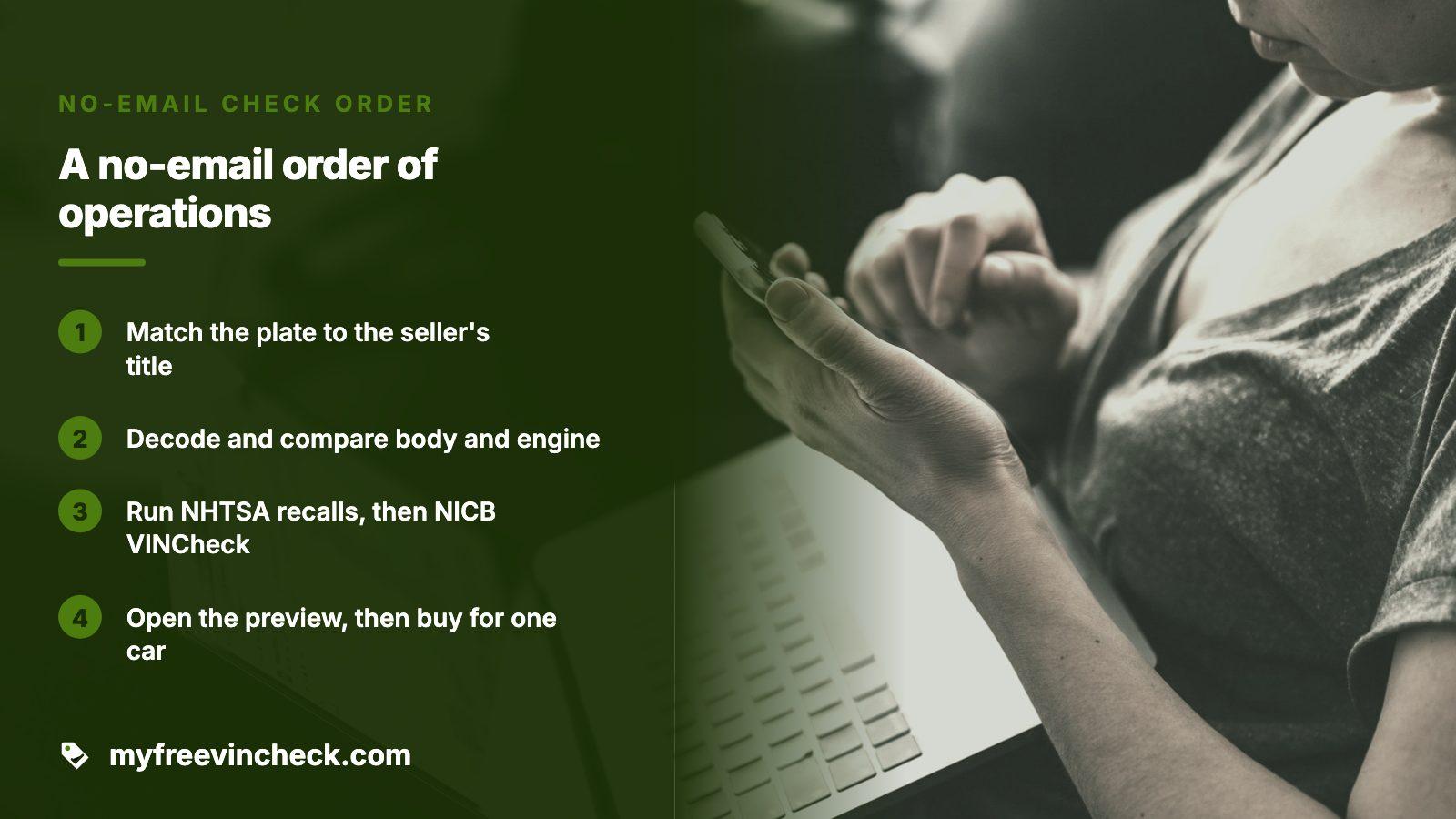
- Photograph the VIN plate on the car and match it with what the seller's title shows. NICB says a cloned car is a stolen one wearing a VIN copied from a legal car of the same make and model.
- Decode it and compare body style, engine and plant with the advert.
- Run NHTSA's recall search; it accepts up to 100 VINs at once.
- Run NICB's VINCheck on the cars still in contention.
- Open the preview on the survivors and see whether the recall, title and auction counts match the seller's story.
- Buy the report for the car about to get a deposit, then pay a mechanic to inspect it. No report replaces that visit.
The report earns its price at step six: odometer readings with dates and locations, title records by state, crash and damage entries, plus any salvage or auction listings and photos.
Where this information comes from
- NICB: VINCheck lookup — The VIN-and-terms form, the daily search cap, the insurer share behind the data and NICB's own warnings.
- NHTSA: Check for recalls — What the VIN recall search returns and leaves out, and that entering a VIN is voluntary.
- NHTSA vPIC VIN decoder — The VIN and model-year boxes, partial VINs and the manufacturer-reported data it returns.
- FTC: Steering clear of vehicle history report scams — How lead generators and fake-buyer scams use history-report sites, and the FTC's checks.
- Justice Department NMVTIS: FAQs — Why title data is fee-for-service, what its records include and what an empty result means.
- NHTSA owner complaint 11397157 — owner experience, paraphrased
- NHTSA owner complaint 11456000 — owner experience, paraphrased
Sources and photos: Facts checked against the sources above in November 2026. Photos by Shadow Photography, Michal Biernat and Bence Balla-Schottner on Unsplash; diagrams by MyFreeVINCheck.
Keep reading
- Where Can I Get a Free VIN Check? Three Lookups and What They MissThe three lookups in more detail, and how to rank several cars before spending anything.
- Check a VIN Number for Recalls: Free Lookup, Then the Full PictureWhat an open recall means on a car you are buying and how the repair works.
- Is a Free VIN Check Legit? What the Real Ones Cover and MissHow to tell a trustworthy lookup from a sign-up funnel.
- PricingOne report or a pack, paid once, with no subscription.
Frequently asked questions
Is there any vehicle history report that is free and needs no email?
Not a full one. The no-email options are partial: NHTSA's decoder and recall search, plus NICB's VINCheck. Title brands, odometer history and crash records come from paid providers, since the federal title system is fee-for-service. A preview that counts records from a VIN alone is the closest step before paying.
Why does a free VIN check ask for my email?
Sometimes to deliver the result, sometimes to build a marketing list. The FTC says lead generators collect details and sell them on. NHTSA's and NICB's forms ask for none. If another site wants an address, read what it says it will do with it first.
How often can I run NICB VINCheck?
Up to five searches in any 24-hour period from one IP address; over the long run there is no cap. It needs a correct 17-digit VIN or a match may be missed, so save your searches for the finalists.
If the free checks come back clean, is the history clean?
Not necessarily. NICB says a clean VINCheck result is no guarantee, and the recall search skips repaired recalls and those past 15 years. None of the three reads odometer history or state title brands. Treat clean results as a filter, then book an inspection.
Do I need an email to buy a report on this site?
Yes, at checkout. The address is where the report link and receipt go, and it lets you reopen the report later. The preview before that step takes only a VIN. Payment is one charge, and a VIN with no data on file is refunded.
Now check the car itself
The guide explains what to look for. The report shows what this VIN has on record.