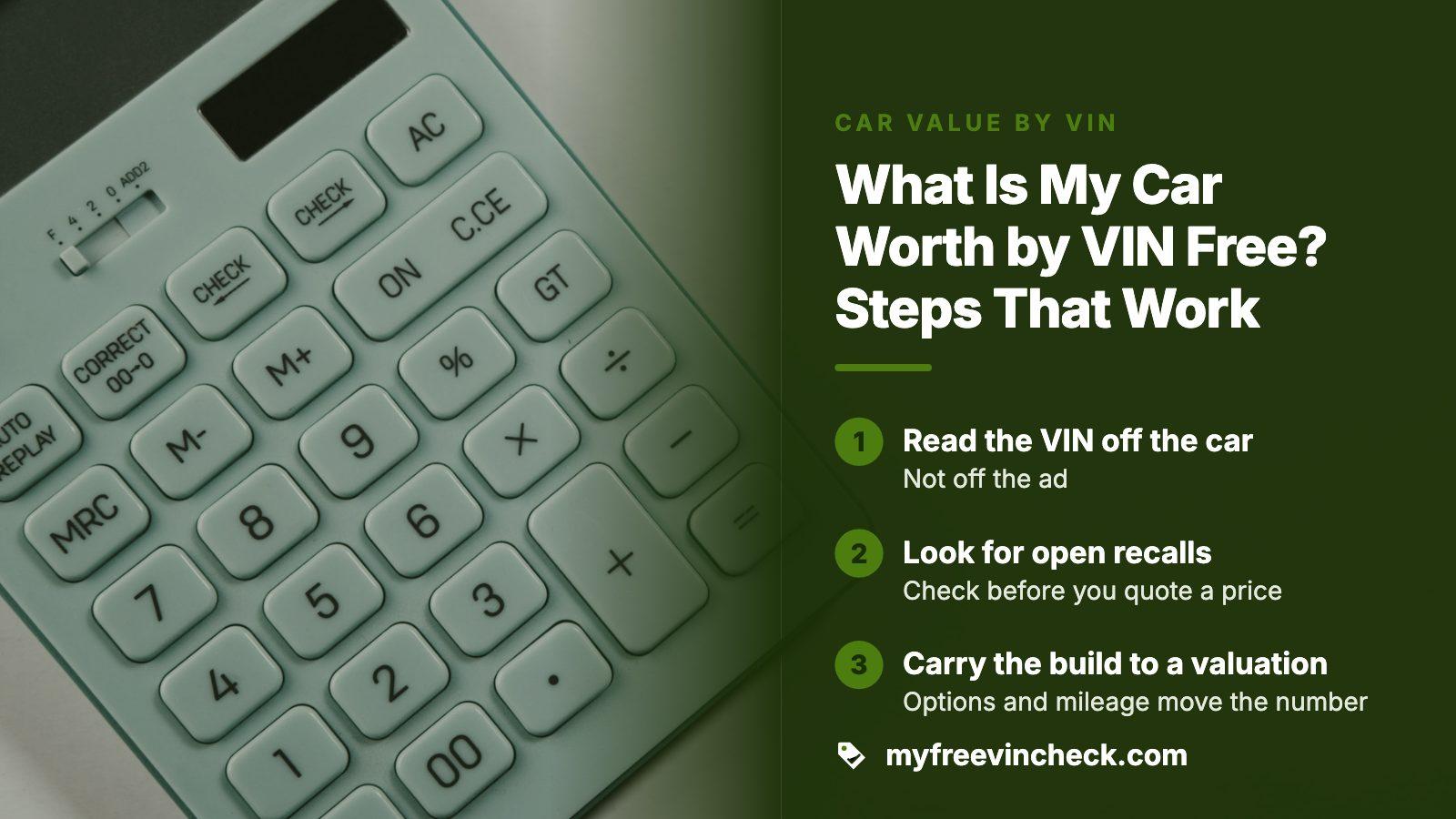
THE SHORT ANSWER
You cannot get a value from a VIN alone. NHTSA's decoder returns the build, and its base price field, meant for the original new-car price, came back empty on the sample VIN tested. Use the decode to pick the right trim, then enter mileage and condition into a valuation book such as Kelley Blue Book. Check title and odometer history separately, since neither is among the inputs a book lists.
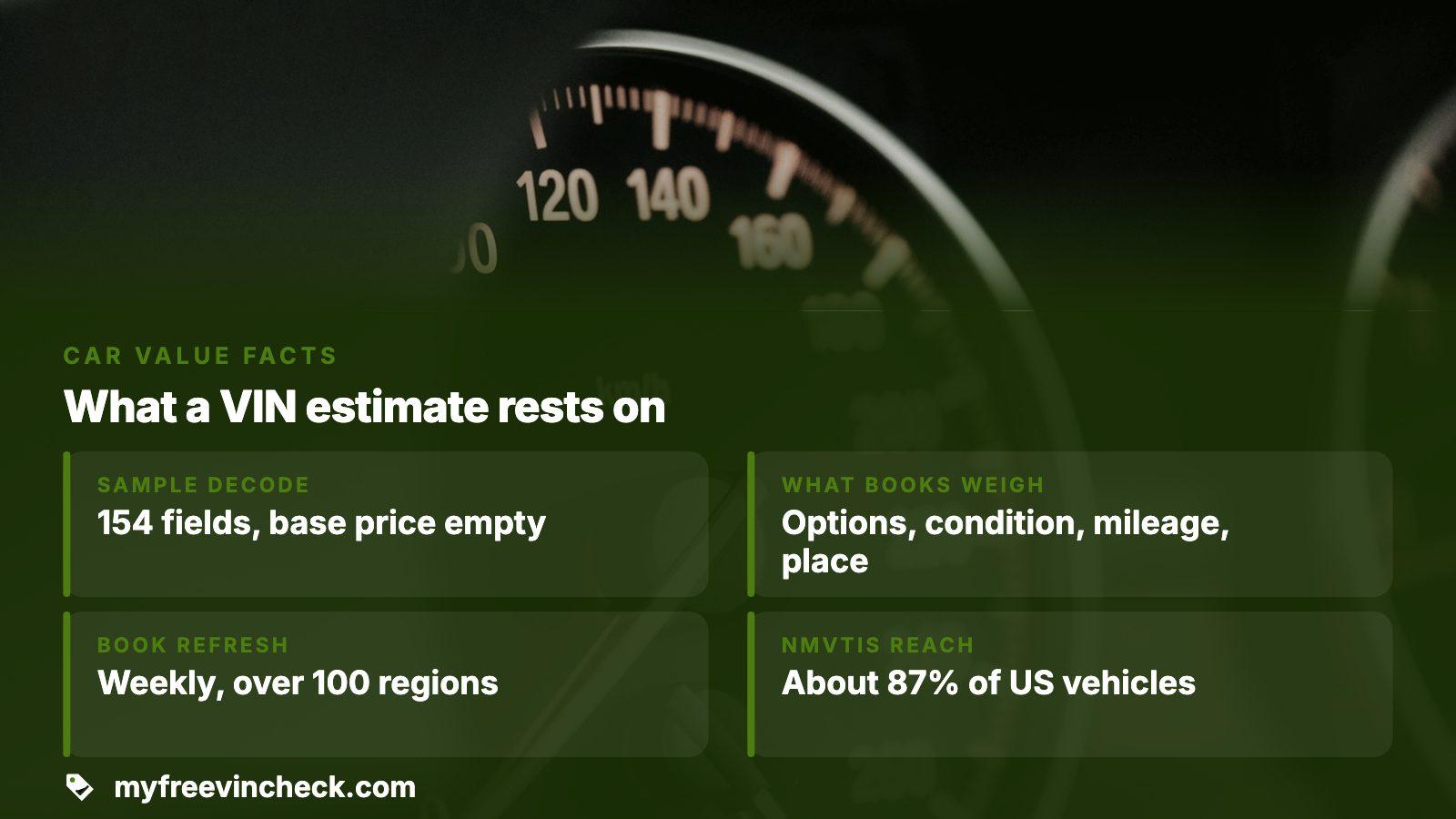
- Sample decode
- 154 fields returned, base price field empty
- What books weigh
- Options, condition, mileage and location
- Book refresh
- At least weekly, over 100 regions
- NMVTIS reach
- About 87 percent of US vehicles
A VIN names the car and says nothing about its price
A VIN is a coded description of how the car left the factory: maker, model, body, engine, year and assembly plant, in 17 characters. It tracks none of the miles, wear or repairs that came later, and those decide what a buyer will pay.
NHTSA's decoder shows how thin the link to price is. Its one money field, Base Price, means a new vehicle with standard equipment only and no option packages. Nothing in it covers market value, mileage, condition, owners, title status or crashes.
A live decode of a 2003 Honda Accord coupe confirmed it: 154 fields came back, the base price field was empty, and the check digit passed.
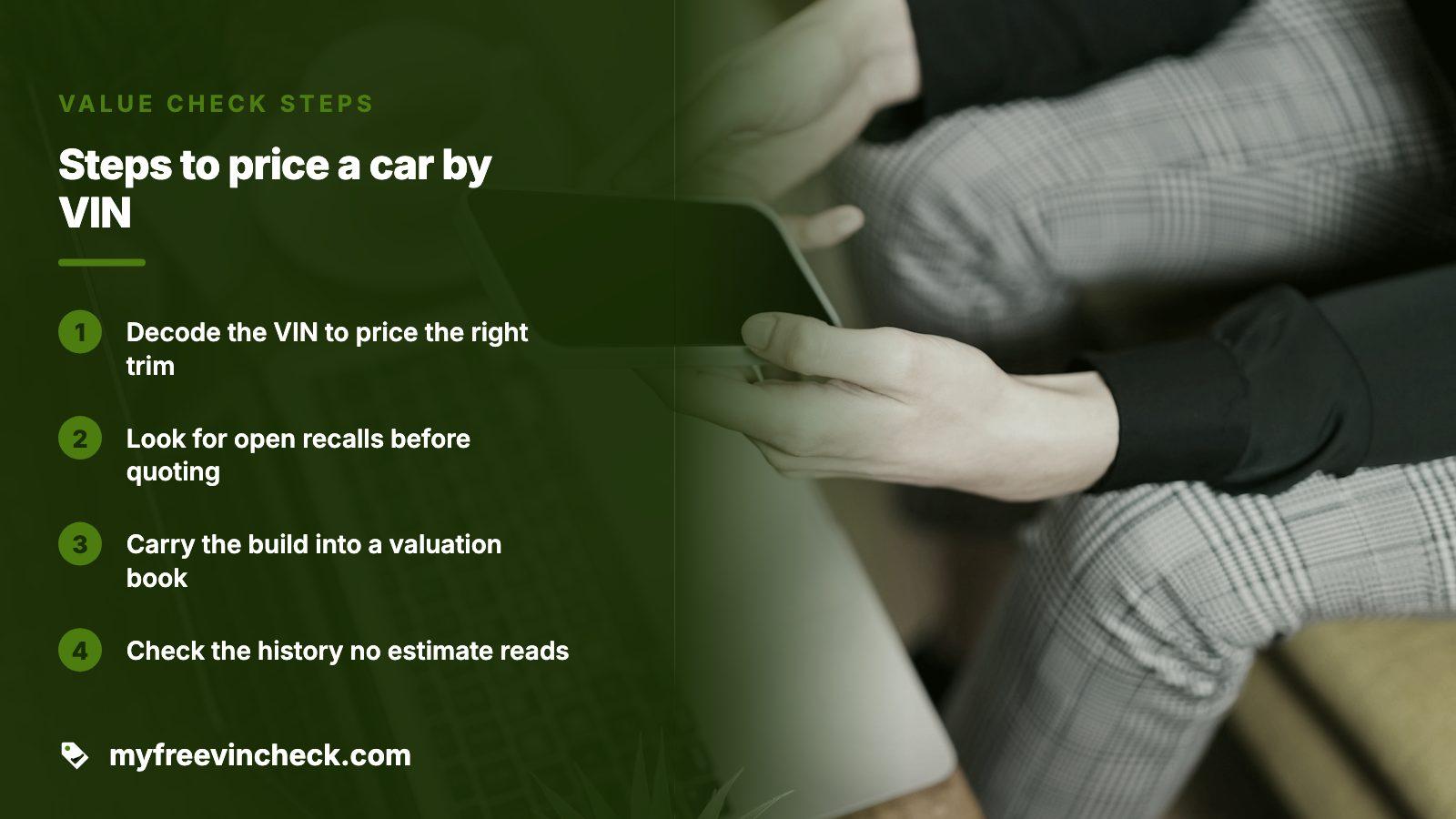
Step one: decode the VIN so you price the right trim
Two cars of one model and year can price very differently once trim, engine and body differ, and value forms ask for those exact choices. A decode tells you which car you hold before anyone starts guessing.
- Trim and model year: compare them with the ad and the registration before picking an option in a value form.
- Engine and cylinders: a four-cylinder claim on a six-cylinder car shows up here.
Manufacturers supply the data, so disputes go to the maker. The tool accepts partial VINs and refuses years before 1981. A VIN with a wrong ninth character still decoded in testing, but with an error flag, so one slipped digit will not quietly send you to the wrong car.
Read the VIN off the car, not off the ad
Typos and recycled ad copy often make a lookup describe the wrong vehicle. Copy the VIN from the vehicle, not the listing, then check it against the paperwork.
- Driver's-side corner of the windshield glass, read from outside the car.
- The driver's door or the frame beside it, often on a sticker.
- The insurance card or policy.
- The title.
Photograph each one and compare. If two disagree, settle that before discussing price.
Step two: look for open recalls before you quote a figure
An open recall means the repair has not been done on that exact vehicle. The FTC points buyers to NHTSA for the lookup, and the recall check on this site runs on NHTSA data too, so it fits right after the decode.
A pending recall does not move the book figure, but it is a fair point in the negotiation and a task for the seller before handover.
Step three: carry the build into a valuation book
The FTC links three value tools in its used-car pages: Edmunds, Kelley Blue Book and NADA Guides. Kelley Blue Book's form takes a VIN or a make and model, and the page says a copy of the result is emailed within 24 hours. It shows no price for the lookup, so check what the form asks for before submitting.
| Figure | What it estimates | Who it suits |
|---|---|---|
| Trade-in range | A dealer's likely offer this week | A seller who wants a quick, simple exit |
| Private party value | A fair price between two individuals | A seller ready to do the extra work |
| Typical listing price | Where dealers are asking, not where cars sell | A buyer comparing lots |
| Instant cash offer | A real offer to buy, not an estimate | A seller deciding whether to accept |
Why two honest estimates for one VIN will not match
Kelley Blue Book builds used values from completed sales at both wholesale and retail, adjusts for season and for local markets in over 100 regions, and refreshes at least weekly. Options, condition, mileage and the car's location all feed in.
- Sale type: private party figures usually sit above trade-in ones.
- Place and week: the same car prices differently in another region or a few weeks later.
- Inputs: a missed option or a generous condition grade moves the result.
- Basis: listing prices rest on dealer asking prices, while book values rest on completed transactions.
Treat the spread as a range to negotiate inside.
Step four: check the history no estimate reads
Kelley Blue Book's list of used-value factors leaves out title status, yet title records are where brands and odometer readings sit. NMVTIS, run through the Justice Department, can show title brands (junk, salvage, flood), the latest mileage on file, insurer total-loss rulings and transfers to salvage yards.
The same page adds cautions. NMVTIS covers roughly 87 percent of US vehicles and reporting gaps remain, so an all-clear can still be a miss. A total-loss label does not make a car worthless, and buyers of branded cars can overpay when brand washing is involved.
From an NHTSA owner complaint
The owner of a used 2015 Nissan Altima told NHTSA in September 2026 that the mileage stood at 73,328 when it was purchased. A report the lender had provided showed 69,850 miles on an August 2022 date, yet a dealer assessing a trade-in found a second report with 117,974 miles from May 2022. The owner alleges odometer fraud.
Take from it that a dash reading proves nothing, and that a price built on wrong mileage can collapse at the dealer's desk.
Condition is the input a VIN estimate cannot check
A book converts the condition grade you pick into a figure, and nothing on the car checks that grade. The FTC cautions that no history report takes the place of an independent inspection, so a mechanic's verdict is the real test of that input.
From an NHTSA owner complaint
The owner of a 2014 Jeep Cherokee told NHTSA in October 2026 about a power transfer unit that was never durably repaired. The maker declined to buy the car back, and a dealership put $200 on it. By the owner's reckoning, the tires on it were worth more than the whole vehicle.
A book figure applies to the car as described; an offer applies to the car as the dealer finds it. After a drivetrain failure, the offer is the number that counts.
Where the paid report fits after the free steps
The decode and recall check on this site run on NHTSA data and settle which car you are pricing; they stop there. Before a number turns into a deposit or a listing, open the preview. It is free, needs no card, and counts the records on file for that VIN, so you learn whether title, odometer, damage or auction entries exist.
Buying is a single payment per report, with pack sizes of three, five and ten for people comparing several cars, and no subscription follows. Each amount is on the pricing page. The entries that move a price are title brands, dated odometer readings, damage and crash records, and salvage or auction sales with photos, next to a market value figure.
Where this information comes from
- NHTSA: vPIC VIN decoder — Who supplies the decoder's data, which model years it accepts and the fields it returns for a VIN.
- Justice Department NMVTIS: consumer search — What a title search shows, how many vehicles it covers, and why a clean result can still miss a brand.
- FTC: Used cars — The value tools the FTC links to and its advice on history reports and independent inspections.
- Kelley Blue Book: What's my car worth — What the form asks for and the trade-in and private party figures it returns.
- Kelley Blue Book: Car values — Which factors drive used values, how often prices refresh and how listing price differs from value.
- NHTSA owner complaint 11767543 — owner experience, paraphrased
- NHTSA owner complaint 11769410 — owner experience, paraphrased
Sources and photos: Facts checked against the sources above in November 2026. Photos by Sasun Bughdaryan, Jakub Żerdzicki and CHUTTERSNAP on Unsplash; diagrams by MyFreeVINCheck.
Keep reading
- Where Can I Get a Free VIN Check? Three Lookups and What They MissThe no-cost lookups that identify a car before you try to price it.
- Can I Check if My Car Has Been in an Accident for Free? What the Free Tools ShowCrash history moves a price more than most inputs, and this page covers what a search can show.
- Free Salvage Title Check by VIN: What It Shows and MissesHow to look for the salvage and flood brands that a valuation form never asks about.
- Sample reportSee a finished report before deciding whether the paid layer is worth opening.
Frequently asked questions
Can you find a car's value with only the VIN?
No. A VIN names the build and nothing more. The decoder's base price field means the original new-car price with standard equipment, and it came back empty on the sample tested. A real value needs mileage, condition, options and location on top of the decode, so the VIN identifies the car and a valuation book prices it.
Is there a completely free way to see what my car is worth?
Valuation companies publish consumer lookups that take a VIN, and the FTC links to three of them. NHTSA's decoder responded to anonymous requests without asking for a key, an account or a fee. Whether a valuation form charges or wants your email is shown on that form. A history report with a value inside is paid here, after a free preview.
Why does a dealer's trade-in offer land below the online figure?
Trade-in and private sale are separate figures. Kelley Blue Book explains that a private seller takes on extra time, money and effort, so private party figures usually sit above trade-in ones. A dealer also looks at the real car, so mileage history, damage and wear can pull an offer under a book number.
Does a salvage or flood brand change what a car is worth?
Brands live in title records, and the factors Kelley Blue Book lists for used values leave title status out, so a branded car needs its own check before you trust any estimate. NMVTIS notes that a total-loss label does not make a car worthless, and that buyers of branded cars can overpay when brand washing is involved.
What will the preview tell me about a VIN before I buy?
It reports whether records exist for that VIN, such as title, odometer, damage or auction entries, and asks for no card. That tells you whether the paid report has anything to add for this car. Buying is a one-time charge with nothing renewing, and the pricing page lists the amounts.
Now check the car itself
The guide explains what to look for. The report shows what this VIN has on record.