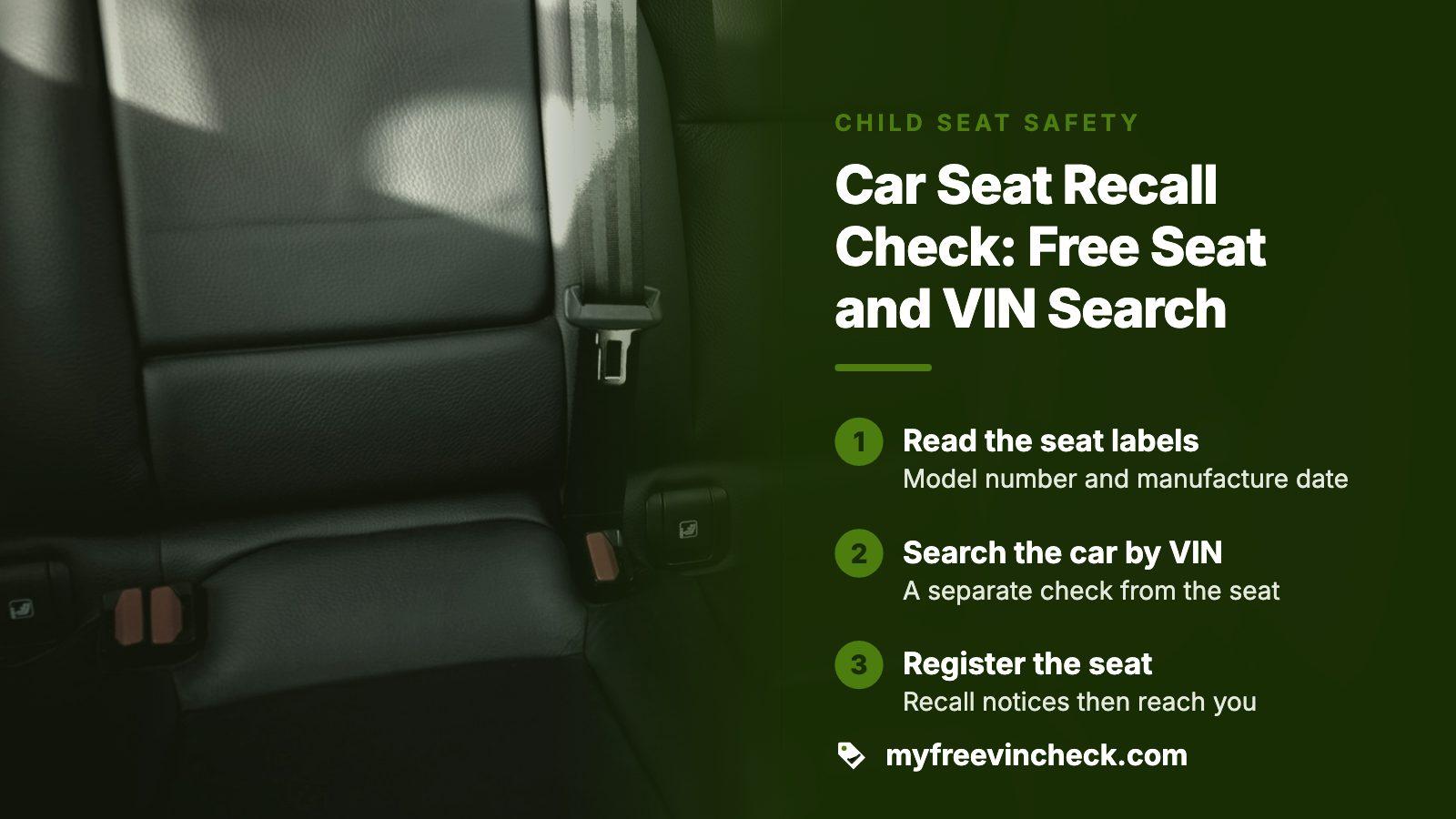
THE SHORT ANSWER
Car seats are tracked as equipment, separate from vehicles. To check one, copy the model number and date of manufacture from the labels, then search them on NHTSA's recall page under its Car Seat tab. To check the car, decode the VIN with the free recall check on this site. Register the seat with its maker afterward so recall notices reach you directly.
- Seat identifier
- Model number and manufacture date on the seat's labels
- Car identifier
- The 17-character VIN, not the seat
- Free alerts
- NHTSA's SaferCar app and email notices
- VIN search gap
- Misses recalls older than 15 years
Why one search cannot cover the seat and the car
NHTSA runs its recall lookup with separate tabs for vehicles, car seats, tires and general equipment. That split matters to anyone buying a used car with a child in mind. A recall filed against a carrier or booster belongs to the seat's maker and follows the seat's model and build date. A recall on the car follows the VIN. Neither shows up in the other's results.
| Question | What you search with | Where |
|---|---|---|
| Is this seat under recall? | Model number and manufacture date from its labels | NHTSA recall page, Car Seat tab |
| Does this car have an open recall? | The VIN | The free recall check on this site, or NHTSA |
| Did a crash ever happen to this car? | The VIN | The full report, after the free preview |
Reading the seat before you search
Flip the seat over and look at the sides, back and base for stickers. You want two details: the model number and the date the seat was made. NHTSA's own used-seat checklist says those labels are what you need to learn whether a recall exists and whether the seat has simply aged out. A seat with no readable label cannot be checked, which on its own is a reason to pass on a hand-me-down.
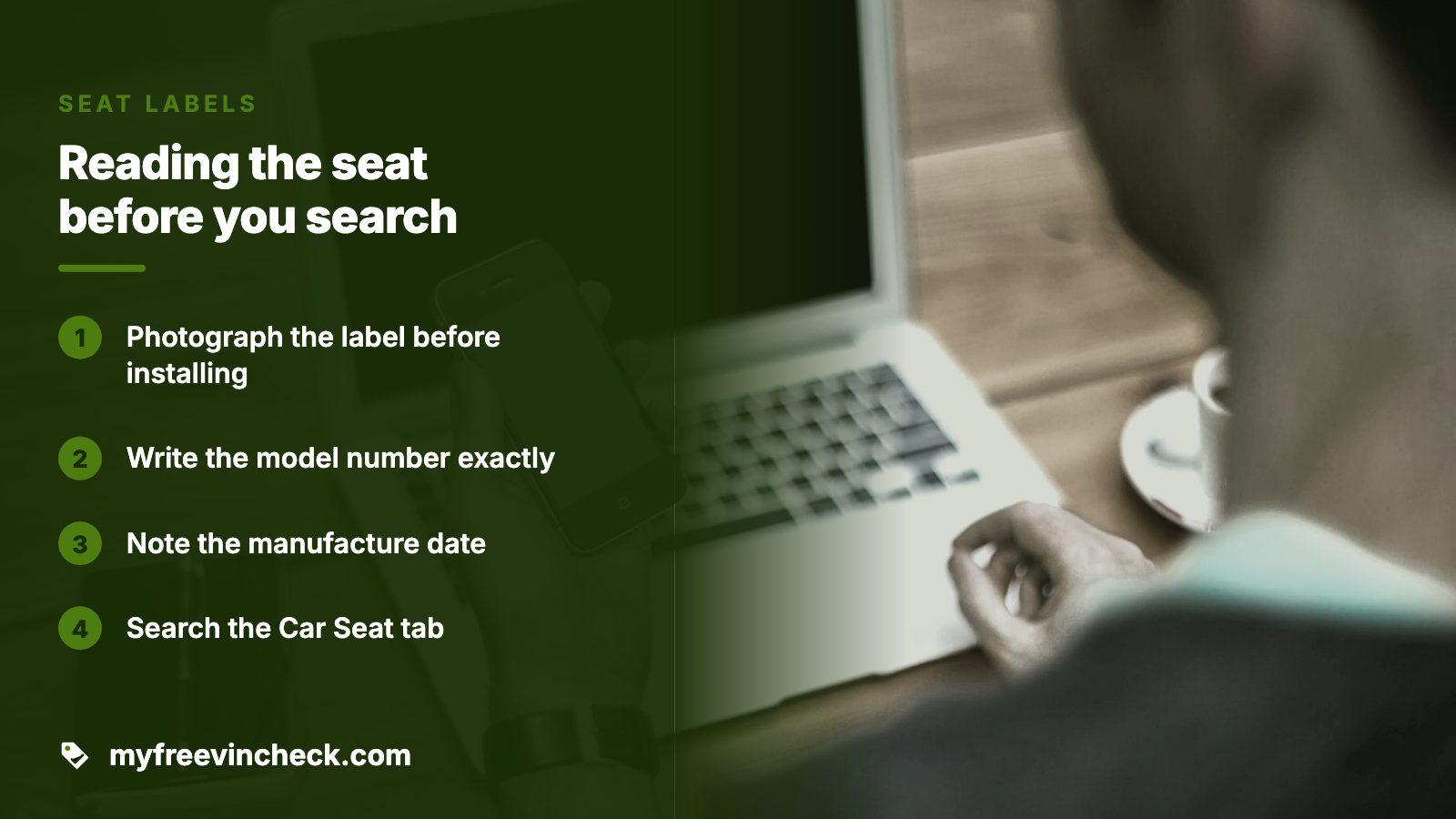
- Find the label and photograph it before the seat goes into the car.
- Write down the model number exactly, including letters and dashes.
- Note the manufacture date, not the purchase date.
- Search the Car Seat tab on NHTSA's recall page with those details.
- If the maker has a recall page, read it too, since some brands post notices there first.
The vehicle half, run free on this site
The car matters because the seat rides on its belts, anchors and back seat. Paste the VIN into the free tools here and the decode confirms the make, model and year, and the recall check reads NHTSA's records for that exact build. You will see any recall that has not been repaired, with the maker's description and the remedy.
When the car has nothing open, NHTSA's result says so with a zero count of unrepaired recalls tied to that VIN. Seeing a zero before you buy removes one surprise. It does not remove all of them, which the next section explains.
What a clean result still leaves out
NHTSA states what its VIN and plate search leaves out. Knowing the gaps keeps a clean screen from being read as a clean car.
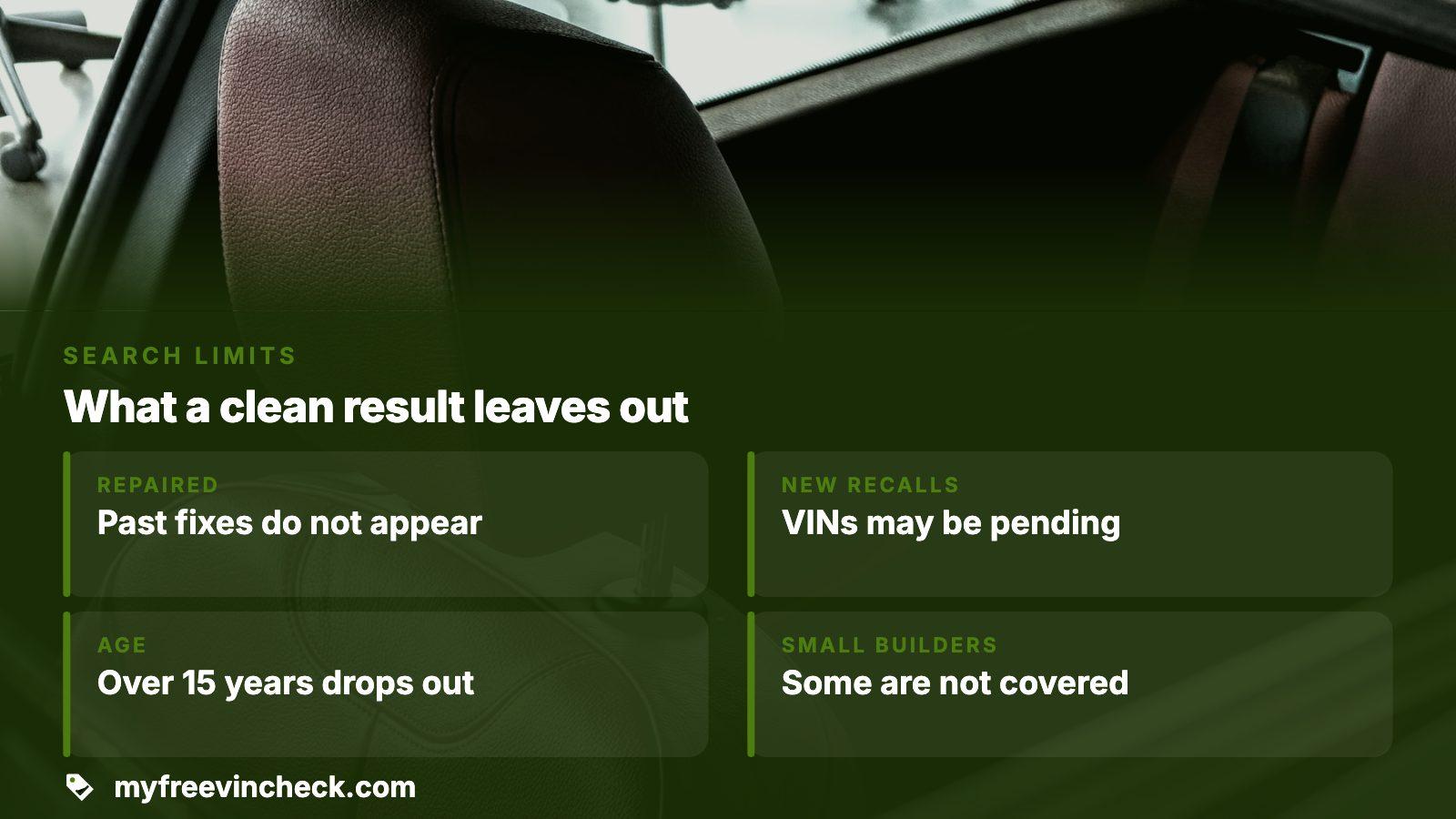
- Repaired recalls, so defects fixed in the past do not appear.
- New announcements, where the affected VINs are still being added.
- Anything older than 15 years, unless the maker extends its coverage.
- Campaigns from small builders, including some specialty makers.
- Service campaigns that are not safety recalls, and vehicles built for other countries.
Then there is the question the recall record cannot touch at all: whether the car has been wrecked, flooded or branded. Those answers sit in title and damage records, which is where the paid report comes in after the free preview.
If the seat is second-hand
NHTSA's checklist for a used seat runs on five points: no moderate or severe crash in its past, labels with date and model, no recall, every part present, and the instruction book. A recall alone is not always a dead end. NHTSA notes that some problems can be fixed by the maker, and missing parts or manuals can often be ordered.
The crash question has a definition
NHTSA calls a crash minor only if the car drove away, the door nearest the seat was undamaged, nobody was hurt, no airbags went off and the seat shows no damage. If any one of those fails, replace the seat. A stranger's word that it was a fender-bender does not meet that test.
Register the seat so recalls come to you
A search tells you the state of things today. Registration covers tomorrow. NHTSA's advice is to register with the maker, either with the card in the box or on the brand's site, so the company has your details and can reach you itself when a recall or safety notice goes out. NHTSA's registration page links to the sites of many seat brands, from Britax to Graco to Evenflo.
Registration works for a second owner too, which is the point if you bought the seat used. If a maker's form will not take your submission, NHTSA gives an email address for its consumer help staff. Separately, the free SaferCar app and NHTSA's email list push alerts for the vehicle or equipment you entered.
After the recall check, the fit check
A seat with no recalls can still be installed badly. NHTSA says to use either the lower anchors or the seat belt, never both, and to add the tether on any forward-facing seat when both makers allow it. When the seat has no label stating a lower anchor limit, NHTSA's rule is to take 65 pounds and subtract the seat's own weight.
NHTSA also advises that children ride in the rear seat until at least age 12, and says inspection stations, staffed by certified technicians, will check an installation at no charge in most cases. Book one before the first long drive in a car you just bought.
What stays free and when a report helps
The VIN decode and the recall check on this site cost nothing, and so do NHTSA's seat search and alerts. The vehicle history report is the paid step: you see a free preview of what exists for the VIN, then pay once for the report if you want the full record. There is no subscription. Current pricing is on the pricing page.
The report is worth opening when a family is about to rely on a particular car for years, because crash and damage history, title brands and odometer readings change what the car is worth and how it was treated. A seat recall is a small fact. A salvage brand on the car carrying the seat is a large one.
Where this information comes from
- NHTSA: Check for Recalls — The tabbed search for vehicles and car seats, plus what the VIN search does and does not show.
- NHTSA: Car Seats and Booster Seats — Registration, alerts, tether and lower anchor guidance, inspection stations.
- NHTSA: Used Car Seat Safety Checklist — Five-point test for a second-hand seat.
- NHTSA: Car Seat Use After a Crash — Definition of a minor crash and when to replace.
Sources and photos: Facts checked against the sources above in November 2026. Photos by Maxim Hopman, Alejandro Escamilla and Obi on Unsplash; diagrams by MyFreeVINCheck.
Keep reading
- Check a VIN Number for Recalls: Free Lookup, Then the Full PictureThe vehicle side of the check, step by step.
- Car Recall Alerts: Get Notified Free, and Check What the Alerts MissHow to get notified when a new recall lands.
- Tire Recall Check: What a VIN Search Misses and the Sidewall Code FindsAnother equipment recall that a VIN search does not cover.
- PricingHow a single report or a pack is billed, with no subscription.
Frequently asked questions
Can I check a car seat recall with a VIN?
No. A VIN identifies a vehicle. A car seat is looked up by its model number and manufacture date, entered on NHTSA's Car Seat tab. The VIN is still worth running on the car, since vehicle recalls are a separate list.
Where is the model number on a car seat?
Look for a sticker on the sides, back or underside of the shell, and sometimes on the base. It sits beside the manufacture date. NHTSA's checklist treats both as required: without them you cannot confirm a recall or the seat's age, so a seat missing the label is better left behind.
Is the car seat recall search really free?
NHTSA's seat search, its SaferCar app and its email alerts cost nothing to use. The VIN decode and recall check on this site are free as well. The only paid item here is the vehicle history report, which you buy once after the free preview.
What if my seat has a recall?
Contact the manufacturer first. NHTSA says some problems can be fixed, and parts can often be ordered. Follow the maker's instructions on whether to keep using the seat in the meantime, and register the seat so later notices reach you.
Should I reuse a seat after a fender-bender?
Only if the crash was minor under NHTSA's test: the car was driven away, the door by the seat was undamaged, no one was hurt, airbags stayed shut and the seat looks fine. Otherwise replace it, and follow the maker's own instructions too.
Now check the car itself
The guide explains what to look for. The report shows what this VIN has on record.