THE SHORT ANSWER
The 2008 Accord carries nine federal campaigns: 09E063000 (nose mask), 11V395000 (transmission software), and seven air bag notices numbered 16V056000, 16V346000, 17V030000, 17V545000, 18V268000, 19V378000 and 19V502000. Dealers repair covered cars at no charge. Whether any remain open is decided car by car, so look up the stamped number rather than trusting the badge.
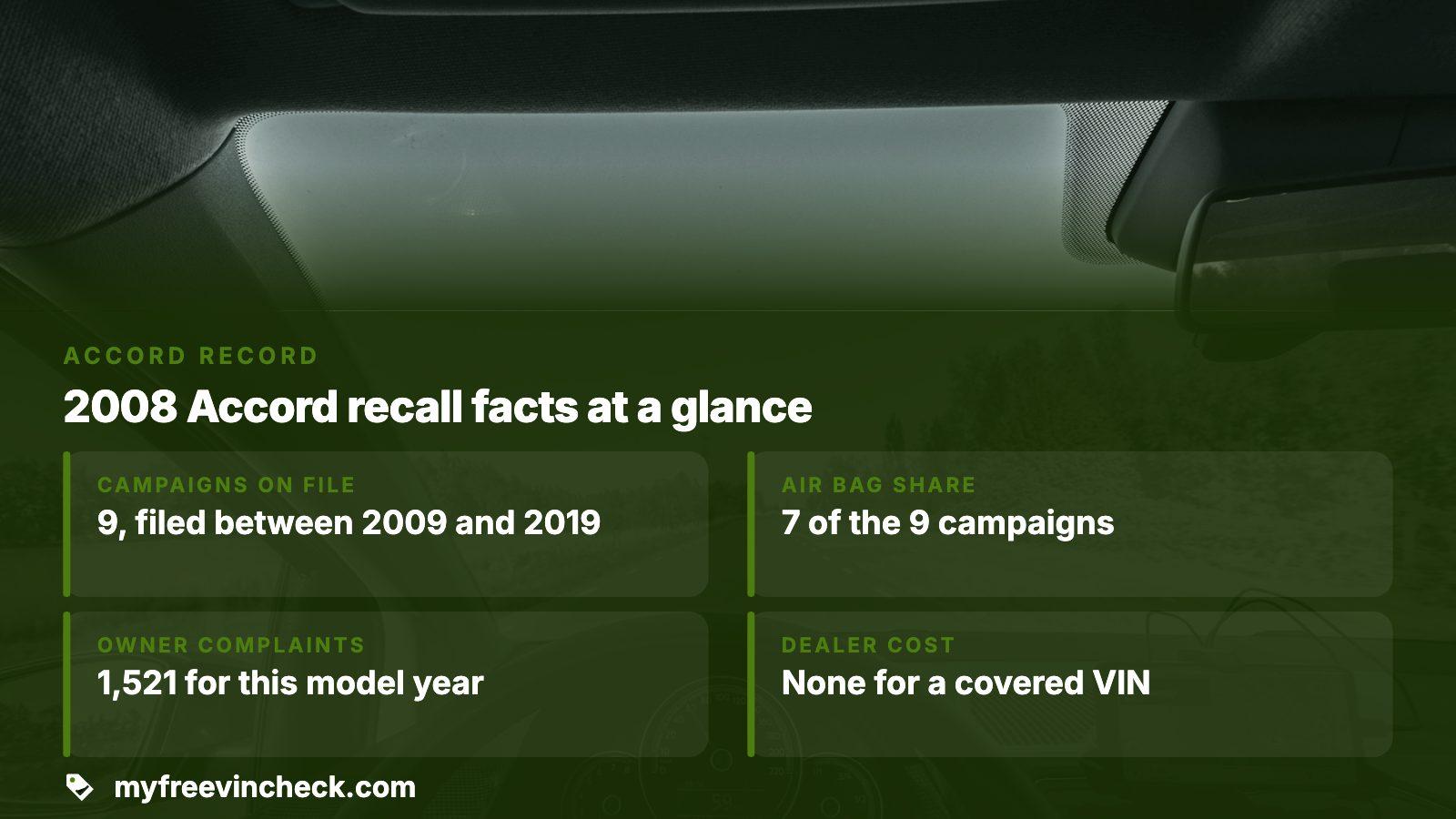
- Campaigns on file
- 9, filed between 2009 and 2019
- Air bag share
- 7 of the 9 campaigns
- Owner complaints
- 1,521 filed with NHTSA for this model year
- Cost to the owner
- None at a Honda dealer for a covered VIN
All nine campaigns in one table
This list comes straight from NHTSA's recalls feed for the 2008 model year. Dates are when NHTSA logged each report, which can precede the day Honda began mailing owners.
| NHTSA number | Logged | Part | Reach |
|---|---|---|---|
| 09E063000 | Nov 18, 2009 | Aftermarket nose mask | 2008-2010 four-door Accords fitted with the accessory |
| 11V395000 | Aug 4, 2011 | Transmission control module software | 2005-2010 Accords built July 1, 2004 to Sept 3, 2010, among other models |
| 16V056000 | Feb 2, 2016 | Air bag control unit | 2008-2010 Accords |
| 16V346000 | May 24, 2016 | Passenger inflator | 2008-2011 Accords, humid-state zone plus some others |
| 17V030000 | Jan 10, 2017 | Passenger inflator | 2008-2012 Accords sold or registered in the same zone |
| 17V545000 | Aug 31, 2017 | Replacement inflator installed wrong | Cars that received a replacement inflator at one dealership |
| 18V268000 | Apr 26, 2018 | Passenger air bag installed wrong | 2003-2012 Accords, among many Honda models |
| 19V378000 | May 16, 2019 | Replacement inflator installed wrong | 2008-2012 Accords, among others |
| 19V502000 | June 27, 2019 | Replacement inflator that may degrade | 2008-2012 Accords with a replacement inflator |
Why seven of nine point at the air bags
Two different faults hide inside that group. The first is the control unit that decides when to fire the bags. Campaign 16V056000 says the unit can corrode and fail, so the bags may stay folded in a crash.
The second is the passenger inflator. Two early notices, 16V346000 and 17V030000, concern a rupture risk that can send metal fragments into the cabin, and they lean on a list of hot, humid states and territories. The later ones are stranger: 17V545000, 18V268000 and 19V378000 say a replacement bag or inflator may have been fitted badly, and 19V502000 says some replacement inflators may themselves degrade.
- A car repaired once can appear again in a later campaign, because the replacement part was the problem.
- Cars that spent time in Alabama, Florida, Texas or another listed state or territory fall into the earliest inflator notices, wherever they sit now.
- Every air bag notice here ends in a free dealer repair; Honda lists customer service at 1-888-234-2138.
The transmission update and the nose mask
Campaign 11V395000 is a software fix. A bearing race in the transmission could break, which may set off the check engine light, stall the engine or let broken pieces jam the parking pawl so the car rolls after it was put in Park. Dealers reflash the control module at no charge. Nothing is replaced, so there is no part to look for under the car; only a repair record shows the update went in.
Campaign 09E063000 is the odd one out. It covers an accessory front mask sold for 2008 to 2010 four-door Accords, which could stop the secondary hood latch from catching, letting the hood fly up on the road. If the car you are looking at wears a bra-style mask on the nose, ask who installed it and whether it was returned.
What an owner chasing the repair ran into
The repairs cost nothing, but the afternoon is not free. NHTSA's complaint files hold owners describing the wait.
From an NHTSA owner complaint
In a 2023 filing, the owner of a Honda that was under a recall said several urgent letters had arrived, yet the dealer wanted a few hours and would not lend a car. The offered alternative was a rental at $45 a day. The owner works gig driving and objected to absorbing lost income for a fault they did not cause.
The lesson: a covered repair costs nothing in parts and labor but can cost hours. Book early and ask about a loaner before handing over the keys.
Run the check on the car you are looking at
Start with the free tools on this site, which read NHTSA data. Neither shows who owned the car or what happened to it, but both tell you which of the nine are open.
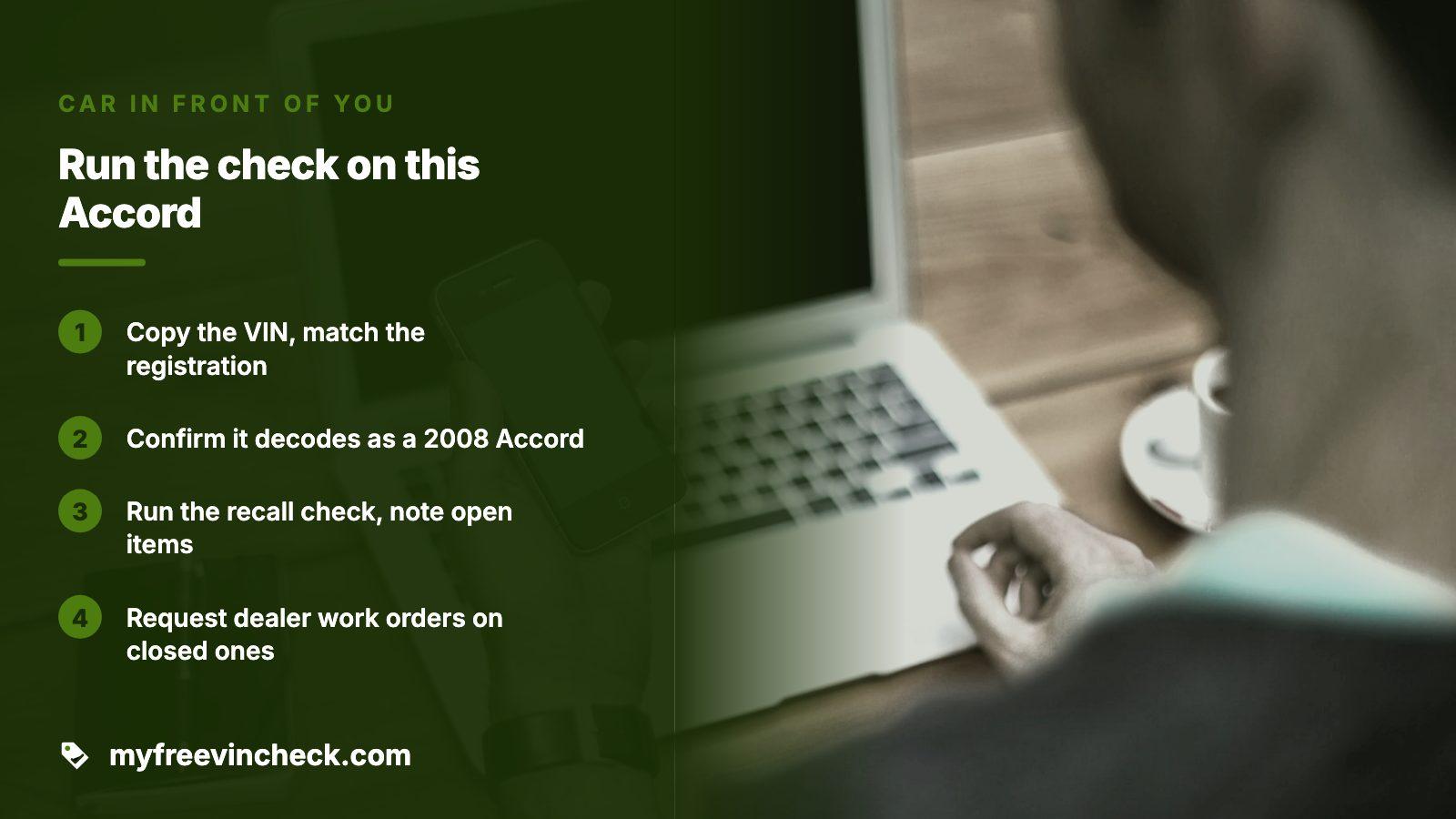
- Copy the 17-character code visible through the glass at the lower corner by the steering wheel, then compare it with the registration card.
- Enter it in the free decode and confirm it reads as a 2008 Honda Accord. A different year changes which rows above apply.
- Run the free recall check and copy down any open campaign number.
- Match each open number to the table. For any item that shows as closed, request the dealer's work order from the seller.
- If the car still looks right, open the paid report for the history the recall feed leaves out.
What the federal VIN search leaves out
NHTSA's own lookup page lists its limits, and they matter on a car this old.
- A recall already repaired does not appear, so a clean answer says nothing about whether the car was ever affected.
- A recall announced recently may not have every VIN attached yet.
- Recalls more than 15 years old drop out unless the maker extends coverage, which is why a printout of a 2011 campaign can differ from the VIN result.
- Maker service campaigns that fall outside safety recalls stay hidden.
The all-clear message says zero unrepaired recalls. Take it as good news about open repairs and no more than that.
When the VIN comes back clean but the worry stays
From an NHTSA owner complaint
In a 2019 filing, the owner of a 2008 Accord said they had heard about dangerous inflators, never received a notice, and then checked the VIN and found no recall listed. They filed the complaint to ask what to do next, since they drove the car daily.
A clean answer can mean the car was repaired, sat outside the affected group, or slipped through a matching gap. Buyers should ask for paperwork; owners can phone Honda customer service and read the VIN aloud.
Red flags when buying a 2008 Accord
Recalls are only one layer. The owner complaint count for this model year is 1,521, with service brakes, hydraulic and air bag components leading the tags, and 62 of the filings mention a crash. Those are reports, not findings, but they shape what to inspect.
- Air bag warning light on, or a seller who says it is just a sensor. Several owners filed complaints describing a light that stayed on after a recall repair.
- No paperwork for air bag work, particularly if the car lived in a listed humid state.
- Transmission noise or a check engine light, with no record of the software update.
- Mismatched VIN labels, or a title that carries a brand.
A paid report covers what a recall feed cannot: brands on the title, crash and damage entries, mileage history and liens. Those decide whether a nine-campaign Accord deserves a test drive.
Cost, and the next move
The decode and recall check cost nothing. The history report is bought once, as a single report or in a bundle, with no recurring charge; amounts are on the pricing page. Just the preview is free, and the full report is paid.
If open campaigns show up, book the repair before closing, or write it into the deal. If none show, judge the car on its history, not on the recall result alone.
Where this information comes from
- NHTSA: Check for recalls — What the VIN search shows and the cases it omits.
- NHTSA recalls API: 2008 Honda Accord — Source of every campaign number, date, remedy and phone line above.
- NHTSA complaints API: 2008 Honda Accord — Complaint totals by component and crash reports.
- NHTSA owner complaint 11530408 — owner experience, paraphrased
- NHTSA owner complaint 11255615 — owner experience, paraphrased
Sources and photos: Facts checked against the sources above in November 2026. Photos by Erik Andersson, Alejandro Escamilla and Sander Jeurissen on Unsplash; diagrams by MyFreeVINCheck.
Keep reading
- 2017 Honda Accord Recalls: 3 Campaigns, 2 Fuel PumpA newer Accord with a different campaign list to compare.
- Takata Airbag Recall Check: Test Any VIN Before You Drive or BuyGoes deeper on the inflator notices behind most of this list.
- Check a VIN Number for Recalls: Free Lookup, Then the Full PictureRuns the lookup itself for any make and year.
- NHTSA Complaints Lookup: Search Owner Reports by Year, Make and ModelReads the owner complaints behind the counts above.
Frequently asked questions
How many recalls does the 2008 Honda Accord have?
NHTSA lists nine campaigns for the 2008 model year. Seven concern air bags, one is transmission software and one is a front-end accessory. A given car may have none open, since many were repaired. Only a VIN lookup shows what is outstanding on a specific Accord.
Are 2008 Accord recall repairs free?
Yes. Every campaign lists a dealer remedy at no charge to the owner. The cost you may meet is time, such as a few hours at the shop and no loaner. Ask before booking, and file the paperwork afterward.
Does a clean VIN check mean my Accord was never recalled?
No. The federal search only shows unrepaired recalls, and it leaves out repaired ones. A car fixed years ago looks clean. Ask for dealer repair records if you are buying, and call Honda customer service if you own it and are unsure.
Which 2008 Accord recall is the most serious?
The inflator rupture notices, 16V346000 and 17V030000, and the later degrading inflator notice, 19V502000, warn of metal fragments, serious injury or death. The control unit notice, 16V056000, warns that bags may not deploy at all. Treat any open air bag item as a reason to book a repair now.
Should I run a paid report on a 2008 Accord?
After the free preview, yes, once the car passes your own inspection. Recalls show open repairs only. The report adds title brands, crash entries, odometer readings and liens, none of which a recall feed carries.
Now check the car itself
The guide explains what to look for. The report shows what this VIN has on record.