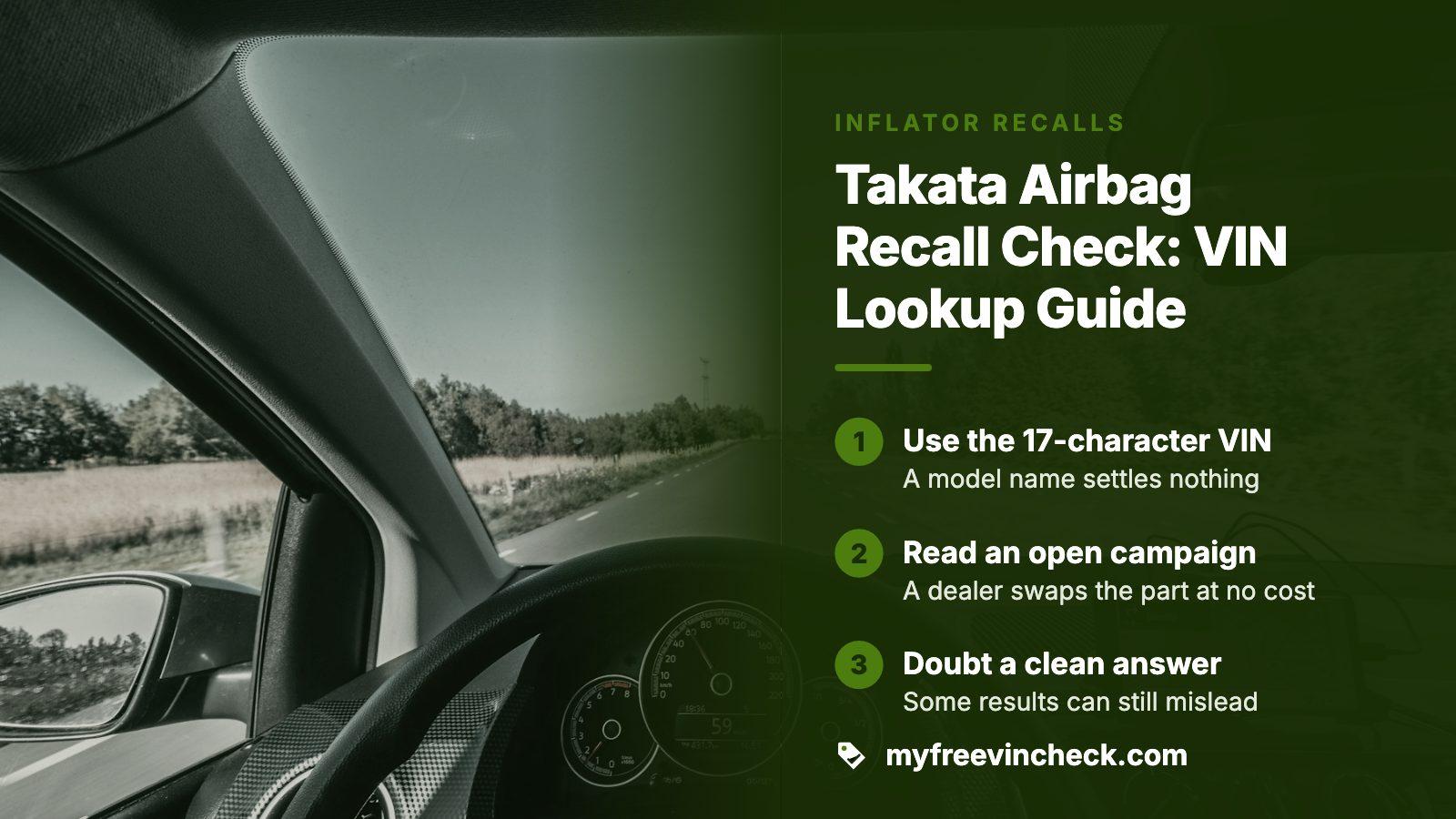
THE SHORT ANSWER
Enter the VIN at nhtsa.gov/recalls. If an inflator campaign is open, a dealer swaps the part at no cost to you. If the page says 0 unrepaired recalls, that is good news with limits: finished repairs, brand-new campaigns and recalls past 15 years do not appear. Repeat the lookup now and then, and before buying any used car.
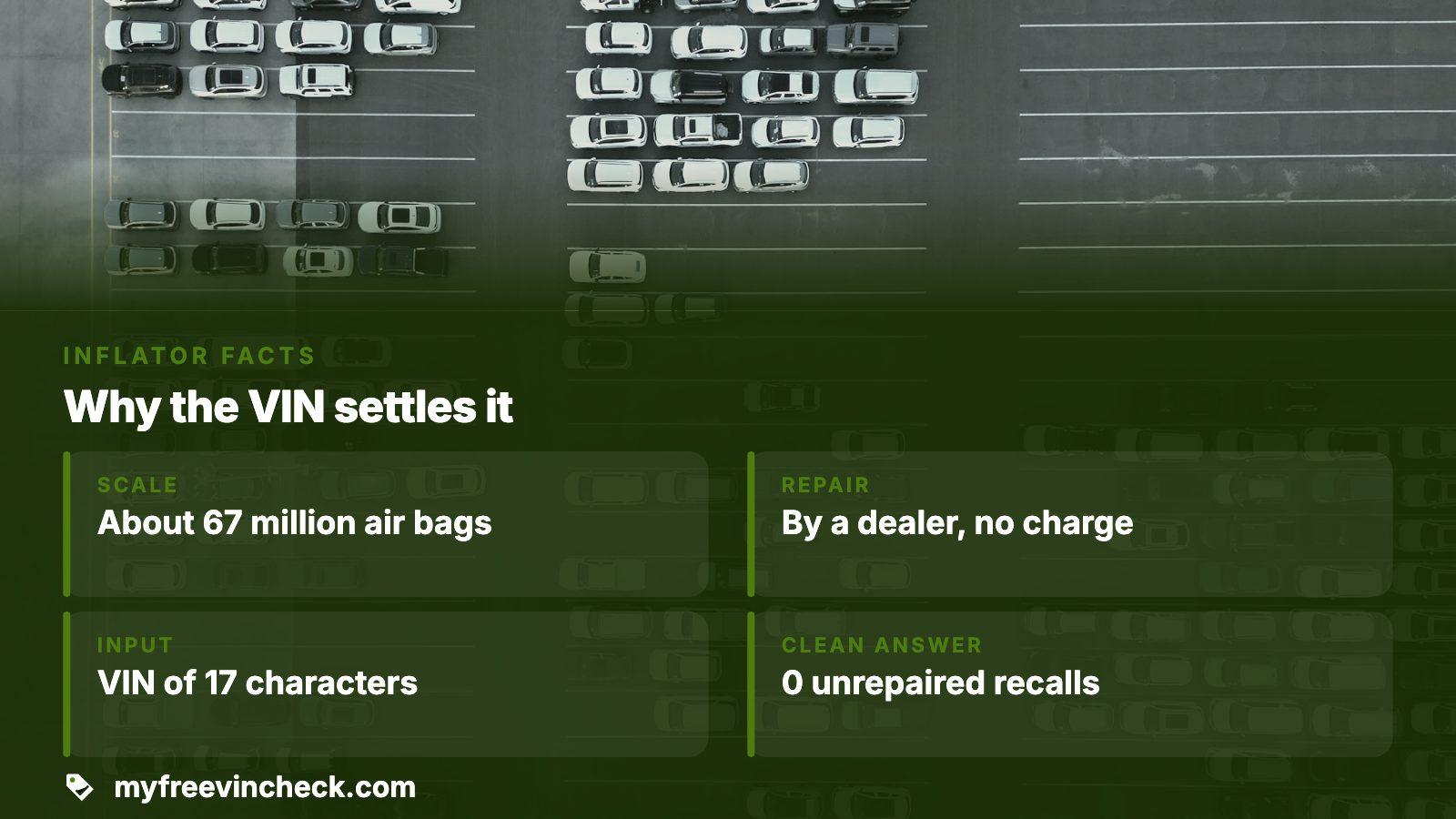
- Scale
- About 67 million air bags recalled
- Repair
- Done by a dealer at no charge
- Input
- VIN of 17 characters
- Clean answer
- 0 unrepaired recalls
The VIN settles it, the model name does not
Takata inflators went into cars from a long list of brands, and inside any one model only certain builds were affected. NHTSA warns that its own brand list is subject to change and does not promise that a given vehicle is in or out. The VIN is what ties a physical car to a campaign.
The defect itself is well documented. NHTSA says long stretches of high heat and humidity can leave the propellant behaving badly, so that on deployment the inflator can burst and fling metal at the people inside. Those explosions have hurt and killed people, which is why the recall is treated as urgent rather than routine.
What the free tools here do first
The tools on this site start with a VIN decode, so you can confirm the year, make and model before reading any recall result. Then the number is matched with NHTSA's open recall data. Both steps cost nothing and draw on public federal records.
- Decode: checks the year and model against the seller's description.
- Recall match: shows open campaigns, their numbers and the fix.
- Preview of the paid report: a taste of the deeper history, still without payment.
The paid report is a separate, later step and is described in the last section.

Locating the VIN on the car
NHTSA points owners to the driver's-side base of the windshield, where the 17-character number can be read from outside the car. It also appears on the registration card, and it may be on the insurance card, which helps when you are checking a car that is not with you.
When the lookup shows a different year or model than the car in your driveway, stop and read the stamped number against the title or registration. A discrepancy is a finding in its own right.
What an open inflator campaign tells you
A listed campaign carries a number such as 15V320000, a component line naming the inflator module, a summary of which model years are covered and the remedy. For that Honda campaign the record shows 6,281,043 vehicles potentially affected and a free driver inflator replacement that began on July 1, 2015.
There is a subtlety in that same record. Cars repaired before September 12, 2014 needed the newer remedy as well, while cars repaired on or after that date already received a different design. The date on the earlier repair therefore matters.
Do Not Drive notices
For a subset of cars the agency went further and published Do Not Drive warnings, citing a much greater chance of a rupture. If your VIN is on that list, get it into a shop right away.
Reasons a clean answer can still mislead
A result of 0 unrepaired recalls means nothing open matched today. NHTSA spells out what that answer leaves off: repaired recalls, announcements still being matched to VINs, campaigns past their 15th year unless the maker extends coverage, and small-maker campaigns.
Because the repair was often done on cars with some years on them, a seller's claim that the bag was replaced is worth backing with paperwork. Ask which campaign the dealer closed.
| What you see | Possible reading | Next step |
|---|---|---|
| Open campaign | Repair not recorded for this VIN | Book the dealer repair |
| 0 unrepaired | Nothing open now | Add a title and damage check |
| Very new campaign | VINs may still be loading | Look again in a few weeks |
When a repair is followed by another recall
Honda's campaign 19V182000, received on June 3, 2019, covers 1,101,534 vehicles that got a Takata replacement inflator earlier, either as a prior remedy or as a service part. The cited cause was a manufacturing error.
For a single 2005 Civic, NHTSA's recall data lists six inflator campaigns: 15V320000, 15V370000, 18V268000, 19V182000, 19V499000 and 19V501000. Driver and passenger sides are both represented. Reading all six, not just the newest, shows what the car has been through.
Two owners, in their own words to NHTSA
Complaints on file for the 2005 Honda Civic, which has 316 of them in total, show the waiting game many owners faced.
From an NHTSA owner complaint
An owner received the notice for campaign 15V370000 but was told the repair part had not arrived. They called the delay unreasonable. No failure had occurred and nobody was hurt.
From an NHTSA owner complaint
Another complainant had the front bags swapped years back, then worried the remaining ones were unrecalled. The Civic stayed parked, a lease on another car covered the gap, and the owner said selling felt impossible.
The lesson for you: ask a dealer about part stock before assuming a repair date, and keep the paperwork for every campaign that was closed.
When to move up to the paid report
A recall lookup speaks only to recalls. For a purchase, the paid report brings in title brands, crash and damage entries and odometer readings, so a clean airbag result cannot hide the rest of the car's past.
The preview comes first and costs nothing; the report, if you want it, is a single purchase with nothing recurring. Options sit on the pricing page. Whatever you decide, any open Takata recall still gets fixed by a dealer for nothing, so do not pay anyone for that repair.
Where this information comes from
- NHTSA: Takata Air Bag Recall Spotlight — defect, scale, Do Not Drive warnings and owner steps
- NHTSA: Check for Recalls — VIN lookup behavior and its listed limits
- NHTSA recalls data: 2005 Honda Civic — the six inflator campaigns for that model year
- NHTSA owner complaint 11465453 — paraphrased in the page
- NHTSA owner complaint 11110668 — owner experience, paraphrased
Sources and photos: Facts checked against the sources above in November 2026. Photos by Sander Jeurissen, Alejandro Escamilla and Iain on Unsplash; diagrams by MyFreeVINCheck.
Keep reading
- Check a VIN Number for Recalls: Free Lookup, Then the Full PictureRun the same lookup for any recall, not just air bags.
- 2012 Honda Civic Recalls: 3 Campaigns, Checked by VINRecall detail for another Civic year.
- Where Can I Get a Free VIN Check? Three Lookups and What They MissOther things the free VIN tools can tell you.
- PricingHow buying a single report works.
Frequently asked questions
Do I pay for a Takata recall repair?
No. NHTSA tells owners to contact a local dealer for the brand and says the fix is free. Honda's records say the same for its inflator campaigns. Take the campaign number from your lookup, and call ahead, because parts have sometimes lagged behind the notices.
Is a license plate search an option?
This site checks by VIN only, and the recall data is tied to that number. If all you have is a plate, read the VIN off the registration, the insurance card or the windshield corner, or ask the seller for it.
My VIN shows nothing open. Am I done?
You are done for today. Remember what the lookup omits: repaired items, new campaigns still adding VINs, and recalls older than 15 years. Look again every few months and join NHTSA's recall alerts.
Is it safe to drive while waiting for the part?
For vehicles under a Do Not Drive warning, NHTSA says repair them immediately. For others, press the dealer for a date and ask about their guidance for your specific car. Avoid putting it off just because nothing has gone wrong.
Does an earlier air bag swap clear a car?
Not necessarily. The 2019 Honda campaign targeted vehicles that already had a replacement Takata inflator. After any repair, run the VIN again and keep the dealer's record of which campaign was completed.
Now check the car itself
The guide explains what to look for. The report shows what this VIN has on record.