THE SHORT ANSWER
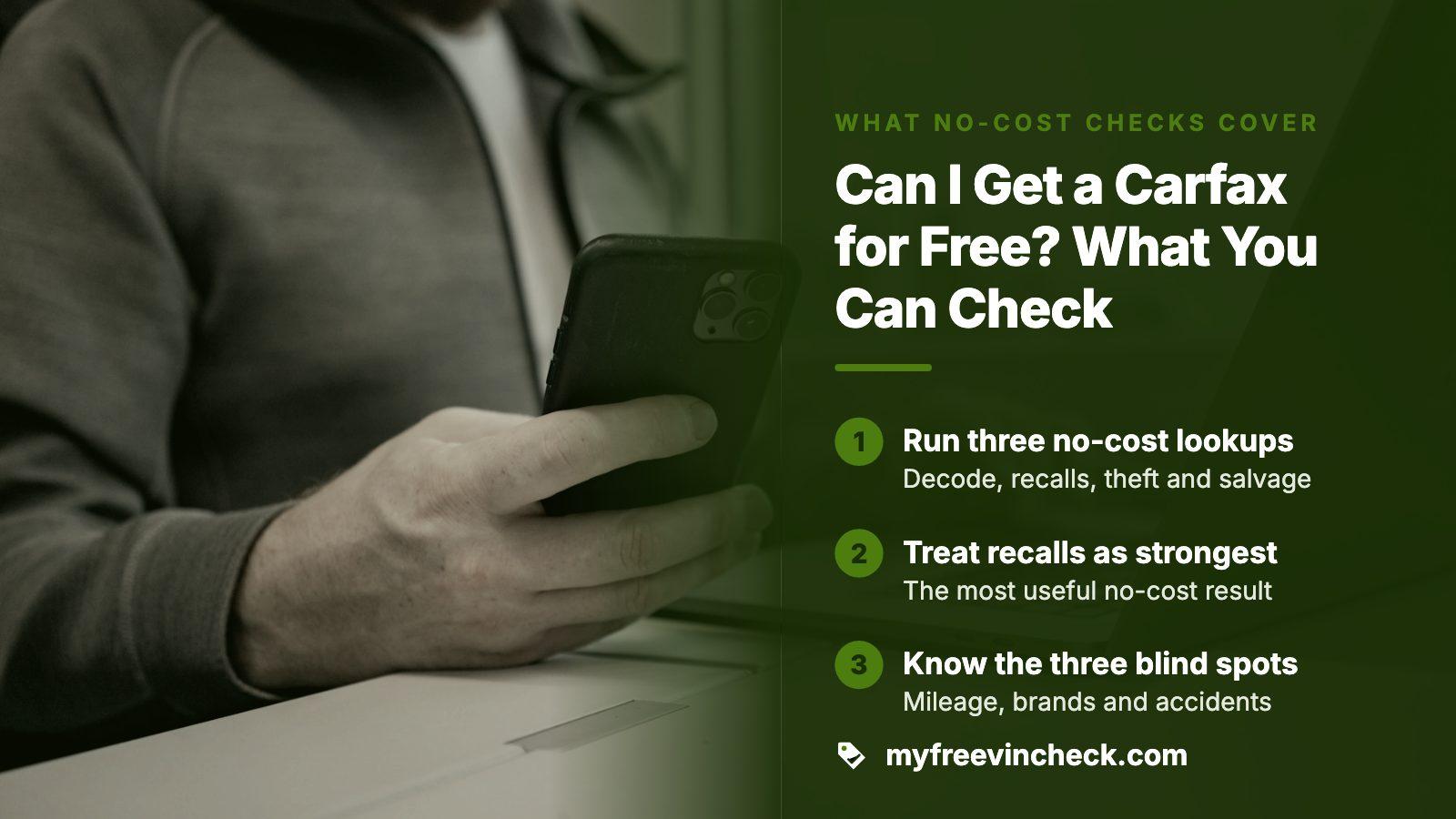
Not directly. No government site returns a Carfax report, and this site does not hand one out. You can ask the seller to show a report they already hold, and you can run three lookups at no charge: NHTSA's VIN decode, NHTSA's recall search and NICB's theft and salvage screen. Those three miss odometer history, title brands and accident records. A paid report covers those gaps, and the preview here is free before you pay.
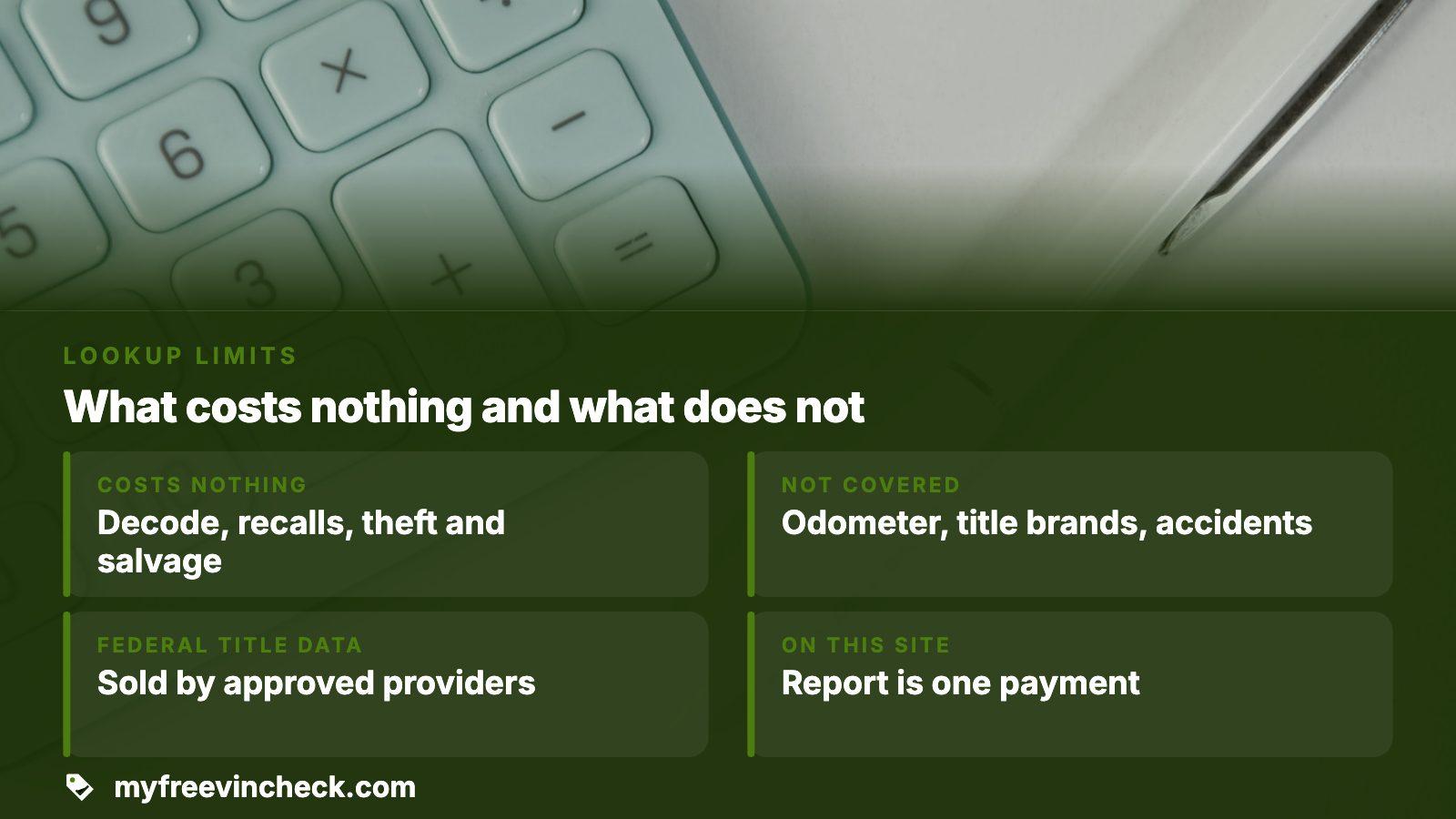
- Costs nothing
- VIN decode, open-recall search, theft and salvage screen
- Not covered
- Odometer history, title brands, accident records
- Federal title data
- Fee-for-service by law, sold through approved providers
- On this site
- Decode, recall check and preview cost nothing; the report is one payment
Three lookups that cost nothing, and the question each answers
The free layer is small, but each piece does real work. Each tool answers one narrow question, and none of them is a history.
| Lookup | Question it answers | What it leaves out |
|---|---|---|
| NHTSA VIN decode | Is this VIN valid, and does it describe the car in the ad? | Owners, titles, crashes, mileage |
| NHTSA recall search | Is there a safety recall nobody has repaired on this car? | Anything that is not a recall, crashes included |
| NICB VINCheck | Was it reported stolen, flooded or declared salvage? | Damage that never produced such a report, plus all title and odometer detail |
A fourth source costs nothing to ask: the seller. Whoever holds a report on that VIN can show it to you, and how they take the request tells you something too.
Decode first: does the VIN describe the car in front of you?
NHTSA's decoder, vPIC, turns the 17 characters into a build record. It runs on VIN specifications that manufacturers file with the agency and was designed for vehicles from model year 1981 on. A result typically lists body style, engine, fuel, transmission, trim and assembly plant, plus whether the ninth-position check digit is correct.
A failed check digit means the VIN as typed is not valid, and a typo is the usual cause, so re-read the plate on the dash first. A decode that contradicts the listing, such as six cylinders on a car sold as a four, is a reason to stop and ask.
NHTSA adds a caution of its own: an empty field means the agency lacks data, not that the car lacks the feature.
The recall lookup is the strongest free result
The FTC sends buyers to NHTSA for open recalls: campaigns where the maker announced a fix that this particular car has not received. Enter the VIN and the answer costs nothing. NHTSA's campaign records name the component, summarize the defect, state the consequence and describe the remedy.
From an NHTSA owner complaint
A buyer picked up a used 2011 BMW 328i from a used-car lot and, on the first drive home, watched it start to overheat, according to an April 2018 complaint to NHTSA. The Carfax the buyer pulled afterward listed two safety recalls. The question put to NHTSA was whether a dealer can sell a car with open recalls. No answer appears in the filing.
The lesson is timing: a no-cost lookup can settle an open-recall question before money moves, when the answer carries the most weight with a seller.
The insurer screen for theft, floods and salvage
The National Insurance Crime Bureau runs VINCheck. Per the FTC, entering a VIN there shows whether the vehicle was flood damaged, reported stolen and not recovered, or declared salvage. It is the nearest free thing to a damage record, and it is easy to over-read.
A clean answer means only that this tool found nothing under that VIN. A car damaged and repaired without ever being declared salvage can come back clean, and the screen is silent on odometer readings and on which states have titled the car.
Three blind spots in every free check
Three questions sit outside all of the lookups above, and a buyer needs them answered before paying.
- Mileage history. A decode carries no odometer data, so the number on the dash has nothing to be checked against.
- Brands on the title. The federal title system exists to collect title and brand records from state agencies, insurers and salvage yards, and a free decode never touches it.
- Crash and write-off records. The Justice Department's list of what that system returns names no accident category, only total-loss and salvage designations.
What the blind spots look like in owners' own words
From an NHTSA owner complaint
A family bought a 2016 Ford Explorer that, within about two months, was losing control on bumpy roads and under braking despite repairs at two Ford dealers. At trade-in, a Carfax report showed two accidents and a total-loss record, the owner wrote in November 2023. Nobody had told them it was a salvage vehicle, and they say they would not have bought it.
Neither the decode nor the recall search carries crash or write-off history, so a clean result from either would have said nothing about it.
From an NHTSA owner complaint
The dash of a 2008 Nissan Sentra showed 87,026 miles when a shopper came to buy it. Carfax's last recorded figure was 125,615, so the shopper suspected a rollback and asked NHTSA where to report one, according to an October 2014 complaint. This one surfaced before any payment.
The second shopper is the pattern to copy: the comparison came before payment, and only earlier readings could supply it.
Why title and damage history is sold, not given away
The federal title system behind most of this data is fee-for-service by design. Per the Justice Department's FAQ, the law that created it demands user fees in place of federal money, and the cost of a report depends on the provider. A consumer gets in through an approved provider, and the FTC says you enter the VIN and pay that provider's fee.
That explains the search results for a free Carfax. The FTC has warned about report sites that may collect card numbers and personal details or resell leads, and about a scam aimed at sellers: a supposed buyer asks you to pull a report from a named site, then vanishes.
An order of checks that spends money last
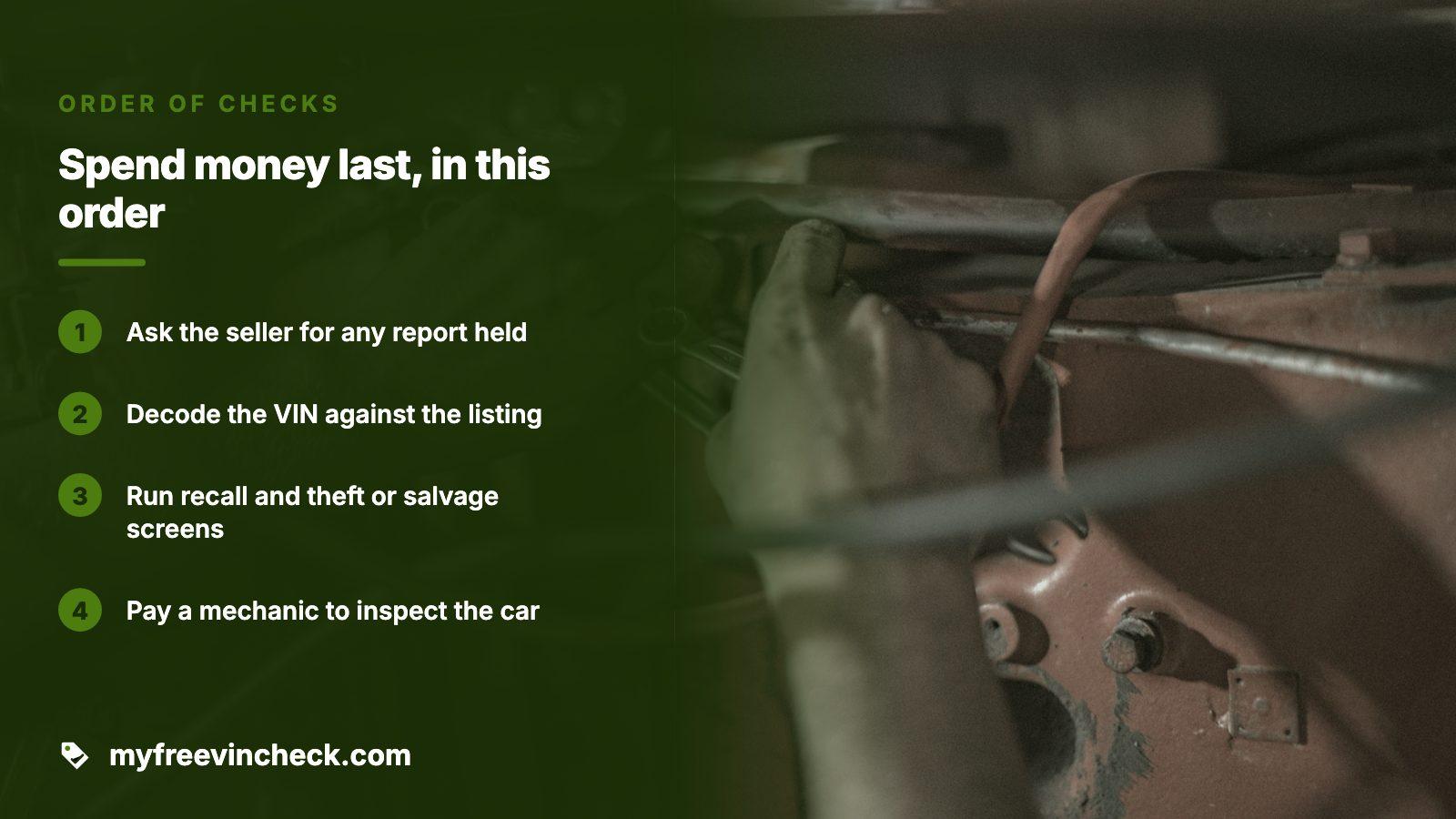
- Ask the seller for any report already held on that VIN, and compare the VIN on the document with the one on the car.
- Decode the VIN and read the result against the listing.
- Run the recall search, then the insurer theft and salvage screen.
- Pay a mechanic for an independent inspection. The FTC says a history report is no replacement, and that a dealer who refuses one is a reason to shop elsewhere.
- For a car that survives steps one to four, buy a full report to settle mileage, title and damage.
Steps one to three take minutes and rule cars out; the paid step belongs only to cars that make it that far.
Where this site's report fits after the free steps
On this site the decode, the recall check and the preview cost nothing, and the preview shows whether records exist on a VIN before you pay. The report itself is one purchase with no subscription, bundles exist for anyone weighing several vehicles, and the pricing page carries each amount.
The report adds what the free tools skip: title brands, odometer readings and accident and damage records, plus salvage and auction entries with photos where they exist. That is the gap to close on a car you are about to leave a deposit on, and not worth buying for one already ruled out by a recall or a decode mismatch. It also does not replace the mechanic in step four.
Where this information comes from
- FTC: Used cars — Where the FTC sends buyers for history reports, open recalls and salvage checks, and why no report replaces an inspection.
- FTC: Steering clear of vehicle history report scams — The seller-targeted report scam, the sites it points to and the agency's advice.
- Justice Department NMVTIS: FAQs — Fee-for-service funding, the record types a title report returns and how state data timing varies.
- NHTSA vPIC VIN decoder — What the decoder is built from and which model years it is meant for.
- NHTSA owner complaint 11085150 — owner experience, paraphrased
- NHTSA owner complaint 11556734 — owner experience, paraphrased
- NHTSA owner complaint 10644296 — owner experience, paraphrased
Sources and photos: Facts checked against the sources above in November 2026. Photos by Anastasiia Nelen, Nina Mercado and Sasun Bughdaryan on Unsplash; diagrams by MyFreeVINCheck.
Keep reading
- Where Can I Get a Free VIN Check? Three Lookups and What They MissRun the decode and the recall check on a VIN, then read the preview before deciding on a report.
- Check a VIN Number for Recalls: Free Lookup, Then the Full PictureHow an open recall reads in the results and what to do with one on a car you want.
- Sample reportSee which records a finished report lists, to judge whether the gaps are worth closing.
- PricingWhere every amount sits: one report or a pack, paid once, with no subscription.
Frequently asked questions
Is there a free version of Carfax?
Not from this site or any government lookup. A seller who already holds a report can show it to you. Otherwise the no-cost options are narrower: NHTSA's decode and recall search, and NICB's theft and salvage screen. None returns odometer history or title brands.
How can I get a free Carfax report without paying?
Ask the seller for a report on that VIN and check the VIN printed on it. Then use the decode, recall search and insurer screen. Be wary of any site that wants a card number before showing a so-called free report; the FTC suggests searching the company's name plus the word complaint.
Does the NHTSA recall check show accidents?
No. It lists safety recalls announced for that VIN and not yet repaired, nothing more. A car can have a clean recall record and a salvage past. Use the result for what it answers, an open safety fix, and add a title and damage check for the rest.
What does the federal title system show that free tools do not?
The Justice Department lists current and earlier title state, title date, latest odometer reading, theft history, any brand with its date, and salvage or total-loss records, but no repair history. Access runs through approved providers that charge fees, and states report on different schedules, so a recent event can lag.
Is a clean free result a green light to buy?
No. It means only that three tools found nothing. They cannot see mileage history or title brands, and the FTC says even a full history report is no substitute for a mechanic's inspection. Treat free results as a filter that rules cars out, never one that rules them in.
Now check the car itself
The guide explains what to look for. The report shows what this VIN has on record.