THE SHORT ANSWER
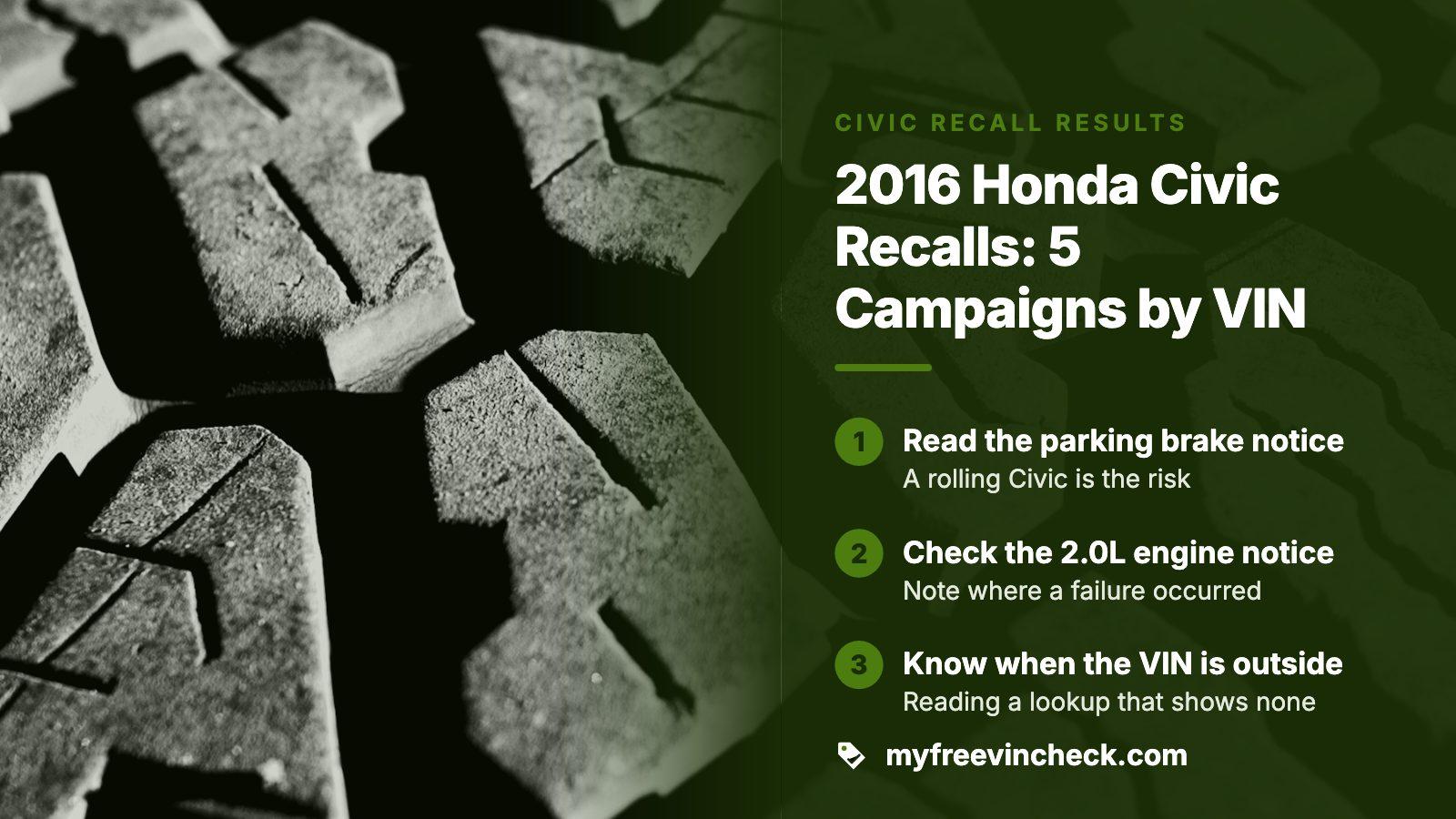
Five campaigns are on file for the 2016 Civic: 2.0L engine pistons (16V074000), two-door side marker lights (16V526000), an electric parking brake software update (16V725000), the in-tank fuel pump (23V858000) and the passenger seat weight sensor (26V332000). Each follows build dates, body style or engine, so a VIN lookup shows what applies. A Honda dealer repairs open ones at no charge.
- Campaigns
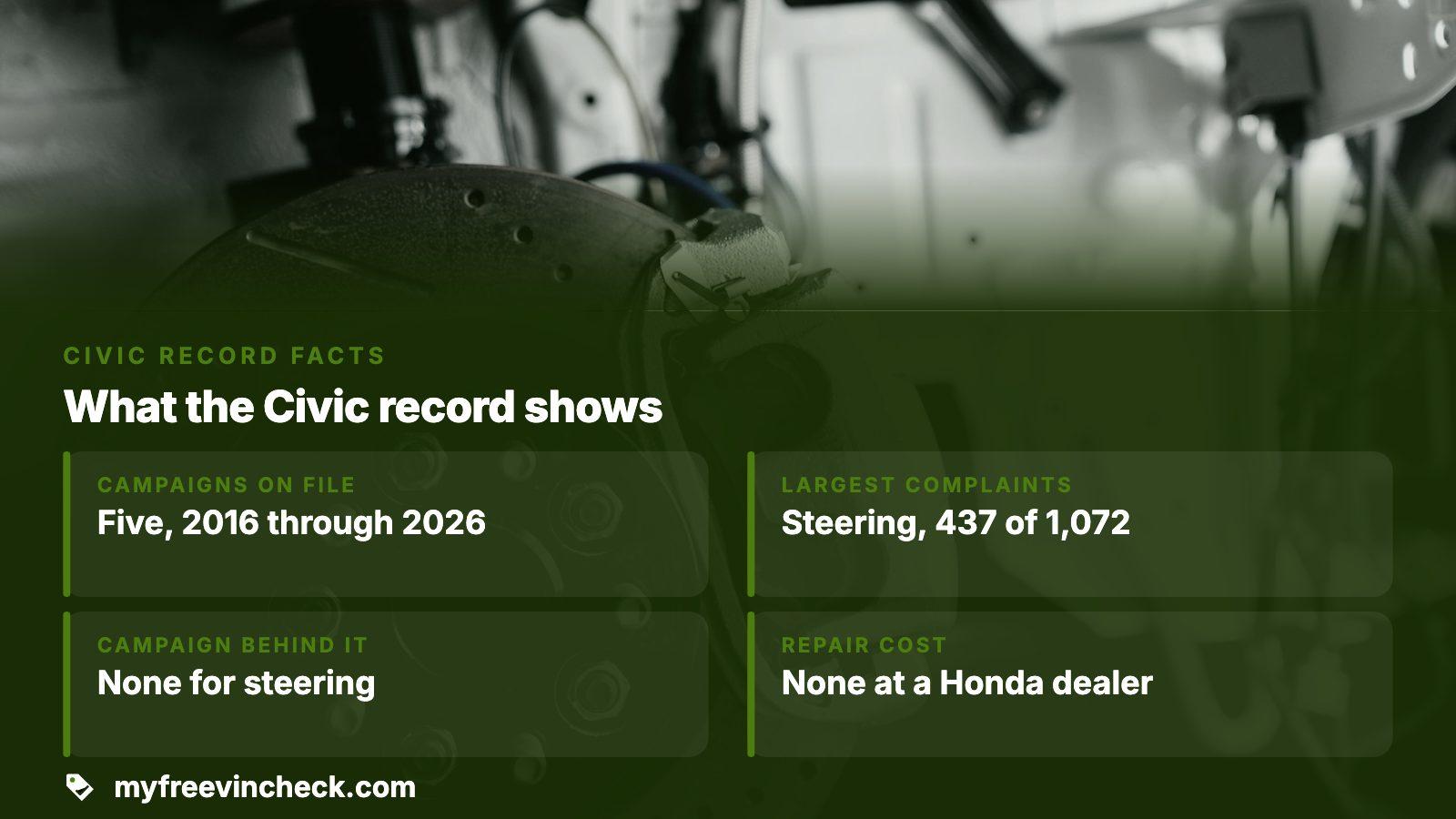
- 5 on file with NHTSA, from 2016 through 2026
- Largest complaint group
- Steering, 437 of 1,072 owner reports, with no campaign behind it
- Repair cost
- None at a Honda dealer for a covered VIN
- Check
- Decode and recall check on NHTSA data, no charge
The five campaigns, and the gate on each
Three notices date from 2016 and were written for the Civic alone. The other two, from 2023 and 2026, name long lists of Honda and Acura models, so a service desk may quote Honda's own code instead of the federal number.
| NHTSA number | Honda code | Part | Who it reaches |
|---|---|---|---|
| 16V074000 | JX9 | Engine pistons | 2.0L Civics from the Sept 22, 2015 through Feb 3, 2016 build window |
| 16V526000 | KB8 | Side marker lights | Two-door Civics built Feb 23 through May 20, 2016 |
| 16V725000 | KC6 | Electric parking brake | Coupes and sedans alike, whether 1.5L turbo or 2.0L |
| 23V858000 | KGC and KGD | In-tank fuel pump | Civic coupe and sedan among many Honda and Acura models, 2013 to 2023 |
| 26V332000 | Many codes | Passenger seat weight sensor | Civics from 2016 to 2022 among many Honda and Acura models |
Decode first, then run the recall check
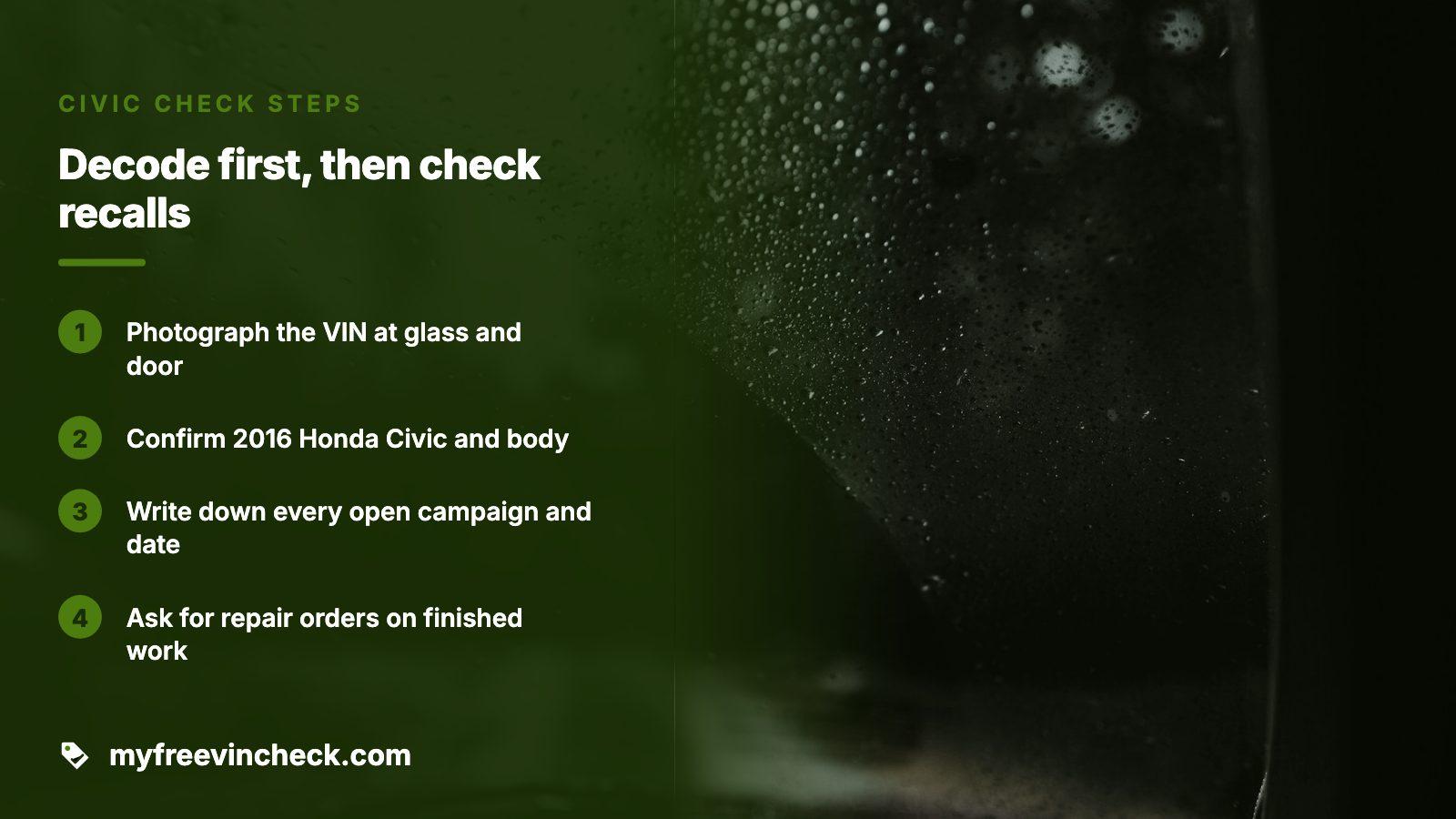
The decode answers three questions the table turns on: coupe or sedan, 2.0L or 1.5L turbo, and when the car was built. Do it first, since a campaign that misses the build may not apply.
- Photograph the VIN where it shows through the windshield, then the label inside the driver's door opening. Both should agree with the title and the listing.
- Run the decode. It should read 2016, Honda and Civic, with the body style and engine the seller advertised.
- Run the recall check and write down every open campaign number with today's date.
- Set the result against the table. A listed campaign that is not open was either repaired or never reached this build, so ask which.
- For any repair shown as done, ask for the dealer's repair order and read the VIN printed on it.
The parking brake notice, and a Civic that rolled away
Campaign 16V725000 is a software fault. The electric parking brake may fail to engage if it is applied right after the ignition goes off, and the car can then roll. Dealers install an update at no charge, and the recall began on November 8, 2016.
From an NHTSA owner complaint
In a 2020 filing, a 2016 Civic owner told NHTSA the car was in park, switched off and with the key out when it rolled backward down a hill, over a tree stump and into a guardrail. Nobody was hurt and no police report was filed, but the underside was so badly damaged that the car was totaled. The owner named campaign 16V725000 as the cause and put the mileage at about 47,173.
The notice describes a failure of this kind. Because the cure is code, there is no part to inspect, and only a repair order or the dealer's records show the update went in.
The 2.0L engine notice, and a failure at 320 miles
Campaign 16V074000 reaches 2.0L cars built between September 22, 2015 and February 3, 2016. A clip meant to hold the piston wrist pin can be absent or badly seated, letting the pin drift, damage the cylinder and seize the engine. The dealer inspects, then replaces piston assemblies and damaged parts as needed.
From an NHTSA owner complaint
Writing in July 2016, a parent who had bought a new Civic for a daughter said the car lost power at a neighborhood intersection about two weeks later, slowing from 15 mph to a stop as the "engine completely failed." Honda roadside assistance towed it with 320 miles showing. Honda service said a new engine would go in, and the family learned only afterward that the model had been recalled for a piston problem.
A 2.0L Civic from that build window should come with a repair order for this notice. If it has none, call a dealer with the VIN before leaving a deposit.
Reading the lookup, and the VIN that is not on the list
| Result | What it means | Your move |
|---|---|---|
| Campaign open | No completed repair on file for this VIN | Have a dealer finish it before delivery, or get a date in writing |
| Campaign closed | A dealer reported the work done on some date | Ask for the repair order, since a software fix leaves nothing to see |
| Not listed | The VIN falls outside that notice's build window or equipment | The part can still fail, so judge it by how it behaves |
| Nothing open | No open campaign reaches this VIN today | Title, damage, odometer and lien records are untouched |
From an NHTSA owner complaint
A coupe owner wrote in November 2023 that Honda had called the car's VIN outside a parking brake software fix described in a service bulletin. When the brake error appeared on October 29, the service center charged $112 to diagnose it and $150 to install the update, $262 in all. The owner felt Honda knew of the fault and left it untreated on this car.
Coverage follows Honda's VIN list, and the lookup returns what the service desk will say. A symptom on a VIN outside it is a repair bill, so price it into your offer.
The fuel pump and seat sensor notices came late
- 23V858000, from December 2023: a pump inside the tank that quits can kill the engine on the road. Dealers replace the pump module, and owner letters went out on September 6, 2024. It widens two earlier notices.
- 26V332000, from May 2026: the weight sensor in the front passenger seat may crack and short out, which can make the air bags deploy unintentionally in a crash. Letters were mailed on July 7, 2026, and VINs became searchable on NHTSA's site from May 29, 2026.
A service file from the car's early years predates both notices. A lookup saved from before late May 2026 could not have shown the sensor campaign, so repeat it when you are ready to pay.
What no campaign covers
The largest group of owner complaints on this model year has no campaign. In the August tally, 437 of 1,072 reports, about 41%, concerned steering, ahead of the unclassified group at 252 and electrical trouble at 118. Complaints are unverified, so they point a mechanic at a system and prove nothing alone. The crash tests were kinder: NHTSA awarded an overall 5 of 5, with the frontal test at 4.
Neither a recall list nor a complaint count says whether this Civic was wrecked, had its odometer rolled back or still carries a lien. Those answers live in title and history records, which is where the paid report starts.
Cost, and the sensible next step
The decode and recall check cost nothing. The preview is free too, a first look at which record types exist for the VIN. A report is bought once, with no subscription, singly or in a pack for anyone comparing several Civics. Amounts sit on the pricing page.
- Decode the VIN and run the recall check today, and again the day you buy.
- Get every open campaign settled in writing at a Honda dealer.
- Run the preview. If the Civic still looks right, buy the report for its title, damage, odometer and lien records.
Where this information comes from
- NHTSA: Recalls — The agency lookup where a VIN is checked and each campaign number above can be searched.
- NHTSA owner complaint 11330744 — owner experience, paraphrased
- NHTSA owner complaint 11553461 — owner experience, paraphrased
- NHTSA owner complaint 10888977 — owner experience, paraphrased
- NHTSA: 5-Star Safety Ratings — The federal crash-test program behind the star ratings mentioned above.
- 49 U.S.C. 30120: Remedies for defects and noncompliance — The statute behind the no-charge repair and the 15-year limit on it.
- NMVTIS: National title information — Federal background on the title brand records that a recall lookup leaves out.
Sources and photos: Facts checked against the sources above in November 2026. Photos by Marvin Sagisi, Justin Cron and Erik Mclean on Unsplash; diagrams by MyFreeVINCheck.
Keep reading
- 2016 Honda Pilot Recalls: 8 Campaigns, Checked by VINAnother 2016 Honda, and the Pilot appears in the same fuel pump notice.
- 2016 Chevrolet Cruze Recalls: 4 Campaigns, Checked by VINA compact sedan from the same model year, checked the same way.
- Sample reportThe records a paid report sets beside the recall status.
- PricingWhere one report or a larger pack is bought, and what each costs.
Frequently asked questions
How many recall campaigns cover the 2016 Civic?
NHTSA lists five: engine pistons, side marker lights on coupes, the electric parking brake, the fuel pump and the front passenger seat weight sensor. That count describes the model year. Build dates, body style and engine decide which reach a single car, and a VIN lookup shows which are still open.
Which 2016 Civics does the engine recall cover?
Campaign 16V074000 covers 2.0L Civics built between September 22, 2015 and February 3, 2016, where a clip on the piston wrist pin may be missing or badly seated. A 1.5L turbo car falls outside it. Decode the VIN to confirm the engine, then read the build month on the door-opening label.
Will a Honda dealer repair a 2016 Civic recall at no charge?
Yes, when the VIN is covered and the campaign is open. The federal limit runs 15 years from the car's first sale, and all five notices fall inside it. Ask for a repair order that names the campaign. A symptom on a VIN outside the list is an ordinary repair, as one owner found out at $262.
Does a closed recall on a Civic mean the work was done right?
It means a dealer reported the work finished. For the parking brake notice the repair is a software update, which shows nowhere on the car, so the repair order is the proof. Look for the campaign name on it and a VIN that matches.
Can I check 2016 Civic recalls before paying for a report?
Yes. NHTSA's own lookup is free, and the decode and recall check here read the same records at no charge. The preview is free as well. A paid report adds the title, damage, odometer and lien records that no recall list includes.
Now check the car itself
The guide explains what to look for. The report shows what this VIN has on record.