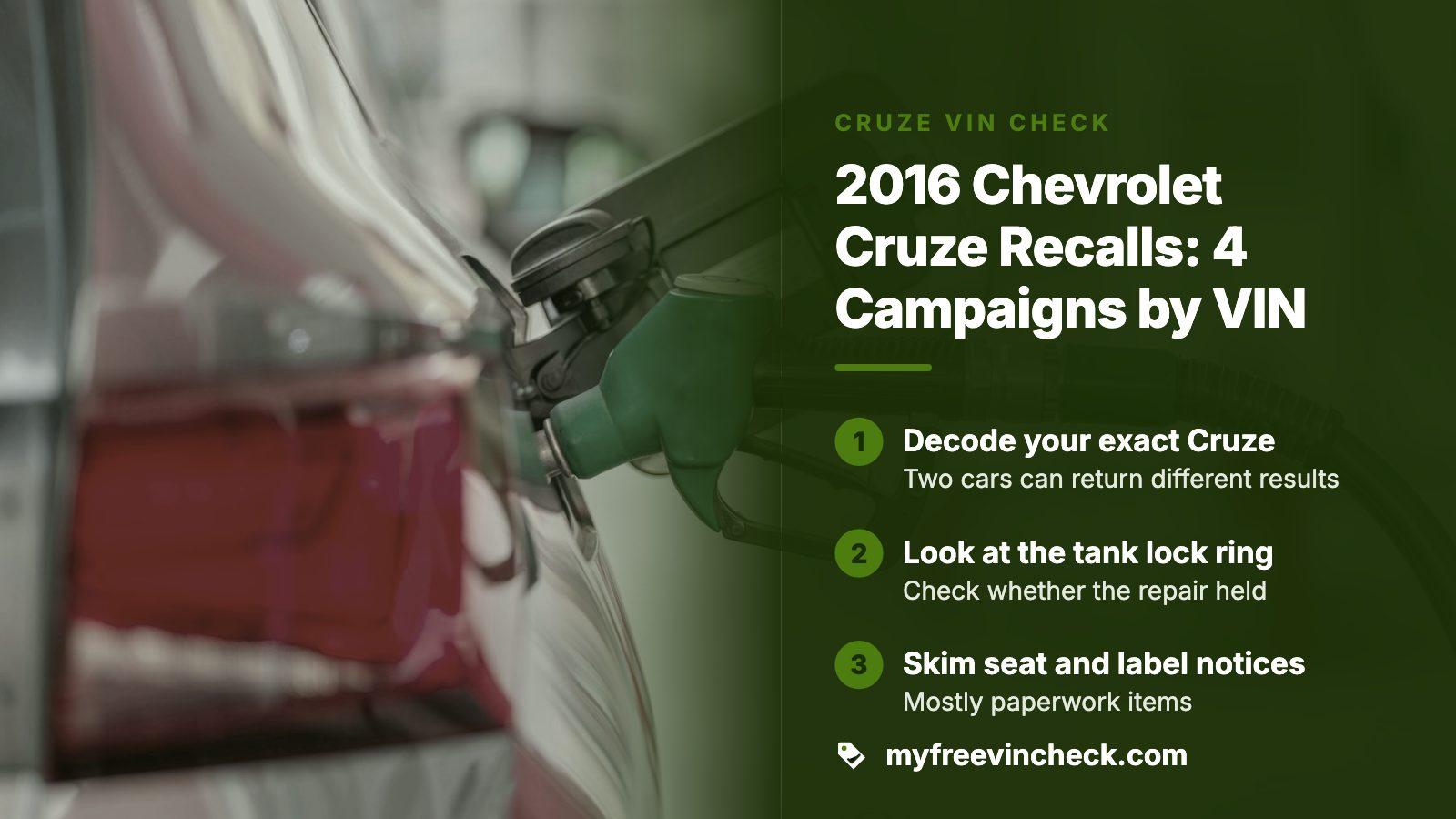
THE SHORT ANSWER
Four campaigns are filed against this model year, with repairs starting between August 2016 and June 2018. They cover the fuel tank sensor, front seat-back welds, headlight aiming labels and the ignition park-lock lever. Each follows a build range, so a Chevrolet dealer repairs only the ones that match your VIN, at no cost to the owner. Run the VIN through the recall check to see which are still open.
- Campaigns
- 4 on file with NHTSA, repairs starting August 2016 to June 2018
- Largest complaint group
- Engine, about 40% of owner complaints
- Repair cost
- None at a Chevrolet dealer, inside the 15-year federal limit
- Check
- Decode and recall check on NHTSA data, no charge
The four campaigns, in plain terms
Each campaign carries an NHTSA number, and a dealer may quote GM's own reference instead. Two came out in 2016, one in 2017 and one in 2018.
| NHTSA number | Part | Cars it reaches | What the dealer does |
|---|---|---|---|
| 16V498000 | Headlights | 2016 cars assembled from Nov. 5, 2015 through May 26, 2016 | Owner gets aiming-code labels by mail, or a dealer applies them |
| 16V502000 | Ignition park lock | Cruzes that were fitted with a defective replacement lever | Inspects the key cylinder lock housing and swaps it where needed |
| 17V057000 | Front seat backs | Certain 2016 and 2017 Cruzes | Inspects the front seats, replaces any badly welded frame |
| 18V304000 | Fuel tank sensor | Certain 2016 to 2018 LS cars: gasoline engine, no spare tire, inflator kit in its place | Fits a lock ring that shields the tank's pressure sensor |
Running the decode and recall check on your Cruze
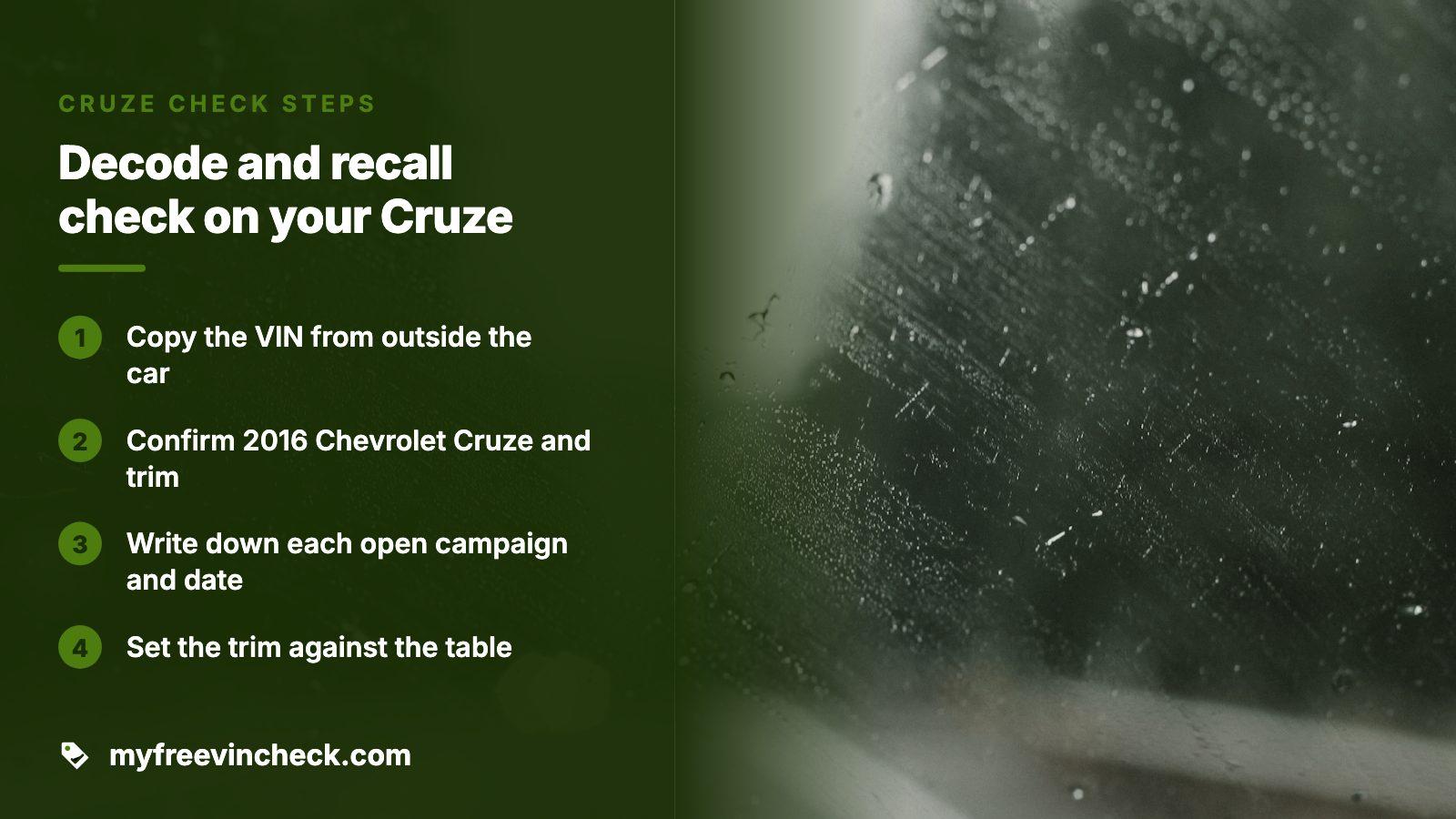
Both tools read NHTSA records and need one input from you, a VIN with no slips. Take it from the car and not from the listing, because a typo in an ad sends the lookup to another vehicle or to nothing.
- Standing outside the Cruze, copy the 17 characters showing where the windshield meets the dash near the driver, then check them against the door-jamb label.
- Run the decode. It should return 2016, Chevrolet and Cruze, with the trim and engine the seller described.
- Run the recall check and write down each open campaign number with today's date.
- Set the decoded trim against the table above. An LS with an inflator kit where the spare should be is the car the fuel notice names.
Why two 2016 Cruzes can return different results
A model year is a label, and campaigns attach to production ranges. The headlight notice shows it best: only cars built from early November 2015 to late May 2016 are inside it, so a Cruze finished after that falls outside.
- Trunk floor: look for a spare tire or an inflator kit before you read the fuel result.
- Door label: the build month printed there tells you whether the headlight window applies.
- Invoices: any bill for the shifter or park-lock parts matters for the ignition notice.
The fuel tank lock ring, and a repair that did not end the story
The 2018 notice exists because a hard rear impact could damage the tank's pressure sensor and let gasoline escape, which raises the fire risk. The remedy is a lock ring over that sensor, fitted by a dealer at no cost, with work starting in June 2018.
From an NHTSA owner complaint
An owner wrote to NHTSA in September 2018 that the Cruze stalled while backing down a sloped driveway and gasoline was leaking from it. The car had been to a dealer on August 8 for this very fuel notice. The owner called the situation "very dangerous and unsafe" and said the leak continued after the recall repair.
Take from this that a closed fuel campaign does not clear the tank area. Get the repair order, then look under the rear of the car for wet spots and sniff for gasoline before you sign.
Seat backs and headlight labels: mostly a paperwork problem
The seat notice concerns a recliner bracket that may be welded badly to the frame, so in a crash a head restraint might not hold. The headlight notice is lighter: the assemblies lack a three-digit code used when aiming them, and the remedy is an adhesive label.
From an NHTSA owner complaint
In April 2017 an owner told NHTSA that a letter about the seat campaign had arrived, yet no repair part was available. The owner felt GM was taking too long. The car had not failed in the meantime.
That was early in the campaign, and the lesson is about records, not parts. A seat-back repair leaves nothing you can see, so the dealer's repair order is the only evidence that it was done.
The ignition notice is about replacement parts
The fourth campaign started with the Buick Verano and the Chevrolet Malibu, whose electronic park-lock lever could let the key be removed while the shifter sat outside park. NHTSA's record adds that Cruzes from 2011 through 2016 may have been repaired with a similar defective replacement lever. The danger is a car rolling away as the driver steps out.
That makes repair history the clue. A Cruze whose shifter was never worked on has less to worry about, but the VIN result is what settles it. If the car did have shifter work, ask the seller which shop did it and when.
When the problem is real but the VIN shows nothing
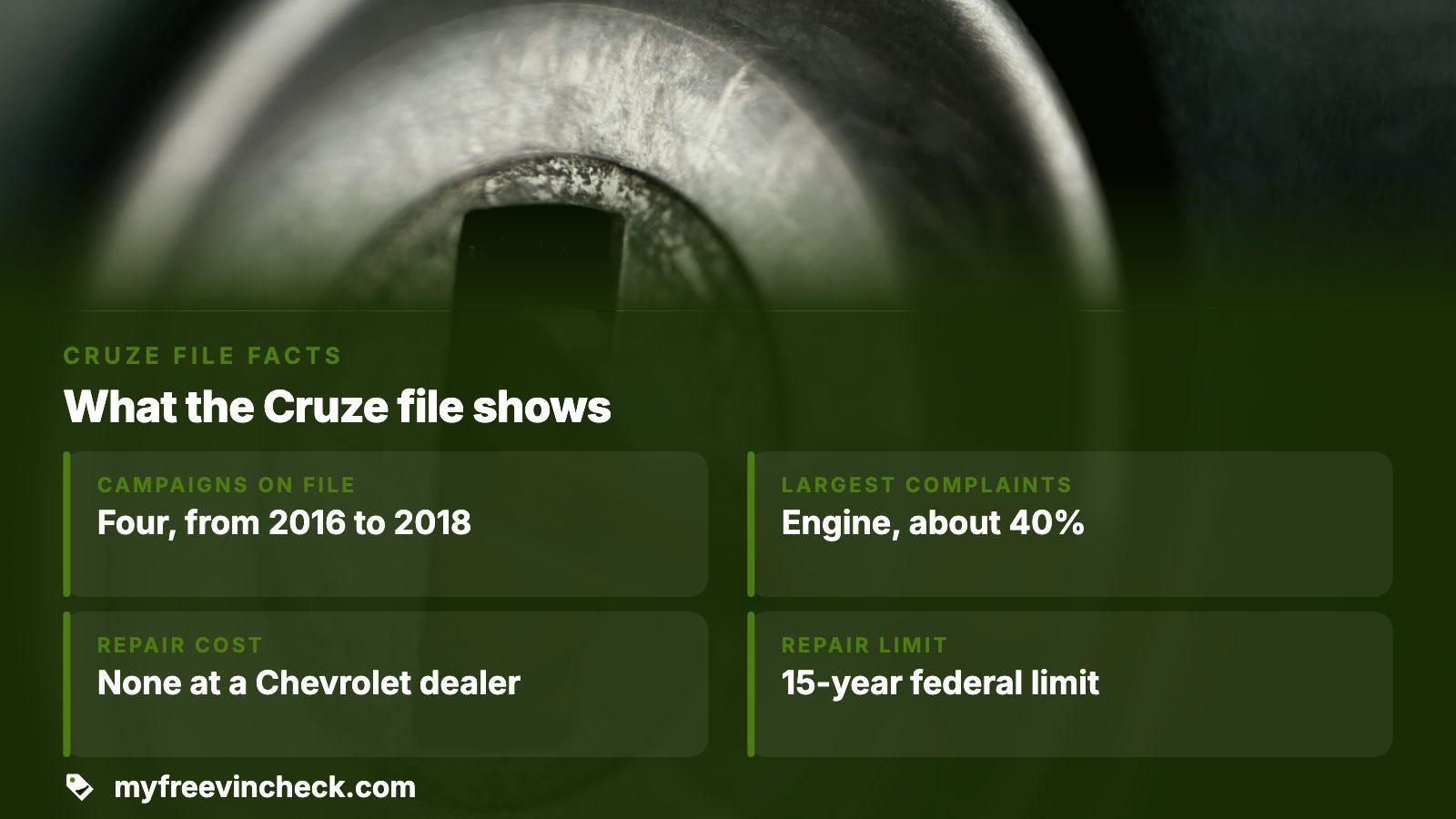
These four are the model year's whole federal recall list, and none of them touches the engine. Yet engine reports are the biggest group of owner complaints, about 40% of the total. A complaint is an owner's account, while a recall is a maker's filing, and only the second brings a no-cost repair.
From an NHTSA owner complaint
An owner wrote in August 2023 that a 2016 Cruze overheated on the highway and a Chevrolet dealer replaced cooling parts. The owner had read about a Cruze recall for coolant leaking at the thermostat housing and found the receipt worded almost the same. The dealer's answer, as the owner reported it, was that the Cruze was "not covered by the recall", and the owner asked NHTSA to extend it to every Cruze.
Coverage follows the VIN list the maker filed. If a repair matches a recall's description but your VIN is outside it, file your own complaint and price the repair into the deal.
Reading the result next to the seller's paperwork
Hold the recall result beside whatever the seller hands you.
- An open campaign on a car the seller calls fully repaired: the record wins until paper says otherwise.
- A closed campaign with no repair order: ask the dealer's service desk to confirm it by VIN.
- A repair order whose VIN differs by one character from the car's: stop and sort that out first.
- An LS with an inflator kit and an open fuel notice: get the lock ring fitted before delivery.
- A shifter that sticks, or a key that releases when the lever is not in park: have the ignition notice checked at once.
Cost, the 15-year limit and where the paid report fits
Under the federal remedy law, a maker repairs a recalled car without charge to the owner, but that duty ends once the car's first sale is more than 15 years behind the notice. Notices from 2016 to 2018 sit well inside that span.
The decode and recall check cost nothing here, and the preview is free. The paid report is a one-time charge, never monthly, and it covers what a Cruze recall list never holds: brands on the title, accident and damage entries, odometer readings and lien checks. The pricing page lists the cost of a single report or a pack. A Cruze with an open fuel notice and no paperwork may never get that far.
Where this information comes from
- NHTSA: Recalls — The agency lookup where a VIN is checked and each campaign number above can be searched.
- NHTSA owner complaint 11129749 — owner experience, paraphrased
- NHTSA owner complaint 10971082 — owner experience, paraphrased
- NHTSA owner complaint 11538069 — owner experience, paraphrased
- 49 U.S.C. 30120: Remedies for defects and noncompliance — The statute behind the no-charge repair and the 15-year limit on it.
- NMVTIS: National title information — Federal background on the title brand records that a recall lookup leaves out.
Sources and photos: Facts checked against the sources above in November 2026. Photos by engin akyurt, Cole Keister and Derek Nelson on Unsplash; diagrams by MyFreeVINCheck.
Keep reading
- 2016 Honda Civic Recalls: 5 Campaigns and the VINs They ReachAnother 2016 compact sedan whose campaigns also depend on the VIN.
- 2010 Chevrolet Traverse Recalls: 5 Campaigns, Checked by VINA second GM model, checked the same way and repaired through the same dealer network.
- Sample reportThe records a paid report sets beside the recall status.
- PricingWhere one report or a larger pack is bought, and what each costs.
Frequently asked questions
How many recalls does a 2016 Chevrolet Cruze have?
NHTSA lists four campaigns, covering the headlights, the ignition park lock, the front seat backs and the fuel tank sensor. They follow build ranges, so a given Cruze may be in some, all or none of them. The VIN recall check shows which apply and whether the work is recorded as done.
Will a Chevrolet dealer fix a 2016 Cruze recall at no cost?
Yes, for an open campaign that covers the VIN. The federal limit is 15 years from the car's first sale, and all four notices fall inside it. Ask for a repair order that names the campaign and keep it.
Does a closed recall mean the repair was done right?
Not always. Closed records the dealer's report of finished work, not a test of the car. Ask for the repair order with the VIN printed on it, and for the fuel and seat items have a mechanic look at the work itself.
What do 2016 Cruze owners complain about most?
Engine problems lead at about 40% of complaints, with the electrical system next at about 23%. Owners filed these without verification, so use them as a list of places for a mechanic to look. None of the four recall campaigns is about the engine.
Can I check 2016 Cruze recalls before paying for a report?
Yes. NHTSA's own lookup is free, and the decode and recall check here read the same records at no charge. The preview is free as well. The paid report is one payment and adds the title, damage, odometer and lien records that a recall list leaves out.
Now check the car itself
The guide explains what to look for. The report shows what this VIN has on record.