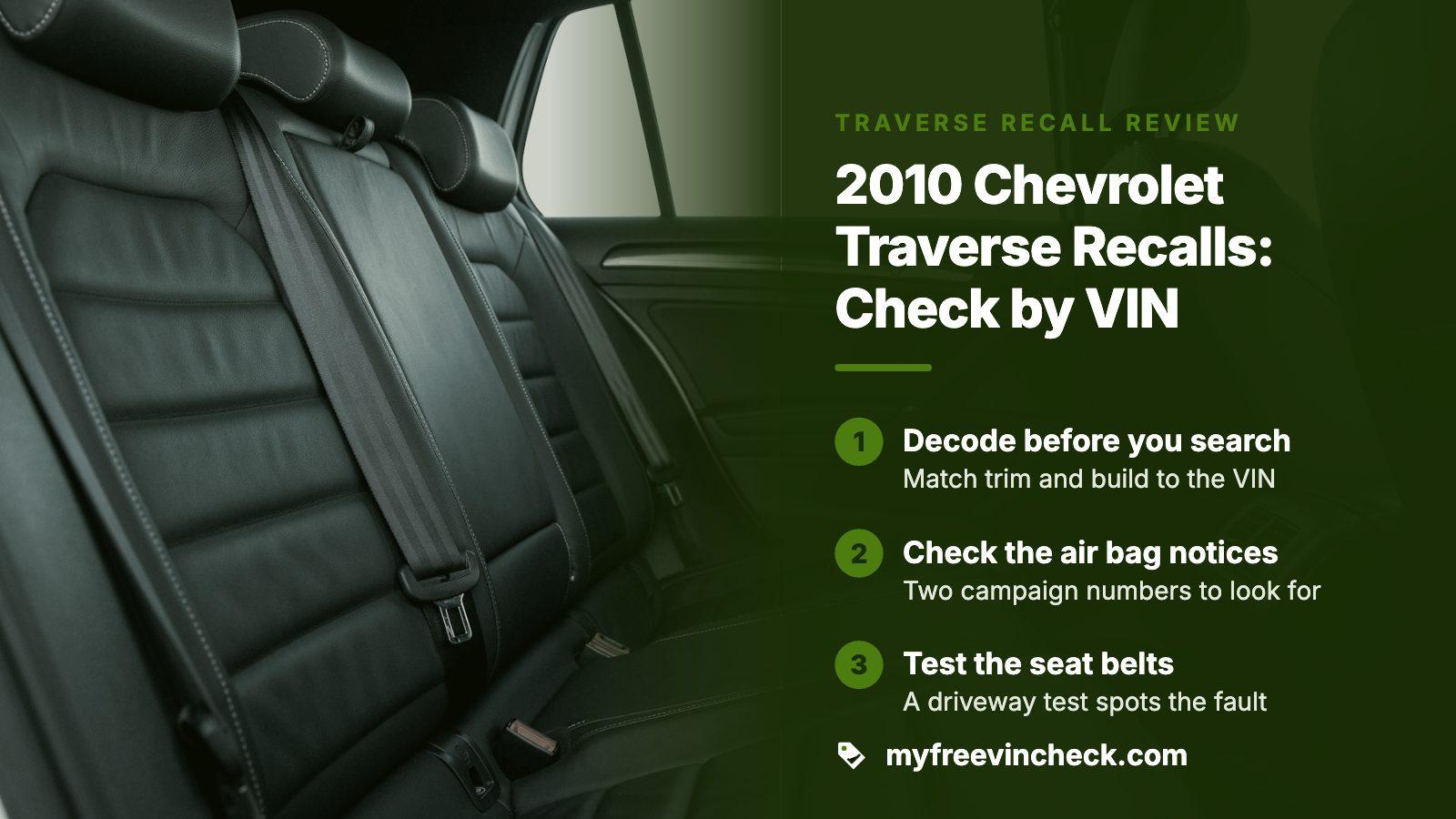
THE SHORT ANSWER
Copy the 17-character VIN, decode it to confirm the build, then run the recall check. NHTSA files five campaigns for this model year, yet each reaches only certain build ranges. Any that is still open is a repair General Motors owes, so find out which apply before agreeing a price.
- Campaigns
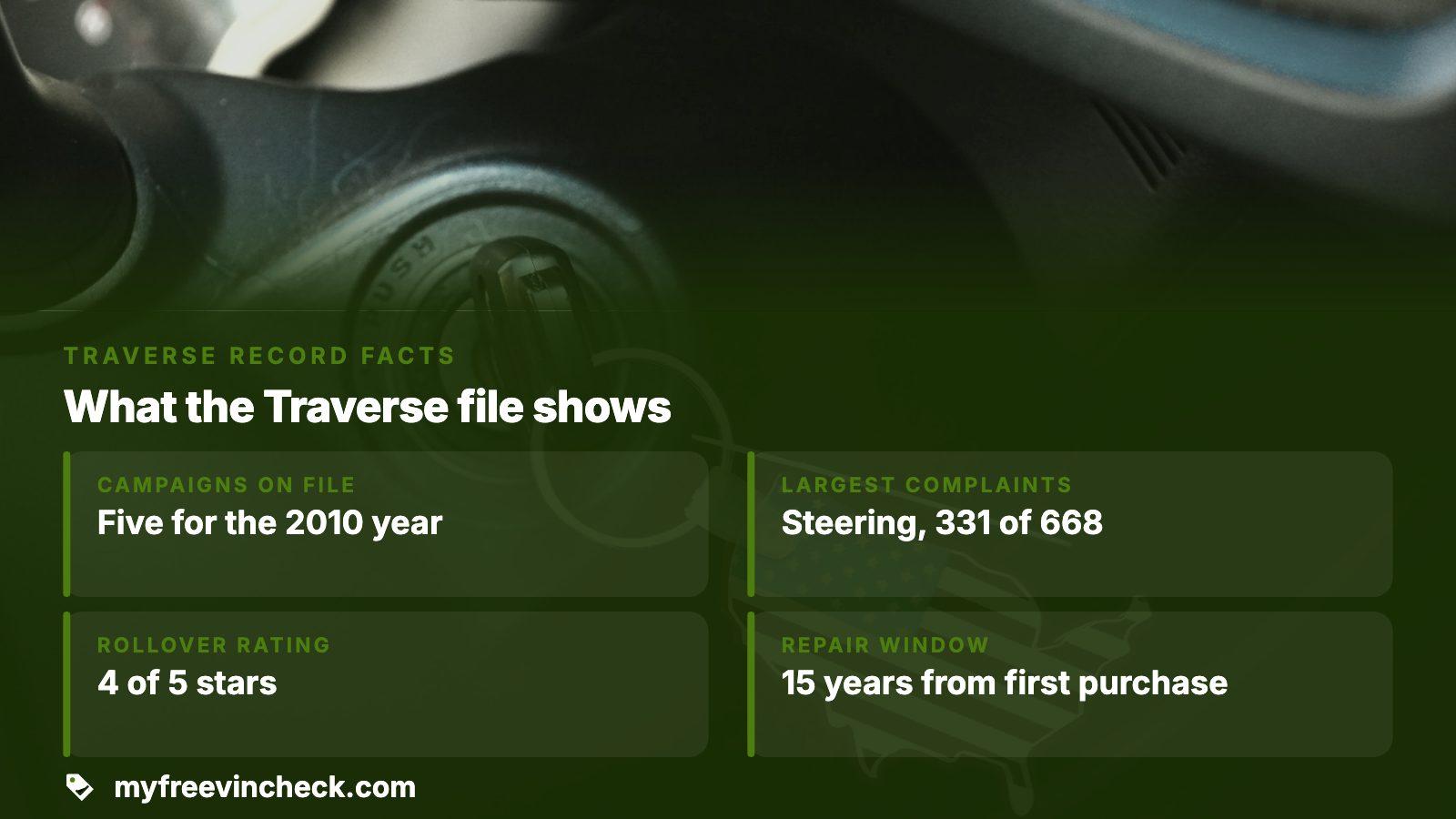
- 5 on NHTSA's file for the 2010 model year
- Owner complaints
- 668, with steering the largest group at 331
- Crash ratings
- No overall, frontal or side stars; rollover 4 of 5
- Free-repair limit
- 15 calendar years from first purchase, 49 U.S.C. 30120
The five campaigns NHTSA files under the 2010 Traverse
A recall follows the production run, not the badge. A Traverse built just outside a campaign's dates is exempt, and one built inside may still await its repair.
| Campaign | Component | What the notice covers |
|---|---|---|
| 21V246000 | Air bags, critical fasteners | Roof-side curtain bags that may be poorly secured |
| 14V266000 | Seat belts | A front belt cable that can fatigue and separate |
| 10V375000 | Seat belts | A second row buckle cover that can slide down the strap |
| 14V118000 | Air bags, side and window | Front seat wiring that can stop side bags deploying |
| 15V415000 | Structure, body, liftgate | Power liftgate struts that wear, letting an open gate drop |
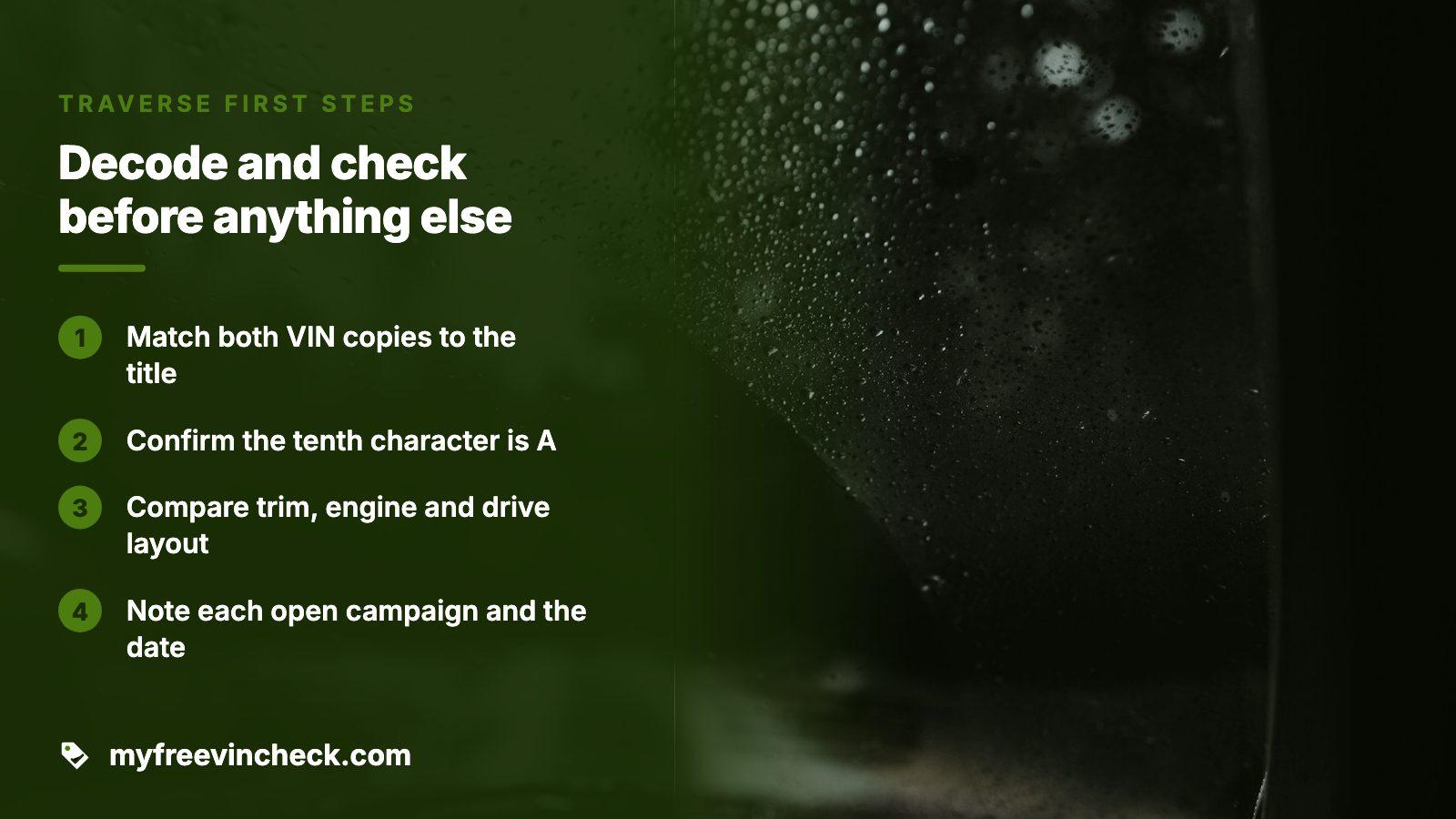
Run the decode and the recall check before anything else
Two working tools on this site read NHTSA data: a VIN decode and a recall check. Neither costs anything, and each comes before any paid report.
- The SUV carries its VIN twice, on the dashboard plate and on a label in the door frame. Match both against the title or listing.
- Character ten encodes the model year; on a 2010 it should be the letter A.
- Decode it and compare trim, engine and drive layout with the listing. A mismatch means a typo or a different vehicle.
- Run the recall check and note each open campaign number and the date.
What these tools cannot say
Neither tool shows that a dealer ever did a repair. The decode reports the factory build, and the recall check lists only notices still open.
The air bag campaigns, 21V246000 and 14V118000
Campaign 21V246000 covers side curtain bags that may be poorly anchored and might not work as intended in a crash. Dealers check the weld nuts and either realign them or fit new ones, at no charge. A Traverse sold since the May 2021 owner letters may never have had one, so call Chevrolet customer service on 1-800-222-1020 with the VIN.
Campaign 14V118000 is a wiring fix: poor connections in the front seat harnesses can stop the side bags and belt pretensioners deploying, and dealers replace them with soldered ones.
From an NHTSA owner complaint
One filing describes a solid air bag warning light at 140,000 miles. The owner's mechanic blamed a seat connector and linked it to a recall, but the VIN fell outside that recall, so the selling dealer wanted to charge for the repair. The SUV had never been in a crash.
Coverage turned on the VIN, not the model year. Decode first, and price the fix into the deal if the VIN falls outside.
Two seat belt campaigns, and a driveway test
- 14V266000 covers Traverse models built from June 6, 2008 to May 14, 2014. A steel cable on the front belts can fatigue and separate, so the belt may not restrain the person wearing it in a crash. Dealers inspect it and replace the lap pretensioner if needed.
- 10V375000 covers 2009 and 2010 models. A trim shield beside the second row seat can block the buckle from rotating up when a folded seat is raised, and forcing it can shift the buckle cover along the webbing and partly press the red release button. Dealers modify the shields and replace damaged buckles.
Fold the second row seats flat and raise them again; the buckles should ride up cleanly. If either campaign is open, ask a dealer to book the repair before the sale.
The liftgate notice, and one owner's account
Campaign 15V415000 applies only to SUVs with the power liftgate option. The gas struts that hold the open gate up can give out early, and the gate may drop without warning. Dealers update the liftgate motor software so the motor prevents rapid closing.
From an NHTSA owner complaint
A 2021 filing says the liftgate would not stay open and dropped shut the moment the owner let go, even after the power button raised it. The owner called it a major safety hazard because of two young boys, and named no campaign.
A gate that falls shut is what this notice describes, though that owner never cited it. On a test visit, raise the gate by button and by hand and see if it holds.
Reading the result for the deal
- An air bag or seat belt campaign is open: ask for the repair before payment.
- The seller says a dealer did the work but has no invoice: ask for the work order, or have a dealer confirm by VIN.
- No open campaigns appear: that means no open recall applies to this VIN, and nothing more. Title, accident and odometer records sit elsewhere.
An open campaign rarely ends a deal, since dealers repair these without billing the owner. Agree in writing who books the work, then rerun the VIN.
From an NHTSA owner complaint
In a 2018 filing, a steel cable at a seat belt anchor snapped as the owner's wife buckled up in a parked car. The owner said the cable's 2014 recall, which fits 14V266000, showed as fixed in the records. Chevrolet answered that the recall was closed and called the failure "normal wear and tear."
A closed status is paperwork, not proof of a sound part, so have a mechanic inspect the front belt anchors anyway.
What owners filed that no recall addresses
NHTSA holds 668 unverified owner complaints for the 2010 model year, so read them as a pattern. Steering leads with 331, about 50%, and no campaign above touches steering. Filings peaked in 2014, and this is the heaviest of 14 model years on record, at 1.87 times the median.
| Component | Reports | Typical age when it failed |
|---|---|---|
| Steering | 331 | 4.2 years |
| Engine | 178 | 7 years |
| Power train | 66 | 6.8 years |
| Electrical system | 59 | 5.8 years |
Owners described a crash in 17 filings, a fire in 6 and an injury in 12, and 2 investigations touch the model year. The ages are medians of unchecked reports, not failure rates; start the mechanic on the steering.
Crash ratings, and how long a recall repair stays owed
NHTSA publishes no overall, frontal or side star rating for the tested 4-door configuration. Its one score is rollover, 4 of 5, at a rollover probability of 15.5%.
Why the no-charge repair can lapse
Free recall repairs have an age cap. Title 49, section 30120(g), lets a maker decline a no-cost fix once 15 years have passed since the vehicle's first retail sale and the recall is announced. Older campaigns still cover this SUV, for instance the 2021 air bag notice. A fresh one could miss the cutoff, though dealers often honor it, so ask first.
Where the decode and recall check stop, and the paid report starts
The decode and recall check cover how GM built the SUV and which notices apply. A Traverse this age has had years to collect owners, a lien, a repaired collision or an odometer reading that drops between sales. None of that lives in recall data.
| Step | Cost | What it shows |
|---|---|---|
| Decode on this site | No charge | The factory build, to match against the ad |
| Recall check | No charge, NHTSA data | Campaigns that apply to the VIN |
| Preview | Free | A first look at what the report holds |
| Paid report | One payment, no subscription | Title brands, collision entries, odometer history, liens and theft flags |
Pricing for a single report and for packs of 3, 5 or 10 is on the pricing page. Get the seller to confirm in writing that all five campaigns were completed, and book your own mechanic.
Where this information comes from
- NHTSA: Recalls — The agency lookup where a VIN is checked for open campaigns, and where each notice above can be read in full.
- NHTSA: Safety ratings — The federal crash-test program behind the rollover rating and the missing star ratings.
- 49 U.S.C. 30120: Remedies for defects and noncompliance — The statute that makes the repair a no-charge one, and the source of its 15-year limit.
- NMVTIS: National title information — Federal background on the title brand records that recall data leaves out.
- NHTSA owner complaint 11141037 — owner experience, paraphrased
- NHTSA owner complaint 11398027 — owner experience, paraphrased
- NHTSA owner complaint 11113486 — owner experience, paraphrased
Sources and photos: Facts checked against the sources above in November 2026. Photos by Erik Andersson, Justin Cron and Jake Kling on Unsplash; diagrams by MyFreeVINCheck.
Keep reading
- 2008 GMC Acadia Recalls: Check the VIN Before You BuyGM's Acadia shares notices with the Traverse; see how its own campaign list reads.
- 2009 Nissan Murano Recalls: 4 Campaigns, Checked by VINAnother mid-size SUV from the same years, read the same way.
- Sample reportThe records a paid report sets beside the recall status.
- PricingWhere a single report or a larger pack is bought, and what each costs.
Frequently asked questions
How many recall campaigns apply to a 2010 Traverse?
Five sit on NHTSA's file: curtain air bag fasteners, two seat belt notices, side air bag wiring and the power liftgate. Each covers a build range, so one Traverse may fall inside only some. The VIN check shows which are open.
Are 2010 Traverse recalls still repaired at no charge?
Usually yes. Makers owe the free repair only until 15 years after a vehicle's first sale, measured to the announcement date, and all five campaigns were announced between 2010 and 2021, inside that window. Confirm by VIN with a Chevrolet dealer.
Can I check Traverse recalls without paying?
Yes. NHTSA's lookup costs nothing, and so do the decode and recall check here. The preview is free too. Buy the report only for title, accident, odometer and lien records.
Does a clean recall result mean a 2010 Traverse is a good buy?
No. It means no open campaign applies to that VIN. With 668 owner complaints on file, half about steering, a mechanic's inspection still matters. Title brands, liens and unreported collisions sit outside recall data.
Which Traverse recall covers the second row seat belts?
Campaign 10V375000 covers 2009 and 2010 models, where a side trim shield can block the buckle from rotating up after a folded seat is raised. The other seat belt notice, 14V266000, concerns the front belt cable.
Now check the car itself
The guide explains what to look for. The report shows what this VIN has on record.