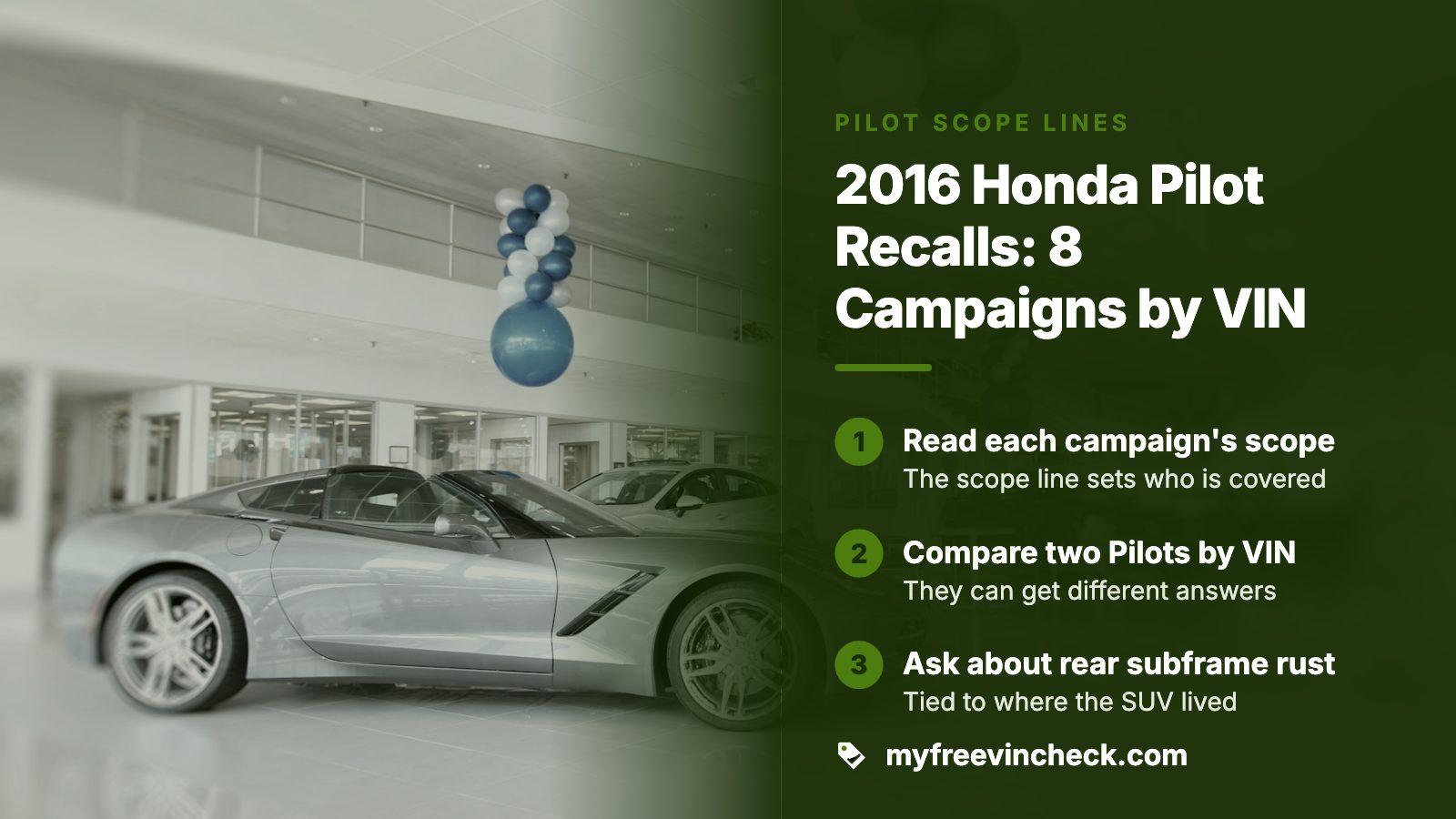
THE SHORT ANSWER
Eight campaigns are on file, and almost none reaches every car. Build dates, drivetrain, engine batch and the state where the Pilot was sold decide each one, so the VIN is the only honest answer. Dealers repair an open campaign at no charge to the owner. Decode the VIN, run the recall check and write down every open campaign number before you talk price.
- Campaigns
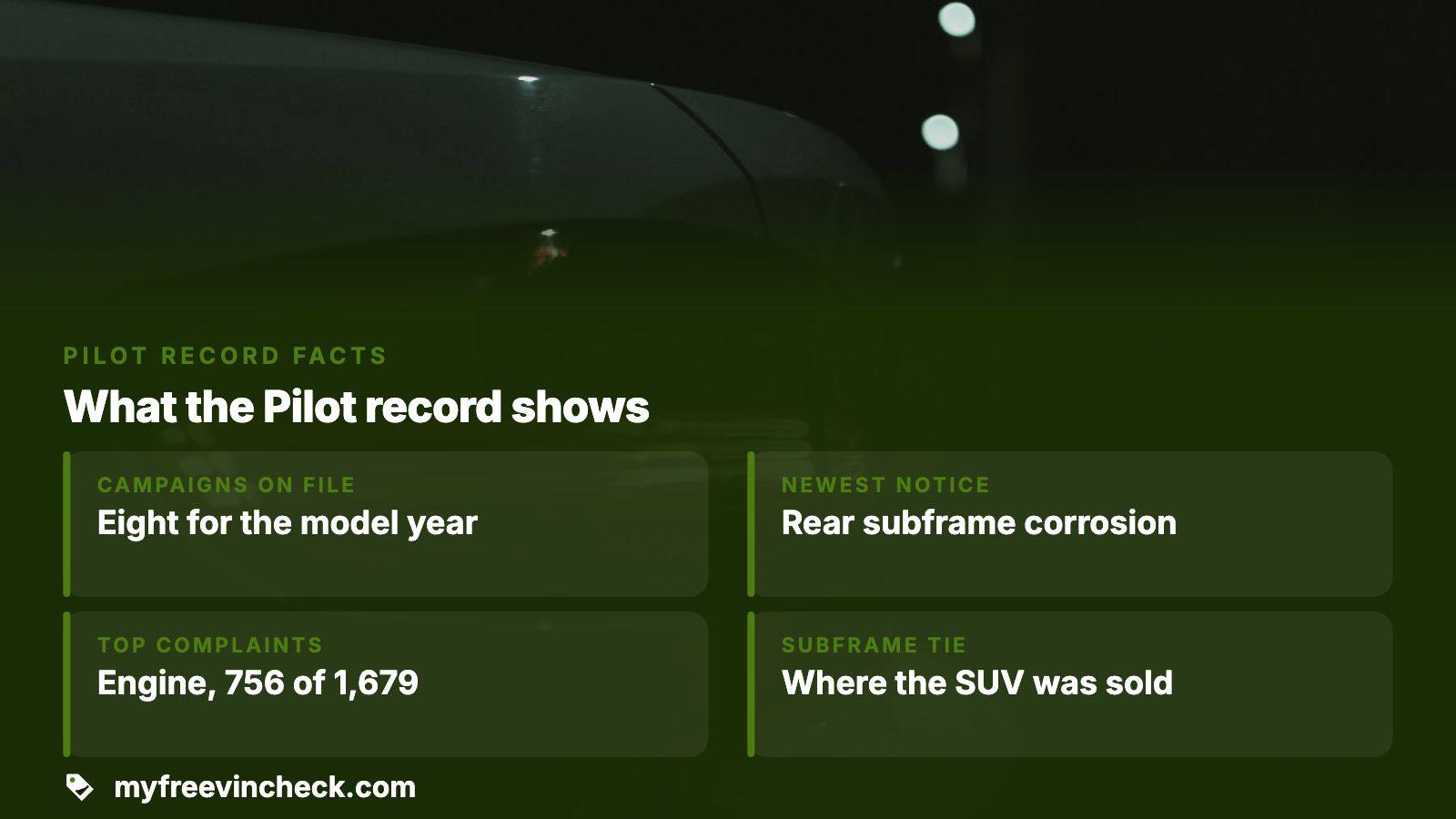
- 8 on file at NHTSA for the model year
- Newest
- Rear subframe corrosion, filed June 2026, tied to where the SUV was sold
- Top complaint group
- Engine, 756 of 1,679 owner reports in the August pull
- Check
- Decode and recall check on NHTSA data, no charge
Eight campaigns, and the scope line in each one
The third column is the one that decides whether a notice could touch your Pilot.
| NHTSA number | Part | Who it reaches | Dealer fix |
|---|---|---|---|
| 15V424000 | Third-row seat belt | Assembled between May 4 and June 5, 2015 | Inspect and repair the belt |
| 15V668000 | Warning lights in the cluster | 2WD assembled between May 4 and September 8, 2015; 4WD between May 7 and September 4, 2015 | Cluster software update |
| 16V417000 | Fuel tank welds | 2WD and 4WD Pilots, shared with the Odyssey and some Acura MDX | New fuel tank |
| 17V219000 | Fuel tank leak | 2WD and AWD Pilots | New fuel tank |
| 21V932000 | Hood latch striker | 2016 to 2019 Pilots, plus Passport and Ridgeline | Repair the striker, replace the hood if needed |
| 23V751000 | Connecting rod bearing | Certain 2016, 2018 and 2019 builds | Inspect, then repair or replace the engine |
| 23V858000 | Fuel pump module | Listed Pilots among many Honda and Acura models | New pump module |
| 26V365000 | Rear subframe corrosion | 2016 to 2022 Pilots sold in a published list of states, plus Washington DC | Inspect, fit a reinforcement kit, repair parts as needed |
Decode first, then run the recall check on the exact Pilot
Both tools read NHTSA data and need only the VIN, so the work is reading it correctly. Read it from the SUV itself instead of copying it out of an ad, because one mistyped character pulls up another vehicle or an empty result.
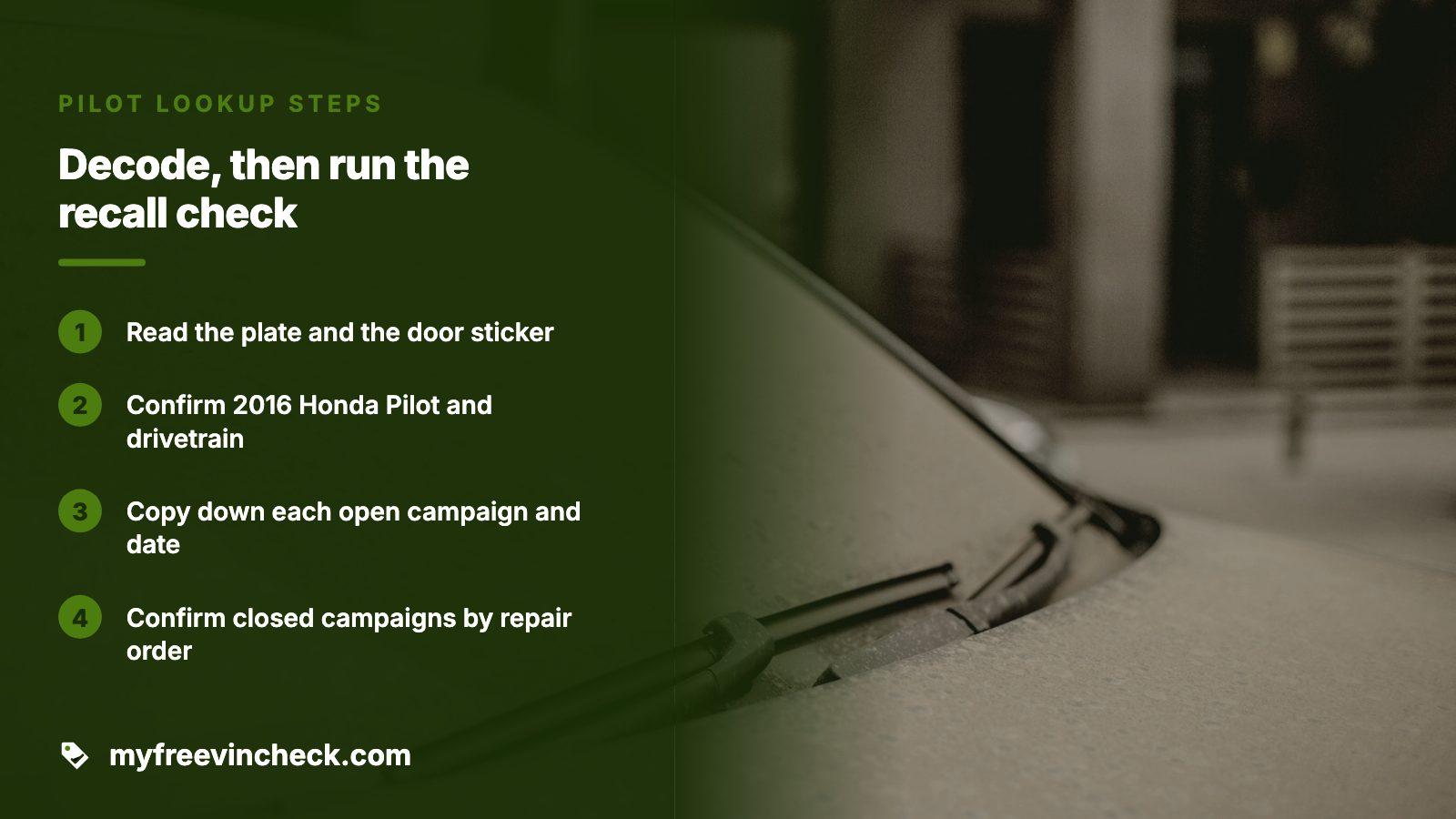
- Stand beside the driver's front wheel arch and read the stamped plate through the glass. A second copy sits on the sticker where the door latches. Check both against the title and the advert.
- Run the decode. It should say model year 2016, Honda, Pilot, with a drivetrain and assembly plant that fit the seller's description. If anything disagrees with the ad, ask the seller before going further.
- Run the recall check and copy down each open campaign number with the date you ran it. Status changes, so last month's screenshot is stale.
- For a campaign shown as closed, ask for the repair order and confirm its VIN matches the car.
Why two 2016 Pilots can get different answers
Honda wrote each notice around something a VIN can reveal: a build window, a drivetrain, an engine batch or the place of sale. The belt and warning-light notices follow build dates in 2015. The engine bearing notice reaches only certain 2016 builds. The subframe notice follows where the SUV was sold, not how it was assembled.
From an NHTSA owner complaint
Filing with NHTSA, one owner said the Pilot came from Honda's Lincoln, Alabama plant, yet the engine bearing campaign skipped its VIN because of production dates. A rod knock arrived anyway, and the owner blamed the same bearing and crankshaft defect. That is the owner's diagnosis, not a confirmed finding.
A clean recall result clears paperwork, not the engine. If the VIN falls outside a notice and the Pilot knocks or stalls, the repair is a cost you carry.
What each answer means for the deal
The lookup returns one of four answers for each campaign, and each calls for a different move.
- Open: the record shows no finished repair for this VIN. Have a dealer complete it before delivery, or get the appointment in writing.
- Closed: a dealer reported the job done. Ask for the repair order and look at the part itself.
- Not listed: the VIN falls outside that notice. Parts still wear, so inspect it regardless.
- Nothing open: no campaign applies today. The result says nothing about title, damage, odometer or liens.
The rear subframe notice is the one to ask about today
Filed in June 2026, it covers Pilots from 2016 through 2022 sold in a published list of states, mostly in the Northeast, Midwest and Mid-Atlantic. Corrosion can eat the points where the rear suspension bolts on, and a failed control arm can cost the driver control. NHTSA's record expected the final remedy in the fall of 2026, so an open item may mean waiting for parts.
From an NHTSA owner complaint
In a filing with NHTSA, a 2016 Pilot owner explained that finishing the subframe campaign meant pulling control arms seized to the frame. Honda would pay for those parts but not the labor, which the dealer quoted at $900. The owner went to the dealer and filed a complaint with Honda Care, was turned down repeatedly, and could not see which components the campaign covered.
Before approving subframe work, ask the service desk in writing what the campaign pays for, parts and labor both, and keep the answer with the repair order. On a Pilot you have not bought yet, price a possible labor bill into the offer.
Where owner complaints run ahead of the campaigns
NHTSA's complaint file for this model year held 1,679 reports when the research for this page was pulled in August. Engine led with 756, about 45%, and the electrical system followed with 578. Of the total, 23 describe a crash, 9 a fire and 20 an injury. These are unverified statements, and one incident can produce several, so treat them as places for a mechanic to look.
From an NHTSA owner complaint
One Pilot owner reported a stall at 20 mph with the check engine and ABS lights on. An independent shop scanned the car, and a dealer confirmed that the low and high pressure fuel pumps both needed replacing. The owner said the VIN was not in fuel pump campaign 23V858000. Honda pointed to a service bulletin that might apply, then said the car was not covered, and the owner paid for the repair after a failure at 100,901 miles.
A campaign that skips your VIN does not make the part sound. When a dealer cites a bulletin, ask whether it pays for anything or only describes a repair.
Where the no-charge tools stop and the paid report picks up
The decode and recall check cost nothing here and read records anyone can search. They say nothing about a Pilot's past: whether a collision bent the hood or frame, whether the title carries a brand, whether the odometer was wound back between owners.
- Decode and recall check: NHTSA data, no charge.
- Preview: free, and it shows what record types turn up for the VIN.
- Paid report: one payment, no subscription. It adds the title record, crash and damage entries, mileage readings and a check for liens.
A ten-year-old SUV has often changed hands, so those records matter here. Prices for one report or a pack are on the pricing page.
If a campaign is open on the Pilot you want
Call a Honda dealer's service desk with the VIN and ask for the open list, the parts situation and a date. Under federal law the maker pays for the repair of an open campaign, and that duty runs for 15 years from the first sale to a buyer. A 2016 Pilot is well inside it. If the seller will not wait, treat the open item as a price cut, or walk away from an engine or subframe item with no date attached.
Where this information comes from
- NHTSA: Recalls — The agency lookup where a VIN is checked and each campaign number above can be searched.
- NHTSA owner complaint 11751974 — owner experience, paraphrased
- NHTSA owner complaint 11767081 — owner experience, paraphrased
- NHTSA owner complaint 11761977 — owner experience, paraphrased
- 49 U.S.C. 30120: Remedies for defects and noncompliance — The statute behind the no-charge repair and the 15-year limit on it.
- NMVTIS: National title information — Federal background on the title brand records that a recall lookup leaves out.
Sources and photos: Facts checked against the sources above in November 2026. Photos by Richard R, JavyGo and Johnathan Kaufman on Unsplash; diagrams by MyFreeVINCheck.
Keep reading
- 2018 Honda Odyssey Recalls: 16 Campaigns and How to Check YoursThe Odyssey appears in the same engine bearing and fuel pump notices, and it is checked the same way.
- 2016 Honda Civic Recalls: 5 Campaigns and the VINs They ReachAnother 2016 Honda whose campaigns also turn on the VIN, including the fuel pump notice.
- Sample reportThe records a paid report sets beside the recall status.
- PricingWhere one report or a larger pack is bought, and what each costs.
Frequently asked questions
How many recall campaigns apply to a 2016 Honda Pilot?
NHTSA lists eight campaigns for the model year, filed between 2015 and 2026. The figure belongs to the model year as a whole, not to any single vehicle. Build dates, drivetrain, engine batch and the state of sale decide which apply, so the VIN recall check is the only way to get a count for a specific Pilot.
Is the 2016 Pilot engine recall for every car?
No. The connecting rod bearing campaign names certain 2016 builds, and an owner who runs the VIN may find it excluded. If the engine knocks anyway, get a written diagnosis, ask the dealer about coverage and file your own complaint with NHTSA.
Does Honda charge to fix an open recall on a 2016 Pilot?
The remedy is free to the owner for a campaign that covers the VIN, within the federal 15-year limit. Ask the dealer in writing what the campaign covers, including labor on neighboring parts, before approving work.
Can I check 2016 Pilot recalls before buying a report?
Yes. NHTSA's own lookup is free, and the decode and recall check here read the same kind of records at no charge. The preview is free as well. The report costs one payment, never a subscription, and adds the title, damage, odometer and lien records.
Does a recall check show whether a Pilot was in an accident?
No. A recall lookup reports defect campaigns and repair status, nothing about the car's past. Crash and damage records, title brands, mileage readings and liens come from other sources, which is what the paid report covers. A hood or frame repaired after a collision is invisible to the recall list.
Now check the car itself
The guide explains what to look for. The report shows what this VIN has on record.