THE SHORT ANSWER
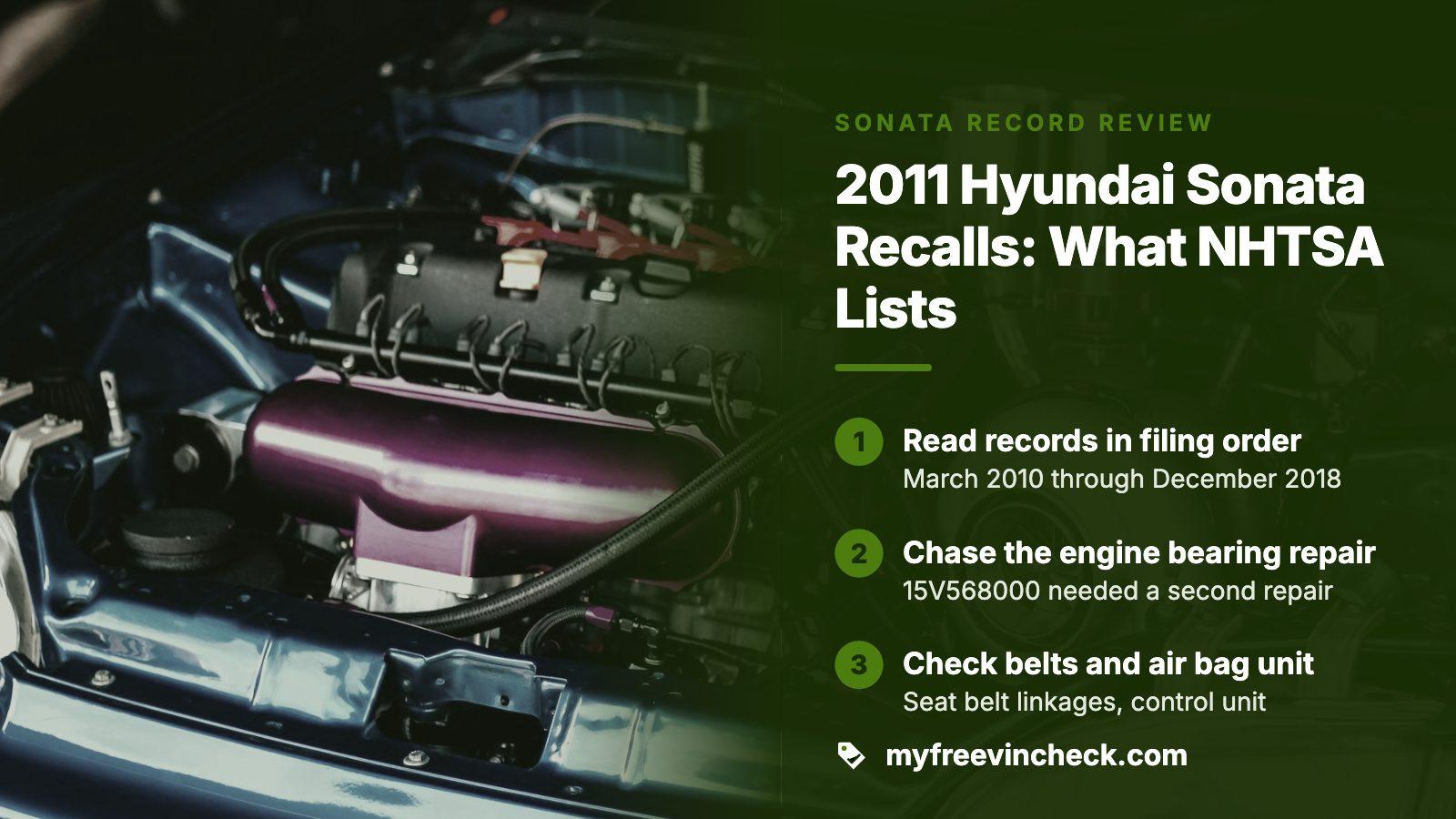
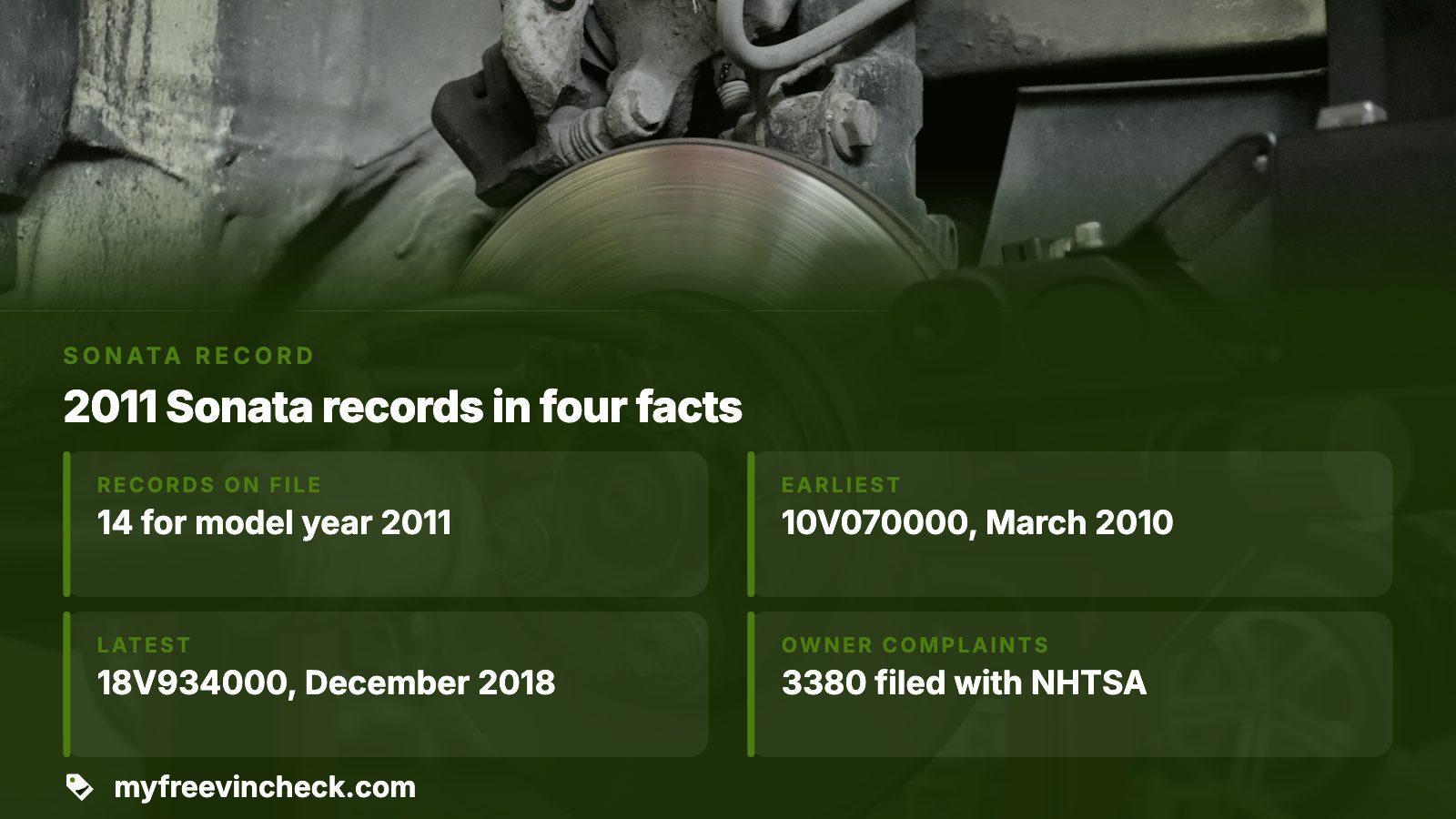
The 2011 Sonata has 14 recall records with NHTSA, filed between March 2010 and December 2018. The heaviest ones involve engine bearings (15V568000), the air bag control unit (18V137000), two steering faults and seat belt linkages. Hyundai repairs all of them at no charge. Paste the VIN into the free recall check to see which are still open on one car.
- Records on file
- 14 for model year 2011
- Earliest and latest
- 10V070000 (March 2010) to 18V934000 (December 2018)
- Owner complaints
- 3380 filed with NHTSA for this model year
- Cost to fix
- Free at a Hyundai dealer
The 14 records, in the order they were filed
Pulling the 2011 Sonata from NHTSA's recall service returns 14 entries. Two describe one steering defect, so the count of separate problems is closer to thirteen. The table gives the filing date and the faulty part.
| Campaign | Received | Part involved |
|---|---|---|
| 10V070000 | March 2, 2010 | Driver and passenger door lock switch |
| 10V426000 and 10V457000 | September 20 and October 1, 2010 | Steering column universal joints |
| 13V113000 | April 1, 2013 | Stop lamp switch |
| 14V433000 | July 18, 2014 | Brake hoses to the hydraulic control unit |
| 14V434000 | July 18, 2014 | Transmission shift cable |
| 15V568000 | September 10, 2015 | Crankshaft debris, rod bearings |
| 15V629000 | October 7, 2015 | Front coil springs, salt states |
| 15V759000 | November 16, 2015 | Brake pedal stopper pad |
| 16V190000 | April 5, 2016 | Electric power steering circuit board |
| 17V152000 | March 8, 2017 | Front seat belt linkage |
| 17V617000 | October 4, 2017 | Seat belt linkage, repeat repair |
| 18V137000 | February 27, 2018 | Air bag control unit |
| 18V934000 | December 28, 2018 | High pressure fuel pipe |
Engine and fuel pipe: the repair that needed a second repair
Campaign 15V568000 is the one most shoppers have heard about. Hyundai found that metal particles from machining could stay inside the crankshaft and starve the connecting rod bearings of oil. The warning sign is a rhythmic knock from the engine, and the end result can be a stall. It covers 2011 and 2012 Sonatas built at the Alabama plant with the 2.0 liter or 2.4 liter direct injection engine.
Dealers inspect the car and replace the engine assembly when needed. On top of the repair, Hyundai lengthened coverage of the engine's lower half to 120,000 miles or 10 years, and the offer reaches second and third owners too. The follow-up, 18V934000, exists because a fuel pipe at the pump outlet could be bent or under-tightened during that engine swap, which risks a fuel leak and fire. If a seller says the engine was swapped under recall, ask to see the work order.
Steering, brake and shift problems
Three records involve steering. The 2010 pair concerns universal joints in the steering column that were assembled loosely, which could reduce or cut steering control on cars built through September 10, 2010. The 2016 record, 16V190000, covers a power steering circuit board that can fail and leave you turning the wheel with much more effort at low speed.
- Brake hoses (14V433000): a leaking fitting lengthens stopping distance and lights the brake warning lamp.
- Shift cable (14V434000): the cable can slip off the lever pin, so the display may say Park while the transmission is not in Park.
- Stop lamp and pedal pad switches (13V113000, 15V759000): brake lights may stay on or fail to light, and the shifter can move out of Park without a brake press.
- Front springs (15V629000): road salt can corrode them in cold-weather states, and a broken spring may cut a tire.
Several apply only to cars built from December 11, 2009 into 2010, so a later build may fall outside them.
Seat belts and the air bag controller
Two seat belt campaigns, 17V152000 and 17V617000, deal with front belt linkages that can detach from the pretensioners. The second was opened for cars already fixed under the first, with a repeat check and a warning label added.
Why 18V137000 matters most
In a crash, the air bag control unit can short circuit and keep the the frontal and side air bags and belt tensioners from deploying. Hyundai first reported 154,753 model year 2011 Sonatas, then added 425,305 newer Sonatas and Hybrids. The fix is an external wire filter kit, installed free. Anyone buying this car should treat this one as a must-confirm item.
Run the free check first, and know what it leaves out
NHTSA's own recall page answers one question for a single car: does it have an unrepaired recall. Read the VIN off the dash corner by the driver's windshield, then match it to the registration card. Our VIN decode and recall lookup read the same federal data, so use either. If nothing is open, NHTSA shows a message saying zero unrepaired recalls.
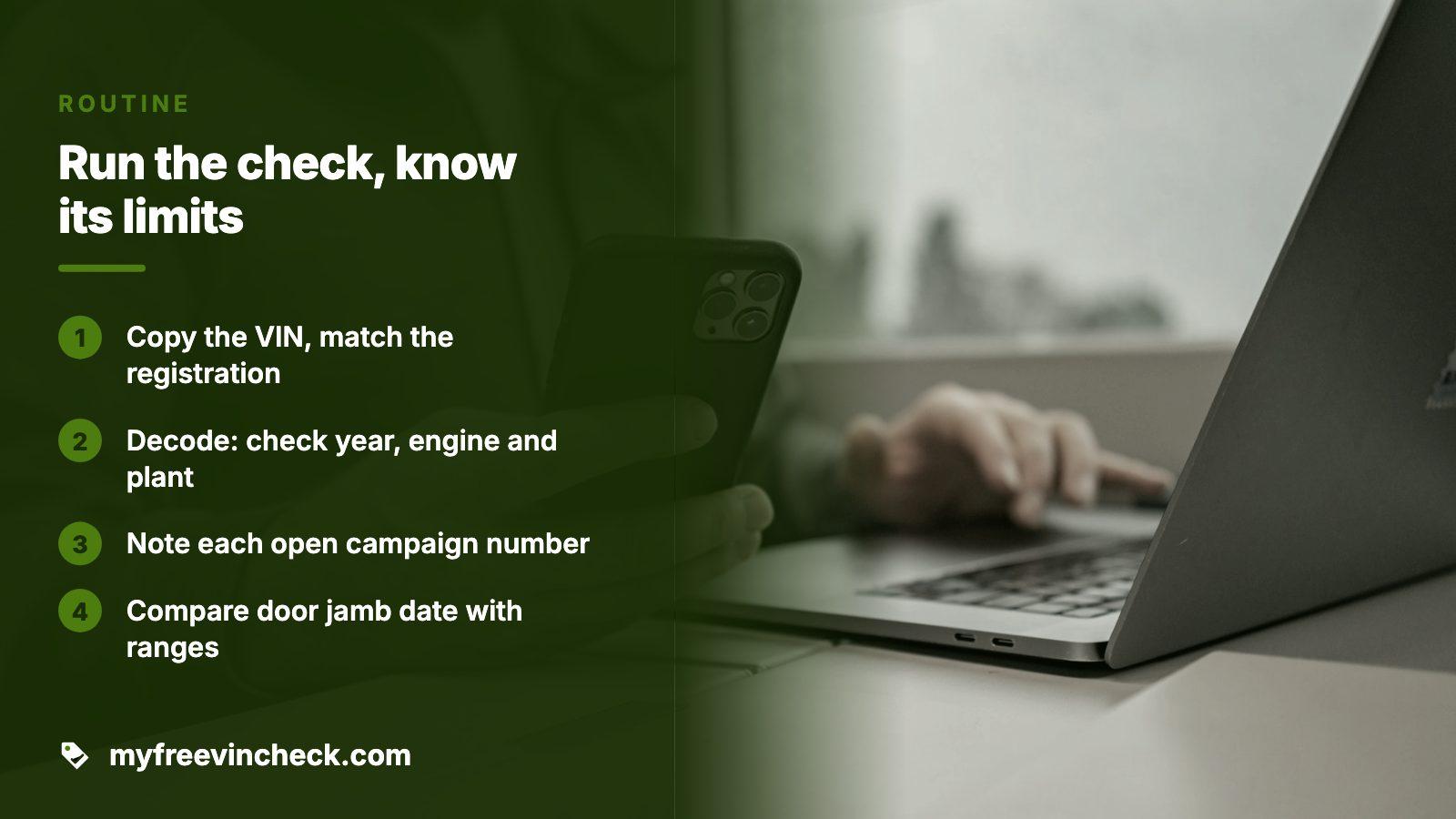
- Copy the VIN from the windshield and match it to the registration paper.
- Decode the number and check that year, engine and plant match the listing.
- Look up recalls and note each campaign number that shows as open.
- Compare the build date on the door jamb with the ranges in this guide.
The lookup has gaps. Repaired recalls drop off the results. So do campaigns older than 15 years, unless the maker has stretched coverage. Several 2010 campaigns on this car sit near that line, so a clean result does not prove those were ever done.
What owners tell NHTSA about this model year
NHTSA holds 3380 owner complaints for the 2011 Sonata. By component label, steering leads with 1171, then engine with 968, electrical system with 444 and air bags with 419. Owners flagged a crash in 116 reports, a fire in 112 and an injury in 85. These are unverified owner statements.
From an NHTSA owner complaint
An owner who had just bought a 2011 Sonata filed in October 2025 after asking Hyundai to pay for engine repairs. During the claim, they learned that a recall applied to the car which nobody had mentioned at purchase, and that a software update was needed before coverage would start.
From an NHTSA owner complaint
Another owner reported in January 2026 that the car lost power at about 30 MPH and had to be towed. The dealer linked the engine failure to an earlier recall, but Hyundai declined coverage and cited the maintenance history. The mileage at failure was roughly 183,000.
Take two lessons from these. Learn the recall status before you pay, and keep service records, because coverage on an older engine can turn on them.
Where the paid report fits after the free steps
Recall data says what the maker owes. It says nothing about what happened to this particular Sonata. The free preview here shows what a full record holds for the VIN. The full report is bought once, with no recurring charge, and today's price sits on the pricing page.
- Title brands such as salvage or flood, which no recall lookup reports
- Accident and damage entries, and odometer readings over time
- Liens, theft records and insurance loss entries
- Number of previous owners and what the car was used for
An engine replaced under 15V568000 is also worth reading beside the ownership timeline, since a replacement leaves a gap in the story you want explained.
A short routine for buyers and new owners
If you already own one, the quickest win is to run the VIN today and book any open campaign with a Hyundai dealer. No recall carries a fee, and the dealer does not care how many owners the car has had. NHTSA's SaferCar app can alert you when a new recall is added.
If you are shopping, put the open-recall list in writing before you negotiate. Ask for dealer paperwork on the engine, the air bag filter kit and the seat belt repairs. Then run the report to see title and accident history. Where a seller cannot show proof for a repair that Hyundai offers free, treat the gap as a reason to pause or lower your offer.
Where this information comes from
- NHTSA: Check for Recalls — the scope of NHTSA's VIN search and where the number is found
- NHTSA recalls API: 2011 Hyundai Sonata — campaign numbers, dates, build ranges and remedies
- NHTSA complaints API: 2011 Hyundai Sonata — complaint counts by component and the owner reports
- NHTSA vPIC VIN decoder — manufacturer-reported build data and plant
- NHTSA owner complaint 11696471 — owner experience, paraphrased
- NHTSA owner complaint 11710623 — owner experience, paraphrased
Sources and photos: Facts checked against the sources above in November 2026. Photos by Willian Cittadin, Anastasiia Nelen and Media Digital on Unsplash; diagrams by MyFreeVINCheck.
Keep reading
- Check a VIN Number for Recalls: Free Lookup, Then the Full PictureStep-by-step on checking one car's open recalls by VIN.
- 2015 Hyundai Sonata Recalls: 9 NHTSA Records, Checked by VINThe same record for a newer Sonata generation.
- Where Can I Get a Free VIN Check? Three Lookups and What They MissWhat the free tools cover and what they skip.
- Sample reportA look at a finished report ahead of any purchase.
Frequently asked questions
How many recalls does the 2011 Hyundai Sonata have?
NHTSA lists 14 records for model year 2011, though two cover the same steering defect, so there are about thirteen distinct problems. They span 2010 to 2018. Which ones apply to a given car depends on its build date and VIN, which is why a lookup beats counting.
Is the 2011 Sonata engine recall free?
Yes. Hyundai's remedy for 15V568000 is an inspection and an engine assembly replacement where needed, at no charge, and Hyundai added a longer warranty on the engine's short block that passes to later owners. Whether a car qualifies depends on its build range and plant.
Can I check a Sonata for recalls without paying?
Yes. NHTSA's recall page and this site's VIN recall lookup are both free and use the same federal data. Neither shows repaired recalls, so ask the seller or a dealer for proof of repair on anything that used to be open.
Do recalls transfer to the next owner?
A safety recall attaches to the vehicle, not the person. Hyundai dealers repair open campaigns free whoever owns the car now, so a used buyer can book the work after purchase. Confirm the status with the VIN first so you know the list.
Is a car with no open recalls automatically a safe buy?
No. It only says no unrepaired campaign is on file. It cannot show a salvage brand, a past accident, odometer problems or a lien. For those, read the preview and the paid report for the VIN, and have a mechanic inspect the car.
Now check the car itself
The guide explains what to look for. The report shows what this VIN has on record.