THE SHORT ANSWER
To check recalls on a 2011 Chevrolet Camaro, copy the 17-character VIN, decode it to confirm the build, then run the recall check. NHTSA files 3 campaigns for the model year, and the main ignition key notice covers every 2011 build, so what matters is whether the repair was completed. A campaign still open is work General Motors usually owes the owner at no charge.
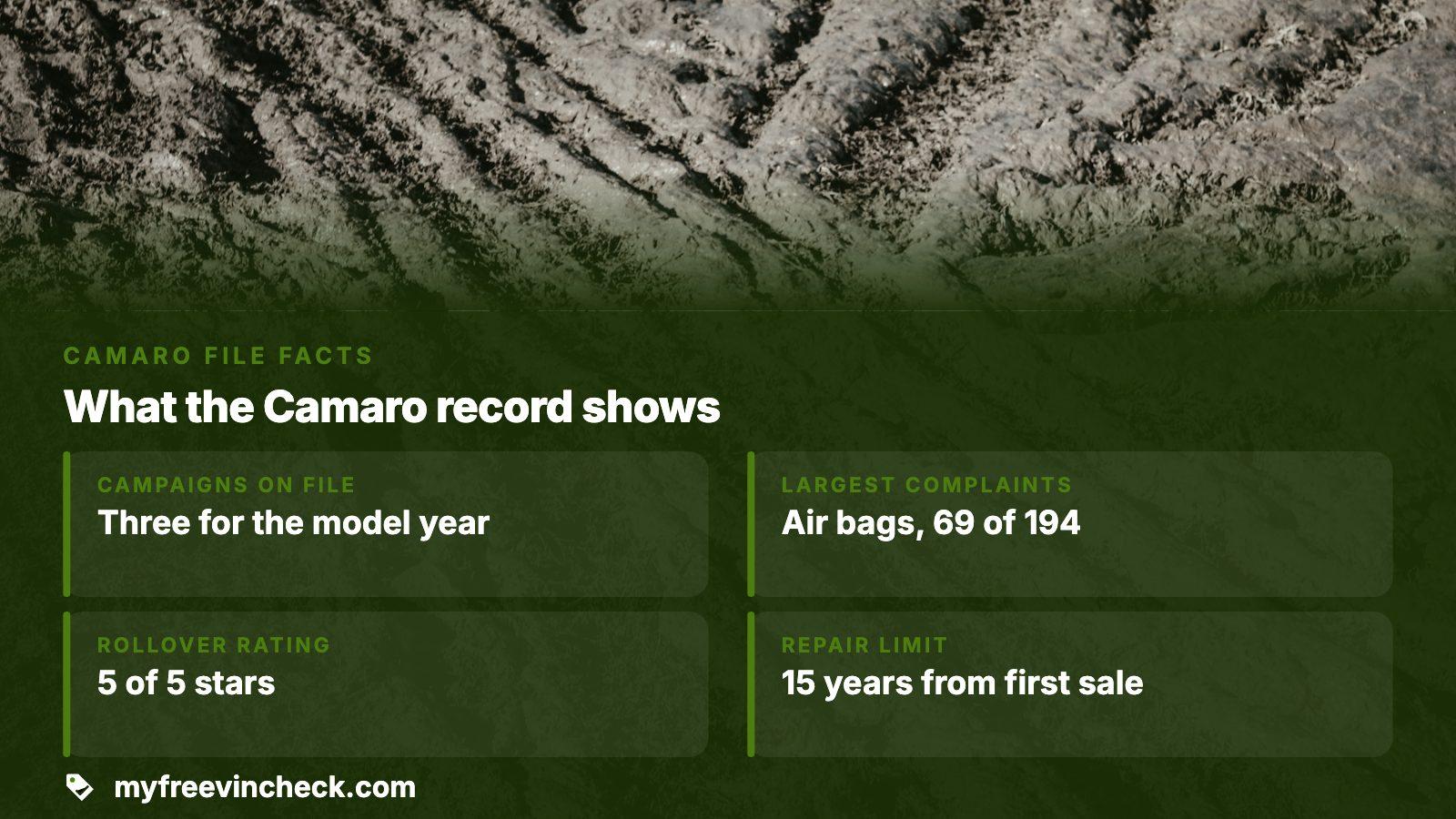
- Campaigns
- 3 on file with NHTSA for the model year
- Owner complaints
- 194, with air bags the largest group at 69
- Crash ratings
- No overall, frontal or side stars; rollover 5 of 5
- No-charge repair limit
- 15 calendar years from first sale, 49 U.S.C. 30120
The 3 campaigns NHTSA files under the 2011 Camaro
Recalls attach to production ranges, so a coupe inside a range can still carry an unfinished repair.
| Campaign | Component | What the notice covers |
|---|---|---|
| 14V346000 | Electrical system, ignition | Original flip keys on 2010 to 2014 Camaros built December 3, 2008 to May 23, 2014 |
| 19E064000 | Electrical system, ignition | Replacement flip-key transmitter assemblies sold for 2010 to 2015 Camaros |
| 14V447000 | Seats, front assembly, power adjust | Certain 2011 and 2012 Camaros with power height-adjustable seats; a loose bolt can drop the seat |
Work the tools in order: decode, recall check, then decide
Two working tools that read NHTSA data come first here. The paid report is an upgrade for cars that earn it.
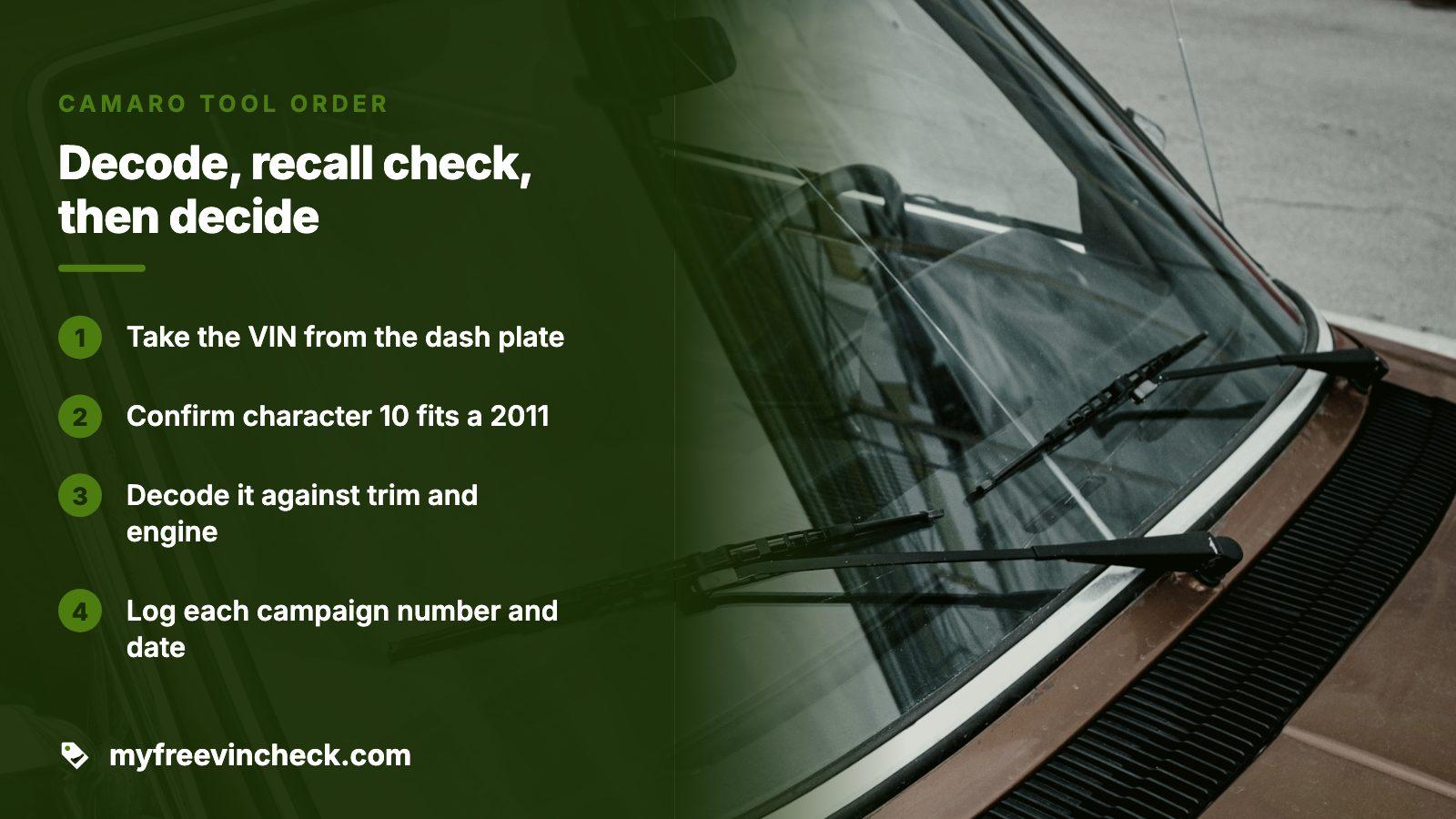
- Take the 17 characters from the dash plate nearest the steering wheel, and see whether the door-frame sticker and the title show the same string. A mismatch means walk away.
- Character 10 is the model year code, so confirm it fits a 2011 build. Positions 4 through 8 encode model, body style and engine.
- Decode it and compare trim, engine and body with the ad. A different result means a typo or a different car.
- Run the recall check and note each campaign number and the date; the record changes when a dealer finishes the work.
What the tools cannot tell you
A decode shows what the factory built, and the recall check lists campaigns tied to the VIN. Neither says who did a repair or when, so ask the seller for the dealer work order.
The ignition key notices, in plain terms
Both electrical campaigns share one cause: a knee bumps the key, the engine stops, and steering and braking assist can fade. NHTSA's notice also warns the air bags might stay folded in a crash while the key is off run.
- 14V346000 covers every 2010 to 2014 Camaro built in that window, so the whole 2011 model year is inside it. Dealers remove the blade from the original flip key and issue two new keys, two rings each. It began August 25, 2014, under GM number 14294.
- 19E064000 exists because dealers sold some already-recalled assemblies as spare keys, so it matters when a coupe's key was ever replaced. The recall began February 4, 2020, and dealers fit a flat blade key where needed. GM's number is N192223230.
From an NHTSA owner complaint
Writing to NHTSA in September 2014, a Camaro owner said the key never caused trouble before the recall visit. Afterward the new key dangled against the knee and legs while driving, and the owner asked for the old setup back.
A repaired coupe carries that new arrangement, so test-drive for knee clearance anyway. Until the work is done, move the seat and column out of knee reach. Chevrolet customer service takes VIN questions on 1-800-222-1020.
What each result means for the deal
- A key campaign is open: ask for the repair before payment, or a written dealer booking date. Losing steering and brake assist is more than paperwork.
- The seller says it was done but has nothing in writing: ask for the invoice, or phone a Chevrolet dealer with the VIN.
- The keys look original: the remedy changes the keys, so a coupe on its first flip key with no paperwork earns a second question.
- The seat campaign is open: it covers a height-adjuster bolt that can fall out, so run each power seat through its whole travel.
- Nothing shows as open: that means no open recall for this VIN, nothing more. Title, accident and odometer records sit outside recall data.
From an NHTSA owner complaint
A Camaro owner who filed with NHTSA in March 2015 said a dealer called the key recall optional in August 2014 and again in January 2015. Reminder postcards kept coming because GM's records showed no repair. The work was finally done on February 2, 2015.
An open campaign seldom sinks a deal, because the maker pays. If a service desk waves it off, quote the campaign number and call Chevrolet customer service yourself. Settle in writing who books the work and when, then rerun the VIN afterward.
Owner complaints, and what they do and do not prove
Owners filed 194 complaints with NHTSA for the 2011 model year. They are unverified and never adjudicated, so they point at places to look. Air bags lead with 69, about 36% of the total. Of the filings, 15 describe a crash, 2 mention a fire and 11 an injury.
| Component | Reports | Median age when it failed |
|---|---|---|
| Air bags | 69 | 4.2 years |
| Electrical system | 29 | 3.9 years |
| Engine | 28 | 4.7 years |
| Seats | 15 | 7.1 years |
The key notices mention air bags, but complaints are sorted by the part the owner blamed, and nothing on file ties the 69 to the key. The ages are medians of unchecked reports, not failure rates. Use them to aim the walk-around:
- Air bags: the biggest group, so watch that the dash warning lamp behaves normally at start-up.
- Engine bay: fire appears in 2 complaints, so scan for scorched plastic and hacked-in wiring.
- Suspension corners: uneven ride height can read as an old collision the paperwork never mentions.
Crash ratings, and how long a recall repair stays owed
NHTSA publishes no overall, frontal or side star score for this coupe. The one published result is rollover, 5 of 5, with a rollover chance of 8.7%.
The no-charge repair has an end date
Section 30120(g) of 49 U.S.C. lifts the no-charge duty when a notice arrives over 15 calendar years after the car's first sale. A 2011 Camaro is inside the window for campaigns announced years ago, such as the two key notices. A newer campaign may fall outside it, though dealers often honor those, so ask first.
From an NHTSA owner complaint
A driver who filed in July 2023 said a dealer would not do the key recall on their Camaro unless paid $800, and the paperwork from that visit showed it as not done. A month later, the owner wrote, a bumped fob cut the engine in traffic, the steering stiffened, and the driver air bag stayed folded in the crash.
That is one unverified account, but both key campaigns were announced inside the 15-year window, so a quote to pay for the key repair is a reason to call GM with the VIN first.
Where the working tools stop and the paid report starts
The decode and recall check describe the factory build and its notices. A Camaro this age may have collected owners, a lien, a repaired collision or a slipped odometer reading, none of which lives in recall data.
| Step | Cost | What it shows |
|---|---|---|
| Decode and recall check | No charge, NHTSA data | The factory build, plus the campaigns tied to the VIN |
| Preview | Free | A first look at which records exist |
| Paid report | One payment, no subscription | Title brands, odometer history, liens, theft entries, and damage or salvage photos |
Pricing sits on its own page: a single report, or packs of 3, 5 or 10. Run the preview first, and get the seller's answer on all 3 campaigns in writing before you pay.
Where this information comes from
- NHTSA: Recalls — The agency lookup where a VIN is checked for campaigns and each number above can be searched.
- NHTSA: Safety ratings — The federal crash-test program that supplies the rollover score and explains the missing stars.
- 49 U.S.C. 30120: Remedies for defects and noncompliance — The statute behind the no-charge repair and the 15-year limit on it.
- NMVTIS: National title information — Federal background on the title brand records that a recall lookup leaves out.
- NHTSA owner complaint 10631658 — owner experience, paraphrased
- NHTSA owner complaint 10702855 — owner experience, paraphrased
- NHTSA owner complaint 11532489 — owner experience, paraphrased
Sources and photos: Facts checked against the sources above in November 2026. Photos by tim, Max Tokarev and Sean Foster on Unsplash; diagrams by MyFreeVINCheck.
Keep reading
- 2016 Chevrolet Cruze Recalls: 4 Campaigns, Checked by VINAnother Chevrolet, run through the same decode and recall steps.
- 2010 Chevrolet Traverse Recalls: 5 Campaigns, Checked by VINA General Motors model from the same years, with its own campaign list.
- Sample reportThe records a paid report sets beside the recall status.
- PricingWhere a single report or a larger pack is bought, and what each costs.
Frequently asked questions
How many recalls does a 2011 Chevrolet Camaro have?
NHTSA files 3 campaigns: two about the ignition key and one about the front seat height adjuster. The main key notice spans every 2011 build, but whether a repair is on record differs by coupe. The VIN check shows the status.
Are 2011 Camaro recalls still repaired at no charge?
Usually. The 15-year cut-off runs from first purchase to the announcement, and the key campaigns date from 2014 and 2019, inside it. A newer campaign could fall outside, though dealers often honor those. Call Chevrolet with the VIN before you buy.
Can I check Camaro recalls without paying?
Yes. NHTSA's own lookup costs nothing, and so do the decode and recall check here, which read the same NHTSA data. The preview is free too. Pay for the report only when you want title, accident, odometer and lien records beside the recall status.
Does a clean recall result mean a 2011 Camaro is a good buy?
No. It means no open campaign applies to that VIN. With 194 owner complaints on file and air bags the largest group, an inspection still matters, and title brands, liens and unreported collisions sit outside recall data. Get service records and check the title first.
Does the Camaro key recall cover replacement keys?
A separate campaign, 19E064000, covers replacement flip-key assemblies sold for 2010 to 2015 Camaros, since some recalled parts were resold as spares. If the key was ever replaced, ask for the receipt and have a dealer check the VIN against both key notices.
Now check the car itself
The guide explains what to look for. The report shows what this VIN has on record.