THE SHORT ANSWER
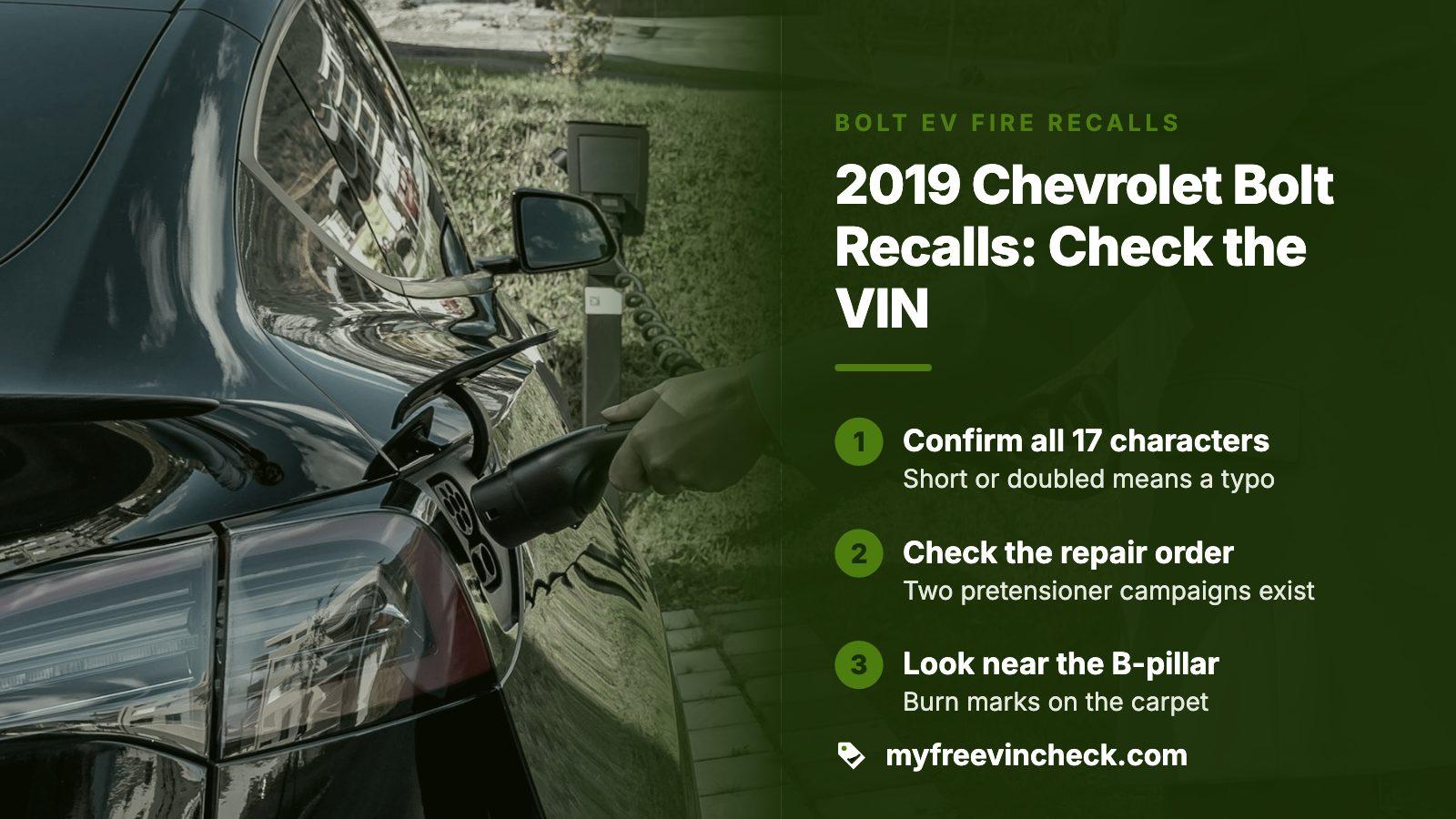
For a 2019 Chevrolet Bolt, take the VIN off the car itself, decode it to confirm the build, then put it through NHTSA's recall lookup. The model year has 6 campaigns on file: rear brakes, door-handle cables, two high voltage battery fire recalls and two seat belt pretensioner fire recalls. Each reaches only some cars, so the VIN settles it, and an open one is fixed free at a dealer.
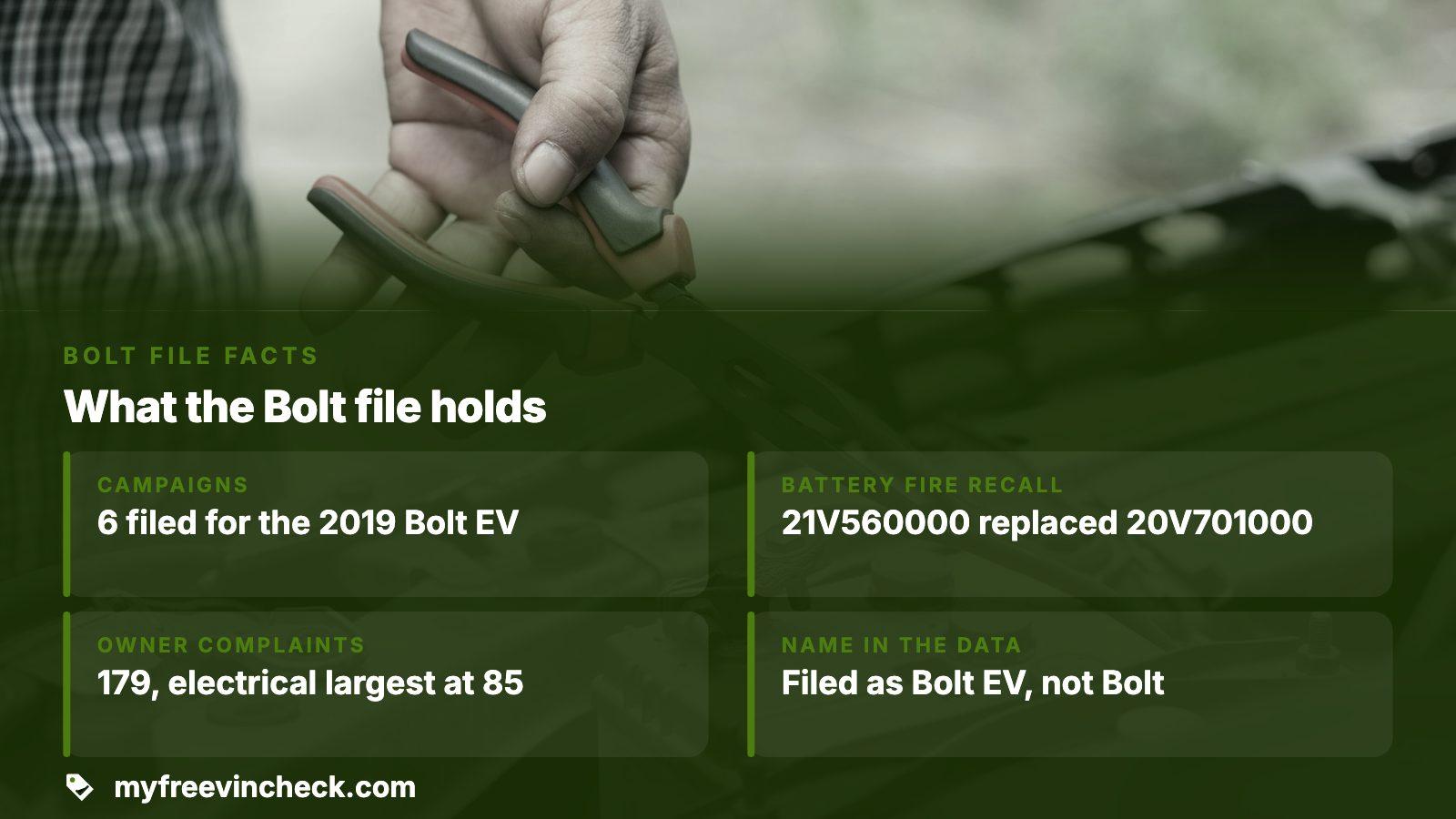
- Campaigns
- 6 filed with NHTSA for the 2019 Bolt EV
- Battery fire recall
- 21V560000, which replaced the earlier 20V701000
- Owner complaints
- 179 on file, electrical system the largest group at 85
- Model name in the data
- Filed as Bolt EV, not Bolt
Six campaigns on file, and what each one is about
A search for the plain model name "Bolt" in NHTSA's data returns nothing for this year. The car is filed as Bolt EV, and under that name there are 6 campaigns. Several apply to a limited range of cars, so one Bolt can show an open item while another from the same dealer lot shows none.
| Campaign | Reported | Problem | Fix |
|---|---|---|---|
| 18V576000 | August 2018 | Rear caliper pistons with thin coating, gas pockets can cut rear braking | Dealer bleeds the brake system |
| 20V184000 | March 2020 | Rear door-handle cable too long, rear door may open or the inside handle may fail | New rear door-handle cables |
| 20V701000 | November 2020 | Battery fire risk near full charge | Software cap at 90%, now superseded |
| 21V560000 | July 2021 | Battery fire risk near full charge | Defective battery modules replaced |
| 22V930000 | December 2022 | Pretensioner exhaust can ignite carpet after a crash | Foil at the carpet, cover if needed |
| 23V845000 | December 2023 | Same pretensioner problem, includes cars fixed wrongly the first time | Inspection, foil and cover |
The battery recall that came back as a second one
GM's first battery campaign, 20V701000, started with a software fix: dealers reprogrammed the propulsion control module so the pack stops charging at 90%. That did not close the matter. The July 2021 campaign, 21V560000, names cars already handled under the first one and calls for defective battery modules to be replaced. NHTSA now marks the earlier campaign as superseded, and a Bolt fixed under it is still owed the newer work.
Until the modules are swapped, the recall text tells owners to keep the 2019 Target Charge Level setting on, recharge before the pack runs very low (the notice names 70 miles of range remaining), and park outside after charging rather than charging indoors overnight.
From an NHTSA owner complaint
A 2019 Bolt lessee wrote that the March software update was supposed to settle the battery issue, yet a second recall followed within a year. The owner described being restricted in where to park, how to charge and how much range to use, and said trust in GM's ability to spot bad cells was gone.
Take from it that a completed first repair is not the same as a closed recall: ask the seller which campaign the paperwork actually cites.
The free checks, in the order that saves time
This site gives you a working VIN decode and a recall lookup built on NHTSA data. Neither asks for a card. Start from the car itself, because an ad can carry a typo or the number of a different vehicle.
- Read the number on the dash plate through the windshield, then check that it agrees with the sticker on the door pillar and with the title.
- Confirm it runs to 17 characters with no gaps, since a short or doubled entry is a typo.
- Decode it here and compare trim and drive details against the listing.
- Put it through the recall lookup and record each open campaign number along with today's date.
Keep the screenshot. If a campaign shows as open today and the seller says it was done, the dated result is your evidence.
The pretensioner pair is easy to miss
These two campaigns matter only after a crash in which the front seat belt pretensioners fired. GM's finding is that the hot gas can reach carpet fibers near the B-pillar and start a fire.
The first campaign, 22V930000, added metal foil and sometimes a cover. The second, 23V845000, exists because some cars were repaired incorrectly under the first, so it asks dealers to inspect both front pretensioners again. A Bolt showing only the older campaign as complete may still be owed the second visit.
- Ask whether the car has ever been in a collision that deployed the belts.
- Ask which of the two campaign numbers the repair order shows.
- Look at the carpet near the B-pillar for any burn marks.
What owners report that no recall covers
NHTSA holds 179 owner complaints for this model year. These are unverified accounts, but the pattern is worth knowing. Electrical system leads with 85 tags, followed by steering with 47 and the fuel and propulsion group with 44, and a single complaint can carry several tags. Ten of the filings mention a fire.
Steering is the odd one out, because it has no recall in the 2019 list yet draws the second largest group of complaints. Owners describe a wheel that stays turned after a corner and a steering gear replaced at a cost they quote around $3,500 or more.
From an NHTSA owner complaint
An owner who bought a 2019 Bolt new noticed, at about 26,861 miles, that the wheel would not return to center. The dealer replaced the steering gear twice without a cure and then proposed a steering column, while the owner kept pressing GM to pay.
Take from it that a recall search with no hits is silent on this wear item. On a test drive, make slow and fast turns and let the wheel slide through your hands.
A garage fire, as one owner filed it
Fire is the reason the battery campaigns exist, and the complaint record shows what it looks like at home. Park-outside advice in the recall text is about this scenario.
From an NHTSA owner complaint
An owner reported hearing the horn while a 2019 Bolt EV sat on its charger in the garage, then finding white smoke under the rear and unplugging the car. The fire department put out the flames, the owner was treated for smoke inhalation, and a family member broke three toes leaving the house. The insurer declared a total loss at roughly 27,000 miles.
The fire department was unsure the battery was the cause, so read it as one household's account rather than a finding. It does explain why a Bolt with an open battery campaign deserves a firm answer before purchase.
Where the free preview ends and the paid report begins
A recall lookup answers one question: what has the maker said needs fixing on this VIN. It cannot show a salvage title, a lien or odometer readings that step backward. For a used EV bought on faith in a battery warranty, those matter as much as the campaigns.
| Step | Cost | What it tells you |
|---|---|---|
| VIN decode here | Free | Factory build details to match the ad |
| NHTSA recall lookup | Free, run by the agency | Open campaigns for that VIN |
| Preview here | Free | A first look at what records exist |
| Paid report | One payment, no subscription | Open recalls plus title, accident, mileage and lien history |
The pricing page lists what a single report costs and how multi-report bundles work.
If a campaign shows as open
An open campaign is rarely a reason to walk away, since GM pays for the repair. A battery campaign is the exception that calls for patience.
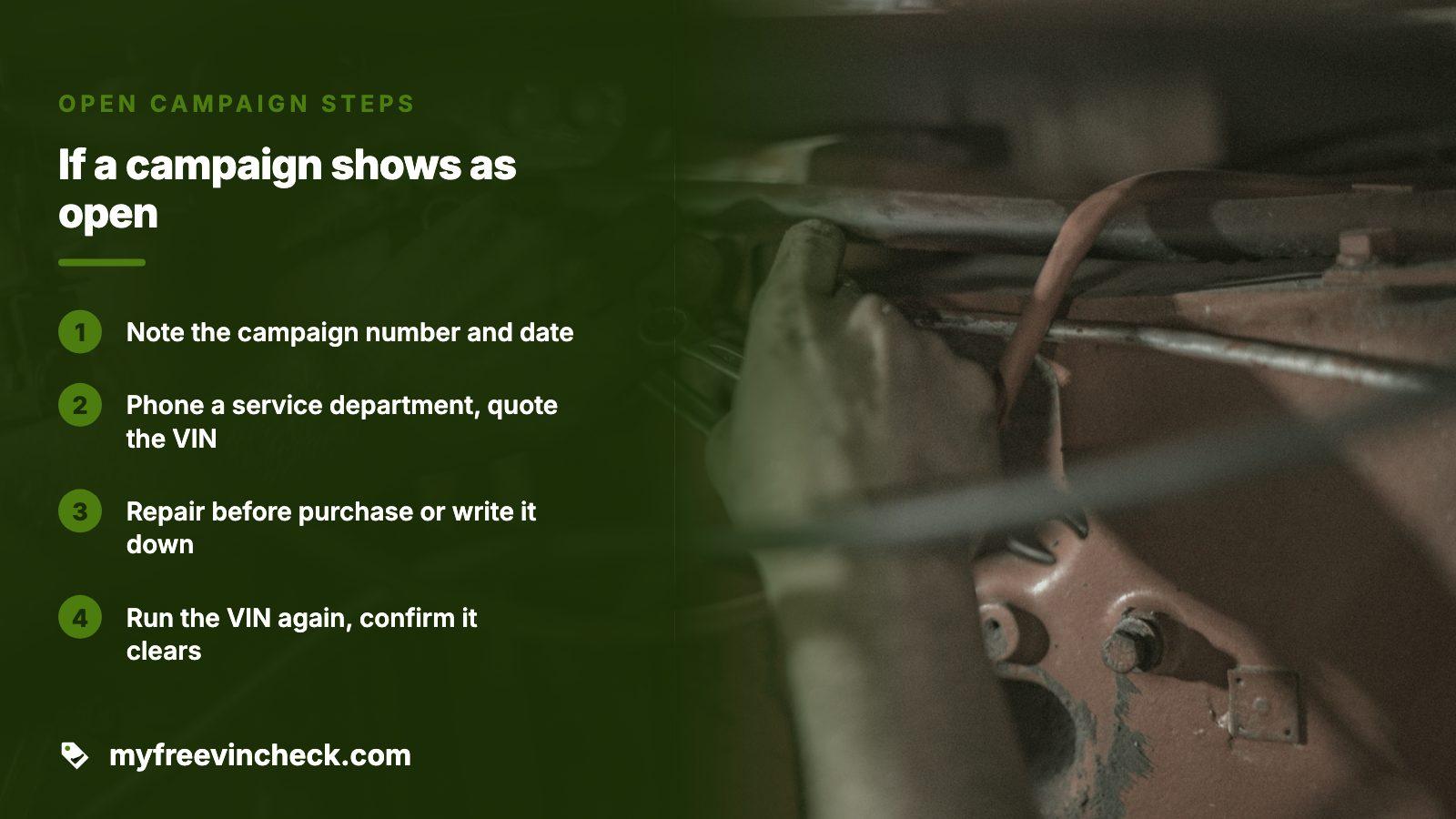
- Note the campaign number and the lookup date.
- Phone a Chevrolet service department, quote the VIN and ask whether parts and a repair slot exist now.
- Get the repair done before purchase, or put the arrangement in writing.
- Run the VIN once more afterward and confirm the campaign no longer reads as open.
NHTSA's hotline, 1-888-327-4236, is also listed in the campaign notes for owners who need help.
Where this information comes from
- NHTSA recalls API: 2019 Chevrolet Bolt EV — The campaign numbers, dates, defects and remedies in the table.
- NHTSA complaints API: 2019 Chevrolet Bolt EV — Complaint counts by component and the owner accounts quoted here.
- NHTSA owner complaint 11426342 — owner experience, paraphrased
- NHTSA owner complaint 11588926 — owner experience, paraphrased
- NHTSA owner complaint 11427180 — owner experience, paraphrased
Sources and photos: Facts checked against the sources above in November 2026. Photos by smart-me AG, Nina Mercado and Towfiqu barbhuiya on Unsplash; diagrams by MyFreeVINCheck.
Keep reading
- 2020 Tesla Model 3 Recalls: 21 Campaigns and How to Check Your VINAnother popular used EV, with its own campaign list.
- Check a VIN Number for Recalls: Free Lookup, Then the Full PictureThe general steps for checking any VIN against open recalls.
- Sample reportWhat the paid report shows beside the recall status.
- PricingHow a single report or a bundle of 3, 5 or 10 is bought.
Frequently asked questions
How many recalls does the 2019 Chevrolet Bolt have?
NHTSA lists 6 campaigns under the 2019 Bolt EV: brakes, door-handle cables, two battery fire campaigns and two pretensioner campaigns. None applies to every car, so only a lookup on the exact VIN answers for one vehicle.
Is the 2019 Bolt battery recall finished?
The earlier campaign 20V701000 is marked superseded by 21V560000, which replaces defective battery modules. Whether a given car has had that work is shown by its VIN lookup and the dealer's repair order, not by the model year.
Do I pay for a Bolt recall repair?
The campaign texts say each repair is free of charge to the owner. Quote the campaign number to a Chevrolet service desk, confirm parts are in stock, and have any timing promise put on paper.
Can I check Bolt recalls without paying?
Yes. NHTSA's lookup is open to anyone, and our preview carries no charge. Paying only adds records a recall list does not carry, such as title, accident and odometer history.
Why does a search for Chevrolet Bolt return nothing?
NHTSA files this car as Bolt EV. A query using only the word Bolt can come back empty, so decode the VIN or search under the full name to see the campaigns.
Now check the car itself
The guide explains what to look for. The report shows what this VIN has on record.