THE SHORT ANSWER
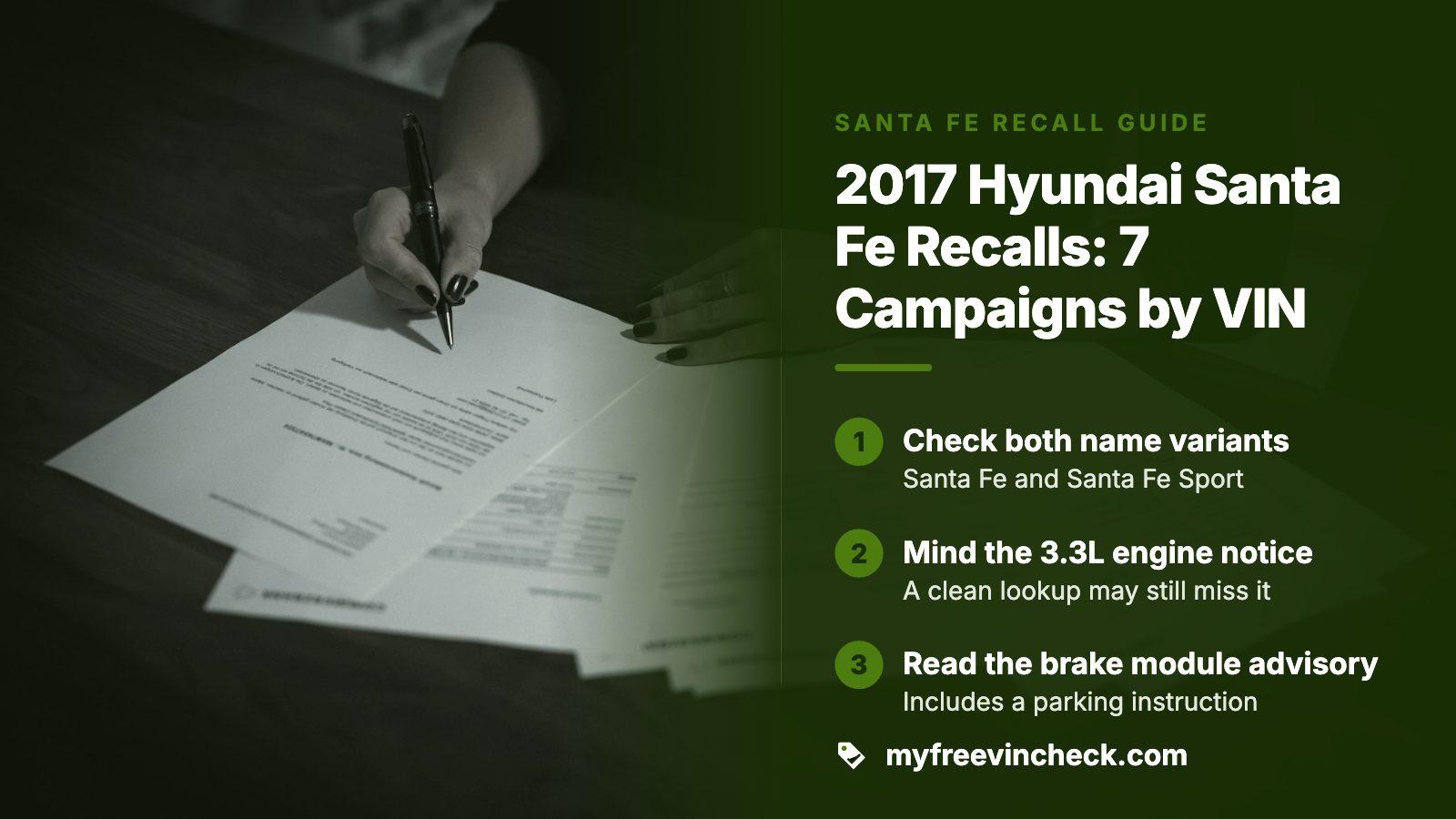
NHTSA files 7 campaigns for the 2017 Santa Fe: tire pressure monitor (17V142000), hood latch cable (17V358000), 3.3L engine bearings (17V578000), trailer hitch wiring (16V842000), front belt chime (16V145000), brake module fire risk (22V056000) and driver's belt anchor (17V365000). Build dates, engine and options decide which apply, so only a VIN lookup answers for one car. Covered repairs cost nothing at a Hyundai dealer.
- Campaigns
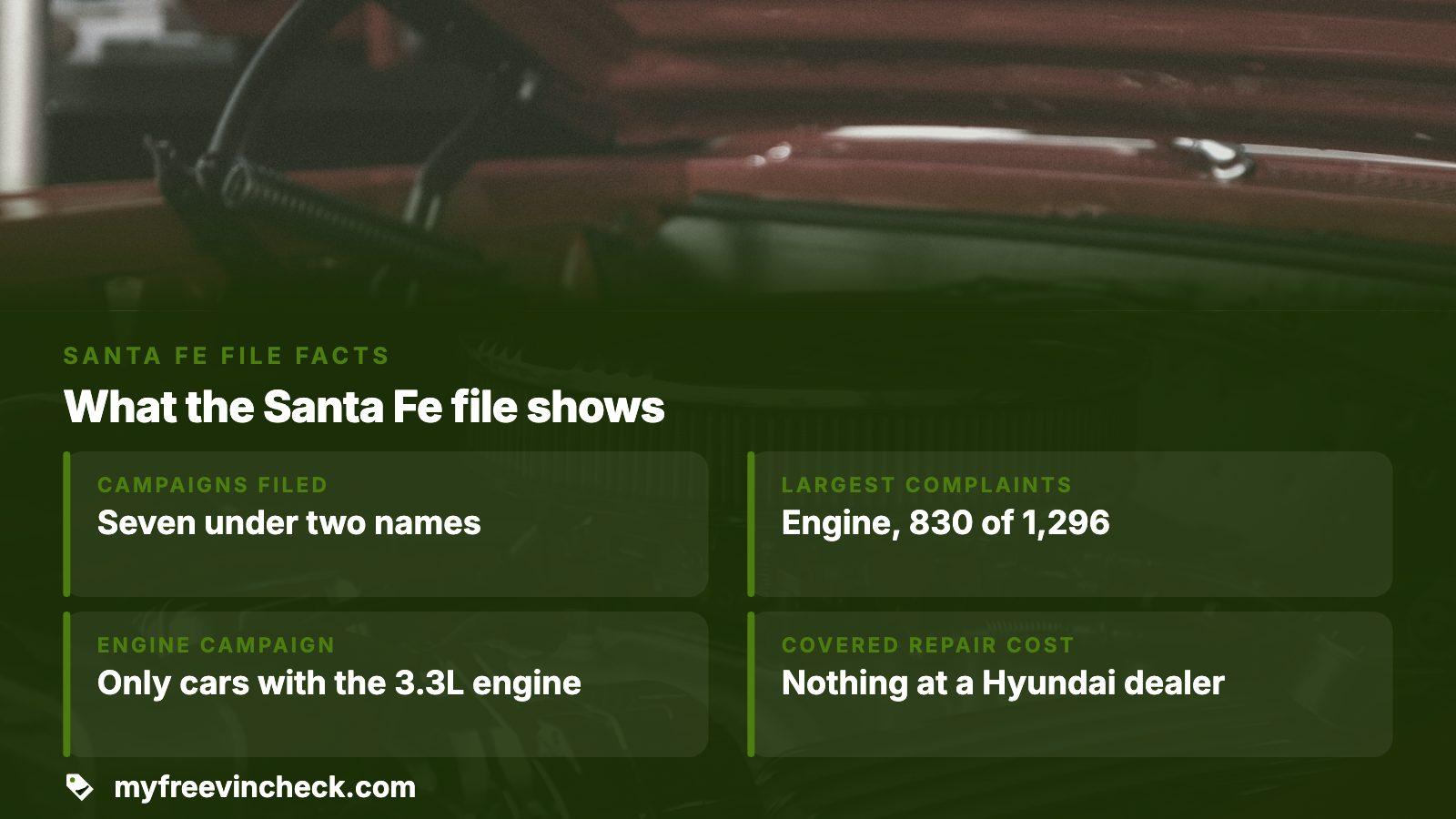
- 7 under the Santa Fe and Santa Fe Sport names
- Largest complaint group
- Engine, 830 of 1,296 owner reports as of August
- Engine campaign
- Limited to cars with the 3.3L engine
- Cost of a covered repair
- Nothing at a Hyundai dealer while the campaign is open
The seven campaigns filed under a 2017 Santa Fe
NHTSA files these under two names, Santa Fe and Santa Fe Sport. The tire monitor notice names the Sport yet shows up in a Santa Fe search. Only the engine campaign is tied to one engine; the rest are limited by model, build date or equipment.
| NHTSA number | Fault | Who it reaches |
|---|---|---|
| 17V142000 | Tire monitor set in the wrong mode at assembly, no low-pressure warning | Certain 2017 Sport models |
| 17V358000 | Backup hood catch cable corrodes and sticks | Certain cars of model years 2013 to 2017, both names |
| 17V578000 | Crankshaft pin flaw wears the bearings, car may stall | 2017 cars with the 3.3L engine |
| 16V842000 | Tow harness module keeps trailer brake lights on | Cars with the accessory harness, built late November 2015 to mid-November 2016 |
| 16V145000 | Front belt buckle wiring damaged, no unbuckled chime | Cars built from early September 2015 to mid-February 2016 |
| 22V056000 | ABS module can short, fire risk in the engine bay | Certain 2016 to 2018 Santa Fe, 2017 to 2018 Sport |
| 17V365000 | One bolt on the driver's belt anchor may be loose | Certain 2017 Sport models |
Checking one Santa Fe: decode first, then the recall lookup
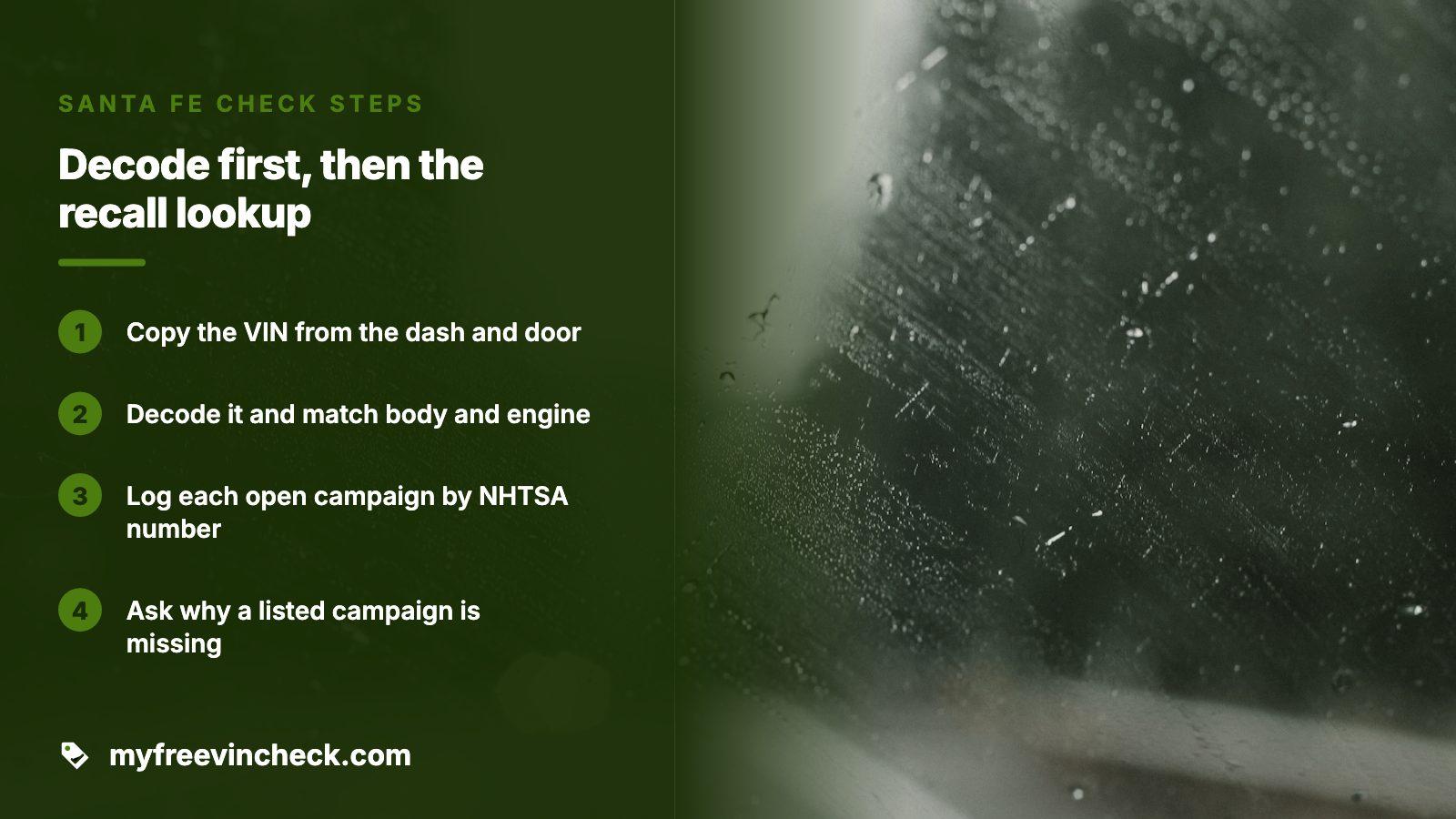
Both steps run here on NHTSA data at no charge. Decode first: it shows whether the car is a Santa Fe or a Santa Fe Sport, and which engine it has, before you read any campaign.
- Copy the 17-character VIN off the car itself, not the listing: the tag low on the driver's side of the dash, and the sticker in the door opening. Both should agree with the title.
- Decode it: 2017, Hyundai, the body the seller described, and the engine.
- Run the recall lookup and log each open campaign by NHTSA number with the date. Service desks may know a campaign by Hyundai's own number instead, 168 for the engine one.
- A campaign from the table that is missing from the result means the VIN sits outside its range or the repair is on record. The seller should know which.
What each result means for the sale
| On the lookup | What it means | Your move |
|---|---|---|
| Campaign open | No completed repair on record for this VIN | Get a Hyundai dealer to do it before delivery, or a written date |
| Campaign closed | A dealer reported the work done | Ask for the repair order, match its VIN to yours, and ask whether trouble has returned |
| Listed above, absent here | VIN falls outside the range or equipment | Treat a matching symptom as an ordinary repair bill |
| Nothing open | No campaign reaches this VIN today | Title, damage, odometer and lien records still need a look |
From an NHTSA owner complaint
Writing to NHTSA in June 2016, the owner of a 2017 Santa Fe said an unbuckled front passenger got no warning chime. A Hyundai dealer mechanic said no recall applied, and Hyundai's customer line agreed. The owner had read on NHTSA's site that a recall covered the problem.
The seat belt chime campaign, 16V145000, fits that symptom, but whether it reached that car depended on its build date, which the complaint does not give. A counter answer and a database answer can differ, so run the VIN yourself.
The engine campaign, and what a clean lookup does not clear
Campaign 17V578000 reaches 2017 cars with the 3.3L engine. Hyundai found crankshaft pin flaws that wear the bearings and can stall the car. Dealers inspect and replace the engine where needed, at no cost, and owner notices began in November 2017.
Engine is also where owners write most. Of 1,296 complaints held in August, 830 (about 64%) are filed under engine, and owners put the median failure 6.4 years after the model year.
From an NHTSA owner complaint
A complaint dated August 2022 says a daughter was driving at about 70 MPH when the Santa Fe knocked and stalled. A dealer found damage at the rod bearing and crankshaft, and the owner was told the VIN was outside 17V578000, though the owner said the failure matched the campaign. At 72,000 miles, the car was still unrepaired.
A VIN outside the list leaves the engine question open. Get the service records and have a mechanic inspect the engine before you settle on a price.
The brake module campaign and its parking advice
Campaign 22V056000 covers the anti-lock brake module, which can short and start a fire in the engine bay. Dealers replace the multi-fuse where needed at no charge, and owners were advised to keep the SUV outdoors and clear of buildings until the fix. Letters went out May 31, 2022.
From an NHTSA owner complaint
In April 2022 an owner described smoke under the hood at a traffic light, brakes that failed as the driver pulled over, then flames in the engine compartment. Nobody was hurt, but the SUV, at 54,000 miles, was destroyed. The notice for 22V056000 arrived the day after the fire.
- A letter can arrive too late, so look the VIN up yourself. If the campaign is open, treat the parking advice as live and ask how long it has been open.
- If it shows closed, the multi-fuse invoice is the only proof of the work.
- 30 of the 1,296 complaints describe a fire. They are unverified, but check the engine bay for heat marks and aftermarket wiring.
The four smaller notices, and the one that depends on a hitch
- Tire monitor, 17V142000: set in the wrong mode at assembly, so a low tire could go unwarned. Dealers replace the sensors.
- Hood cable, 17V358000: a corroded backup latch cable can let the hood open while driving. Dealers replace the cable.
- Seat belts, 16V145000 and 17V365000: chime wiring on cars from a narrow build window, and a loosely tightened driver's anchor bolt on the Sport.
- Trailer wiring, 16V842000: matters only if an accessory hitch harness was fitted, so find out whether the car ever towed.
Each is repaired at no charge and none alone is a reason to walk away. Get the paperwork, because an unrepaired campaign stays open against the VIN for the next owner.
What a recall lookup leaves out, and where the paid report starts
A recall lookup reads one federal record. It cannot say whether the Santa Fe has a salvage or flood brand, a repaired collision, a rolled-back odometer or a lender's lien. Those sit in title, damage and odometer records, the layer the paid report adds to the decode and recall check.
The preview is free and shows which of those record types exist for the VIN. You pay once, for a single report or a larger bundle, and no recurring charge follows. The pricing page lists the bundle sizes and amounts.
The order of work before money changes hands
Campaigns get added years after a sale. The brake module campaign reached 2017 cars only in 2022, so an old clean result can be out of date.
- Decode the VIN and run the recall lookup before the first visit, then again on the day you pay.
- Get each open campaign repaired by a Hyundai dealer, or dated in writing, before the sale.
- Run the preview. If the Santa Fe still looks right, buy the report.
- Book a mechanic for the engine, with the service records on the table.
Where this information comes from
- NHTSA: Recalls — The agency lookup where a VIN is checked and each campaign number in the table can be searched.
- NHTSA owner complaint 11459713 — owner experience, paraphrased
- NHTSA owner complaint 11479049 — owner experience, paraphrased
- NHTSA owner complaint 10876079 — owner experience, paraphrased
- 49 U.S.C. 30120: Remedies for defects and noncompliance — The statute behind the no-charge repair and the 15-year limit on it.
- NMVTIS: National title information — Federal background on the title brand records that a recall lookup leaves out.
Sources and photos: Facts checked against the sources above in November 2026. Photos by Dimitri Karastelev, Cole Keister and Victor Hughes on Unsplash; diagrams by MyFreeVINCheck.
Keep reading
- 2016 Hyundai Tucson Recalls: 5 Campaigns and How to Check Your VINThe 2016 Tucson is named in the same trailer hitch campaign, 16V842000.
- Tire Recall Check: What a VIN Search Misses and the Sidewall Code FindsThe tire pressure monitor notice is one of the seven here; this covers tire recalls themselves.
- Sample reportWhat the paid report sets beside the recall status.
- PricingWhere a single report or a pack is bought.
Frequently asked questions
How many recalls does a 2017 Hyundai Santa Fe have?
NHTSA carries 7 campaigns across the Santa Fe and Santa Fe Sport names. Few reach every car, since each follows build dates, equipment or engine. One Santa Fe can be open on three while its neighbor on the lot is open on none.
Does the engine recall cover every 2017 Santa Fe?
No. Campaign 17V578000 reaches 2017 cars with the 3.3L engine, and only those on its VIN list. Some owners whose engines failed the same way told NHTSA a dealer found their VIN outside it, so a mechanic's look is worth paying for.
Will a dealer fix an open recall if I am not the first owner?
Yes. The repair follows the VIN, and a covered, open campaign costs nothing. Federal law, 49 U.S.C. 30120, limits the no-charge remedy to 15 years from the first sale. Give the service desk the VIN and campaign number when booking.
Does a clean recall result mean the Santa Fe is trouble free?
No. A recall covers a defect the maker has admitted, and owners report more. NHTSA held 1,296 complaints for this model year in August, engine leading with 830, and none of that shows on a lookup.
Can I check 2017 Santa Fe recalls before paying for a report?
Yes. NHTSA's own lookup costs nothing, and the decode and recall check here read the same federal records at no charge. The preview is free too. The report is a one-time payment adding title, damage, odometer and lien records.
Now check the car itself
The guide explains what to look for. The report shows what this VIN has on record.