THE SHORT ANSWER
Five campaigns are filed against the 2016 CX-5 at NHTSA, four in 2016 and one in 2020. They cover liftgate supports, front strut bolts, the fuel filler pipe, certain replacement windshields and the daytime running lights, and a Mazda dealer repairs open ones at no charge. Build dates decide which apply, so run the VIN through the recall check to see what is still open.
- Campaigns
- 5 on file with NHTSA, four from 2016 and one from 2020
- Largest complaint group
- Exterior lighting, 161 of 510 owner reports
- Repair cost
- None at a Mazda dealer, within the 15-year federal limit
- Check
- Decode and recall check on NHTSA data, no charge
The five campaigns and what each one reaches
Four of the five notices date from 2016 and one from 2020. Two were written for several Mazda models at once, so a dealer may quote Mazda's own reference instead of the federal number.
| NHTSA number | Mazda's number | Part | What the notice says |
|---|---|---|---|
| 16V644000 | 9916H | Liftgate supports | Corroded supports can break and let the liftgate drop; dealers replace both |
| 16V203000 | 9316D | Front strut bolts | Lower bolts at the steering knuckle may loosen; dealers inspect, then tighten or replace |
| 16V064000 | 9216B | Fuel filler pipe | The pipe may rupture in a crash; dealers rework its mounting at the left rear bracket |
| 16E002000 | Glass maker's notice | Replacement windshield | A sensor bracket for the Smart City Brake Support held on by tape alone |
| 20V063000 | 4320A | Daytime running lights | LED lights may fail while driving; dealers inspect and replace a gasket or the headlight assembly |
Running the decode and recall check on your CX-5
Both tools read NHTSA data and need only a VIN, so the work is getting a clean one. Photograph it on the car instead of retyping it from an ad, because a single wrong character returns another vehicle or nothing.
- Find the 17 characters on the small plate at the driver's corner of the dash and again on the sticker along the driver's door frame. Both should agree with the title and the ad.
- Run the decode. It should say 2016, Mazda and CX-5, with the trim and drivetrain the seller advertised.
- Run the recall check and write down each open campaign number with today's date.
- For anything shown as done, ask the seller for the dealer's repair order and confirm the VIN printed on it is this car's.
Reading what the recall check returns
| Result | What it means | Your move |
|---|---|---|
| Campaign open | No completed repair on record for this VIN | Have a dealer finish it before delivery, or get a written date |
| Campaign closed | A dealer reported finishing the work on some date | Ask for the repair order, then look at the part itself |
| Campaign not listed | This VIN sits outside that notice's build range | The part can still wear, so inspect it anyway |
| Nothing open | No open campaign applies to this VIN today | Title, damage, odometer and lien records are untouched |
From an NHTSA owner complaint
An owner told NHTSA that a Mazda dealer, handed the 2020 headlight notice, decided the car's lamps carried the wrong production dates and did no work, yet logged the repair as done. Later one daytime light flickered and the other quit. Mazda customer service said first that the repair was complete, then that the dates did not fit, then that the lamps did not fit, and after about two months had shown no criteria. The owner's own reading of the recall papers put the VIN and dates inside the range.
Closed in a database is a claim about paperwork. A repair order carrying the right VIN is the proof.
The 2020 lighting notice, and why it gets its own look
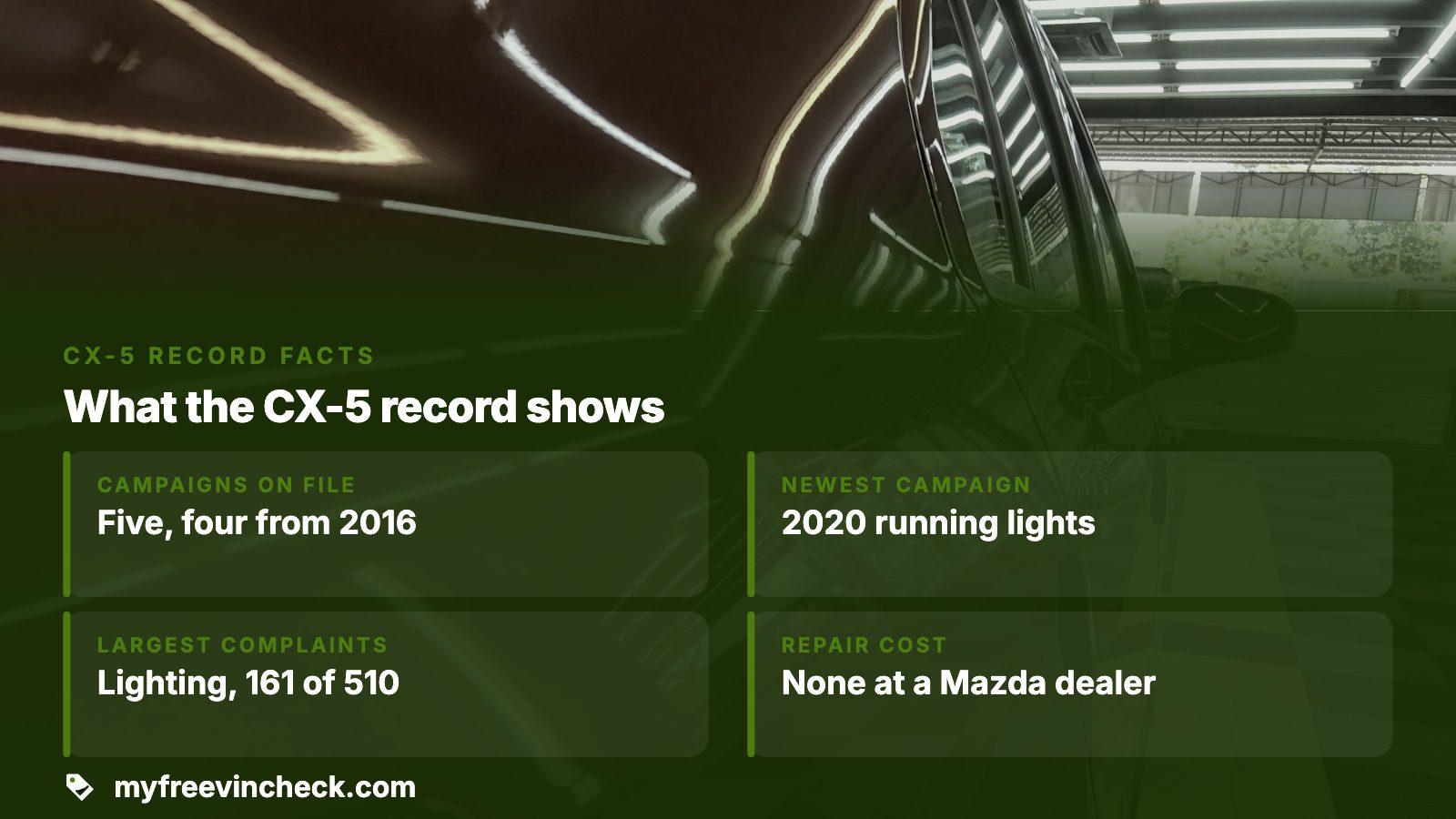
Exterior lighting is the heaviest group of owner complaints on this model year, 161 of 510 filed with NHTSA, about 32%. Those reports are unverified, but they point the same way as the 2020 notice, which has dealers inspect the headlights and fit a new sealing gasket or the whole assembly where needed.
From an NHTSA owner complaint
A CX-5 owner wrote in August 2025 that the 2020 repair put a new passenger-side light on the car but only a gasket kit on the driver side. That light has since turned dim and flickers. Mazda and its dealer declined to replace it, and Mazda's estimate came to $1,466. The owner attached the original invoice, which lists a driver-side gasket kit only.
Read the repair order line by line. It should show what went on each side. Two sides repaired differently are worth a question, and worth a replacement allowance in your offer.
When the VIN is outside the list but the lamp is dead
Coverage rests on the VIN list the maker filed. A car outside it gets a no at the service desk whatever the part is doing, and the recall check shows the same answer the dealer sees.
From an NHTSA owner complaint
An owner whose daytime light died without warning in 2023 phoned Mazda and heard that the car was not part of the recall. The owner believed the VIN fell inside the affected range and asked for it to be added to the list. Their safety point was plain: "Other cars won't be able" to see the car in daylight.
The check cannot widen a campaign. If your VIN is out but the symptom matches, get a diagnosis in writing, file your own complaint with NHTSA, and count the repair as a cost of the car.
The four 2016 notices: liftgate, struts, filler pipe, glass
- Liftgate supports (16V644000): corrosion can weaken them until the hatch drops on whoever stands under it. The notice went out before parts existed, and repairs began in April 2017. It names Mazda3 and other models too.
- Front strut bolts (16V203000): the lower bolts joining each strut to the steering knuckle may work loose enough for the knuckle to separate. Four Mazda models share this notice.
- Fuel filler pipe (16V064000): a rupture in a crash could leak fuel and raise the fire risk. The dealer fix changes how the pipe is attached at the left rear bracket.
- Replacement windshield (16E002000): the glass maker's notice, not Mazda's. It names glass made in late 2015 for cars with the Smart City Brake Support sensor, so ask whether the windshield was ever replaced.
Each asks for a dealer visit that costs the owner nothing, and three involve structure or fuel, not nuisance.
What repairs cost and when that stops
Under the federal remedy statute, a maker repairs a recalled car without charge to the owner, but the duty lapses once the car's first sale is more than 15 years behind the notice. These five notices came out in 2016 or 2020, comfortably inside that span. A future one might not.
Call a Mazda service desk, give the VIN and request the open list. Keep a repair order naming every campaign, and for the lighting work, one stating which part went on which side.
Where the free tools stop and the paid report starts
The decode and recall check cost nothing here and read data you could search yourself. Neither tells you whether the CX-5 was wrecked, who owned it or whether the odometer moved backward between sales.
- Decode and recall check: NHTSA data, no charge.
- Preview: free, a first look at which record types exist for the VIN.
- Paid report: one payment, no subscription, adding title brands, crash and damage history, odometer readings and lien checks.
Prices sit on the pricing page, for one report or a larger pack. A CX-5 with open liftgate or strut notices and no repair orders may never get that far.
Where this information comes from
- NHTSA: Recalls — The agency lookup where a VIN is checked and each campaign number above can be searched.
- NHTSA owner complaint 11459871 — owner experience, paraphrased
- NHTSA owner complaint 11681765 — owner experience, paraphrased
- NHTSA owner complaint 11538974 — owner experience, paraphrased
- 49 U.S.C. 30120: Remedies for defects and noncompliance — The statute behind the no-charge repair and the 15-year limit on it.
- NMVTIS: National title information — Federal background on the title brand records that a recall lookup leaves out.
Sources and photos: Facts checked against the sources above in November 2026. Photos by Rafał Karoń, Wesley Tingey and Clarence Tioh on Unsplash; diagrams by MyFreeVINCheck.
Keep reading
- 2010 Mazda 3 Recalls: 3 Campaigns, Checked by VINMazda3 appears in the same liftgate support notice, and it is checked the same way.
- 2016 Hyundai Tucson Recalls: 5 Campaigns and How to Check Your VINAnother 2016 compact SUV whose campaigns also depend on the VIN.
- Sample reportThe records a paid report sets beside the recall status.
- PricingWhere one report or a larger pack is bought, and what each costs.
Frequently asked questions
What is the recall count for a 2016 Mazda CX-5?
NHTSA lists 5 campaigns, four filed in 2016 and one in 2020, covering the liftgate supports, front strut bolts, fuel filler pipe, certain replacement windshields and the daytime running lights. Each follows build dates, so the count describes the model year. The VIN recall check shows which belong to one car.
Will a Mazda dealer repair a 2016 CX-5 recall at no charge?
Yes, for an open campaign that covers the VIN. The federal limit is 15 years from the car's first sale, and all five notices fall inside it. Bring the VIN, ask for a repair order naming the campaign and keep it. A part failing outside a notice's range is not covered by that notice.
Does a closed recall mean the lighting repair was done properly?
Not always. A closed entry means a dealer reported the work finished. One owner told NHTSA a dealer logged the repair complete without doing it, and another found only a gasket kit on one side. Ask for the repair order and look at both front lamps.
What do 2016 CX-5 owners complain about most?
Exterior lighting leads, with 161 of the 510 complaints filed with NHTSA, about 32%. Electrical problems and service brakes follow at about 14% each. Owners filed these without verification, so treat them as a guide to what a mechanic should inspect rather than a verdict on the car.
Can I check 2016 CX-5 recalls before paying for a report?
Yes. NHTSA's own lookup is free, and the decode and recall check here read the same records at no charge. The preview is free as well. The paid report is one payment and adds the title, damage, odometer and lien records that a recall list leaves out.
Now check the car itself
The guide explains what to look for. The report shows what this VIN has on record.