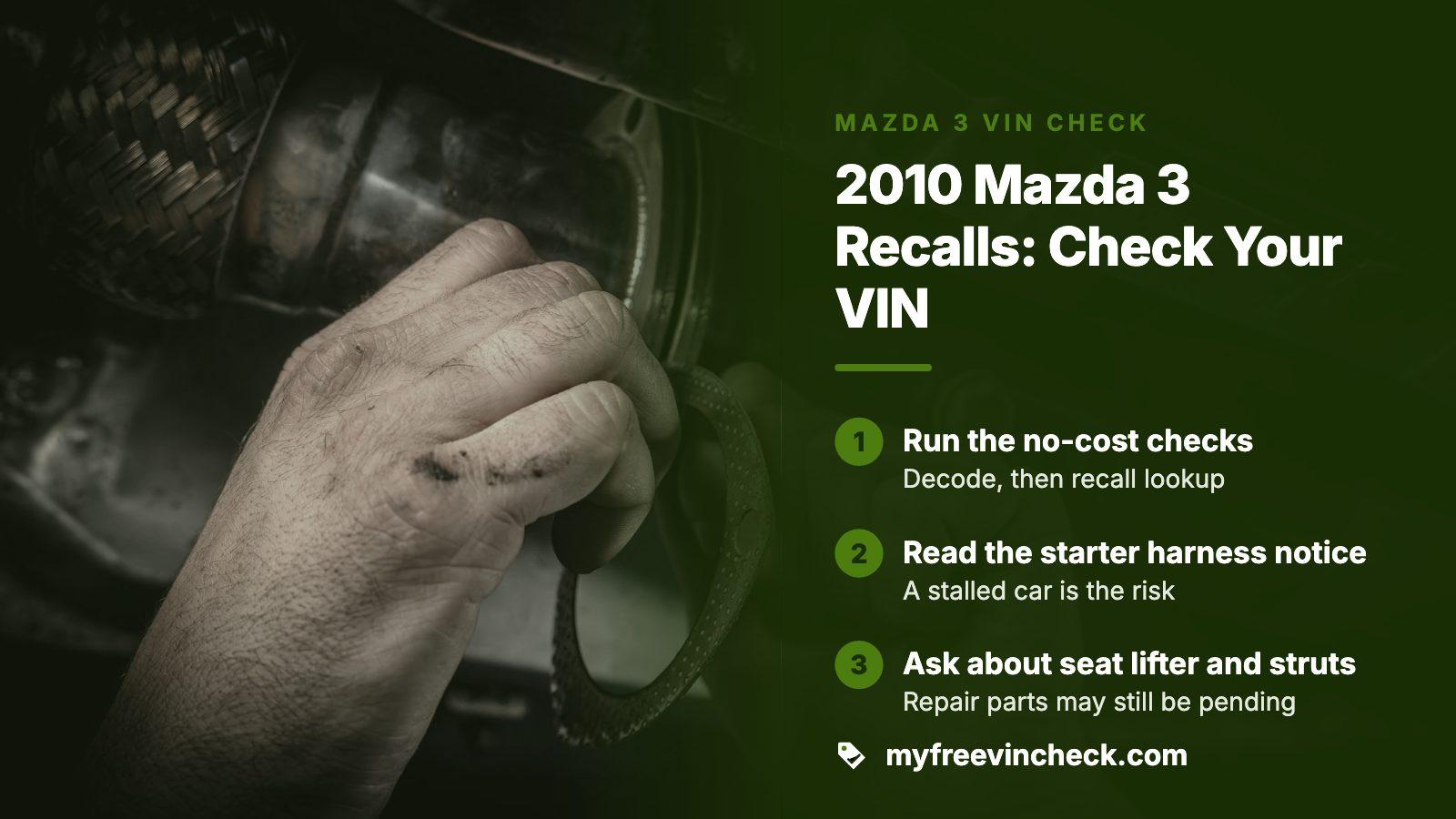
THE SHORT ANSWER
To check recalls on a 2010 Mazda 3, copy the 17-character VIN, decode it to confirm the build, then enter it in NHTSA's recall lookup. Three campaigns are on file: 09V126000 for the starter harness, 17V082000 for the manual seat lifter and 16V644000 for the liftgate struts. An open one is a repair Mazda owes at no charge, so settle it before you pay.
- Campaigns
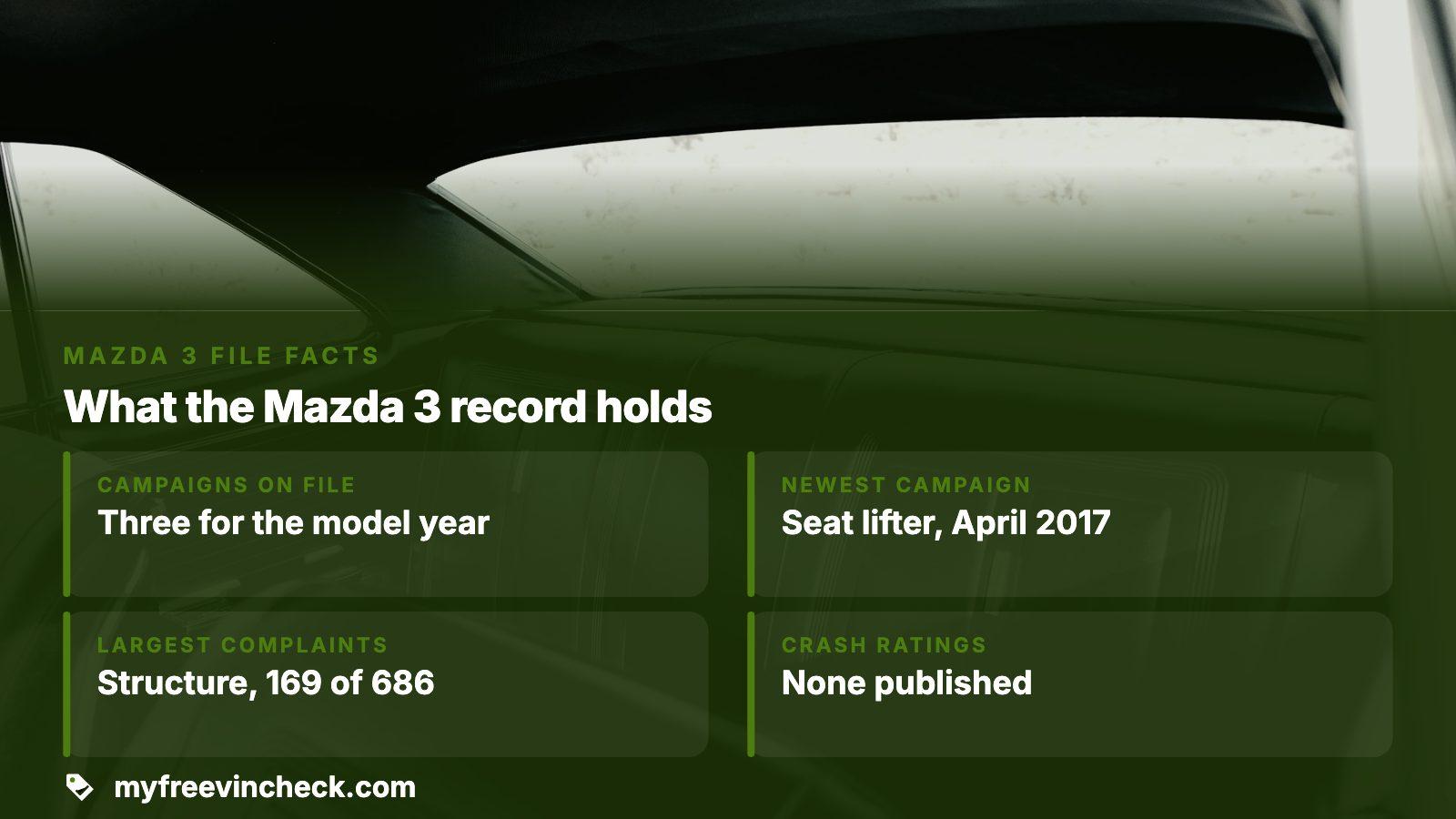
- 3 on file with NHTSA for the model year
- Owner complaints
- 686, structure the largest group at 169
- Crash ratings
- None published for either configuration
- Newest campaign
- 17V082000, seat lifter, started April 7, 2017
The three campaigns NHTSA files under the 2010 Mazda 3
Each free tool on this site works against this list. Every campaign follows a production range or an equipment choice, so none reaches every 2010 Mazda 3. The dealer repair is at Mazda's cost, whoever holds the title.
| Campaign | Part | What can go wrong |
|---|---|---|
| 09V126000 | Starter motor wiring harness | Worn insulation can short, the main fuse blows and the engine stalls |
| 17V082000 | Manual seat height lifter | The links can break and the driver's seat tilts out of a safe position |
| 16V644000 | Hatchback liftgate support struts | Corroded struts can snap and let the gate drop |
Run the free checks before anything else
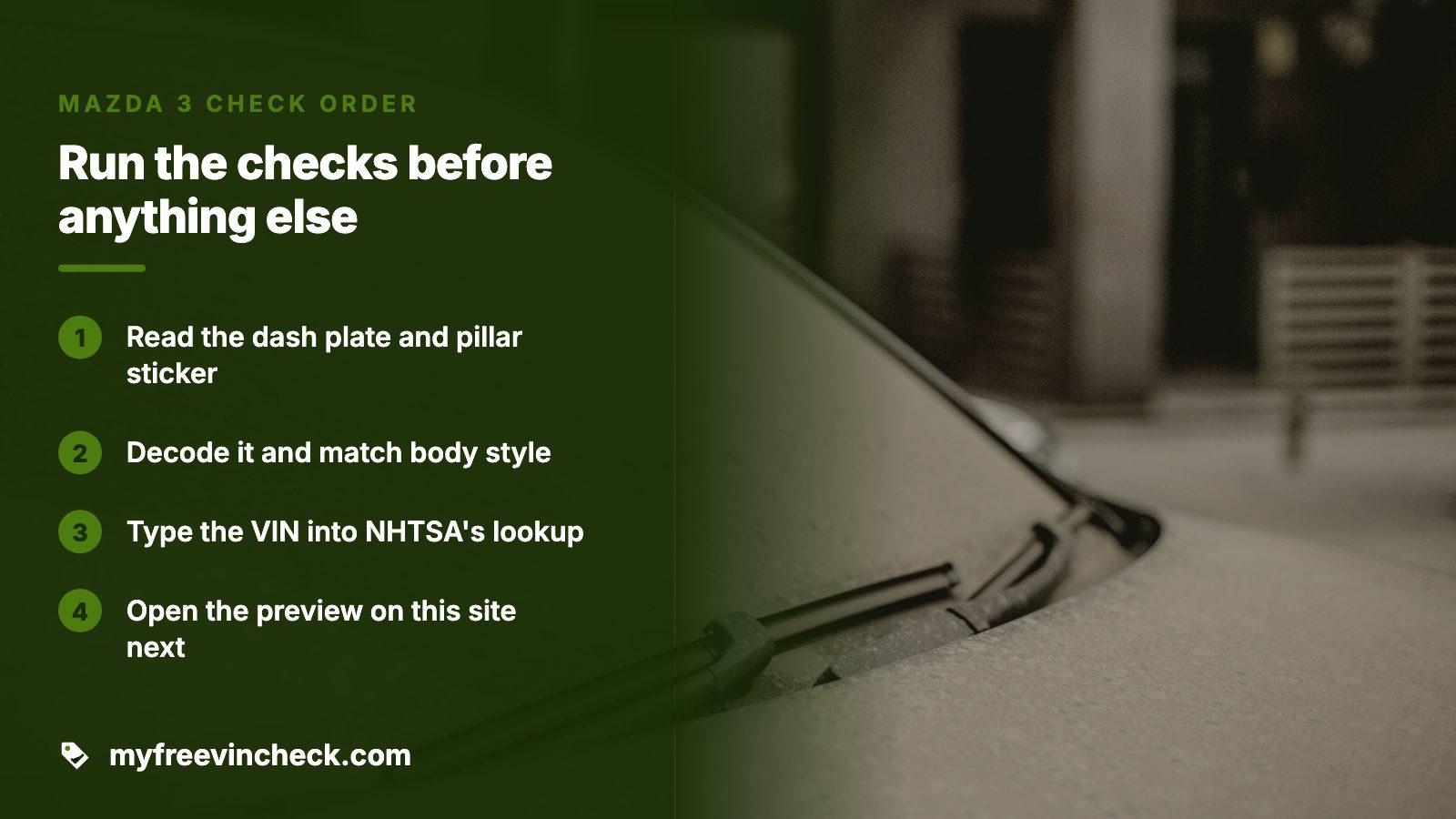
- Find the VIN on the dash plate you can see from outside, low on the driver's side, and on the door pillar sticker. Position 10 is the model year code, and a 2010 car shows the letter A.
- Decode it on this site and hold the trim, engine, transmission and body style against the listing. Body style counts, because only the 5-door has a liftgate.
- Type the VIN into NHTSA's recall lookup. It charges nothing and names each open campaign by number.
- Run the preview on this site next. It costs nothing and asks for no card.
The decode shows how Mazda built the car, not whether the bracket or harness work was ever done. Only the lookup and dealer paperwork answer that.
09V126000: the starter harness and a stalled engine
Mazda counted 25,400 cars of the 2010 model year in this campaign. The engine harness can sit too close to the starter motor housing, and vibration wears through its covering until bare wires short against the housing.
A short can mean engine control faults, a blown main fuse, a stall and a car that will not restart, which raises crash risk. Dealers inspect the harness, clip a protector onto the exposed stretch and repair the wiring if needed, free of charge.
From an NHTSA owner complaint
After a no-start in December 2016, an owner was told a battery cable had shorted and split in two because of a defective harness. The owner traced the same part to this campaign, yet Mazda replied that the VIN was not listed and priced the repair at $1,400. The owner was relieved the short "did not cause a fire."
A clean lookup describes coverage, not condition. The same part can fail on a car outside the list.
17V082000: the seat lifter, and a repair that did not hold
Campaign 17V082000 reaches certain 2011 Mazda2 and 2010 to 2011 Mazda3 and Mazdaspeed3 cars with a manual seat lifter. The height links can break or pull off the frame, and the seat may tip back so the driver cannot hold a proper position. The fix is a reinforcement bracket or a new adjuster unit, at no cost to the owner. It began April 7, 2017.
From an NHTSA owner complaint
In February 2025 an owner reported a broken lifter link on a car under this campaign. A dealer had fitted only a reinforcement bracket, where the owner read the recall as calling for a new adjuster. On the next visit the shop said the work was already done and the car "cannot be repaired again."
A repair marked done is a claim about paperwork. Work the seat lever yourself before you accept it.
16V644000: the liftgate struts and the wait for parts
Campaign 16V644000 sits under body structure, hatchback and liftgate. NHTSA's record says the support struts can corrode and break, and the gate may fall on whoever is loading the car. Dealers replace both supports free of charge. It began April 2017, with parts short.
From an NHTSA owner complaint
An owner got the liftgate damper notice in October 2016, and the dealer had no part. A second visit in December ended the same way, with a call-back promised for February. The gate had not failed yet, but the owner said "4 months seems long" and did not want to ignore the notice.
Treat an open campaign as a waiting list, and settle who books the repair before you pay.
Reading what the recall lookup returns
| Result | Reading | Your move |
|---|---|---|
| Open campaign | Mazda still owes the repair on this VIN | Book it, or agree in writing who will, before you pay |
| Nothing open | No campaign applies, or the work was done | Still ask for work orders on the harness, seat and struts |
| Repair claimed, no paperwork | A claim is not a record | Ask for the invoice, then run the VIN a second time |
Open items on a car this old rarely end a purchase, since the repairs cost the buyer nothing. A seller who cannot say which were done tells you more.
686 owner complaints, and what they cluster around
NHTSA holds 686 owner complaints for the 2010 model year. They are unverified, so read the shape and not the sum. Structure leads with 169, about 25%, then seats at 106 and wiper and visibility at 100. The filings include 18 crash reports, 5 fire reports and 13 reported injuries.
No single group swamps the rest, so this reads as ordinary wear more than one systemic fault. These are unchecked reports, not failure rates.
Crash ratings, and the 15-year limit on free repairs
NHTSA lists two configurations for this year, the 5-door hatchback and the 4-door, and gives neither an overall, frontal, side or rollover score. A star score also describes a new car, not one that has been welded, straightened or hit.
The free repair is not permanent
The statute behind free recall repairs, 49 U.S.C. 30120(g), has a cutoff: once the original sale is 15 calendar years or older at the date of the notice, the maker no longer has to repair at no charge. A 2010 car clears it for all three campaigns, since each was announced long ago, but a campaign announced today may miss it.
A pre-purchase checklist built from the record
- Body structure and underbody: the biggest complaint group, and corrosion or old repair is likelier at this age than any recall item
- Seat height lever: work it through full travel and watch whether the seat holds its angle under your weight
- Liftgate on a hatchback: raise it and see whether both struts hold it
- Engine bay wiring near the starter: NHTSA holds fire reports for this model year, so look for scorch marks and taped splices
Then ask the seller for dealer paperwork on all three campaigns, and for your own mechanic's look before you agree on a price.
Where the free tools stop and the paid report starts
A recall list describes the model. A car from 2010 has had years to change owners, pick up a lien, get repaired after a collision or show an odometer reading that falls between sales. Title and claims records hold those events.
| Step | Cost | What you learn |
|---|---|---|
| Decode on this site | No charge | The factory build, to match against the ad |
| NHTSA recall lookup | No charge | Which campaigns are open on the VIN |
| Preview on this site | Free, no card | An early read before you decide on the report |
| Paid report | One payment, no subscription | Title and ownership record, mileage history, accident and damage detail, liens and theft entries |
Prices sit on the pricing page, for one report or for packs of 3, 5 and 10; each is a single payment. Run the preview first, and pay only if the car clears the checks above.
Where this information comes from
- NHTSA: Recalls — The agency lookup that checks a VIN for open campaigns and lets each campaign number above be searched.
- NHTSA: Vehicle safety — Entry point to the public owner complaint records behind the counts on this page.
- NHTSA: Safety ratings — The federal crash-test program whose star scores are missing for this model year.
- 49 U.S.C. 30120: Remedies for defects and noncompliance — The statute that makes a recall repair free and sets the 15-year limit.
- NHTSA owner complaint 10935226 — owner experience, paraphrased
- NHTSA owner complaint 11643478 — owner experience, paraphrased
- NHTSA owner complaint 10939659 — owner experience, paraphrased
Sources and photos: Facts checked against the sources above in November 2026. Photos by Martin Fennema, JavyGo and Wesley Tingey on Unsplash; diagrams by MyFreeVINCheck.
Keep reading
- 2012 Kia Forte Recalls: 4 Campaigns, Two Tied to Fire RiskAnother compact sedan and hatchback, read the same way.
- 2015 Ford Focus Recalls: 9 Campaigns and Which Ones Fit Your VINA compact with its own campaign list to test a VIN against.
- Sample reportThe records a paid report sets beside recall status.
- PricingHow one report and the packs of 3, 5 and 10 are bought.
Frequently asked questions
How many recall campaigns cover the 2010 Mazda 3?
Three: 09V126000 for the starter harness, 17V082000 for the manual seat lifter and 16V644000 for the hatchback liftgate struts. None covers every car, so the VIN lookup shows which apply to yours.
Can I check a 2010 Mazda 3 for recalls without paying?
Yes. NHTSA's lookup takes the VIN at no charge, the decode on this site costs nothing and the preview is free with no card. Only the report with title, accident, odometer and lien records is a paid, one-time purchase.
Does the 2010 Mazda 3 have a crash-test rating?
NHTSA shows no star rating for either configuration, the hatchback or the 4-door, and no rollover probability. Only an inspection can test the actual car.
Does a clean recall result mean a 2010 Mazda 3 is safe to buy?
No. It means no open campaign matches that VIN. With 686 complaints on file, 169 about structure, the car still needs a mechanic and a test drive. Title brands, past collisions and liens sit outside recall data.
Will Mazda still do these repairs at no charge on a 2010 car?
Each of the three campaigns promises the repair at no charge, and all were announced long ago. Federal law ends that duty 15 calendar years after the original sale, so a newer campaign could miss it.
Now check the car itself
The guide explains what to look for. The report shows what this VIN has on record.