THE SHORT ANSWER
NHTSA holds 15 recall entries for the 2016 Ford Explorer. They span a rear toe link that can fracture, A-pillar and B-pillar trim, roof rail covers, fuel tank bolts, a parking brake, seat parts and two block heater faults. Build date, engine or state of sale narrows many of them, so one SUV needs its own VIN lookup, which lists what is still unrepaired.
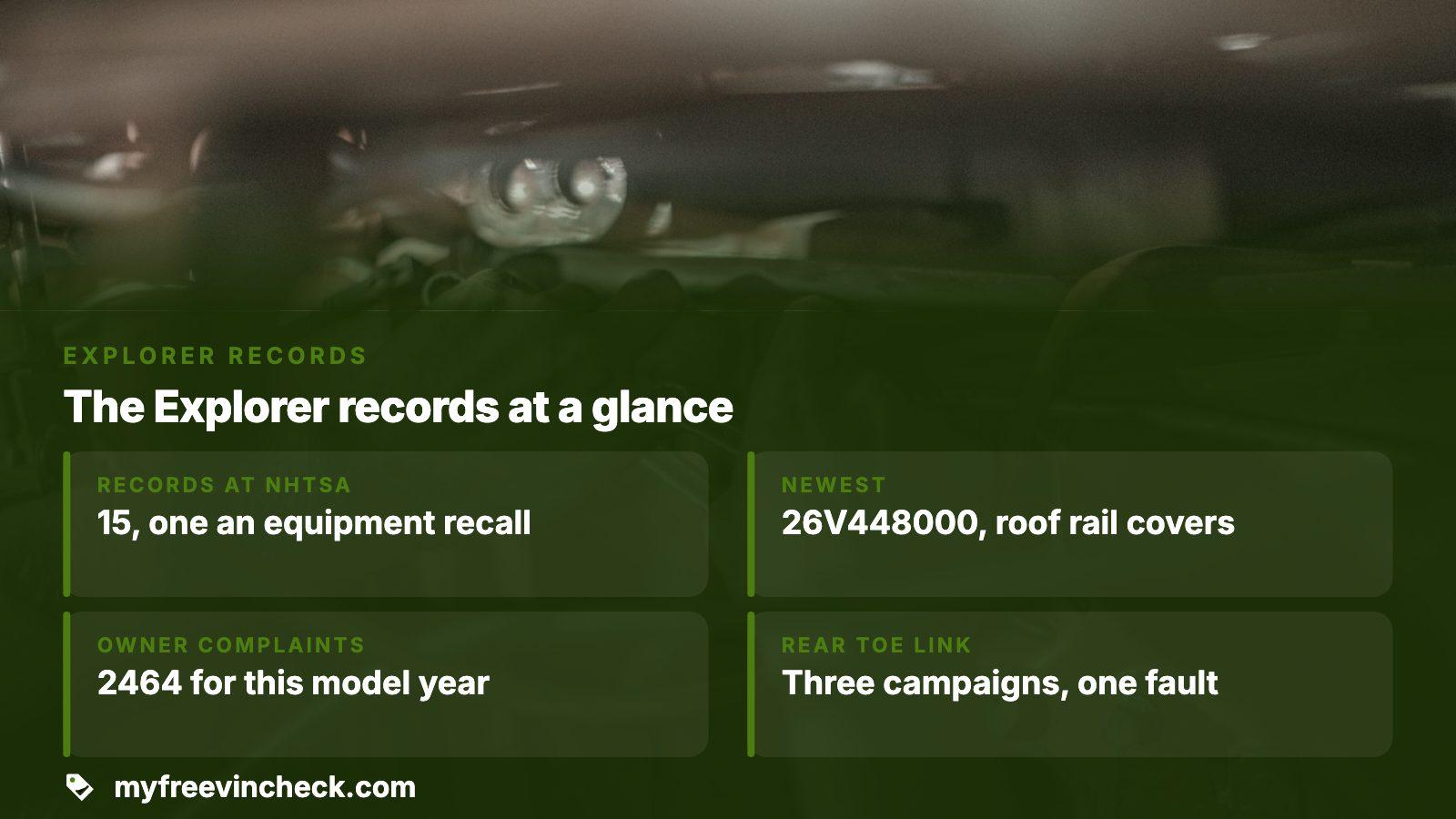
- Records at NHTSA
- 15 for the 2016 model year, one of them an equipment recall
- Newest
- 26V448000, received July 14, 2026, roof rail covers
- Owner complaints
- 2464 filed with NHTSA for this model year
- Repair cost
- Nothing to the owner when a dealer does an open campaign
All 15 records NHTSA holds for the 2016 model year
One of the 15, 17E048000, is an equipment recall about replacement wheel hub bearings sold for the wrong axle, not a fault in a built Explorer. That leaves 14 campaigns that name the SUV itself. Whether one applies to a given SUV turns on build date, engine, drive type and, for two, where it was sold.
| Campaign | Received | Fault |
|---|---|---|
| 15V464000 | July 2015 | Parking brake can fail to hold |
| 15V605000 | Sept 2015 | Fuel tank bolts not tightened |
| 16V183000 | Mar 2016 | Block heater overheats (2.3L engines) |
| 16V475000 | June 2016 | Weak welds in manual recline seat frame |
| 17E048000 | Aug 2017 | Wrong-axle hub bearings (equipment) |
| 17V767000 | Nov 2017 | Power seat pivot bolts loose |
| 19V435000 | Oct 2019 | Rear toe links may fracture |
| 20V675000 | Mar 2021 | Toe link fracture after earlier repair |
| 20V692000 | Nov 2020 | Front halfshaft bracket may fail |
| 21V316000 | May 2021 | Roof rail covers can detach |
| 21V537000 | July 2021 | Salt-corroded toe link joint |
| 24V031000 | Jan 2024 | A-pillar trim can detach |
| 25V347000 | May 2025 | B-pillar door trim can detach |
| 25V685000 | Oct 2025 | Block heater cracks and shorts |
| 26V448000 | July 2026 | Roof rail covers, wider scope |
The four records most likely to be open on a used car
Old campaigns have mostly been worked through. Recent ones differ, because several were announced before Ford had the final part. A car can hold a notice letter and still be unrepaired, and a tidy service history will not show it.
- 24V031000, A-pillar trim: a phased campaign by model year, with letters going out over a long stretch from mid 2024 into December 2025.
- 25V347000, B-pillar trim: interim letters went out June 5, 2025, and NHTSA's record puts the final remedy at November 2026.
- 25V685000, block heater: owners are told not to plug it in; the final remedy is listed as anticipated December 2026.
- 26V448000, roof rail covers: interim letters were mailed August 28, 2026, with a remedy anticipated in January 2027.
Those dates are Ford's estimates, as logged by NHTSA. Use them as a prompt to question the seller, not as a promise.
What owners report when the repair part does not exist
Complaints for this model year lean heavily toward the trim campaigns, and many follow one script: notice received, dealer visited, part unavailable.
From an NHTSA owner complaint
This account, dated October 2026, says A-pillar trim worked loose on a highway and struck the car behind. That driver swerved but kept control, and the filer paid to fix the other windshield. Dealers had said "not in stock for repair" for most of a year.
From an NHTSA owner complaint
Filed in June 2026, this one comes from a buyer who got the Explorer at a dealership in 2024 and says no open recall came up at the sale. Trim looked loose within weeks, and after more than two years a door trim panel came off and hit a child in the back seat, per the filer.
Both are single owners' words, not findings. The takeaway for a buyer is practical: look the VIN up before the sale, and ask what the dealer will do about a repair that cannot yet be done.
The rear toe link: three campaigns, one fault
Toe links that can fracture show up three times. The first, 19V435000, began on June 26, 2019 and spans Explorers from 2011 to 2017. The second, 20V675000, targets 2013 to 2017 cars in listed salt-belt states that were already repaired once. The third, 21V537000, widens the earlier ones to vehicles sold or ever registered in 22 states plus Washington, DC, because winter road salt can corrode and seize the ball joint.
Per NHTSA's text, a car fixed under an older campaign may be called back for the latest remedy. A seller saying the toe links were replaced years ago has therefore settled nothing. The stated danger is losing steering control. Ask for the dealer's repair order and compare it with the dates above.
Older campaigns: heaters, seats, fuel tank and brake
- Block heater, 16V183000: 2.3L cars built from late 2014 into January 28, 2016. The element can overheat, so owners were told not to use the heater until it was fixed.
- Fuel tank, 15V605000: one build day, July 24, 2015, with bolts that may not have been tightened.
- Parking brake, 15V464000: cars from a May 2015 build window, where the brake may let the vehicle roll on a slope.
- Seats, 16V475000 and 17V767000: a manual recline frame, and power seat pivot bolts.
- Halfshaft bracket, 20V692000: front-wheel-drive Explorers with 2.0L or 2.3L engines.
Dealers have likely handled most of these years ago. The VIN lookup settles it either way, since it lists only repairs still outstanding.
Free lookups first, and what they leave out
The decode and recall tools on this site both read NHTSA data and cost nothing, so they come before any purchase. The agency's own lookup is free too, and takes up to 100 VINs in one go if you are comparing cars.
Neither is a history check. The agency search reports unrepaired recalls only. A campaign already repaired will not appear, and a brand-new one can slip by while the maker is still adding VINs. Nothing in it speaks to a salvage brand, a past accident or a rolled-back odometer. Those need title and damage records, the job of a paid report after the preview.
Running it on the Explorer you are looking at
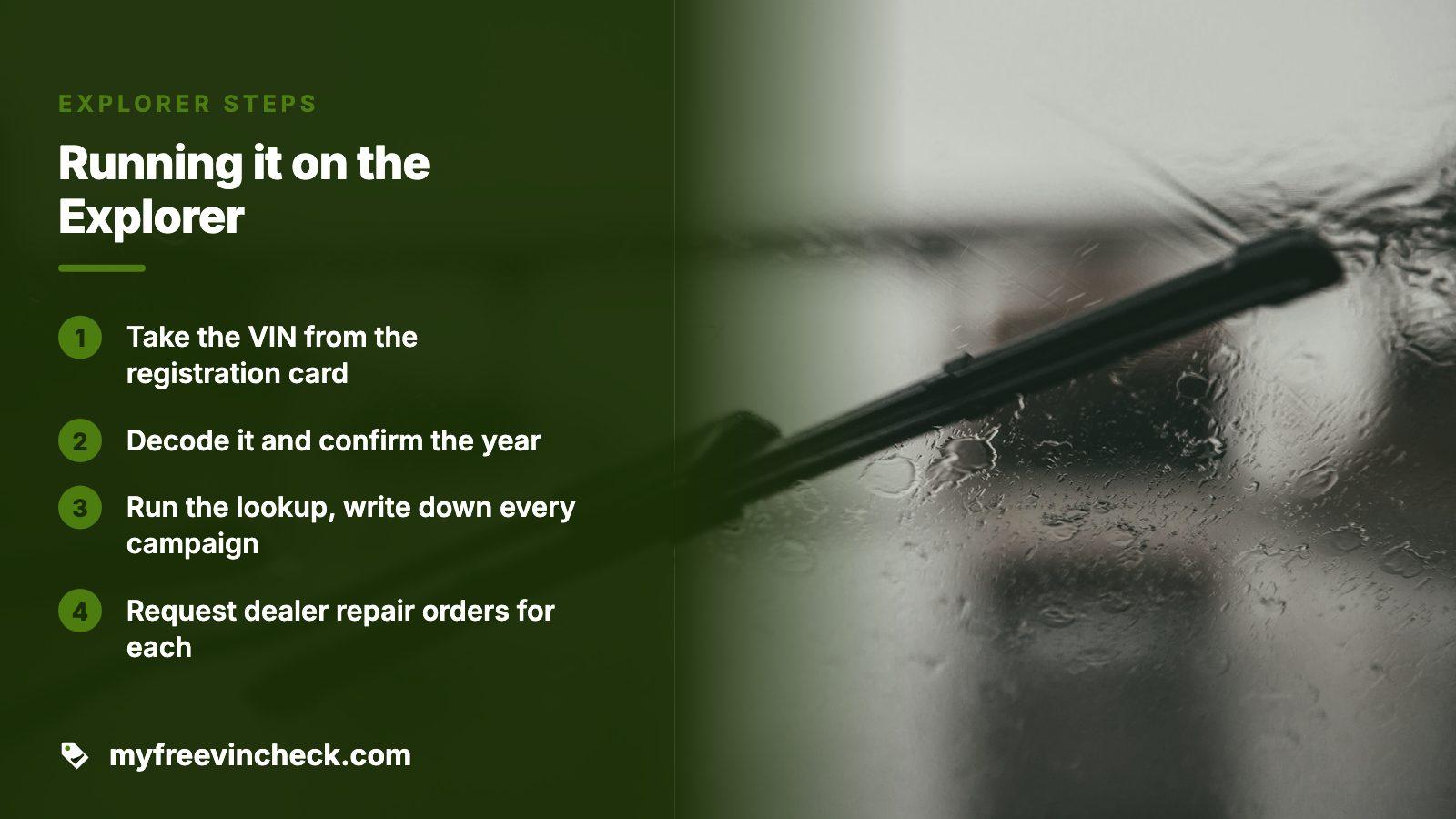
- Take the VIN from the registration card, then locate the same code on the car itself and make sure the seller's papers agree.
- Put it through the decode tool and confirm the year reads 2016 and the engine matches the ad.
- Run the recall lookup and write down every campaign returned.
- Compare that list with the table above, watching the toe link, trim and block heater entries.
- Request dealer repair orders for each campaign that fits this build.
- Open the report preview if you still want the car.
Reading the lookup result
| Lookup shows | Probable meaning |
|---|---|
| 0 unrepaired recalls | Nothing open now, though a brand-new campaign can lag |
| Trim or roof rail campaign open | Repair may be waiting on parts; get the dealer's answer in writing |
| Block heater campaign open | Leave the heater unplugged until a dealer has fixed it |
| Toe link campaign open or unproven | Ask for repair paperwork before a long drive or a signature |
An open recall is not grounds to reject every Explorer, because a Ford dealer does the work without charging the owner. It is grounds to learn how long the car has waited and what the seller knew.
Preview first, one purchase for the history
Decoding, the recall lookup and the preview carry no charge. The full report is bought once, as a single report or a bundle, with no renewals; the pricing page lists current amounts. It earns its place once the car has cleared the recall lookup and you want title brands, crash records and mileage readings in hand before paying the seller.
Where this information comes from
- NHTSA: Recalls lookup — NHTSA's lookup page, which spells out what a VIN search leaves off.
- NHTSA: 2016 Ford Explorer — Model-year page for reading each campaign number above in full.
- NHTSA owner complaint 11763430 — owner experience, paraphrased
- NHTSA owner complaint 11743417 — owner experience, paraphrased
Sources and photos: Facts checked against the sources above in November 2026. Photos by Franck V., Thibault Valjevac and Nina Mercado on Unsplash; diagrams by MyFreeVINCheck.
Keep reading
- 2020 Ford Explorer Recalls: 33 NHTSA Records, and How to Check One VIN FreeThe same SUV from a later model year, with a separate campaign list.
- 2017 Ford Escape Recalls: Four Campaigns and the Engine Problem None CoverAnother Ford from the same period, if the Explorer does not work out.
- Check a VIN Number for Recalls: Free Lookup, Then the Full PictureA longer walk through the lookup behind this page.
- PricingWhere the report is bought once the preview has done its job.
Frequently asked questions
How many recalls does a 2016 Ford Explorer have?
NHTSA holds 15 records for the model year. One is an equipment recall for hub bearings, so 14 name the SUV. Almost no car is covered by all of them, since build date, engine, drive type and state of sale narrow most notices. A VIN lookup returns whatever is still unrepaired on one vehicle.
Is the 2016 Explorer rear toe link recall still open?
It can be. The toe link has three campaigns, and the latest one tells some previously repaired cars to come back. Cars sold or ever registered in listed salt-belt states are the focus. Only a VIN check or a dealer can tell whether the newest remedy has been done.
Can I get the trim recall fixed right now?
Not always. NHTSA's records say the B-pillar remedy was anticipated for November 2026, and A-pillar parts came in phases by model year. Several owners describe dealers having no parts. Call a Ford dealer with your VIN, ask for a written answer, and keep the date you asked.
Does a free NHTSA lookup show every problem with the car?
No. It shows safety recalls still waiting for repair. It leaves out repaired recalls, some campaigns whose VINs are not yet loaded, and everything about title, accident and odometer history. Treat it as the first check and not the last.
Do I pay for recall repairs on a used Explorer?
For an open campaign, no. The records say the dealer repairs it free of charge, whoever owns the car now. Settle the timing before buying, since parts for some notices have been slow to arrive.
Now check the car itself
The guide explains what to look for. The report shows what this VIN has on record.