THE SHORT ANSWER
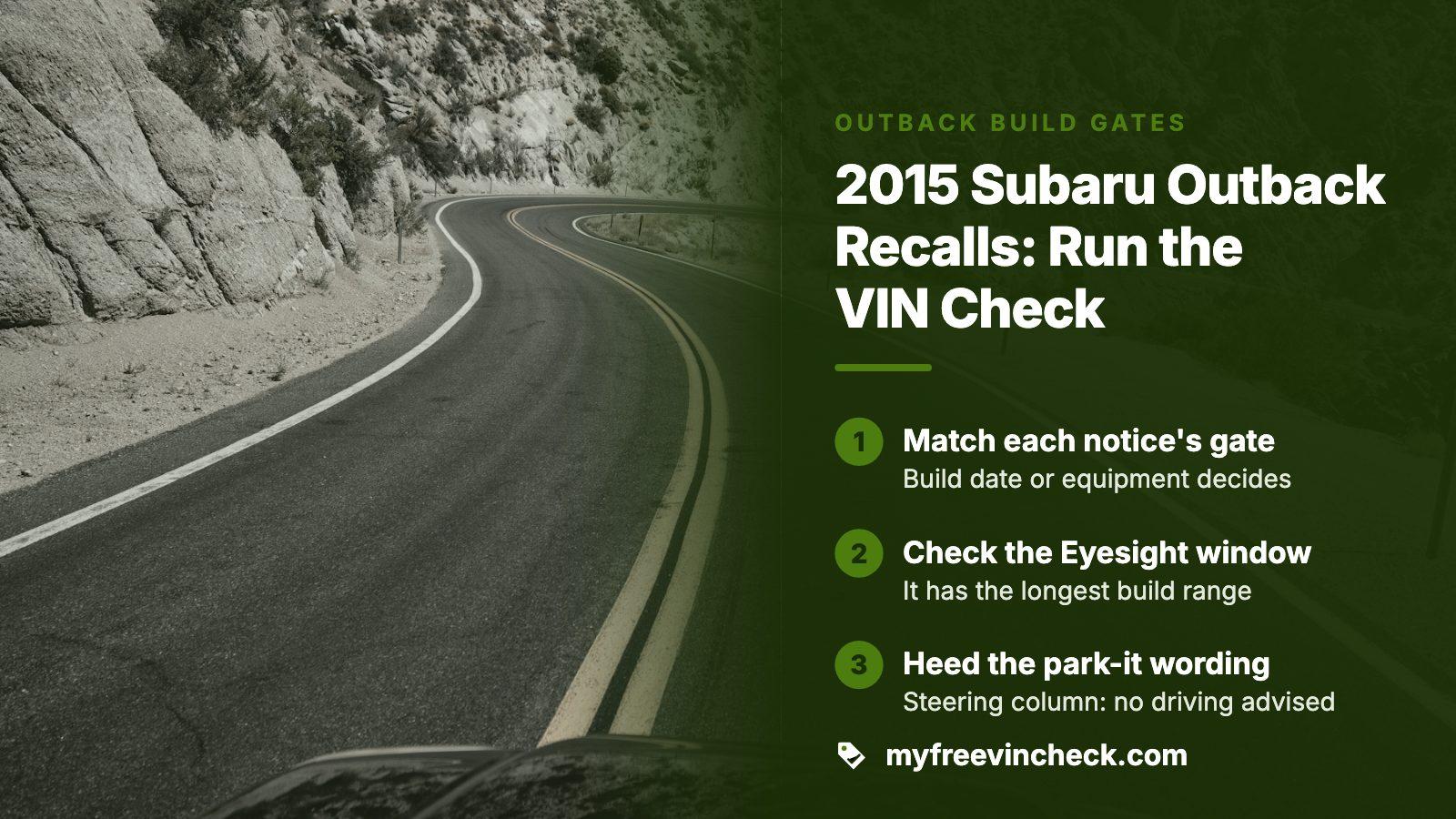
NHTSA files 5 recall campaigns under the 2015 Subaru Outback: 15V366000 (Eyesight braking), 14V577000 (trailer hitch), 15V502000 (driveshaft seal, fire risk), 16V251000 (stability control fluid) and 16V292000 (steering column). Every one is narrowed by build dates or by equipment, and a Subaru dealer repairs them at no charge. A VIN lookup is what tells you which, if any, apply to one car and whether the work was done.
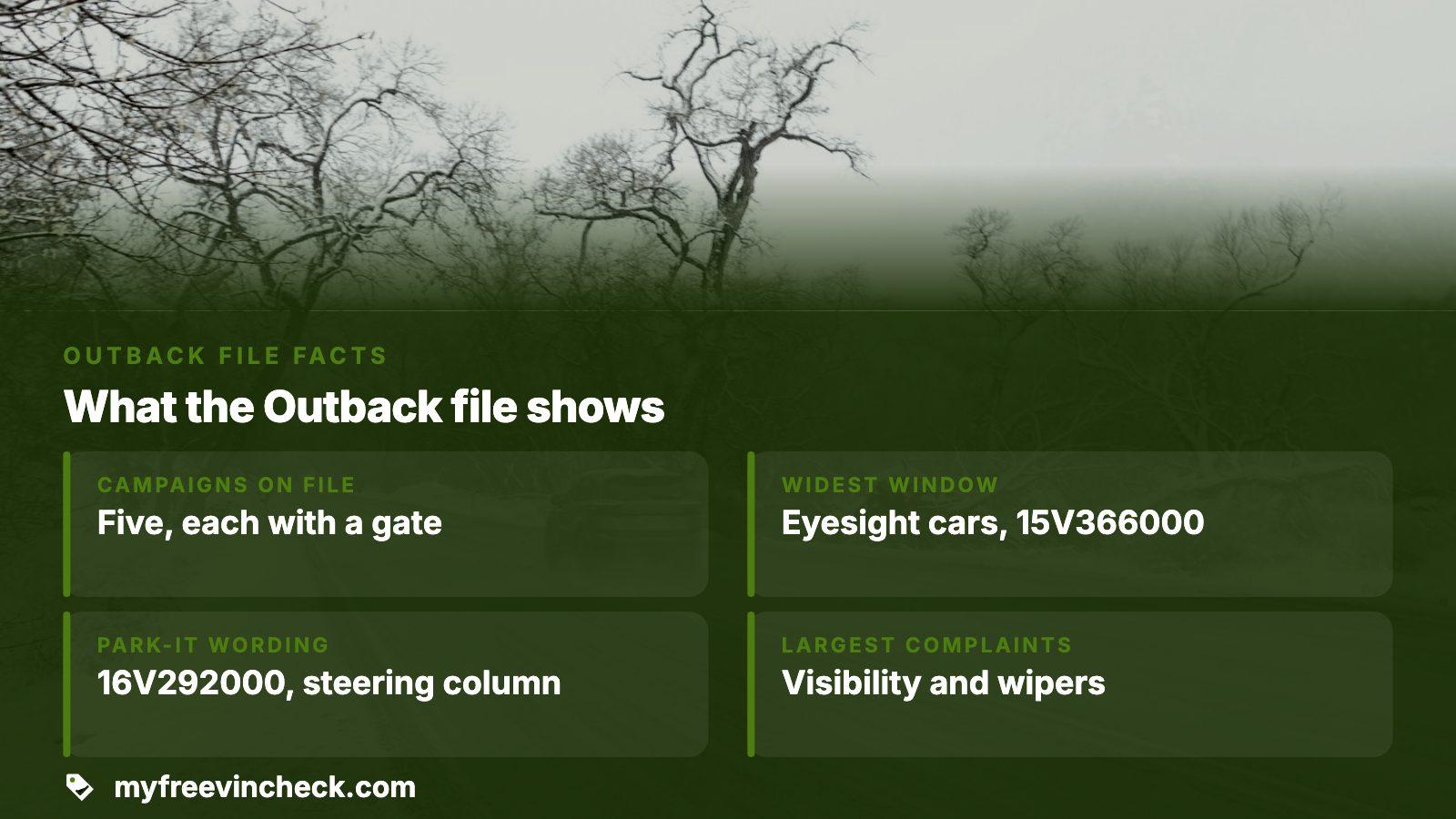
- Campaigns
- 5 under the 2015 Outback, each with a build or equipment gate
- Widest window
- 15V366000, Eyesight cars built Feb 24, 2014 to Apr 16, 2015
- Park-it wording
- 16V292000, steering column, advises no driving until inspected
- Largest complaint group
- Visibility and wipers, 130 of 509 filings, mostly cracked glass
Five notices, five different gates
A model-year list overstates what any one Outback faces. Each notice carries its own condition, shown beside the part involved, with Subaru's campaign code in brackets for the service desk.
| NHTSA number (Subaru code) | Part and fault | Cars it names | Dealer repair |
|---|---|---|---|
| 15V366000 (WQS-54) | Eyesight: a failed brake-light switch disables automatic braking | Built Feb 24, 2014 to Apr 16, 2015, with Eyesight | Driver-assist software reprogrammed |
| 14V577000 (WQN-50) | Accessory hitch: overtightened nuts can lead to broken studs | Built Jan 22 to Aug 18, 2014, with the Subaru hitch | Eight nuts replaced, eight studs inspected |
| 15V502000 (WQU-56) | Driveshaft: a deformed seal cap can leak oil toward the exhaust | Built July 3 to 27, 2015 | Propeller shaft replaced |
| 16V251000 (WTC-64) | Stability control: moisture in the brake fluid can weaken it | Built July 20, 2015 | ABS activation, then fluid replaced |
| 16V292000 (WTD-65) | Steering column: the wheels may not follow the wheel | Notice text says 2016-2017 models, built Feb 29 to May 6, 2016 | Column lot number checked, column replaced if needed |
Look at the last row. NHTSA files that steering notice under the 2015 Outback, yet its wording names the 2016 and 2017 model years, so a car built for 2015 would sit outside it. The lookup settles it either way.
Working the no-charge tools in order
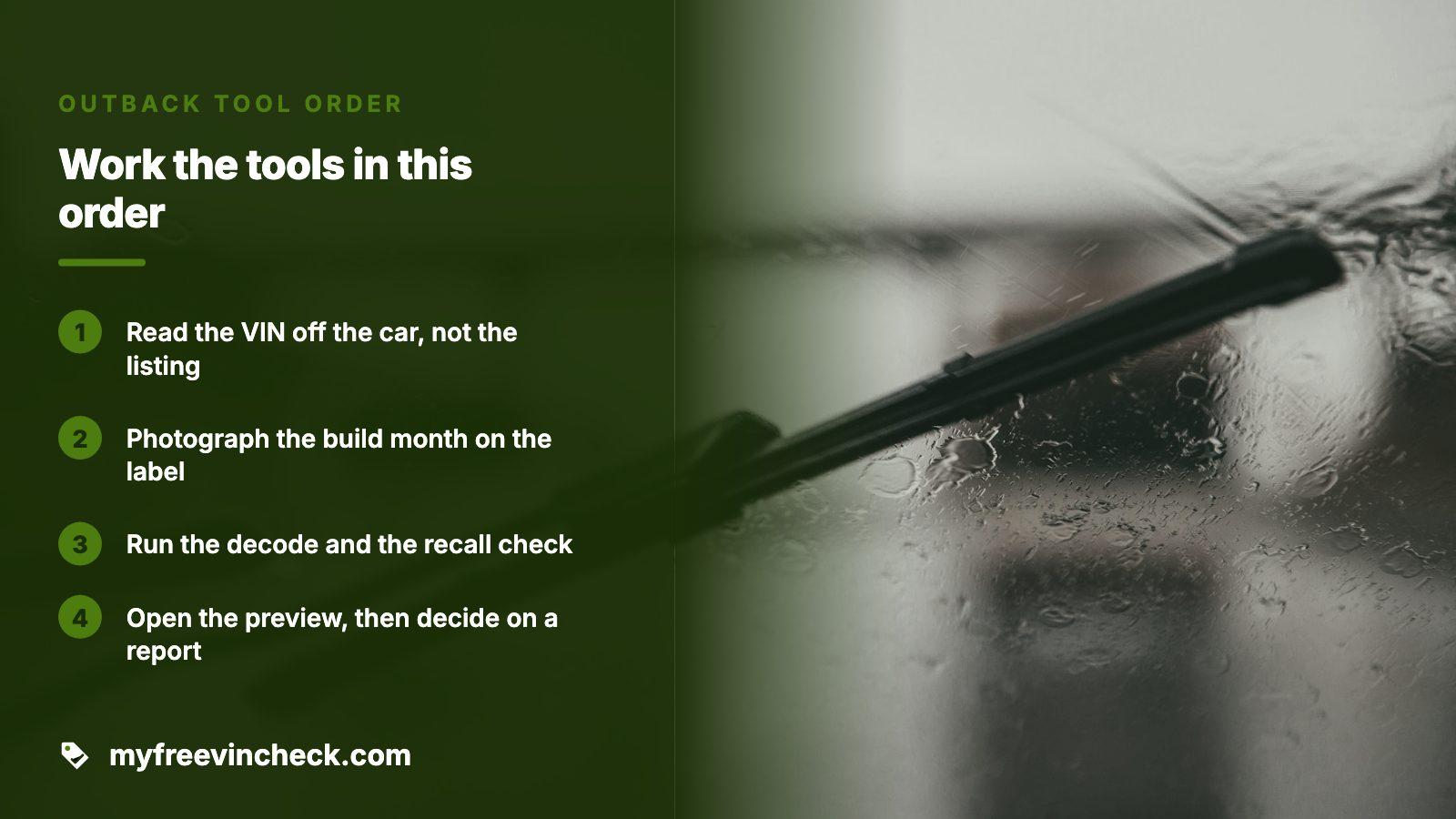
- Read the VIN off the car, not off the listing, and make sure the two agree. Paste it instead of retyping, since one wrong character returns a different car.
- Photograph the build month printed on the driver-side door-frame sticker. Every notice above is measured in build dates, and the VIN itself does not carry the month.
- Run the decode here to confirm a 2015 Outback and its engine, then look behind the windshield near the mirror for the twin Eyesight cameras.
- Run the recall check here, then NHTSA's own lookup, which is free. Both draw on federal records. If they disagree, screenshot both before you phone anyone.
- Open the preview for the same VIN, also free, to see what else is on file. Decide on the paid report after that, not before.
The Eyesight notice has the longest window
Of the five, 15V366000 covers the most build months, and it applies only to cars fitted with Eyesight. If the switch behind the brake lights fails, the car also loses automatic pre-collision braking and will not react to something in its path. The fix is a reprogramming visit, and that repair program began on July 20, 2015.
From an NHTSA owner complaint
An owner filed in July 2015 after collision-prevention, lane-warning and check-engine lights came on. A service advisor said the car was fine to drive until the appointment, and the owner learned only when a spouse followed behind that the brake lights had been dead for two days. The owner knew of campaign WQS-54, showed it to the advisor, and said Subaru had sent no notice about it.
Take from it that a letter proves nothing either way. A car that changed hands, or an owner who moved, can miss the mailing entirely. A lookup by VIN does not depend on the mail.
Driveshaft seal and steering column: the two with warnings attached
15V502000 concerns a seal cap on the propeller shaft yoke. Transmission oil reaching the hot exhaust could start a fire, and the cars named were built July 3 to 27, 2015. The remedy is a new propeller shaft. 16V292000 has the sternest wording: until an affected car is inspected, owners are told not to drive it.
From an NHTSA owner complaint
In late 2015 an owner reported receiving a notice for campaign 15V502, then hearing from a Subaru dealer that no such recall existed. The filing closes with a plain question: "Who is right?" It does not say how the dispute ended.
Treat a phone answer as a lead, not a result. A VIN lookup gives you something to put in front of the service desk: the NHTSA number, Subaru's code and the build window it names.
What each lookup result should make you do
| Result | What it means | Your move |
|---|---|---|
| Open notice listed | NHTSA data show the repair undone for this VIN | Have a Subaru dealer do it before you pay, and keep the repair order |
| No open notice | No unrepaired campaign applies to this VIN today | Good news, but cracked glass, wear and collision history sit outside it |
| A notice you expected is missing | The VIN falls outside its window, or the work was done | Compare the door-frame build date with the dates in the table above |
| Lookup and dealer disagree | The two records have not matched | Ask the dealer to search by VIN and by NHTSA number; keep screenshots |
Date every screenshot. Campaigns get added over time, so an old printout will miss a newer notice.
The largest complaint group has no recall at all
Owners have filed 509 complaints on this model year with NHTSA, 19 flagged as crashes and 5 as fires. The biggest group, 130, sits under visibility and wipers, just ahead of 127 under electrical. About nine in ten of the 130 describe a cracked windshield, often starting low on the passenger side near the wiper rest, and 72 date from 2015, the first year on the road. These reports are unverified, and none of the five campaigns covers glass.
From an NHTSA owner complaint
An owner whose Outback was under two months old found a large crack running from the lower passenger corner the morning after it sat in the driveway, with no sign of a stone strike. An insurance claim went in on April 12, 2015, but the shop could not source a new windshield, since so many were already on order for the identical crack. By the owner's account, online threads showed no recall for it.
A recall lookup cannot see any of this. Ask the seller whether the windshield has been replaced and why, then look along the lower passenger edge for a crack or a repaired line.
What a repair costs and when the promise ends
A Subaru dealer does these repairs at no charge, whoever holds the title and however many owners the car has had. The statute is 49 U.S.C. 30120. Under it the no-charge duty ends for a car bought new more than fifteen calendar years before the maker's notice. All five notices came out in 2014, 2015 or 2016, well inside that span. Subaru's customer line, printed in each notice, is 1-800-782-2783.
Where the tools stop and the paid report starts
- Decode and recall check: factory details and open campaigns from NHTSA data, at no charge.
- Preview: a free first look at what the VIN has on file.
- Paid report: a single purchase with no subscription, adding any title brand, accident and damage records, odometer history, liens and insurance records.
Recall status says nothing about a collision repair or a rolled-back odometer. On a model whose commonest complaint is glass, insurance records and the odometer trend are worth seeing. The pricing page has the price of one report and of bundles of 3, 5 or 10.
Where this information comes from
- NHTSA: Recalls — The agency lookup by VIN, and the full text of each campaign summarized above.
- NHTSA owner complaint 10733538 — owner experience, paraphrased
- NHTSA owner complaint 10783441 — owner experience, paraphrased
- NHTSA owner complaint 10721934 — owner experience, paraphrased
- 49 U.S.C. 30120: Remedies for defects and noncompliance — The statute behind the no-charge repair and its 15-year limit.
- NMVTIS: National title information — Federal background on the title records that a recall lookup leaves out.
Sources and photos: Facts checked against the sources above in November 2026. Photos by Will Truettner, Thibault Valjevac and Zoshua Colah on Unsplash; diagrams by MyFreeVINCheck.
Keep reading
- 2015 Jeep Grand Cherokee Recalls: 10 Campaigns and How to Check a VINAnother 2015 SUV where build windows decide which notices apply.
- 2016 Mazda CX-5 Recalls: 5 Campaigns, Checked by VINA compact crossover from the next model year, run through the same lookup.
- Sample reportThe title, damage and odometer records a paid report sets beside recall status.
- PricingWhere one report or a larger pack is bought, and how the payment works.
Frequently asked questions
How many recalls are on a 2015 Subaru Outback?
Five campaigns sit under the 2015 Outback at NHTSA: 14V577000, 15V366000, 15V502000, 16V251000 and 16V292000. Each one is tied to certain build dates or options, and the steering notice names model years 2016 and 2017 in its text. Only a lookup by VIN reveals which of them touch a given car.
Does the 2015 Subaru Outback have a windshield recall?
No. Cracked glass leads the owner complaints, with 130 filings under visibility and wipers, but none of the five federal campaigns covers it. A recall check will return nothing for the glass, so inspect the windshield and ask whether it was replaced.
Are 2015 Outback recall repairs free?
Yes. A Subaru dealer does the work at no charge under federal law, whoever owns the car. The exception only reaches cars first sold more than fifteen calendar years before the notice, and none of these five does. Call the dealer with the VIN first, and ask for the repair order afterward.
How can I check 2015 Outback recalls without paying?
Use NHTSA's recall lookup, which is free, or the decode and recall check on this site, which read the same federal data at no charge. The preview is free too. Buy the paid report only when you want title, accident, odometer or lien records on one specific car.
Does a clean recall result mean a 2015 Outback is a good buy?
No. It means no open campaign applies to that VIN today. Cracked glass, electrical faults, wear and a past collision all sit outside it, so pair the lookup with a mechanic's inspection and a history report before any money moves.
Now check the car itself
The guide explains what to look for. The report shows what this VIN has on record.