THE SHORT ANSWER
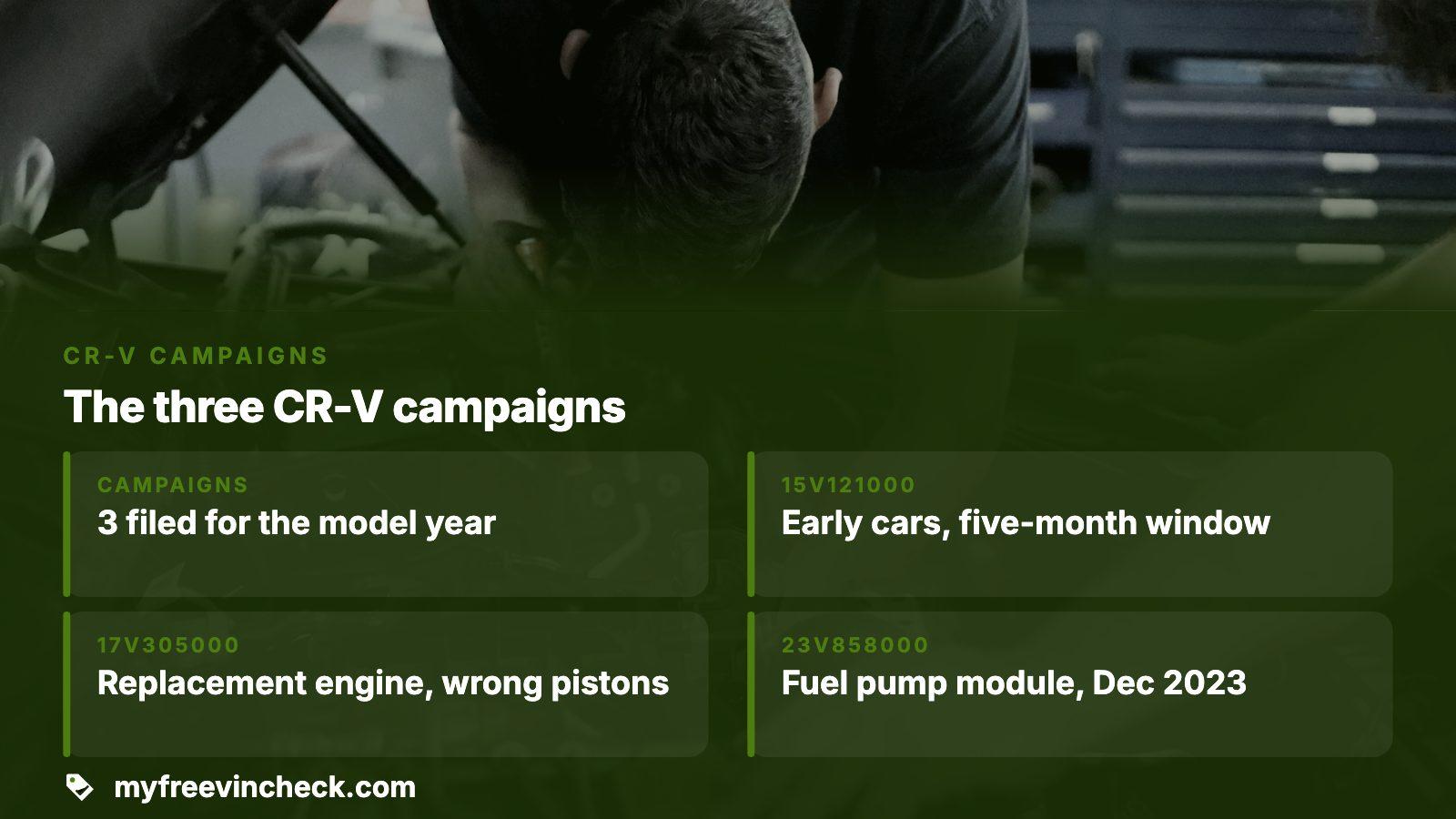
The 2015 Honda CR-V has 3 NHTSA recall campaigns: 15V121000 for engine bolts on early-build cars, 17V305000 for cars given a replacement engine with the wrong pistons, and 23V858000 for an in-tank fuel pump that can fail. Checking a single VIN reveals which of them remain unrepaired on that car, and a Honda dealer performs the repair without billing you.
- Campaigns
- 3 filed with NHTSA for the model year
- Build window
- 15V121000 reaches only CR-Vs from a five-month build window ending in early 2015
- Newest
- 23V858000, received December 19, 2023, fuel pump module
- Repair cost
- None at a Honda dealer for an open campaign
The three campaigns at a glance
Three entries is a short list for a vehicle this common, but each one describes a different kind of risk, and each has its own gate. A given car can fall inside one, two or none of them.
| Campaign | Fault | Which cars |
|---|---|---|
| 15V121000 | Rod bolts tightened wrongly; power loss or oil leak | 2015 CR-V assembled between early September 2014 and early February 2015 |
| 17V305000 | Replacement engine fitted with wrong pistons | 2015 and 2016 CR-V that recently had an engine swap |
| 23V858000 | In-tank fuel pump may fail | Certain 2013 to 2023 Honda and Acura models, including this CR-V |
Two of the three are about the engine and all three name a stall as the outcome. Nothing in the NHTSA record marks any of them as a park-it or park-outside order.
The two engine notices, and why build date matters
Campaign 15V121000 is a factory-build problem. Honda traced it to rod bolts torqued incorrectly during a narrow stretch of production. The result can be lost power or an oil leak, and NHTSA notes that oil dripping near hot exhaust parts adds fire risk. The remedy is a new engine short block, which began on March 27, 2015, and Honda's internal code for the CR-V part is JP3.
Campaign 17V305000 is a service-history problem. It is aimed at cars that recently received a replacement engine, built with pistons that may have been wrong. A CR-V that never had an engine swap is outside it by definition. A CR-V that did get one is exactly the car a buyer should ask about. Dealers inspect the engine and change the parts if needed, and that campaign opened on June 20, 2017.
So the build date on the door-jamb label and any engine replacement on the invoice file both matter. Neither can be seen from the driver's seat.
The fuel pump notice that spans two brands
Campaign 23V858000 reached NHTSA on December 19, 2023, and it is unusual in size. The list runs through Accord, Civic, HR-V, Ridgeline, Odyssey and several Acura lines from 2013 to 2023, with the CR-V among them. The part at issue is the pump submerged in the gas tank. If it quits, the engine can die while the car is rolling.
Dealers replace the pump module at no charge. Honda mailed owner letters on September 6, 2024, and it widens two earlier NHTSA notices, 21V-215 and 20V-314. That history is a useful clue: if a seller says the pump was already done years ago, the older campaign number should appear on the repair order, and the later one may still be open.
Running the check on the CR-V in front of you
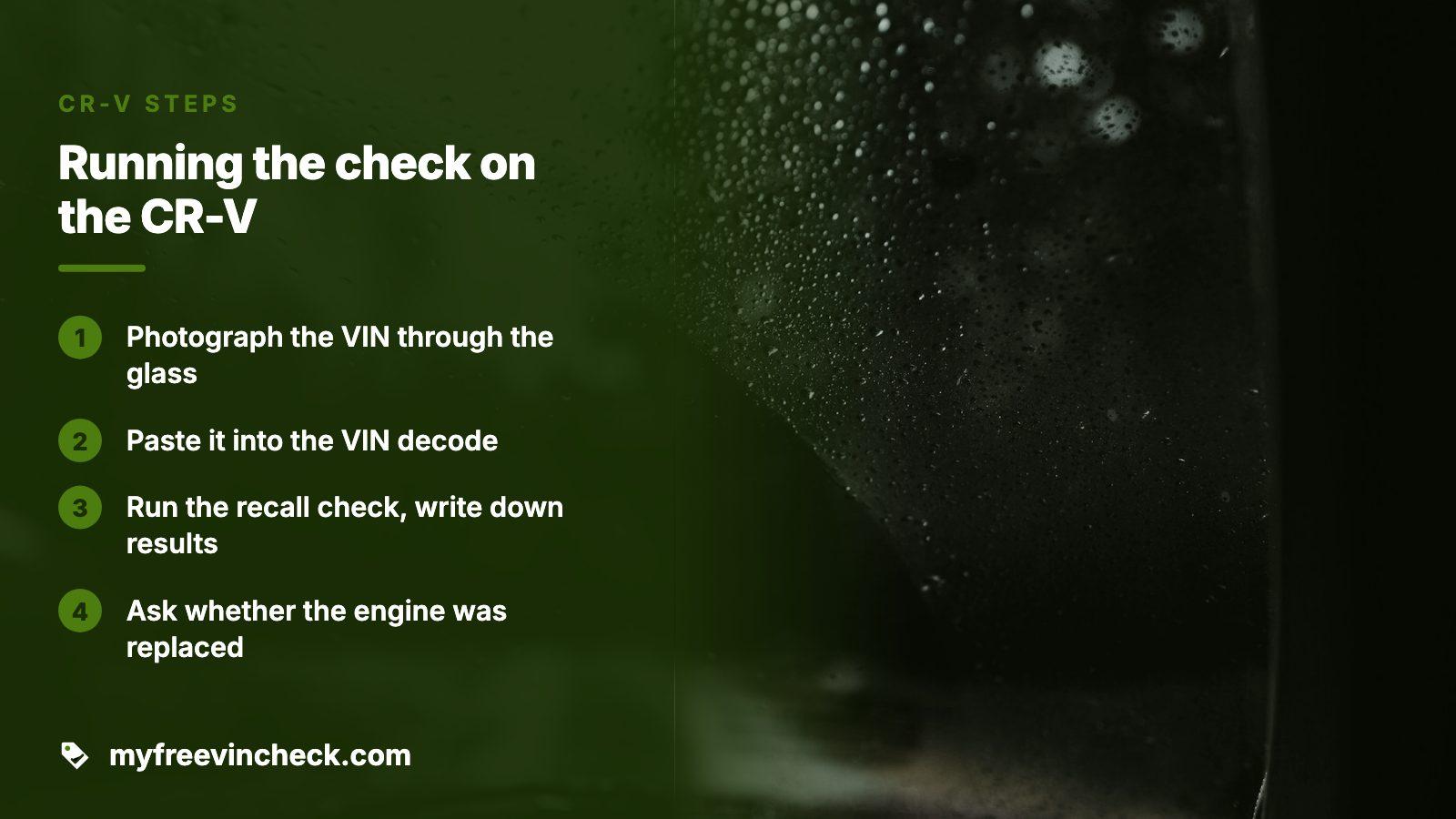
- Photograph the 17-character VIN visible through the glass at the dash corner, and hold it against the registration card. If the two differ, walk away.
- Paste it into this site's VIN decode. Confirm that the model year, trim and drive type match the listing.
- Run the recall check, which reads NHTSA records. Write down each open campaign number with the date you looked.
- Ask whether the engine was ever replaced. If so, the 17V305000 question is live.
- For each campaign the lookup marks done, ask for the repair order.
Entering a partial VIN into NHTSA's decoder works too, though the full number gives the cleanest result.
Reading the result, and what a clean line leaves out
| Result | Meaning | Your move |
|---|---|---|
| Open campaign | No completed repair on record for this VIN | Have a Honda dealer finish it before you pay, or get a dated written promise |
| Zero unrepaired | No open recall applies today | Title, damage, odometer and lien history are still unchecked |
| Nothing, but symptoms | The VIN may sit outside the stated range | Pay a mechanic to read fault codes |
NHTSA's own lookup does not show recalls already repaired, newly announced recalls where VIN lists are incomplete, or non-safety service campaigns from the maker. A clean screen is a statement about open safety recalls, nothing broader.
From an NHTSA owner complaint
An owner reported in February 2026 that a 2015 CR-V died on the highway at 70 mph, showed no dash warning, coasted down and needed a tow. The owner linked the event to 17V305000, yet Honda's records did not place that VIN in the recall, and the company pointed the owner to the NHTSA hotline. The failure came at about 92,876 miles.
The lesson is that a recall lookup answers one narrow question. A stall with no matching campaign still counts as a defect for a buyer to weigh.
What owners report that no recall covers
Owners have sent NHTSA 673 complaints on this model year. Engine is the most tagged component at 243, then power train at 150, electrical system at 85, steering at 45, seats at 39 and service brakes at 38. A complaint can carry several tags, so the numbers overlap. Across the set, owners report 38 crashes, 23 injuries and 4 fires.
Those are unverified owner reports, not findings, and most have no recall behind them. They are still the best view of what a given model year does after the warranty ends.
From an NHTSA owner complaint
An owner filed in January 2024 that a 2015 CR-V lost power at roughly 45 mph and sent an oil and gasoline smell through the vents. A dealer diagnosed it but made no repair, and the car was not included in campaign 15V121000. Mileage at failure was about 100,000.
Treat a car with a similar history as a reason for a pre-purchase inspection, even when the recall screen is clean.
What an open repair costs you
Each of the three campaigns states that the repair is free of charge at a Honda dealer. That covers the campaign work only. A dealer may find other worn parts while the engine is open, and those are billed in the ordinary way.
Parts and scheduling can slow things down, particularly for a short-block replacement. If you are the buyer, ask the seller to book the appointment before the sale, or agree a price that accounts for the delay. Honda customer service can confirm the status of a specific campaign by its Honda number.
Where the paid report fits
The decode and recall check here cost nothing, and a preview of the paid report is free as well. Closing all three campaigns says nothing about a salvage brand, a tampered odometer or money still owed on the car, and no recall list holds those.
You pay once, for one vehicle or a bundle of several, never a recurring fee; current amounts sit on the pricing page. If the seller cannot show repair paperwork for an engine swap, that answer may settle things before you spend anything.
Where this information comes from
- NHTSA: Check for Recalls — The agency lookup, and its own list of what a VIN search does and does not show.
- NHTSA: VIN decoder (vPIC) — Where a VIN is decoded to manufacturer-reported specs and build plant.
- NHTSA: Recalls API for the 2015 CR-V — The record behind the three campaigns, their dates and remedies.
- NHTSA owner complaint 11715587 — owner experience, paraphrased
- NHTSA owner complaint 11563132 — owner experience, paraphrased
Sources and photos: Facts checked against the sources above in November 2026. Photos by Victor Hughes, Justin Cron and Mustafa Sheikhmouss on Unsplash; diagrams by MyFreeVINCheck.
Keep reading
- Check a VIN Number for Recalls: Free Lookup, Then the Full PictureHow the VIN recall lookup works and what its results mean for any car.
- 2019 Honda CR-V Recalls: 8 NHTSA Campaigns, Listed by DateThe same model four years newer, for comparing recall history.
- 2017 Honda Accord Recalls: 3 Campaigns, 2 Fuel PumpAnother Honda that appears in the wide fuel pump family of notices.
- PricingWhere a single report or a larger pack is bought, and what each costs.
Frequently asked questions
How many recalls does the 2015 Honda CR-V have?
NHTSA lists 3: an engine bolt notice for cars built between September 9, 2014 and February 6, 2015, a replacement-engine piston notice, and a fuel pump notice shared with many other Honda and Acura models. A VIN lookup shows which are still open on one car.
Does Honda charge to fix a 2015 CR-V recall?
No. All three campaign records say dealers do the repair free of charge. Work found beyond the campaign, such as other worn parts, is billed at normal rates, so ask the dealer to separate the two on the estimate.
Can a 2015 CR-V stall without any recall applying?
Yes. NHTSA owner complaints describe stalls in cars whose VINs fell outside the engine campaigns. A missing recall means no open campaign matches, not that the car is free of faults, so a mechanic's inspection still helps.
Where do I find the VIN to check a CR-V?
Read it through the glass at the dash corner, then match it to the registration card. Some insurance cards print it too. Use the same number for the decode, the recall check and any paid report, and make sure all copies match.
Is a car with no open recalls safe to buy?
Only that no unrepaired safety recall matched the VIN when you searched. It says nothing about title brands, accident damage, odometer rollback or liens, which is what a vehicle history report is for.
Now check the car itself
The guide explains what to look for. The report shows what this VIN has on record.