THE SHORT ANSWER
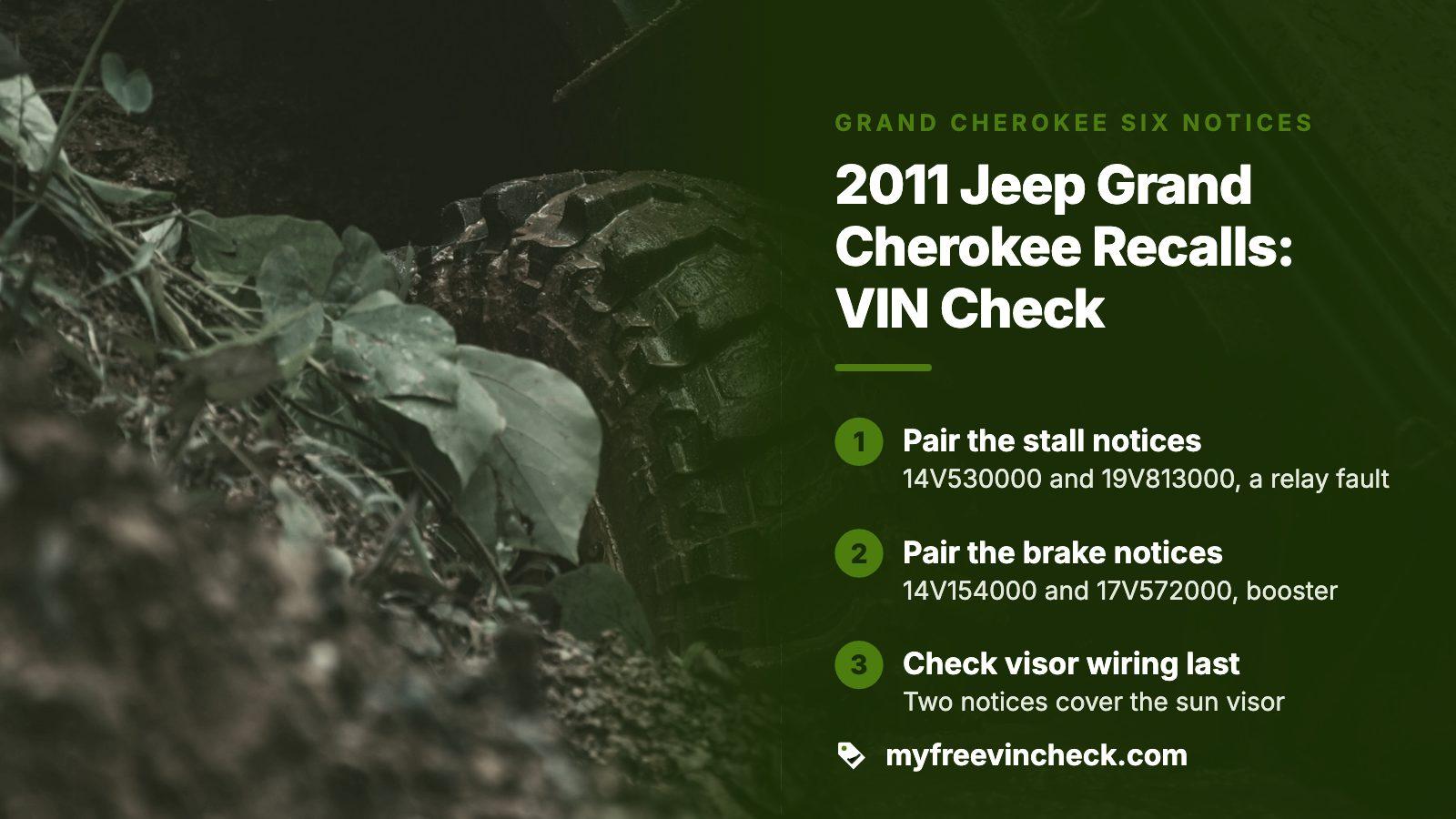
The 2011 Jeep Grand Cherokee has 6 recall campaigns on record with NHTSA: 14V530000 and 19V813000 for a relay fault behind sudden engine cut-outs, 14V154000 and 17V572000 for the brake booster, and 14V391000 and 15V879000 for sun visor wiring. Dealers fix them without charge. Whether a given vehicle is covered depends on its VIN and build date, not on the model year.
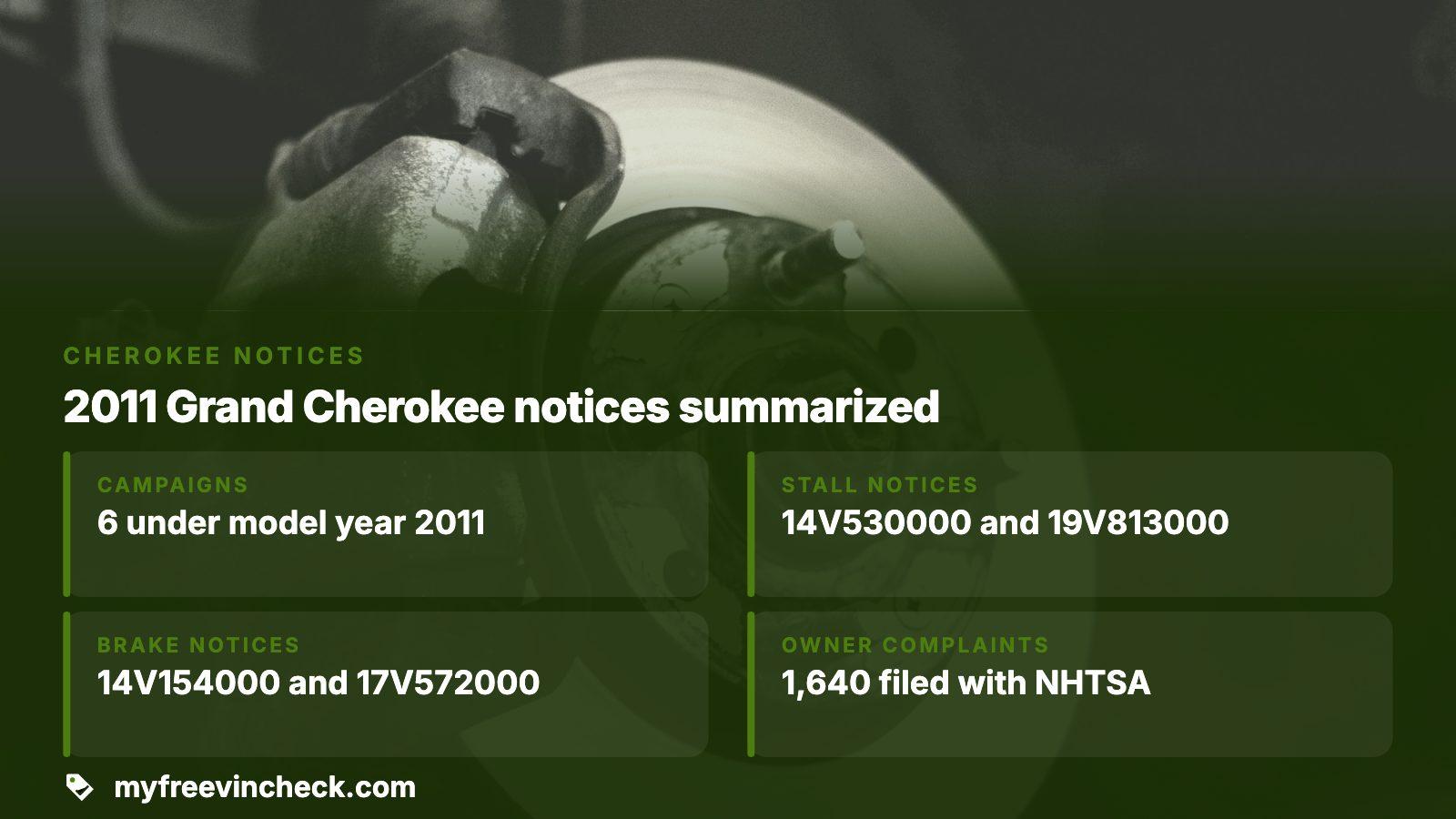
- Campaigns
- 6 under model year 2011
- Stall notices
- 14V530000 and 19V813000
- Brake notices
- 14V154000 and 17V572000
- Owner complaints
- 1,640 filed with NHTSA
The six campaigns at a glance
NHTSA's recall data groups these under the 2011 Grand Cherokee, but the notices were written for the Dodge Durango as well, and several stretch to 2013 or 2014 models. Use the list below to know what to look for; the VIN settles what applies.
| Campaign | Reported | Problem |
|---|---|---|
| 14V154000 | April 2014 | Brake booster shell can corrode and admit water |
| 14V391000 | July 2014 | Sun visor lamp wiring can short after a repair |
| 14V530000 | September 2014 | Fuel pump relay in the power module can fail |
| 15V879000 | December 2015 | Visor wiring can short again after the first fix |
| 17V572000 | September 2017 | Check that the booster shield was fitted correctly |
| 19V813000 | November 2019 | Fuel pump relay and harness, covering earlier repairs |
NHTSA's record for these entries carries no park-it or park-outside flag.
The stalling pair: 14V530000 and 19V813000
These two matter most. The first covers 2011 builds made between early January 2010 and July 20, 2011, fitted with the 3.6L or 5.7L engine. The switch that powers the fuel pump lived inside the power module (TIPM-7), and when it quit the engine could die without any warning. Chrysler's first answer, which began on December 19, 2014, moved the relay outside that module.
NHTSA now marks that campaign as superseded by 19V813000. The newer one reaches 2011 to 2013 vehicles with the 3.6L, 5.7L or 6.4L engine, including ones that already went through the earlier repair. Its remedy swaps the relay and the wiring harness. Interim letters went out from December 2019, vehicles that suffered a pump failure got a temporary repair, and a second letter was promised once the final part existed.
Why a closed first notice proves little
A service record showing the 2014 relay change does not close the matter. The later notice exists because cars that had the first fix could still be affected, so check both numbers against the VIN.
Brake booster: 14V154000 and 17V572000
The booster is the vacuum canister that multiplies pedal force. On vehicles built between January 5, 2010 and September 8, 2013, its center shell can corrode and let water in, and frozen water can limit braking. The remedy tests the booster's ability to hold vacuum, bolts on a diverter shield, and replaces the booster when the vacuum loss is too great. Chrysler's own campaign code was P14 and the work started on May 30, 2014.
17V572000 followed in 2017 because some of those shields had not been installed correctly. Dealers inspect the shield and redo it where needed. If you see a car with the 2014 work on its paperwork, ask whether the shield inspection was also done.
From an NHTSA owner complaint
A 2024 filing describes a pedal that sank to the floor with no warning at about 157,000 miles. A mechanic found a bad booster and tied it to 14V154000, yet the dealer said that VIN was not in the recall and sent the owner to the NHTSA hotline.
For a buyer, the point is that a mechanic naming a campaign does not make a car eligible. The VIN lookup decides, and that result is what you carry to a dealer.
The sun visor wiring notices
14V391000 and 15V879000 are the quiet pair. Wiring that powers the vanity lamp in the visor could short, which raises the risk of a fire. The first notice covers 2011 to 2014 builds made from January 5, 2010 to December 11, 2013. The second covers 2011 to 2013 vehicles built from December 3, 2009 to September 1, 2012, and it applies to cars fixed under the first notice and to cars that never got it.
The remedy in the second is more thorough: more clearance around the wire, protection from sharp edges, and a new visor. Both are free. When you walk around a used Grand Cherokee, pull the visors down and look for a lamp that does not work; that is a cheap tell that the wiring has been touched or neglected.
What owners say about the same parts
NHTSA holds 1,640 owner complaints for this model year. Counted by component tag, electrical system leads with 780, followed by service brakes at 351, engine at 344 and fuel or propulsion at 247. A complaint can carry more than one tag, and none of these are verified findings. Still, 53 mention a crash, 61 mention a fire, and 47 injuries are reported across them.
From an NHTSA owner complaint
Another filer reported four highway-speed stalls despite three dealership visits for 19V813000, at roughly 124,000 miles. The shop could not reproduce the fault or find codes, and the driver said losing the brakes and power steering was the only sign the engine had quit.
Treat this as a reason to ask the seller for repair invoices. A finished recall is a plus, though the symptom can still come back.
Run the free tools first, then decide
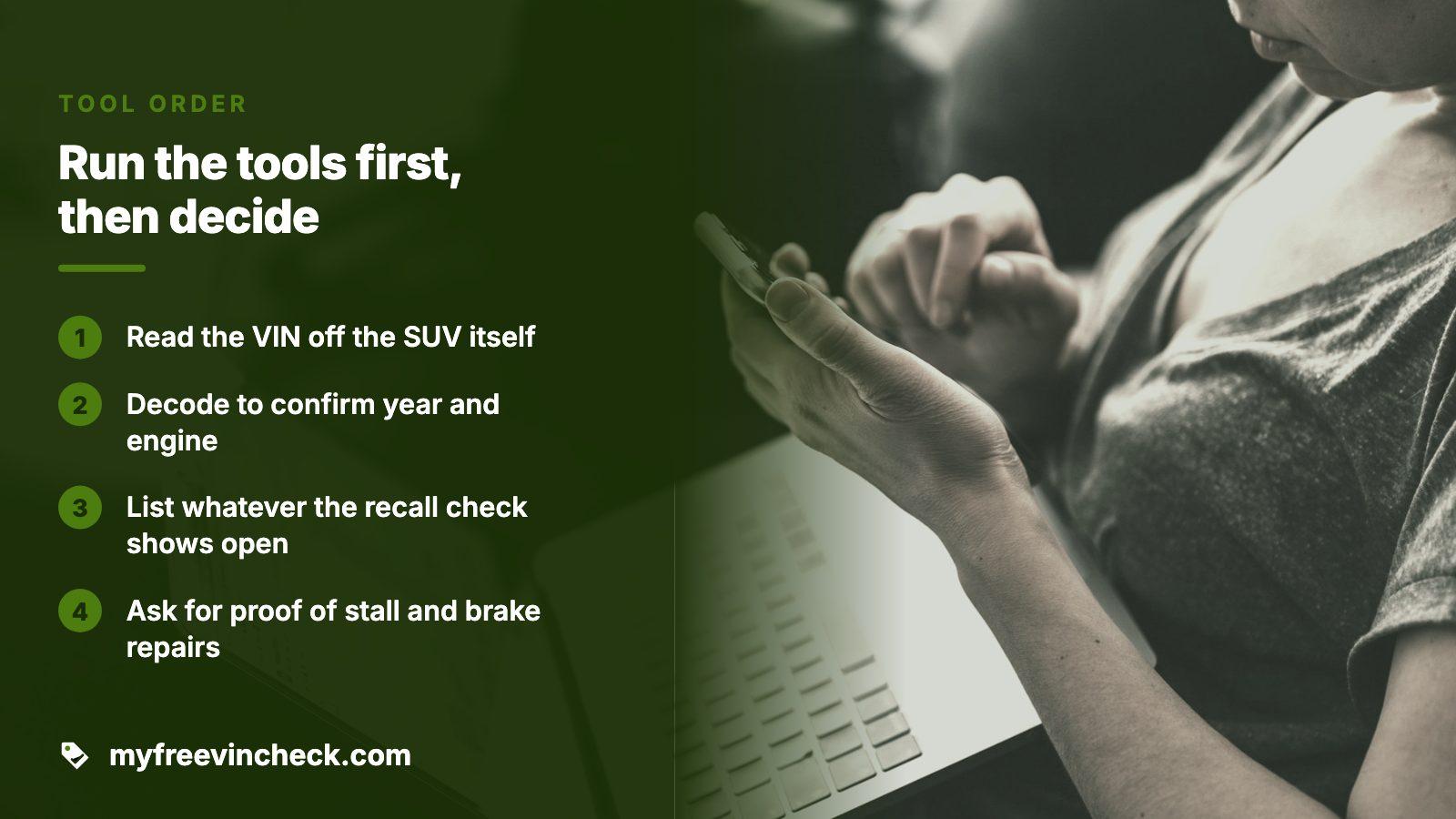
Begin with the VIN, which you can read through the glass on the driver's side of the dash or on the sticker inside the driver door. Enter all 17 characters in this site's VIN decode to confirm a 2011 Grand Cherokee with the engine you were promised, then run the recall check against NHTSA records for that one vehicle.
- Read the VIN off the SUV, not just the listing.
- Run the decode and confirm model year and engine.
- Run the recall check and list whatever is still open.
- Ask for proof of the stall and brake repairs, or book the dealer visit yourself.
- If the car still looks good, move from the preview to the paid report.
What the recall check cannot tell you
A recall lookup tells you which safety campaigns attach to a VIN and whether they are open, and nothing more. It is silent on a salvage brand, an odometer rollback, a theft record or a lien. A 2011 model with over a decade behind it may have changed hands several times, so those gaps matter.
- Title brands and salvage or flood history
- Crash and damage records
- Odometer readings over time
- Liens, impound records and theft reports
- Market value, to test the asking price
Those sit in the paid report, which you buy once. A preview comes first at no charge.
What the report costs and when it earns its place
The pricing page lists a single report and bundles for people shopping several cars; nothing renews. For this Jeep, the report is worth buying when the recall check is clean but the seller has no service history, or when the price looks low for the mileage. If the recall check already shows an open stall notice and the seller will not fix it, you may not need a report to decide.
If you find an open recall
Phone a Jeep dealer, give the VIN and request the repair. The work costs nothing, though parts can run late: one owner in the NHTSA file waited more than a year for a booster. Keep the repair order. When you are buying, ask the seller to complete it before you pay, or take the value of the risk off the price. Each campaign record prints Chrysler's recall line and the NHTSA hotline.
Where this information comes from
- NHTSA: Recalls — NHTSA's own search page for entering a VIN; each campaign named here can be read there.
- NHTSA recalls data: 2011 Jeep Grand Cherokee — Source for the six campaign numbers, build windows and remedies.
- NHTSA vPIC VIN decoder — Federal decoder behind the model year and engine confirmation step.
- NHTSA owner complaint 11564408 — owner experience, paraphrased
- NHTSA owner complaint 11609319 — owner experience, paraphrased
Sources and photos: Facts checked against the sources above in November 2026. Photos by Johann Noby, Michal Biernat and Benjamin Brunner on Unsplash; diagrams by MyFreeVINCheck.
Keep reading
- 2015 Jeep Grand Cherokee Recalls: 10 Campaigns and How to Check a VINA later year of the same model with a different set of campaigns.
- 2017 Jeep Grand Cherokee Recalls: 6 Notices and a Free VIN CheckSee how the recall list changes two generations further on.
- Check a VIN Number for Recalls: Free Lookup, Then the Full PictureThe check itself, for any make and year.
- PricingWhat a single report or a bundle costs, before you commit.
Frequently asked questions
How many recalls does a 2011 Jeep Grand Cherokee have?
NHTSA's recall data lists 6 campaigns under this model year. Two concern stalling from a fuel pump relay, two concern the brake booster and two concern sun visor wiring. Each applies only to certain VINs, so an individual SUV may have all of them, some, or none.
Are the 2011 Grand Cherokee recalls free to fix?
Yes. Every campaign record says the dealer performs the repair without charge. Parts supply can lag, so book early, and keep the repair order as proof for the next buyer.
Does a completed fuel pump relay recall mean the stalling is solved?
Not always. 19V813000 was issued for vehicles that already had the earlier fix, and some owners in the NHTSA complaint file report stalls after the work. A completed recall removes an open campaign; it does not promise the problem will never return.
Where do I find the campaign number for my own car?
Put the VIN into the federal recall search or this site's recall check. Open campaigns appear with their NHTSA numbers, such as 14V154000, which you can quote to a dealer.
Is the full report free?
No. The decode, the recall check and the preview are no-charge steps. The full report is paid once, priced on the pricing page, and adds title, damage, odometer and theft history that a recall lookup does not hold.
Now check the car itself
The guide explains what to look for. The report shows what this VIN has on record.