THE SHORT ANSWER
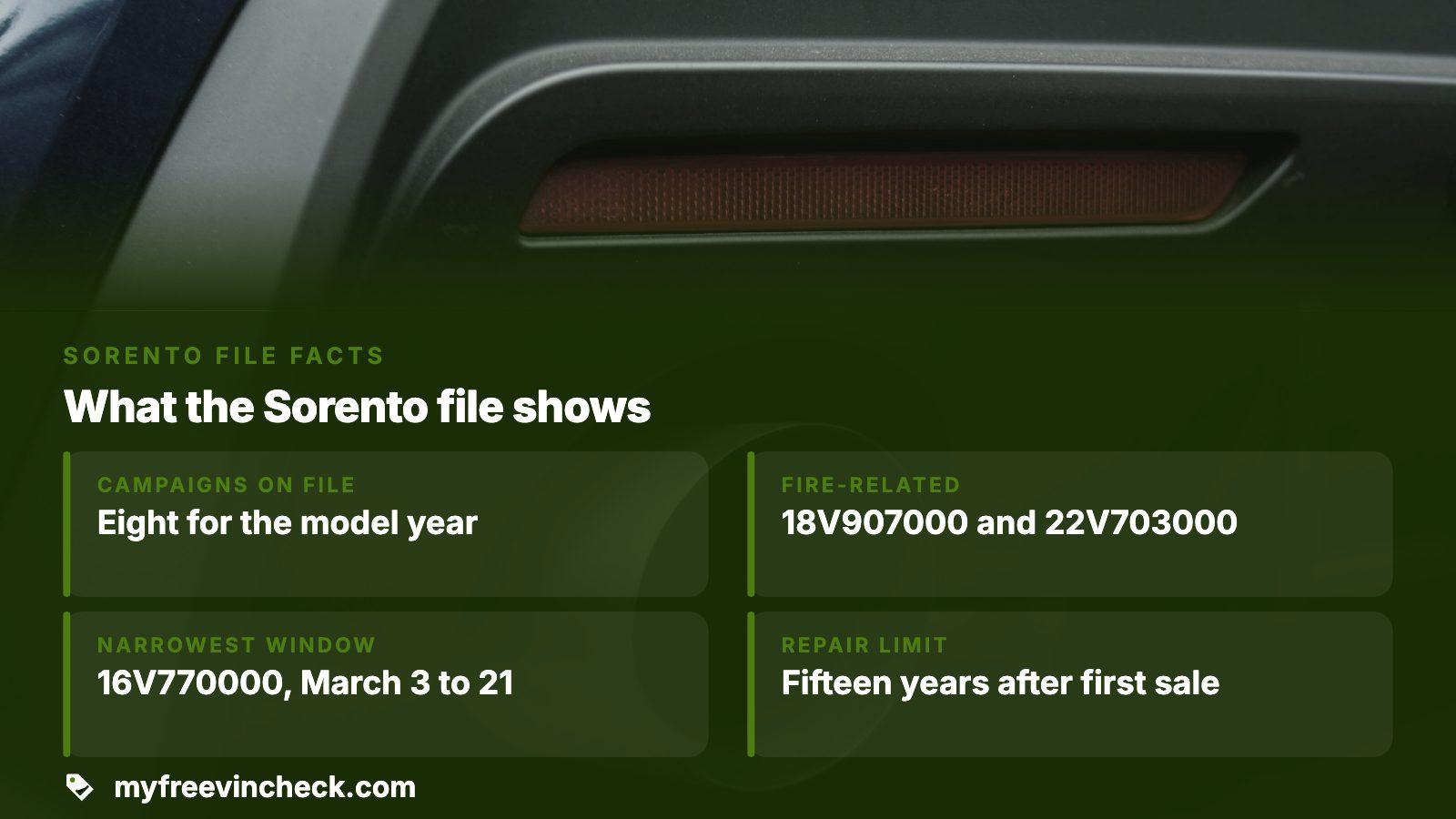
Eight campaigns sit under the 2016 Kia Sorento at NHTSA: 18V907000, 15V446000, 16V770000, 16V862000, 16V480000, 15V089000, 22V612000 and 22V703000. A Kia dealer repairs each at no charge, yet every notice names certain VINs, not the whole model year. Enter the VIN, record whatever is still open, and have it finished or priced in before you pay.
- Campaigns
- Eight under this model year at NHTSA
- Fire-related
- Two: 18V907000 (fuel pipe) and 22V703000 (tow hitch module)
- Narrowest window
- 16V770000, cars built March 3 to 21, 2016
- No-charge repair limit
- Up to fifteen years after first sale, per 49 U.S.C. 30120
Start with the VIN, not the model year
A model-year list shows what could apply. The VIN shows what does. Two 2016 Sorentos built months apart can carry different open notices, so take the 17 characters from the car you are considering and run the decode and recall check on this site.
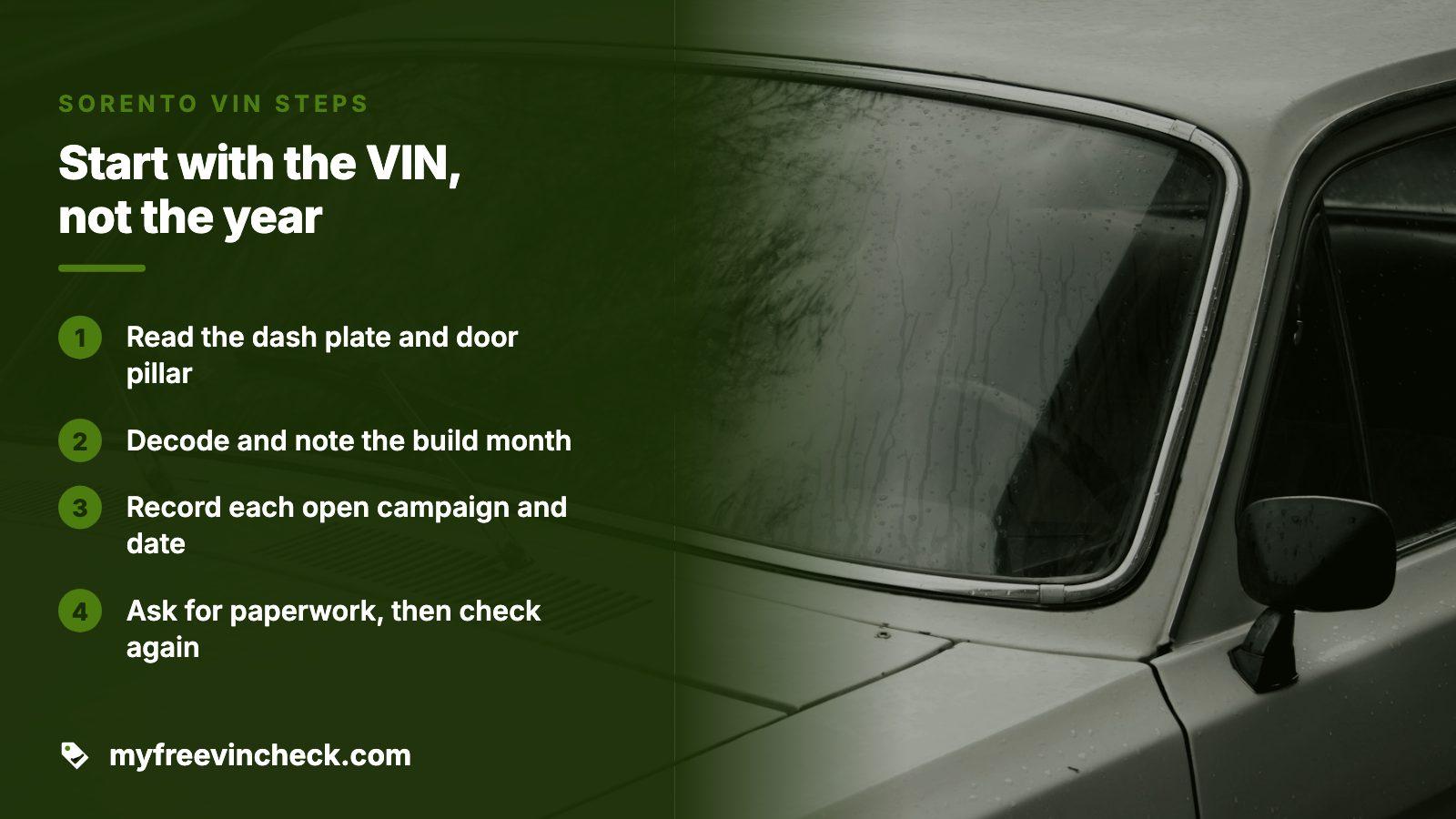
- Read the VIN off the dash plate through the windshield's lower corner, then check it against the label on the driver's door pillar and the title. A mismatch means stop.
- Run the decode and compare the build with the ad: trim, engine, drivetrain. Note the build month on the door label, since four notices below are tied to build dates.
- Run the recall check and record each open campaign number with the date you looked.
- When a seller claims the work was done, ask for the dealer's paperwork, then run the check again to see whether the record moved.
The eight campaigns NHTSA files under the 2016 Sorento
A Kia dealer does every repair below at no charge to the owner. The last column decides whether it reaches your car.
| Campaign | Area | Fault named | Which cars |
|---|---|---|---|
| 18V907000 | Fuel pipe | Pipe at the pump may be damaged or badly tightened during an engine swap; leak and fire risk | Sorentos that had an engine replaced or got the knock sensor software |
| 15V446000 | Front passenger belt | Buckle may refuse to latch | Builds from Oct. 23 to Dec. 10, 2014 |
| 16V770000 | Driver seatback | Weak welds in the seatback frame | Builds from March 3 to 21, 2016 |
| 16V862000 | Hitch wiring | Trailer brake lights can stay lit | Builds from Oct. 27, 2014 to Aug. 25, 2016, with the accessory harness |
| 16V480000 | Rear suspension | Cross-member weld may break | Certain 2016 Sorentos |
| 15V089000 | Accelerator pedal | A soldering fault may stop acceleration | Builds from Oct. 27, 2014 to Jan. 29, 2015 |
| 22V612000 | Shift lever | Lever may not lock; the car can roll away | Certain 2016 Sorentos and Sedonas |
| 22V703000 | Tow hitch module | A short can start a fire, parked or driving | Sorentos with a tow hitch harness, factory or dealer accessory |
Why the build date matters more than the badge
Four of the eight name a build window. The accelerator pedal notice ends on January 29, 2015, and the driver seatback notice spans under three weeks of March 2016. Compare the manufacture date on the door label against the window before deciding a notice applies, or that it does not.
From an NHTSA owner complaint
An owner told NHTSA in November 2016 that a Sorento would not accelerate properly, mostly under hard throttle, the trouble the accelerator pedal notice describes. The door sticker gave a build date of mid-February 2015, roughly two and a half weeks after the last date the notice covers. The owner's point was that the symptom matched while the build date fell outside the campaign.
Feeling the symptom is not proof of coverage, and a model year is not proof either. The VIN lookup settles it; a mechanic judges what is actually on the car.
The two notices that name a fire risk
18V907000 reaches Sorentos that had an engine replaced under an earlier recall or warranty, or that received the knock sensor software campaign. Kia says the high-pressure fuel pipe at the pump may have been damaged or wrongly tightened during that work, and fuel leaking near a spark or hot part could catch fire. Ask each seller whether this Sorento ever had an engine swapped.
22V703000 concerns the tow hitch wiring module. Debris and moisture can short it, and Kia says that can cause a fire parked or driving. Until the repair is done, Kia asks owners to park it outside and away from any structure. The dealer inspects it and replaces the fuse, the module, or both.
From an NHTSA owner complaint
A Sorento owner wrote to NHTSA in January 2023 after the hitch notice arrived and the dealer had no part. Several calls to Kia brought the answer that no fix existed yet. The owner added that a truck-rental company could fit an aftermarket harness and thought Kia should pay for it.
A notice in the mailbox is not a repair on the car.
The shifter notice and the dealer who asked for payment
22V612000 covers shift lever parts that may fail to lock the lever, which can let the car roll away. Kia mailed owner letters in October 2022. Treat an open entry as an unfinished safety repair, not as paperwork.
From an NHTSA owner complaint
One owner told NHTSA the shift lever moved freely without the brake pressed, but the part was unavailable at first. Appointments at the dealer kept slipping. Once parts arrived, the dealer quoted a charge for the shifter assembly even though the VIN was inside the campaign. Kia stepped in and booked a different dealer.
A no-charge campaign should stay no-charge on a covered VIN. If a dealer names a price, phone Kia customer service and quote the campaign number.
Reading what the recall check returns
| Result | What it means | Your move |
|---|---|---|
| Open campaign | No completed repair on record for this VIN | Have a Kia dealer do it before you pay, or get a written date |
| Remedy not yet available | The dealer has no part or procedure yet | Price the wait in; for 22V703000, plan on parking outside |
| Seller says it was done | A claim is not a record | Get the repair order, then rerun the check on the VIN |
| Nothing open | No open campaign applies to this VIN today | Title, accident, odometer and lien records still need checking |
The fifteen-year cutoff
The statute behind these repairs, 49 U.S.C. 30120, no longer requires a free remedy when the notice comes more than fifteen calendar years after the car's first sale. Every Sorento notice here went out well inside that span. A campaign announced late in the car's life could miss it, so ask about status before assuming.
What the complaint file adds to the recall list
Complaints are owners' unverified reports, so they point without proving. NHTSA holds 1,262 for this model year and about 55 percent carry an engine tag. None of the eight campaigns is filed under the engine, so a clean result says little about the engine in a high-mileage Sorento.
- Ask for service records, especially anything about an engine replacement or oil use.
- Have a mechanic check the shifter action, the rear cross-member welds and the driver seat.
- Look for a tow hitch, factory or dealer-fitted, since the fire notice is tied to that equipment.
Where the no-charge tools stop and the paid report starts
The decode shows what Kia built, and the recall check shows which campaigns follow the VIN. Neither can reveal a salvage brand, a paid collision claim, an odometer that slipped between owners, or a lien.
- Decode and recall check: no charge, NHTSA data.
- Preview: free, a first look at which record types exist for the VIN.
- Paid report: one payment, no subscription, covering title, damage, odometer, lien and theft records.
Pricing sits on its own page: one report or a bundle of several.
Where this information comes from
- NHTSA: Recalls — The agency lookup where a VIN is checked and each campaign number above can be searched.
- NHTSA owner complaint 10927051 — owner experience, paraphrased
- NHTSA owner complaint 11502481 — owner experience, paraphrased
- NHTSA owner complaint 11637550 — owner experience, paraphrased
- 49 U.S.C. 30120: Remedies for defects and noncompliance — The statute behind the no-charge repair and the 15-year limit on it.
- NMVTIS: National title information — Federal background on the title brand records that a recall lookup leaves out.
Sources and photos: Facts checked against the sources above in November 2026. Photos by Hidde van Esch, Tigran Shishmanyan and Dain Lindo on Unsplash; diagrams by MyFreeVINCheck.
Keep reading
- 2015 Kia Soul Recalls: 7 NHTSA Campaigns, Checked by VINAnother Kia model year run through the same VIN-by-VIN recall steps.
- 2016 Hyundai Tucson Recalls: 5 Campaigns and How to Check Your VINA same-year SUV from Hyundai, checked the same way.
- Sample reportThe records a paid report sets beside the recall status.
- PricingWhere a single report or a larger pack is bought, and what each costs.
Frequently asked questions
How many recalls has NHTSA logged for the 2016 Sorento?
NHTSA lists 8 under the model year, but several cover only certain build windows and a few reach other Kia models. The number open on one car can be lower. Only the VIN lookup shows which ones are open there.
Are 2016 Kia Sorento recalls repaired at no charge?
Yes, at a Kia dealer, for up to fifteen calendar years from the first sale under 49 U.S.C. 30120. Parts have lagged, and one owner told NHTSA a dealer quoted a price on a covered VIN. Bring the notice letter and campaign number to the appointment.
Is there a 2016 Sorento recall for engine failure?
None of the 8 campaigns is filed under the engine component. 18V907000 touches engine work only because it covers the fuel pipe on cars that already had an engine replaced. Engine is the biggest complaint group, so service records and an inspection matter more.
Should I park a 2016 Sorento outside because of a recall?
Kia's notice for the tow hitch module, 22V703000, tells owners to leave the car outdoors, clear of structures, until it is fixed. None of the other seven says so. Call a Kia dealer with the VIN to find out whether the hitch campaign applies, since it depends on a harness being fitted.
Does a clean recall check mean a used 2016 Sorento is safe to buy?
No, only that no open campaign applies to that VIN today. Title brands, liens, odometer rollbacks and unreported collisions sit outside recall data, and so do wear and faults no campaign covers. Add a test drive, a mechanic's inspection and, before paying, the paid report.
Now check the car itself
The guide explains what to look for. The report shows what this VIN has on record.