THE SHORT ANSWER
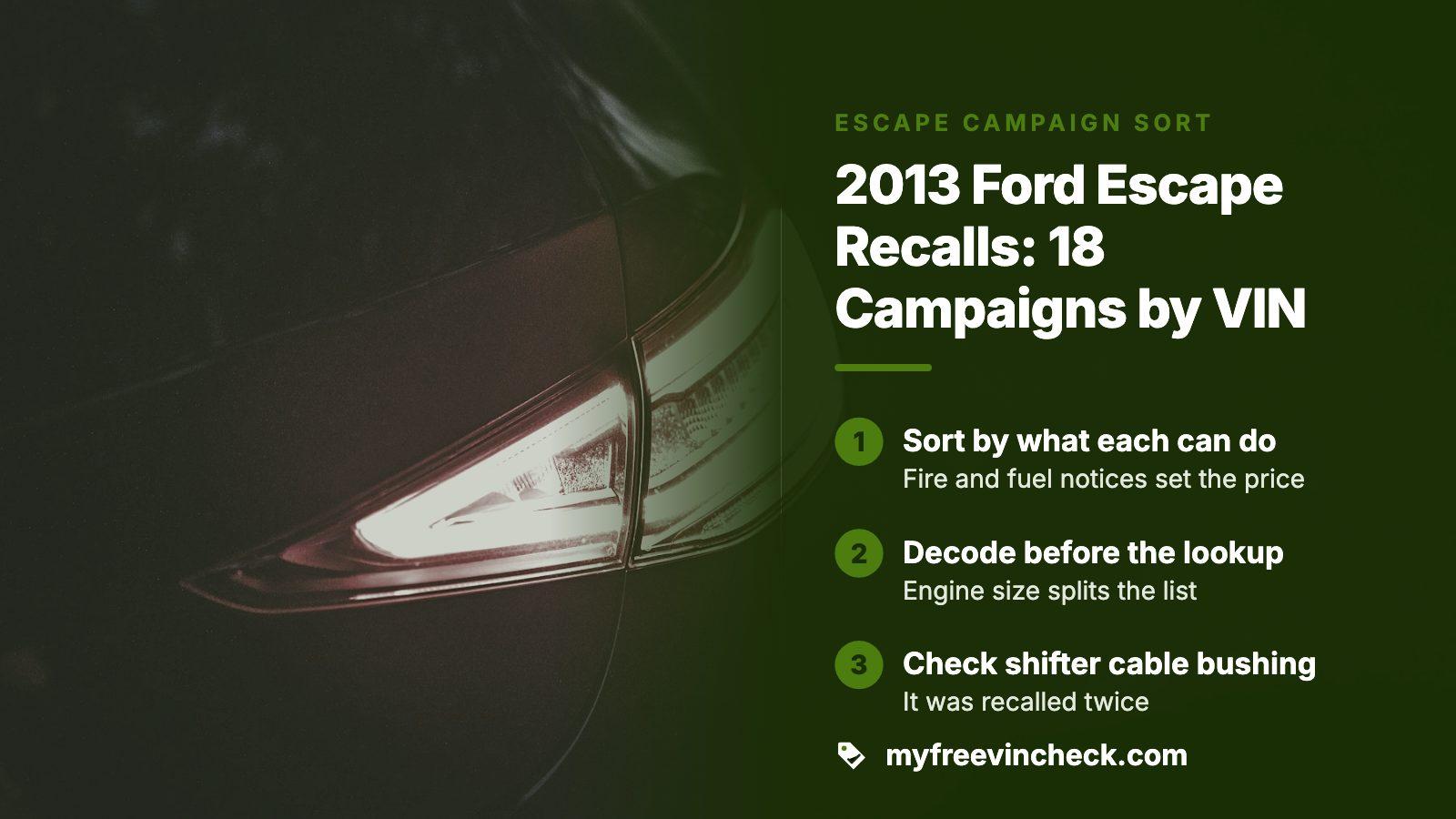
Eighteen campaigns are filed against the 2013 Ford Escape, from 12V336000 in 2012 to 26V011000 in January 2026. Five name the 1.6-liter engine and two name the 2.0-liter, so the decode comes first. Ford dealers repair open ones at no charge. A recall check on the VIN lists what is still open; the paid report adds title, damage, odometer and lien records.
- Campaigns
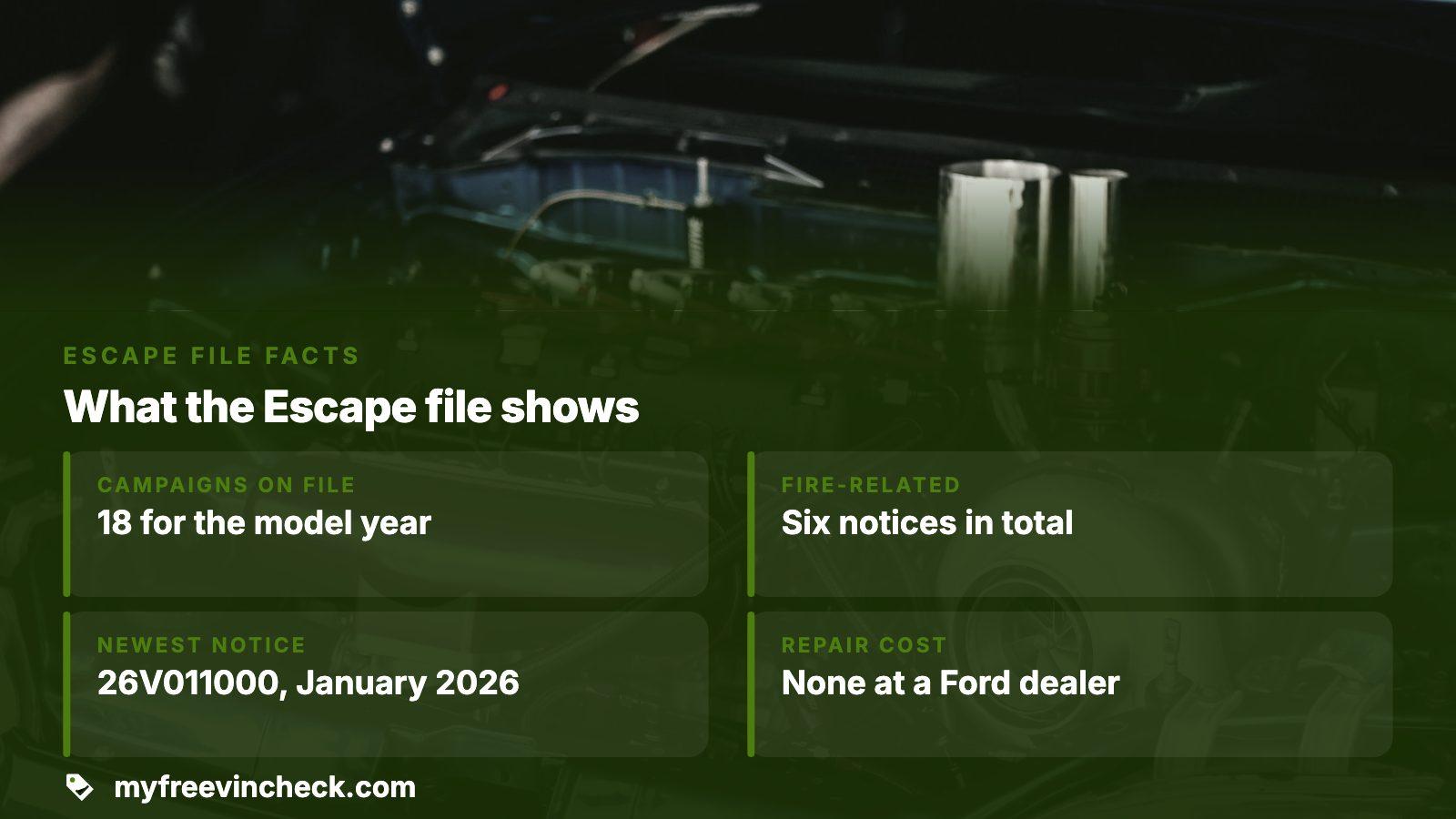
- 18 on file with NHTSA for the model year
- Fire-related
- Six: five on the 1.6-liter engine, one on 2.0-liter block heaters
- Newest notice
- 26V011000, January 2026
- Repair cost
- None at a Ford dealer, within the 15-year federal limit
The 18 campaigns, sorted by what they can do
Eighteen entries read like a wall of paperwork until you group them. Several are second visits for a fault the first repair did not settle.
| Fault area | Campaigns | What the notices describe |
|---|---|---|
| Engine and coolant | 12V551000, 13V583000, 12V431000 | Coolant or oil reaching hot metal on the 1.6-liter engine |
| Fuel line | 12V336000, 13V584000 | A split or chafed line in the engine bay; the second notice rechecks the first repair |
| Block heater | 26V011000 | A cracked heater element that can short when plugged in |
| Shifter cable | 18V471000, 22V413000 | A bushing that lets go, so Park may not hold the car |
| Doors | 14V239000, 16V643000, 13V085000, 20V331000 | Handles, latches and a rear child lock; the newest rechecks older latch work |
| Air bags | 14V597000, 14V237000 | A control module that can short, and software that delays the curtain bag in a rollover |
| Engine wiring | 15V813000, 14V495000 | Crimped sensor splices that risk hesitation or a stall |
| Seat and pedal | 14V164000, 12V319000 | A weak recliner weld and a console panel crowding the brake pedal |
Why the decode comes before the recall check on this model
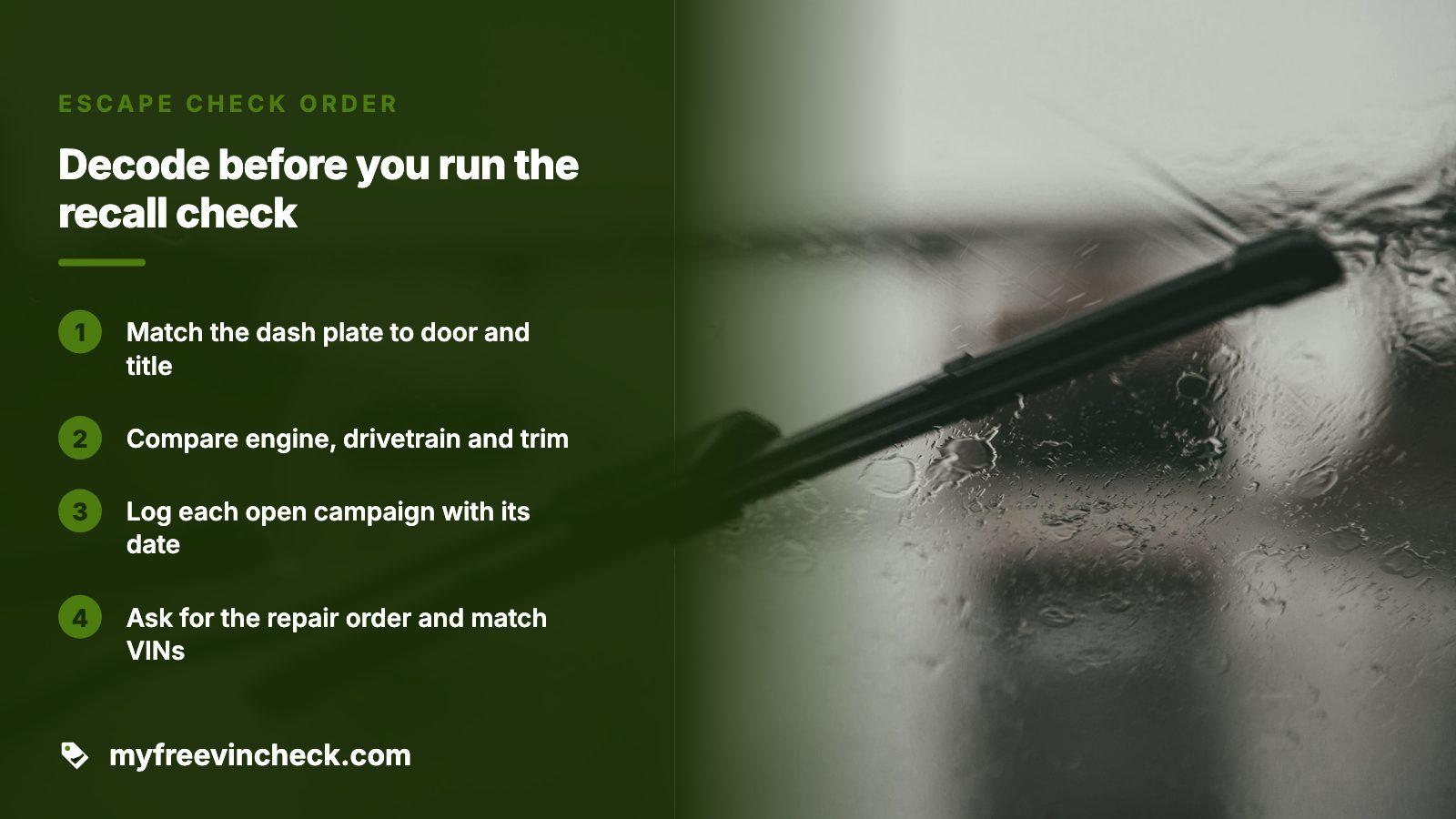
Most fire notices name one engine. The decode reads the build off the VIN, so you learn whether the Escape has the 1.6-liter, the 2.0-liter or neither, and which of the 18 can reach it at all. The recall check then shows what is still open for that exact number.
- Read the 17 characters on the dash plate at the corner of the windshield, then match them to the door-frame sticker and the title. Any difference means walk away.
- Run the decode and compare engine, drivetrain and trim with the listing.
- Run the recall check and write down each open campaign number with the date you looked. Dealer repairs change the record.
- If the seller says a campaign was done, ask for the repair order and match its VIN to the car.
Fire and fuel: the notices that set the price
The oldest group dates to 2012 and concerns the 1.6-liter engine. A fuel line in the engine bay can split, and owners under the first notice were told to stop driving until a dealer replaced it. A later notice, 13V584000, sends the car back because the first repair may itself have gone in wrong. Three more cover coolant loss, a dislodged cylinder head plug and a cracked head, each ending with oil or glycol meeting hot metal. On 2.0-liter cars, 26V011000 says to leave the block heater unplugged for now.
From an NHTSA owner complaint
A buyer who picked up a 2013 Escape from a used car dealer in June 2025 told NHTSA that no vehicle history came with it. By February 2026 a fuel line to the tank was leaking gasoline odor into the cabin, despite what the owner described as two earlier fuel recall repairs. A Ford dealer called the recall work finished and quoted about $1,400. The owner wrote, "I had no idea that there were 18 recalls on this vehicle."
Learn the count and the engine before the sale, not after it. A buyer holding the open list and dated repair orders negotiates from facts.
The shifter cable bushing, twice
Two campaigns, 18V471000 and 22V413000, deal with the same small part. When the bushing detaches, the selector can read Park or release the key while the transmission is not locked, and the car may roll once the driver steps out. The 2018 notice told owners to set the parking brake until repaired. The 2022 notice added a protective cap to the new bushing.
From an NHTSA owner complaint
One owner told NHTSA that a dealer finished the 22V413000 repair in January 2023. By October 2025 the bushing had come off again, so the selector showed Park while the car could still roll. Ford customer service declined coverage, pointing to the 12-month, 12,000-mile mark after the repair.
A closed campaign marks a repair date, not a guarantee. Ask when the work was done, and shift through every gear on the test drive.
Doors, air bags and wiring: quieter notices, real consequences
- Doors: 14V239000 covers a misaligned handle that can let a door swing open on the move, 16V643000 a latch part that can break, and 20V331000 was added because a few past latch repairs may have been faulty.
- Air bags: 14V597000 covers a control module whose coating can crack and short in humid air, and 14V237000 reprograms software that could delay the side curtain bag in a rollover.
- Wiring: 15V813000 and 14V495000 replace crimped splices at an engine sensor, because bad signals can make the engine hesitate or stall.
- Seat and pedal: 14V164000 swaps seatbacks with weak recliner welds, and 12V319000 covers cars built in spring 2012 whose console trim can crowd the brake pedal.
None of these announces itself until the day it matters, so an open air bag or door campaign deserves the same attention as a fuel one.
Reading what the recall check returns
| Result | What it means | Your move |
|---|---|---|
| Campaigns open | No completed repair on record for this VIN | Get a dealer to finish them before delivery, or a written date |
| Campaign closed | A dealer reported finishing the work on some date | Ask when, and what the car has done since |
| Campaign not listed | This VIN sits outside that notice's range | Still look at the part itself |
| Nothing open | No open campaign applies to this VIN | Title, damage, odometer and lien records are untouched |
From an NHTSA owner complaint
An owner whose shifter froze in Reverse at about 197,000 miles reported that a dealer said the VIN was not part of 22V413000. A transmission shop then found the shifter cable detached from the transmission. Ford pointed the owner to NHTSA's hotline to ask about adding the VIN.
A clean line answers one question about the VIN. It does not clear the part behind it.
What the repair costs you, and when that ends
Under the federal remedy statute, the no-charge duty ends when a car's first sale lies more than fifteen calendar years behind the notice. For a 2013 Escape, all 18 notices were announced inside that span, the newest in January 2026. A future notice might not be. Dealers sometimes do the work anyway, but ask before you count on it.
Phone any Ford dealer, give the VIN and ask for the open list. Keep a repair order naming each campaign number. The no-charge promise covers a campaign's own scope and nothing beyond it.
Where the free tools stop and the paid report starts
The decode and the recall check run on NHTSA data and cost nothing here. Neither can tell you whether the Escape was in a collision, who owned it or whether the odometer slipped between sales.
- Decode and recall check: NHTSA data, no charge.
- Preview: free, a first look at which record types exist for the VIN.
- Paid report: one payment, no subscription, adding title brands, damage records, odometer readings and liens.
Prices are on the pricing page: one report or a larger pack. An Escape with open fuel or engine campaigns and no repair orders may never reach the report.
Where this information comes from
- NHTSA: Recalls — The agency lookup where a VIN is checked and each campaign number above can be searched.
- NHTSA owner complaint 11719080 — owner experience, paraphrased
- NHTSA owner complaint 11696160 — owner experience, paraphrased
- NHTSA owner complaint 11651283 — owner experience, paraphrased
- 49 U.S.C. 30120: Remedies for defects and noncompliance — The statute behind the no-charge repair and the 15-year limit on it.
- NMVTIS: National title information — Federal background on the title brand records that a recall lookup leaves out.
Sources and photos: Facts checked against the sources above in November 2026. Photos by Maurice Sahl, Thibault Valjevac and Willian Cittadin on Unsplash; diagrams by MyFreeVINCheck.
Keep reading
- 2013 Ford Edge Recalls: 2 Campaigns, a Fuel Line and a HalfshaftA Ford SUV from the same year with a shorter campaign list, checked the same way.
- 2013 Ford Fusion Recalls: 20 Campaigns and the VIN That Sorts ThemShares the shifter cable bushing and control module notices with the Escape.
- Sample reportThe records a paid report sets beside the recall status.
- PricingWhere a single report or a larger pack is bought, and what each costs.
Frequently asked questions
What is the recall count for a 2013 Escape?
NHTSA files 18 campaigns under the model year, from 2012 to January 2026. Each covers certain build ranges and some also reach other Ford models, so 18 describes the model year rather than one car. The VIN recall check shows which apply to a specific Escape.
Does a 2013 Escape still get recall repairs at no charge?
Yes, at a Ford dealer, within each campaign's scope. The maker can stop covering a repair once the first sale is more than fifteen calendar years behind the notice, and all 18 notices fall inside that span. Give the dealer the VIN and ask for a repair order naming the campaign.
Which 2013 Escape recalls involve fire?
Six name a fire risk: two fuel line notices and three coolant or cylinder head notices, all on the 1.6-liter engine, plus 26V011000 for the 2.0-liter block heater. Decode the VIN first, because the engine decides which of those could apply to the car on the lot.
Does a closed recall mean the problem is gone for good?
No. A closed entry says a dealer reported finishing the work. One owner told NHTSA the shifter bushing detached again after a January 2023 repair, and Ford customer service declined coverage once 12 months or 12,000 miles had passed.
Can I check 2013 Escape recalls before buying a report?
Yes. NHTSA's own recall lookup costs nothing, and so do the decode and recall check on this site, which read the same data. The preview is free too. The report is one payment and adds the title, damage, odometer and lien records a recall list leaves out.
Now check the car itself
The guide explains what to look for. The report shows what this VIN has on record.